

Managing patient expectations well comes down to five repeatable steps: elicit the patient’s goals, explain realistic outcomes using the B.R.A.N. framework (Benefits, Risks, Alternatives, Nothing), verify understanding with teach-back, agree and document a written treatment plan, then schedule a follow-up appointment. Clinicians who build this sequence into every consultation reduce misunderstandings, protect themselves medicolegally, and deliver measurably better patient satisfaction.
Quick-reference checklist for your next consultation:
- Ask the patient to describe their goal in their own words before you say anything about treatment
- Walk through B.R.A.N. — cover benefits, risks, alternatives, and the option to do nothing
- Use teach-back: “Can you tell me in your own words what we’ve agreed today?”
- Provide a written treatment plan with realistic outcome description and indicative pricing
- Record the consent process contemporaneously, noting what was discussed
- Book a follow-up appointment before the patient leaves
Pro Tip: Instead of asking “Do you understand?”, try “Just so I can be sure I’ve explained this clearly, could you walk me through what you’re expecting after treatment?” That single reframe surfaces misinterpretations that a yes/no question never will.
Understanding patient expectations is central to patient-centred care, and the gap between what a patient anticipates and what treatment can realistically deliver is one of the most consistent drivers of complaints in medical aesthetics.
Key takeaways
Effective management of patient expectations requires eliciting goals, applying B.R.A.N., verifying understanding with teach-back, documenting a written plan, and scheduling follow-up as a single, repeatable consultation sequence.
| Point | Details |
|---|---|
| Consent is non-delegable | The practitioner performing the procedure must personally obtain informed consent and ensure realistic expectations. |
| Use B.R.A.N. every time | Cover Benefits, Risks, Alternatives, and Nothing in every consultation to meet GMC and JCCP standards. |
| Teach-back beats “Do you understand?” | Ask patients to summarise the plan in their own words to surface misinterpretations before treatment. |
| Document the cooling-off period | Record the consultation date, proposed treatment date, and the patient’s right to take time to decide. |
| Refusal is sometimes the right call | Decline or delay when expectations are unrealistic or psychological red flags are present; document your reasoning. |
Table of Contents
- Why do patients and clinicians so often disagree about outcomes?
- What are your UK legal and professional duties when setting expectations?
- How to run a structured consultation that aligns expectations
- What communication techniques help patients grasp realistic outcomes?
- What should a written treatment plan and consent record contain?
- When should you decline, delay, or refer a patient?
- How do follow-up and feedback reduce future expectation gaps?
- An illustrative consultation template you can adapt for your clinic
- Balancing patient autonomy with your duty of care
- Sources
Why do patients and clinicians so often disagree about outcomes?
The mismatch rarely comes from bad faith on either side. It arises from genuinely different information sources, emotional states, and cognitive frameworks that clinicians and patients bring to the same conversation.
Research on patient expectations and satisfaction shows that when expected care diverges from actual care, satisfaction falls regardless of clinical quality. Patients who arrive with unrealistic benchmarks are more likely to report dissatisfaction even after technically successful procedures.
Common drivers of expectation gaps:
- Internet misinformation and selective imagery. Patients frequently arrive having researched treatments on social media, where before-and-after images are curated, filtered, and rarely representative of typical results.
- Emotional and psychological state. Anxiety, low self-esteem, or distress can amplify expectations; a patient in emotional distress may hear “improvement” as “transformation.”
- Time-limited consultations. When a clinician has ten minutes, nuanced outcome discussions get compressed into reassuring generalities.
- Language and health literacy barriers. Medical terminology can obscure rather than clarify; patients may nod without genuinely understanding.
- Cognitive bias. Optimism bias leads patients to weight best-case scenarios more heavily than statistical averages.
Structured communication interventions consistently reduce this gap. The implication for clinic design is clear: a standardised, tailored consultation is far more protective than a tick-box consent exercise.
What are your UK legal and professional duties when setting expectations?
The short answer: obtaining informed consent, including ensuring patients hold realistic expectations, is a non-delegable duty for the practitioner who will perform or directly supervise the procedure. You cannot delegate it to a receptionist, a nurse coordinator, or a pre-consultation leaflet.
GMC cosmetic interventions guidance is explicit: practitioners must ensure patients have realistic expectations as part of the informed consent process. The JCCP and CPSA code of practice reinforces this, requiring that the practitioner performing the intervention must seek consent themselves and allow adequate time for the process.
Minimum duties every clinician must meet:
- Give balanced, plain-language information about proposed treatment, realistic outcomes, risks, and alternatives
- Explain the option to do nothing and what that means for the patient’s condition or concern
- Check the patient’s understanding before proceeding, not just at the point of signing
- Provide a written treatment plan and, where relevant, transparent pricing before treatment starts
- Record the consent process contemporaneously, including what was discussed and any questions raised
- Offer a cooling-off period between consultation and treatment, particularly for elective cosmetic procedures
The GDC’s communication standards require that patients receive a written treatment plan and that pricing information, including variable ‘from–to’ ranges, is available before treatment begins. While GDC standards apply directly to dental professionals, they represent a widely adopted benchmark across medical aesthetics.
Medical Protection guidance identifies managing expectations as one of the primary medicolegal risks in cosmetic practice. Informed consent is a process, not a one-off signature. Detailed contemporaneous records and a documented cooling-off period are your strongest defences if a complaint arises.
The GMC’s decision-making and consent guidance sets out the practical expectations for clinician-patient conversations: talk plainly, explain all options including doing nothing, go through benefits and risks, and check what risks the patient is willing to accept.
Understanding your role of consent in aesthetics is not a compliance formality. It is the foundation of safe, patient-centred practice.
This guide is practical, not legal advice. For regulatory or medicolegal questions, contact your defence body or indemnity provider.
How to run a structured consultation that aligns expectations
A standard non-surgical aesthetic consultation can be structured into a brief workflow without feeling rushed. The key is sequencing: elicit before you explain, explain before you document, and document before you treat.
Step-by-step consultation workflow:
-
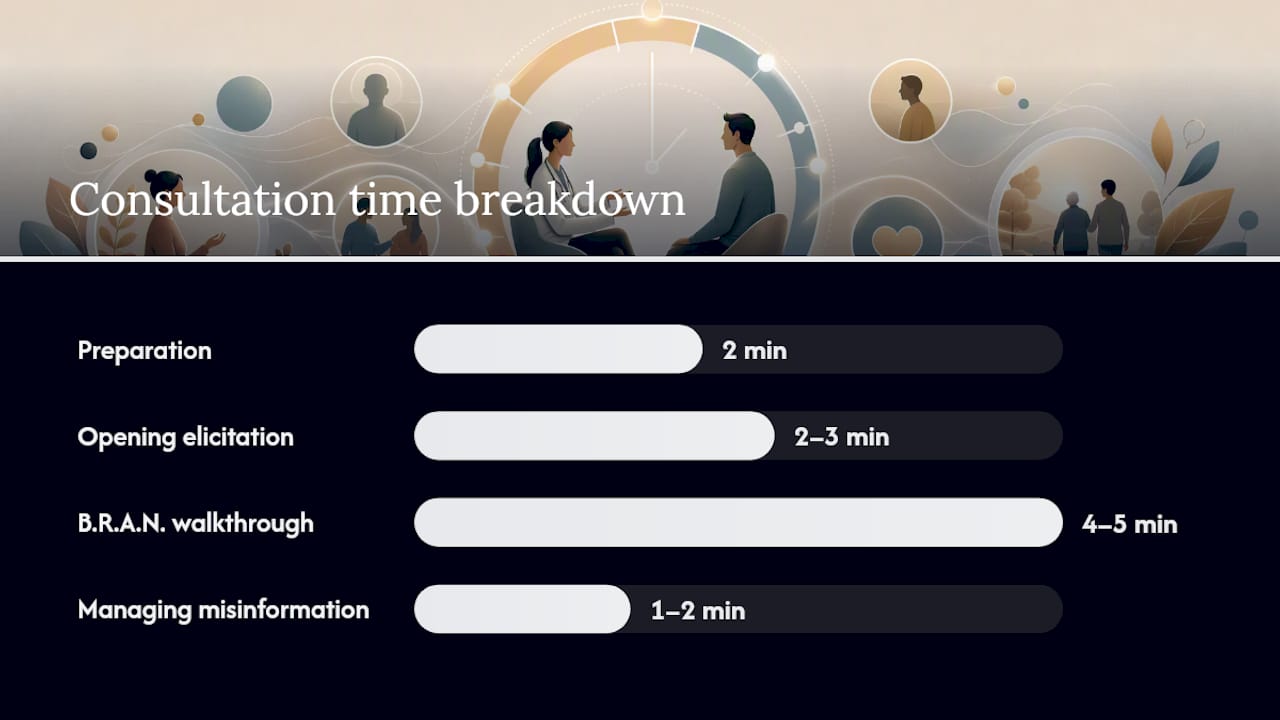
Preparation (before the patient enters, 2 minutes). Review any pre-visit questionnaire, note stated goals, and flag any psychological risk indicators. Send pre-visit information about the treatment category so the patient arrives informed.
-
Opening elicitation (2–3 minutes). Ask the patient to describe their concern and their goal in their own words. Sample phrasing: “Before I tell you what I think might help, I’d like to understand what you’re hoping to achieve. Can you describe what you’d like to look or feel differently?” Resist the urge to jump to solutions.
-
B.R.A.N. walkthrough (4–5 minutes). Systematically cover Benefits (what the treatment can realistically achieve), Risks (common and rare), Alternatives (including non-treatment options), and Nothing (what happens if the patient does nothing). Be specific about timelines and degree of change. Sample phrasing for limits: “I can improve the appearance of this area, but I cannot promise a specific result. What I can tell you is what most patients in a similar situation experience.”
-
Managing misinformation (1–2 minutes). If the patient references a social media image or a dramatic before-and-after, address it directly. “That image may show an exceptional result or may have been taken under specific lighting conditions. I want to make sure your expectations are based on what’s typical for this treatment.”
-
Teach-back (1 minute). Ask the patient to summarise the plan. “Just so I know I’ve explained this clearly, could you tell me in your own words what we’ve agreed and what you’re expecting?” Correct any misunderstandings before moving on.
-
Written plan and cooling-off (1–2 minutes). Provide the written treatment plan, confirm the indicative price range, and discuss the cooling-off period. Book the follow-up appointment.
Before leaving the room, confirm:
- Signed written treatment plan given to the patient
- Indicative price range stated and documented
- Aftercare instructions provided
- Follow-up appointment booked
- Consent process recorded in the notes
Pro Tip: Document the cooling-off period explicitly in the record: note the date of consultation, the date treatment is proposed, and that the patient was informed of their right to take time to decide. This contemporaneous note is your clearest evidence if a complaint arises weeks later.
For a detailed walkthrough of the full process, the step-by-step patient consultation guide from Theaestheticsroom covers each stage with practical clinic-level detail.
What communication techniques help patients grasp realistic outcomes?
Simple, concrete language consistently outperforms clinical terminology when it comes to patient understanding. The goal is not to lower the intellectual bar, it is to remove ambiguity.
Phrases that set expectations clearly:
- “Most patients see a noticeable improvement, not a dramatic transformation. The change tends to be subtle and natural-looking.”
- “I cannot guarantee a specific outcome, but I can tell you what the evidence shows for patients with a similar concern.”
- “Realistic expectations for this treatment tend to be moderate, rather than a complete transformation.”
- “Some patients need more than one session to reach their goal. We’ll review progress at your follow-up.”
Visual aids work well when used ethically. Use standardised, consistently lit before-and-after images that represent typical results, not outliers. Label images clearly with treatment type, number of sessions, and time elapsed. Avoid images that have been filtered or retouched, and never use a single exceptional result as the benchmark for what a patient should expect.
Decision aids and handouts to prepare or provide:
- A printed B.R.A.N. prompt sheet the patient can take home and review before treatment
- A realistic timeline graphic showing when results typically appear and how long they last
- A written treatment plan (see the documentation section below)
- Links to patient-facing educational resources, such as the dermal fillers guide from Theaestheticsroom, which explains what to expect before and after treatment
The beauty consultation process at Theaestheticsroom demonstrates how a structured, information-rich consultation translates directly into realistic expectations and better patient outcomes.
What should a written treatment plan and consent record contain?
A written treatment plan is both a clinical document and a patient communication tool. It must be kept in the record and given to the patient before treatment begins.
Minimum fields for a written treatment plan:
- Patient’s stated goals (in their own words where possible)
- Agreed realistic outcome description (what the treatment can and cannot achieve)
- Proposed treatment, including product, technique, and number of sessions
- Known risks and side effects, common and rare
- Alternatives discussed, including the option to do nothing
- Indicative cost range (from–to, not a single figure if pricing varies)
- Cooling-off period noted, with date of consultation and proposed treatment date
- Clinician name, registration number, and date
- Patient signature confirming receipt and understanding
| Template field | Why it matters |
|---|---|
| Patient’s stated goals | Anchors the plan to what the patient actually wants, not what the clinician assumes |
| Agreed realistic outcome | Prevents post-treatment claims that a different result was promised |
| Risks and alternatives | Satisfies informed consent requirements under GMC and JCCP guidance |
| Indicative cost range | Meets GDC pricing transparency standards; prevents financial disputes |
| Cooling-off period note | Provides contemporaneous evidence of process if a complaint arises |
| Clinician name and registration | Confirms the non-delegable consent duty was met by the treating practitioner |
GDC standards require that pricing information, including variable ranges, is available in practice literature before treatment starts. For aesthetic clinics, this means ‘from–to’ ranges in written material, not a single aspirational figure.
Records should be stored securely in line with UK GDPR requirements. Patients have the right to access their records, and notes should be written on the assumption that the patient may read them. Keep records for a minimum of eight years for adult patients, or until the patient’s 25th birthday for those treated as minors.
For practical guidance on customising treatment plans and pricing transparency in cosmetic practice, Theaestheticsroom’s clinic resources offer a useful reference point.
When should you decline, delay, or refer a patient?
Declining or delaying treatment is sometimes the correct clinical decision, not a failure of service. GMC cosmetic guidance is clear that practitioners should refuse treatment when expectations are clearly unrealistic or when psychological risk indicators are present.
Red flags that warrant pausing or declining:
- Persistent dissatisfaction with previous treatments that were objectively successful
- Repeated requests for revision without a clear clinical rationale
- A fixed belief that a specific dramatic change will resolve a broader life problem
- Pressure from a third party (partner, family member) to undergo treatment
- Inability to describe a realistic or proportionate goal
- Signs of body dysmorphic disorder (BDD): preoccupation with a perceived flaw that others do not notice, or distress disproportionate to the concern
- Capacity concerns, including intoxication, acute distress, or cognitive impairment at the time of consultation
Decision sequence when red flags appear:
- Pause the consultation and acknowledge the patient’s concern without dismissing it
- Explain clearly and kindly that you are not in a position to proceed today
- Use phrasing such as: “I want to make sure any treatment I recommend is right for you. I’d like us to take a little more time before we go ahead.”
- Offer alternatives: a cooling-off period, a referral for psychological assessment, or a second opinion
- Document your clinical reasoning in detail, including the specific concerns observed
- Advise the patient of their right to seek a second opinion elsewhere
Refusal should always be documented with the same rigour as a consent record. Note what was observed, what was said, what alternatives were offered, and the date. Medical Protection guidance supports this approach, noting that a well-documented refusal is protective if a patient later complains or seeks treatment elsewhere.
How do follow-up and feedback reduce future expectation gaps?
Scheduled follow-up is not an administrative courtesy. It is a clinical tool for catching early dissatisfaction before it becomes a formal complaint, and for gathering the outcome data that improves future consultations.
At each follow-up, use a brief structured feedback template:
- “On a scale of 1–10, how closely does the result match what you expected?”
- “Is there anything about the outcome that concerns you?”
- “Did you feel you had enough information before treatment to make your decision?”
These three questions surface mismatches quickly and give you actionable data for improving your consultation process. Research supports structured feedback as a reliable method for identifying communication gaps before they escalate.
When a patient does express early dissatisfaction, the response sequence matters. Listen without interrupting. Acknowledge the patient’s experience. Explain what happened clinically in plain language. Offer remedial options where they exist, and document the entire exchange. Medical Protection notes that a conciliatory, well-documented response significantly reduces the likelihood of a complaint escalating to a formal claim.
An illustrative consultation template you can adapt for your clinic
The following example maps the guidance above into a single, annotated consultation run-through. It is illustrative, not prescriptive. Adapt it to your clinic’s workflow, patient population, and governance requirements.
Pre-visit (sent 48 hours before appointment):
Patient receives a short information sheet covering the treatment category, realistic outcome range, and a request to note their goals and any questions.
Arrival:
Receptionist confirms the patient has read the pre-visit material and flags any concerns to the clinician before the consultation begins.
Structured consultation:
- Clinician introduces themselves and confirms their name, registration, and role
- Patient is asked to describe their goal in their own words
- B.R.A.N. walkthrough completed; misinformation addressed if raised
- Teach-back used to verify understanding
- Written treatment plan provided and reviewed together
- Cooling-off period discussed; patient confirms they are not under pressure to proceed
Documentation checklist (tick during or immediately after the appointment):
- Patient goals recorded verbatim
- B.R.A.N. discussion noted in record
- Teach-back response summarised
- Written treatment plan signed and copy given to patient
- Indicative price range confirmed in writing
- Cooling-off period documented with dates
- Clinician name and registration number recorded
- CQC registration and ACE Group membership noted in clinic governance section of record
- Patient information leaflet provided and noted
Governance proofs to include in the record:
Note the treating clinician’s name and GMC/NMC registration number, the clinic’s CQC registration status, and any professional body membership (such as ACE Group). These entries confirm that the non-delegable consent duty was met by a qualified, registered practitioner.
This template is adaptable. A medical aesthetics workflow guide can help clinic leads integrate this structure into their existing systems.
Balancing patient autonomy with your duty of care
There is a tension that experienced clinicians feel acutely: the patient has the right to make their own decisions, and you have a professional duty to protect them from harm. These two principles are not in conflict when the consultation is done well.
Patient autonomy is only meaningful when it is genuinely informed. A patient who has been shown curated social media imagery, given a rushed explanation, and handed a consent form to sign has not exercised real autonomy. They have been processed. The clinician’s job is to create the conditions in which a real, informed choice is possible: clear information, adequate time, no pressure, and an honest account of what treatment can and cannot achieve.
The harder truth is that refusing treatment can be a professional duty, not a customer service failure. When expectations are clearly unrealistic, when psychological vulnerability is present, or when proceeding would expose the patient to harm they cannot fully appreciate, declining is the ethical act. Good Medical Practice 2024 frames this plainly: treating patients with kindness and respect includes protecting them from decisions that are not in their interest.
For clinic leads, the practical implication is training. Your team needs a shared language for identifying red flags, a clear protocol for escalating concerns, and the confidence to hold boundaries consistently, even when a patient is disappointed. Clinicians who feel unsupported in declining treatment will default to proceeding. That is where complaints, and harm, originate.
The best consultations are not the ones where the patient leaves having agreed to everything. They are the ones where the patient leaves with an accurate picture of what to expect, a written record of what was agreed, and the genuine sense that their clinician had their interests at heart.
Sources
The following UK-focused resources underpin the guidance in this article. Clinicians should consult the primary sources directly for regulatory questions.
- About Cosmetic interventions – professional standards – GMC
- Decision support tools – NHS England (B.R.A.N. reference)
- General Dental Council – Communicate effectively with patients
- Understanding Patient Expectations of Health Care – PMC – NIH
- JCCP & CPSA code of practice
For complex medicolegal or regulatory questions, contact your defence body (Medical Protection, MDU, or equivalent) directly rather than relying on general guidance.
This article is general information, not a substitute for advice from a qualified doctor. Consult a qualified healthcare professional about your own circumstances before acting on anything here.