


A Myers Cocktail IV is an intravenous drip containing a mix of vitamins and minerals, typically magnesium, calcium, vitamin C and B vitamins, given directly into a vein. The short answer is that it is not routinely supported by strong clinical evidence for general wellness, energy or immunity, and it should only ever be delivered in a properly screened, medically supervised setting.
TL;DR:
- The Myers Cocktail varies in formulation across clinics and is not an officially licensed medicine, which can affect safety and transparency.
- Clinical evidence does not support its routine use for wellness, energy, or immunity, with the most significant trial showing no benefit over placebo.
- Proper screening, aseptic technique, trained staff, and clear formulation details are essential for safe administration, especially for vulnerable individuals.
- People with kidney or heart conditions, allergies, unstable health, or on interfering medications should avoid receiving a Myers Cocktail without medical review.
- Marketing claims for health benefits are largely unproven, and clinics should provide detailed formulation, responsible oversight, and realistic expectations.
Table of Contents
- What the Myers Cocktail IV is and why clinics offer it
- Typical ingredients and how formulations vary
- Claims clinics make versus what the evidence shows
- Safety, procedural risks and standards for safe delivery
- Who should not get a Myers Cocktail
- What to expect at a session: preparation, the infusion, aftercare and pricing signals
- How to choose a safe clinic: a patient checklist
- How The Aesthetics Room approaches IV therapy safely
- The gap between demand and evidence in IV therapy
- Book a consultation with The Aesthetics Room
- Sources
- FAQ
What the Myers Cocktail IV is and why clinics offer it
The Myers Cocktail takes its name from Dr John Myers, a Baltimore physician who used intravenous nutrient mixes decades ago, though there is no single fixed formula that carries his name today. What clinics call a “Myers Cocktail” varies from provider to provider: some follow closer to the historical recipe, others adapt the ingredients, doses and diluent to suit their own protocols. This matters because a name that sounds standardised can disguise a genuinely non-standard product.
Interest in the treatment tends to cluster around a few groups. Some people are drawn in by claims around chronic fatigue and fibromyalgia, where curiosity about intravenous nutrient support has persisted for years. Others encounter it through the wellness and IV-bar trend, where drips are marketed as quick fixes for tiredness, hangovers or run-down immunity. In defined clinical settings, IV vitamins also have a legitimate, narrower role as an adjunct to treatment, which is a different use case entirely from a walk-in wellness drip.
Clinics tend to promote the IV route on the basis that it delivers nutrients straight into the bloodstream, bypassing digestion and, in theory, reaching higher blood concentrations faster than swallowing a tablet for improved absorption. That is plausible pharmacology for certain nutrients, but plausibility is not proof of benefit. The ASA’s guidance on IV nutritional therapy is explicit that evidence has to relate to the specific IV product, dose and outcome claimed, not to studies of oral supplements taken by mouth.
- The Myers Cocktail is a practice, not a single licensed medicine, so formulations differ between clinics.
- Interest spans wellness marketing, chronic fatigue and fibromyalgia curiosity, and narrow clinical adjunct use.
- Faster absorption via IV is biologically plausible but does not by itself prove a health benefit.
Typical ingredients and how formulations vary
Most versions of the Myers Cocktail draw from a similar pool of nutrients, even though exact amounts differ between clinics.
- Magnesium, usually as magnesium chloride or sulphate, often included for its role in muscle and nerve function.
- Calcium, typically calcium gluconate, paired with magnesium in many recipes.
- Vitamin C, added in variable doses depending on the clinic’s protocol.
- B-complex vitamins, including B12 (commonly as hydroxocobalamin), B6 (pyridoxine) and sometimes dexpanthenol (a B5 relative).
- Occasional extras such as trace minerals or additional antioxidants, depending on the provider.
Statistic Callout: The 2009 pilot trial used a specific recipe. The randomised, placebo-controlled pilot study of the Myers formulation specified magnesium chloride, calcium gluconate, hydroxocobalamin, pyridoxine, dexpanthenol, B-complex and vitamin C in defined volumes, given weekly for eight weeks. That recipe is a useful reference point, but it should not be mistaken for an industry standard: many clinics adjust doses, swap ingredients or change the diluent without disclosing it.
There is a legal dimension here too. Under the Human Medicines Regulations 2012, injectable medicines are usually classified as prescription-only. Hydroxocobalamin injections are authorised prescription-only medicines in the UK, while methylcobalamin has no MHRA-authorised injectable product available. In practice, that means a legitimate clinic should be able to tell you exactly which form of B12 (or any other ingredient) it uses and on what prescribing basis.
Before booking, it is worth asking a clinic for the precise formulation, the name of the prescriber responsible for it, and the clinical rationale for giving it to you specifically, rather than accepting “our Myers blend” as a sufficient answer.
Claims clinics make versus what the evidence shows
Wellness marketing around the Myers Cocktail tends to repeat a familiar set of promises: more energy, stronger immunity, a faster hangover cure, better absorption than tablets, and even anti-ageing effects. Some clinics also position it as useful for chronic fatigue or fibromyalgia specifically, drawing on decades of anecdotal use in that space.
The most relevant controlled evidence comes from a small trial rather than any of these broader wellness claims. A 2009 randomised, double-blind, placebo-controlled pilot study tested a Myers-style intravenous micronutrient formulation in 34 adults with fibromyalgia, giving weekly infusions over eight weeks. Both the treatment group and the placebo group improved over the course of the study, but there was no statistically significant difference between the two groups at the main follow-up points. One minor adverse event was reported in the group receiving the active infusion.
Both groups showed improvement, but there was no significant difference between IVMT and placebo on the primary outcome measures.
That result matters for two reasons. First, the sample size was small, thirty-four participants split across two arms, which limits how much confidence anyone can place in either a positive or a negative conclusion. Second, the size of the placebo response was large enough that it accounted for most of the improvement seen, which is a common feature of trials involving an invasive procedure like an infusion. A drip can produce a genuine sense of being cared for and treated, and that alone can shift how someone reports feeling, independent of what is actually in the bag.
NHS and advertising regulators have taken a consistent, cautious line on this. NHS England has publicly criticised so-called “party drips,” warning that there is little evidence for many of the benefits advertised and that poor practice has led to publicised adverse events. The ASA’s own guidance requires that marketing claims for IV nutritional therapy be backed by evidence tied to the specific product, dose and outcome, not by studies of oral vitamins or by testimonials. Together, this means that claims of routine energy boosts, immune protection or hangover cures for otherwise healthy adults sit on thin evidential ground, whatever a clinic’s marketing implies.
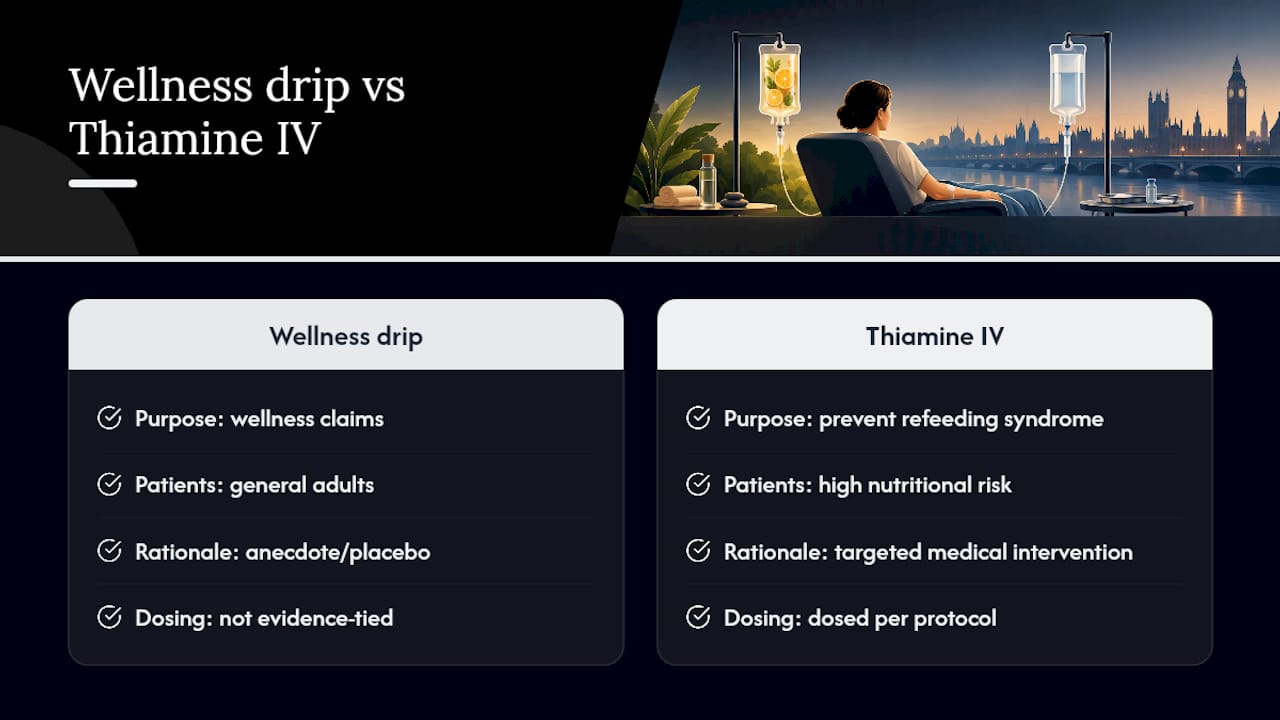
It is worth separating this from genuine clinical indications for intravenous vitamins, which do exist and are well supported. NHS Specialist Pharmacy Service guidance on thiamine sets out how parenteral thiamine is used to prevent refeeding syndrome in patients at high nutritional risk, dosed and monitored according to established protocols. That is a targeted medical intervention for a diagnosed risk, decided by a clinician based on a patient’s condition, and it has almost nothing in common with a wellness drip booked as a lifestyle top-up.
Safety, procedural risks and standards for safe delivery
Any cannula inserted into a vein carries risk, and a Myers Cocktail is no exception, even though serious complications are uncommon when the procedure is done properly.
- Infection at the injection site, ranging from mild redness to more serious local or bloodstream infection if aseptic technique is not followed.
- Infiltration or extravasation, where fluid leaks into surrounding tissue rather than staying in the vein, causing swelling and discomfort.
- Allergic or hypersensitivity reactions to any of the ingredients, which can range from mild flushing to a more serious reaction requiring immediate treatment.
- Air embolus, a rare but serious risk associated with any IV line if air enters the system.
- Ingredient-related toxicity, particularly with higher doses of certain minerals in people with reduced kidney function.
Minimum safe practice starts before the needle goes in. A responsible clinic carries out clinical screening and a medicines review to check for contraindications and interactions, uses proper aseptic technique for cannulation, and monitors the patient throughout the infusion rather than leaving them unattended. NHS trust policy on IV medicines, such as the Solent NHS Trust framework for safe administration, sets out exactly this kind of standard: trained, authorised staff, an appropriate clinical environment, and a clear plan for responding to adverse events during or after administration.
A typical infusion runs somewhere between 20 and 60 minutes, depending on the volume and the rate it is given at. Most people feel nothing dramatic during the drip itself beyond a cool sensation up the arm or a metallic taste, and any effects on energy or mood tend to be subtle and short-lived rather than immediate.
Pro Tip: Ask the clinic what happens if you have a reaction mid-infusion, a properly prepared provider will have a clear answer, not a shrug.
Staff delivering IV medicines should be appropriately trained and working under clear clinical governance, ideally within a setting registered with the Care Quality Commission. That oversight is what separates a clinical procedure from a beauty-bar add-on.
Who should not get a Myers Cocktail
Certain people should not have a Myers Cocktail, or should only have one after a clinician has reviewed their case carefully.
- People with severe renal impairment, since the kidneys clear excess minerals like magnesium and calcium, and reduced function raises the risk of toxicity.
- People with certain cardiac conditions, where fluid or electrolyte shifts from an infusion could aggravate an existing problem.
- Anyone with a known hypersensitivity to one of the ingredients, including specific B vitamin formulations.
- People with unstable medical illness of any kind, where the priority should be diagnosis and treatment rather than a wellness infusion.
- Anyone taking medicines that could interact with high-dose B vitamins or minerals, which is why a proper medicines review before treatment matters.
There is also a prescribing red flag worth watching for. If a clinic cannot explain whether an ingredient is a licensed medicine, an off-label prescription, or an unlicensed preparation, that is a sign the service is not being run with the transparency expected of a properly governed clinic. MHRA correspondence on injectable vitamin B12 underlines exactly this point: clarity about a product’s legal status is a basic marker of professional practice, not an optional extra.
What to expect at a session: preparation, the infusion, aftercare and pricing signals
A well-run appointment follows a fairly predictable pattern, and knowing what to expect makes it easier to spot when something is being skipped.
- Before the infusion, expect a review of your medical history, current medicines and any allergies, along with a clear explanation of what is being given and on what prescribing basis, followed by informed consent.
- Cannulation, carried out using aseptic technique, with a trained clinician checking the line is correctly placed before the infusion starts.
- The infusion itself, usually lasting 20 to 60 minutes, with the clinician monitoring you for any signs of a reaction throughout.
- Documentation and discharge, where the clinic records what was given and checks you are well enough to leave before you go.
Aftercare is generally straightforward. Mild bruising at the cannula site, a brief feeling of coolness, or slight light-headedness are common and usually pass quickly. Anything more pronounced, such as swelling that spreads, breathing difficulty, chest pain or a widespread rash, warrants an immediate call to the clinic or, if severe, emergency medical care.
Pricing varies considerably between clinics depending on the formulation, the setting and what is included in the appointment, so it is sensible to ask for a clear breakdown rather than assume a flat market rate. Whatever the price, one rule holds everywhere: injectable medicines are not over-the-counter products, and there is no safe shortcut that involves buying vials online and administering them yourself.
How to choose a safe clinic: a patient checklist
Choosing where to have a Myers Cocktail matters as much as deciding whether to have one at all.
- Check that the practitioner is appropriately registered and ask directly whether the clinic is CQC registered, and for what services.
- Ask for the exact formulation and doses, and whether each component is a licensed medicine or supplied as an unlicensed preparation, with an explanation of why.
- Confirm the clinic follows proper infection-control practice and has a clear emergency protocol in case of a reaction.
- Ask what follow-up looks like if you feel unwell after leaving.
- Be wary of advertising red flags: medicinal claims made without supporting evidence, names that imply a “cure,” or promotion driven mainly by social media influencers rather than clinical information.
Pro Tip: A clinic that answers every one of these questions without hesitation is telling you as much about its standards as the answers themselves.
For a deeper look at how to interpret CQC status specifically, this guide on choosing a CQC registered aesthetic clinic covers what registration does and does not guarantee.
How The Aesthetics Room approaches IV therapy safely
An established clinic with appropriate healthcare registration offers IV vitamin therapy with an approach that includes initial consultation, review of medical history and suitability, clarity on prescribing arrangements, aseptic administration by trained staff, and a follow-up pathway if any concerns arise afterwards. This approach is part of a broader focus on medically led, bespoke treatment plans across multiple locations.
The gap between demand and evidence in IV therapy
Patient interest in IV vitamin therapy is not going away, and it is easy to see why: an infusion feels proactive in a way that swallowing a tablet does not. But the evidence for wellness use in healthy adults remains thin, and the strongest trial in this space found no clear advantage over placebo. The right response to that gap is not to dismiss the treatment outright, but to insist on the same safety standards, screening and transparency that any other medical procedure demands, and to be honest with patients about what a drip can and cannot promise. Anyone considering it should talk to a qualified clinician rather than rely on a clinic’s marketing copy or an online seller with no prescribing oversight.
— Vishul
Book a consultation with The Aesthetics Room
An accredited clinic offers IV vitamin therapy alongside a wider range of medically led aesthetic and wellbeing treatments, delivered by trained professionals across multiple locations.

A consultation, available in person or virtually, is where suitability is properly assessed: your medical history, current medicines and goals are reviewed before any formulation is discussed, in line with the safety checklist covered above.
- We will talk through your medical history and check for any contraindications before recommending anything.
- We will explain exactly what is in a proposed formulation and the prescribing basis behind it.
- We will set out realistic expectations rather than promise outcomes the evidence does not support.
If you would like to discuss whether IV vitamin therapy, or one of our other treatments, suits you, you can view our full price list and services or book a consultation to get formulation details specific to your case.
This article is general information, not a substitute for advice from a qualified doctor. Consult a qualified healthcare professional about your own circumstances before acting on anything here.
Sources
- Intravenous Micronutrient Therapy (Myers’ Cocktail) for Fibromyalgia: A Placebo-Controlled Pilot Study
- England’s top doctor slams ‘exploitative’ party drips
- Prescribing and using thiamine to prevent refeeding syndrome – NHS SPS
- The Human Medicines Regulations 2012
FAQ
What is the Myers Cocktail IV good for?
Historically it has been used and marketed for tiredness, immune support and fibromyalgia symptoms, but the strongest available trial found no significant benefit over placebo in fibromyalgia patients. Any perceived benefit for otherwise healthy adults is not currently backed by robust clinical evidence.
Who should not get a Myers Cocktail?
People with severe kidney impairment, certain cardiac conditions, known allergies to any ingredient, or unstable medical illness should avoid it unless a clinician has reviewed their case. Anyone taking medicines that could interact with high-dose vitamins or minerals also needs a proper medicines review first.
Is a Myers Cocktail worth it?
That depends on what you expect from it: the main controlled trial found no clear advantage over placebo, so it should not be booked as a proven energy or immunity fix. It may still appeal to some people as a supervised, medically screened infusion, provided it is delivered by a properly registered clinic that is transparent about ingredients and prescribing.
How long does it take for a Myers Cocktail to kick in?
The infusion itself typically takes between 20 and 60 minutes, and any subjective effects tend to be mild and short-lived rather than dramatic. There is no reliable evidence establishing a specific onset time for wellness benefits, since controlled trial data has not demonstrated a consistent effect beyond placebo.