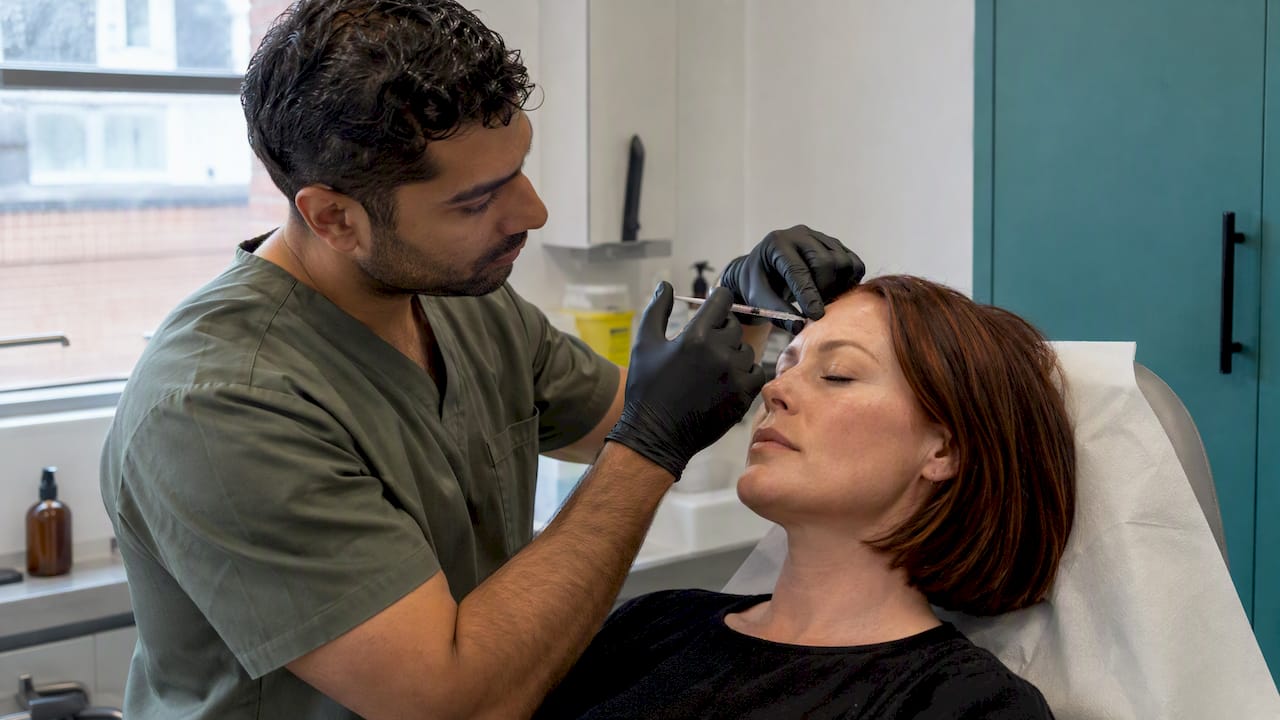
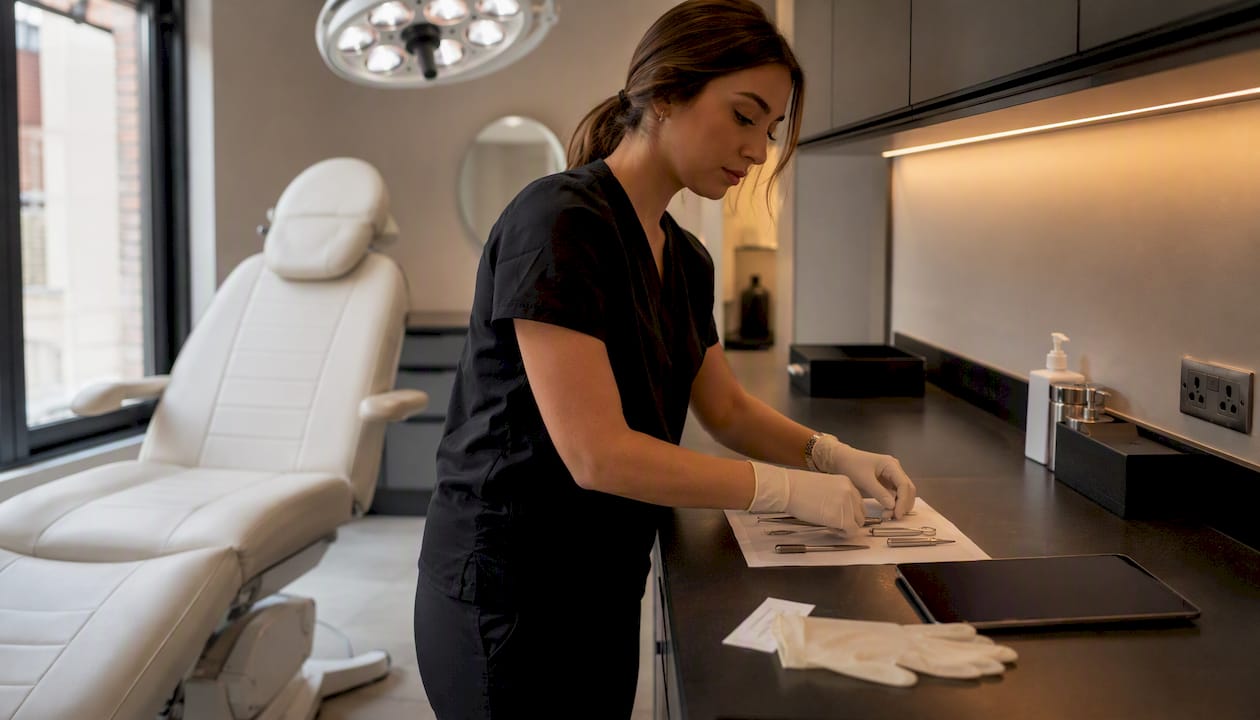

Every aesthetic treatment record must capture who performed the procedure, what was done, which product was used (including batch number and expiry date), that valid consent was obtained, and what aftercare was given. Get those six elements right and your records will withstand a CQC inspection, a GMC review, or a legal challenge.
Quick must-capture checklist for every treatment:
- Practitioner name, registration number and role (performed/supervised)
- Procedure name, technique and precise injection sites
- Product name, manufacturer, batch/lot number, expiry date, dose and volume
- Consent: face-to-face discussion confirmed and signed form referenced
- Date, time and contemporaneous note indicator
- Aftercare instructions given and follow-up plan
Under the NHS Digital records management code of practice, adult records must be retained for a legally required minimum retention period after the final appointment; records for patients treated as minors must be kept until a defined age of majority or an equivalent time after the last appointment, whichever is later.
Key takeaways
CQC-compliant aesthetic procedure documentation requires contemporaneous records capturing product traceability, a two-stage consent process, and a written governance framework with audit evidence retained for at least eight years for adult patients.
| Point | Details |
|---|---|
| Two-stage consent is non-negotiable | A face-to-face clinical discussion by the treating practitioner must be documented alongside the signed consent form. |
| Product traceability at batch level | Record product name, batch/lot number, expiry date, dose and volume for every treatment, every time. |
| Contemporaneous notes only | Complete all mandatory fields before the patient leaves the room; timestamped addenda are acceptable, reconstructions are not. |
| Retention: legally required minimum period | Adults: 8 years after final appointment; minors: until age 25 or 8 years after last appointment, whichever is later. |
| Theaestheticsroom | Offers documentation support, SOP development and inspection preparation grounded in CQC-accredited clinical practice. |
Table of Contents
- What fields must you capture for every treatment record?
- How do you write each field so notes are defensible?
- What does valid informed consent documentation look like?
- Why contemporaneous notes matter and how to write them
- What governance documents will an inspector ask for?
- How do you structure fridge, implant and adverse-event logs?
- How long must you keep records, and how do you dispose of them safely?
- Ready-to-use templates and worked examples
- Electronic records versus paper: which controls do you need?
- What will inspectors ask, and how do you present evidence?
- What we have learnt from real inspection cycles
- Theaestheticsroom supports clinics with documentation and compliance
- Sources
What fields must you capture for every treatment record?
Completeness at the point of care prevents gaps that inspectors flag and that lawyers exploit. Use this as your session-by-session checklist.
Practitioner and role
- Full name and professional registration number (GMC, NMC, GDC or equivalent)
- Whether the practitioner performed or supervised the procedure
Procedure details
- Procedure name and indication (e.g. “glabellar lines, moderate severity”)
- Technique used and precise injection sites; add a diagram reference or annotated body map note
- Any immediate observations or complications
Product traceability
- Product name and manufacturer
- Batch/lot number and expiry date
- Dose and volume administered per site
Consent and aftercare
- Confirmation that a face-to-face clinical discussion took place
- Signed consent form reference number or file location
- Written aftercare instructions given; follow-up appointment or contact details recorded
Pro Tip: Attach the peel-and-stick product sticker directly into the patient’s paper record or scan it into the electronic file. This eliminates transcription errors for batch numbers and expiry dates in a single step.
How do you write each field so notes are defensible?
Vague entries fail inspections and fail patients. Healthcare Improvement Scotland’s procedural documentation guidance specifies that records must capture the practitioner, exact procedure, product name, batch/lot number, expiry date, dose/volume and precise injection sites for full traceability.
Sample field entries:
- Presenting concern: “Patient reports moderate horizontal forehead lines at rest; bothered by appearance for 18 months.”
- Assessment: “Frontalis hyperactivity, moderate rhytids at rest. No contraindications identified. Fitzpatrick III.”
- Procedure performed: “Botulinum toxin type A [Product Name], Batch XY1234, Exp 03/2027, 4 units per injection point × 5 points frontalis, 20 units total. Diagram attached.”
- Outcome: “Procedure tolerated well. No immediate adverse events. Patient advised on post-treatment restrictions.”
For injection sites, combine a written description (“mid-pupillary line, 2 cm above orbital rim”) with a reference to an annotated diagram filed alongside the note. Photographs taken with patient consent add a further layer of traceability; see guidance on storing before-and-after images in patient records.
“Standardised pro-formas are acceptable provided they are tailored and supplemented where necessary — a tick-box alone is not a clinical record.”
BTO Solicitors LLP, Aesthetic medicine: consent, record-keeping and patient selection
Pro Tip: Use a short standardised code for common procedures (e.g. “BTX-F” for frontalis botulinum toxin) in the procedure field, then add a free-text line for anything that deviates from your SOP. This keeps records searchable without sacrificing clinical nuance.
What does valid informed consent documentation look like?
Consent is a two-stage process, not a signature. The GMC’s seven principles of decision-making and consent are clear: a face-to-face clinical discussion must be conducted by the practitioner who will perform or supervise the treatment, followed by a formal recorded document. A signed form without a documented discussion is not valid consent.
Fields your consent record must contain:
- Risks discussed (specific to the procedure and the individual patient)
- Alternatives offered and patient’s response
- Patient questions raised and answers given
- Capacity assessment (confirmed patient has capacity to consent)
- Decision reached and patient’s signature
- Date and name of practitioner who conducted the discussion
When the treating practitioner differs from the person who first obtained consent, reconfirmation is required. Document this separately: record the reconfirming practitioner’s name, the date, and that the patient confirmed their decision before treatment began.
“Consent must be personalised to the individual. Relying on a generic, jargon-heavy form without documented tailored discussion does not meet GMC or JCCP standards.”
GMC guidance for doctors who offer cosmetic interventions
The JCCP/CPSA code of practice reinforces this: contemporaneous consent records and procedure logbooks are mandatory for accreditation. For a deeper look at the consent process, the role of consent in aesthetics resource covers the clinical and ethical dimensions in full.
Why contemporaneous notes matter and how to write them
“Contemporaneous” means recorded at the time of the event, not reconstructed later. The GDC’s principle 4 on record keeping confirms that notes made at the time are far more defensible than end-of-day reconstructions in both regulatory and legal contexts. CQC guidance requires records to be accurate, complete, contemporaneous, legible and securely stored.
How to write contemporaneous notes:
- Record during or immediately after the procedure, before seeing the next patient.
- Use specific, objective language: “Patient reported mild stinging at injection site; resolved within two minutes” rather than “patient fine.”
- Add addenda with a clear timestamp and your initials; never overwrite or delete an original entry.
- State the time of the note alongside the date.
Dos and don’ts:
- Do use approved abbreviations from your clinic’s SOP; list them in your record-keeping policy.
- Do write in plain language a colleague unfamiliar with the patient could follow.
- Don’t use unexplained shorthand or personal codes.
- Don’t leave blank fields; write “nil” or “not applicable” rather than leaving a gap.
Pro Tip: Set a clinical rule: no patient leaves the room until the core procedure fields are entered. Aftercare and follow-up notes can follow within 15 minutes, but product details and injection sites must be live.
What governance documents will an inspector ask for?
CQC’s guidance for providers on meeting regulations requires clinics to map their policies, procedures and evidence to each regulatory requirement. Inspectors will ask for:
- Written record-keeping policy (who may access, amend and authorise records)
- SOPs for each procedure offered
- Training certificates and competency records for all staff who document clinical records
- Audit logs showing access and amendment history
- Access control records (who has which permission level in your system)
Versioning and audit trails for digital records:
- Every SOP must carry a version number, effective date and the name of the authorising clinician.
- Electronic records must log “who, what and when” for every access or amendment — inspectors increasingly request this evidence directly.
- Only named, authorised editors may amend a clinical record; amendments must be timestamped and the original entry preserved.
- Conduct a documented records audit at least annually; record findings and corrective actions taken.
Save Face accreditation standards add that procedure logbooks, training certificates and audit records must all be available at site visits. A CQC-registered clinic demonstrates this governance framework as standard.
How do you structure fridge, implant and adverse-event logs?
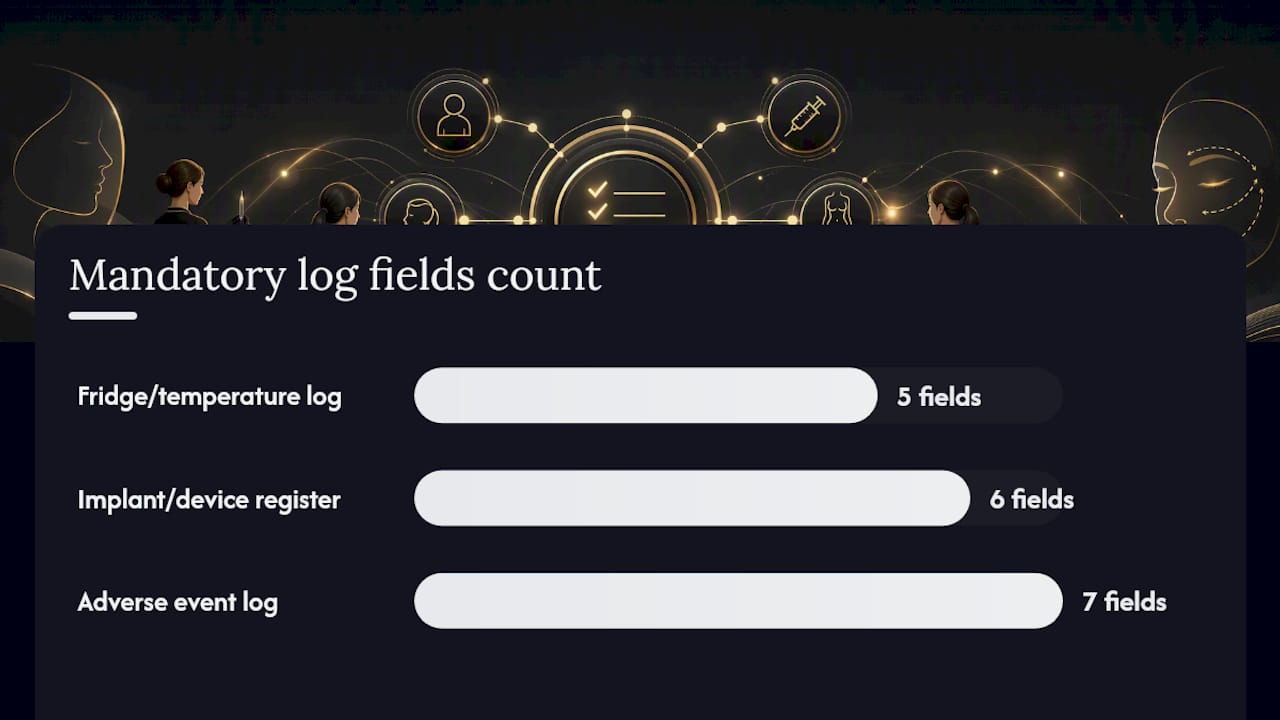
Special logs cross-reference patient records and provide the traceability chain inspectors follow during investigations. Each log type needs consistent columns so entries can be matched to treatment records by unique patient ID, date/time and staff initials.
| Log type | Minimum columns |
|---|---|
| Fridge/temperature log | Date, time, temperature reading, initials, action taken if out of range |
| Implant/device register | Patient ID, device name, manufacturer, batch/lot, implant date, practitioner |
| Adverse event/complaints log | Date, patient ID, event description, severity, action taken, outcome, review date |
Cross-referencing rules:
- Every log entry must carry the patient’s unique record ID so the treatment record and the log entry can be retrieved together.
- Hard-copy logs should be stored in a locked, fire-resistant cabinet; electronic logs should be backed up daily and access-restricted to clinical leads.
- For scalp micropigmentation and similar multi-session procedures, structured aftercare documentation shows how delivery of post-treatment instructions can be recorded session by session and cross-referenced to the main record.
How long must you keep records, and how do you dispose of them safely?
The NHS Digital retention schedule sets the minimum:
| Patient group | Minimum retention period |
|---|---|
| Adults | 8 years after the final appointment |
| Patients treated as minors | Until the patient’s 25th birthday, or 8 years after the last appointment, whichever is later |
Secure storage:
- Electronic records: encrypted at rest and in transit, role-based access, daily automated backup to a geographically separate server.
- Paper records: locked, fire-resistant storage; access log maintained.
- Under UK GDPR, clinical records are special-category data; your Data Protection Officer or lead must approve the retention schedule and any access policy.
Disposal checklist:
- Confirm the retention period has elapsed before any disposal.
- Paper records: cross-cut shredding by a certified confidential waste contractor; obtain a destruction certificate.
- Electronic records: certified data erasure or physical destruction of storage media; retain a destruction log.
Ready-to-use templates and worked examples
A treatment record template should contain every mandatory field as a labelled prompt, not a blank page. Below is a compact worked example for a botulinum toxin treatment.
Sample treatment entry:
Date/time: 14 March 2026, 14:35 | Practitioner: Dr A. Smith, GMC 1234567 (performed)
Presenting concern: Moderate glabellar lines at rest, 12 months’ duration.
Assessment: No contraindications. Capacity confirmed. Fitzpatrick II.
Procedure: Botulinum toxin type A [Product], Batch AB9876, Exp 06/2027. Glabellar complex: 4 units × 5 points = 20 units total. Diagram filed.
Consent: Face-to-face discussion 14 March 2026 by Dr A. Smith. Signed form ref: PT-2026-0314.
Outcome: Tolerated well. No immediate adverse events.
Aftercare: Written instructions given. Follow-up: 2 weeks. Contact: 020 XXXX XXXX.

For SOP excerpts, include: procedure name, indication, responsible practitioner grade, step-by-step technique, product selection criteria, documentation requirements and audit checkpoint. Adapt templates for your clinic’s branding, but never remove a mandatory field to save space.
Pro Tip: Store your master templates in a version-controlled folder on your records system and link each SOP to the relevant consent form. When you update one, update the other on the same date and record both version numbers in your governance log.
Electronic records versus paper: which controls do you need?
Both systems are acceptable; the controls differ. For a medical aesthetics workflow that integrates documentation into patient flow, electronic systems offer searchability and automatic audit trails. Paper records are simpler to implement but harder to audit at scale.
Essential questions to ask any electronic records vendor:
- Does the system produce a tamper-evident audit log of every access and amendment?
- Is data encrypted at rest and in transit to NHS-grade standards?
- Can you set granular user permissions (clinical view vs. admin view)?
- How frequently are automated backups performed, and where are they stored?
- Can you export all records in a portable format if you change provider?
Separate administrative data from clinical notes within the system. Reception and appointment views should not display sensitive clinical content by default; configure role-based views so admin staff see scheduling data only.
System changeover checklist:
- Export and verify all existing records before decommissioning the old system.
- Run both systems in parallel for a defined period (minimum four weeks).
- Confirm all historical records are accessible and complete in the new system before closing the old one.
- Update your record-keeping policy to reflect the new system and re-train all staff.
What will inspectors ask, and how do you present evidence?
CQC inspection frameworks for cosmetic interventions check whether clinical records contain all information needed to deliver safe care and whether that information travels with the patient between services.
Evidence to have ready on inspection day:
- Policy file: record-keeping policy, data protection policy, access control policy.
- Sample patient records (minimum five, spanning different procedures and practitioners).
- Logbooks: temperature, adverse events, procedure logbook.
- Training evidence: certificates, competency sign-offs, induction records.
- Audit outcomes: most recent records audit, findings and corrective actions.
When selecting sample records, choose a spread of procedure types and dates. Anonymise records if asked, but retain the ability to cross-reference to the full record by unique ID. Use the aesthetic consultation checklist as a training reference so staff can describe the process confidently.
Short script for clinic managers:
“Our record-keeping policy sets out who may access and amend records. Every treatment entry is made contemporaneously and includes the product batch number, consent reference and aftercare given. Our audit log shows the date, time and user for every access or change.”
Common pitfalls to fix before the visit:
- Unsigned or undated consent forms
- Missing batch numbers or expiry dates in treatment records
- No version history on SOPs
- Staff unable to locate the record-keeping policy
What we have learnt from real inspection cycles
Documentation gaps are almost always systemic, not individual. When inspectors praise a clinic’s records, it is rarely because one practitioner writes beautifully — it is because the whole team follows the same template, the same timing rule and the same filing convention. The single most effective habit we have seen is the “close the loop before the door” rule: every mandatory field is completed before the patient leaves the room. Batch stickers are affixed at the point of product preparation, not recalled from memory later. Consent forms are cross-referenced to the treatment note by a unique identifier, so there is never a signed form floating without a corresponding clinical entry.
Staff consistency comes from regular, brief internal audits — not annual reviews. A ten-minute monthly spot-check of five random records, with findings shared at the next team meeting, builds the habit faster than any training day. Inspectors notice when a clinic can produce its last three audit dates and the corrective actions taken; that evidence alone signals a governance culture rather than a compliance scramble.
Theaestheticsroom supports clinics with documentation and compliance
CQC-compliant documentation is one of the clearest markers separating a clinic that passes inspection from one that does not. Theaestheticsroom, operating from Knightsbridge and accredited by the CQC, has built its own governance framework around the exact standards described in this guide. Clinics looking for practical support can draw on Theaestheticsroom’s experience across Botox and dermal filler documentation, consent processes and SOP development.
Whether you need a template pack, staff training on contemporaneous record-keeping, or a pre-inspection governance review, Theaestheticsroom’s clinical team can help you build records that are inspection-ready from day one. Contact us to discuss how we can support your clinic’s compliance pathway.
Sources
Keep PDF copies of each source below in your clinic’s governance folder so inspectors can see the regulatory basis for your policies.
- Records management code of practice: retention schedule (NHS Digital)
- Healthcare Improvement Scotland — procedural documentation guidance (April 2026)
- Decision making and consent: the seven principles (GMC)
- JCCP/CPSA code of practice and guidance for practitioners who provide cosmetic interventions (2023)
This article is general information, not a substitute for advice from a qualified doctor. Consult a qualified healthcare professional about your own circumstances before acting on anything here.
Recommended
- How to create before and after galleries for UK clinics – The Aesthetics Room
- Patient follow-up workflow for UK aesthetic patients – The Aesthetics Room
- Clinic hygiene protocol guide: what patients should see – The Aesthetics Room
- Medical Aesthetics Workflow Optimisation for Clinics – The Aesthetics Room