

TL;DR:
- Clinic treatments are performed by qualified professionals and offer more potent, lasting results.
- At-home products are regulated as cosmetics and carry higher safety risks if misused.
- Combining professional procedures with ongoing at-home care can optimize skin rejuvenation outcomes.
Most people assume that booking a clinic appointment is simply the pricier, more time-consuming version of what you could do yourself at home. That assumption is worth examining more carefully. The gap between a high-street LED mask and a medically supervised skin rejuvenation session is far wider than most realise, and the consequences of choosing the wrong approach range from wasted money to genuine skin damage. Whether you are curious about maintaining your routine between appointments or considering your first professional treatment here in London, understanding the real differences will sharpen your decision considerably.
Table of Contents
- What are at-home and clinic treatments?
- Safety: risks and regulations compared
- Results, longevity, and value: what should you expect?
- How to choose the right option for you
- Expert insight: what most people get wrong about choosing treatments
- Ready for results? Explore expert treatments in London
- Frequently asked questions
Key Takeaways
| Point | Details |
|---|---|
| Safety matters | Clinic treatments are regulated and safer for intensive procedures, while at-home care needs strict adherence to instructions. |
| Results vary by method | Clinic-based procedures typically deliver more noticeable and lasting results than home treatments. |
| Personalise your choice | The best approach depends on your goals, risk tolerance, and willingness to invest in expertise. |
| Expert advice helps | Consulting a professional leads to safer, more effective outcomes for complex or high-stakes aesthetic goals. |
What are at-home and clinic treatments?
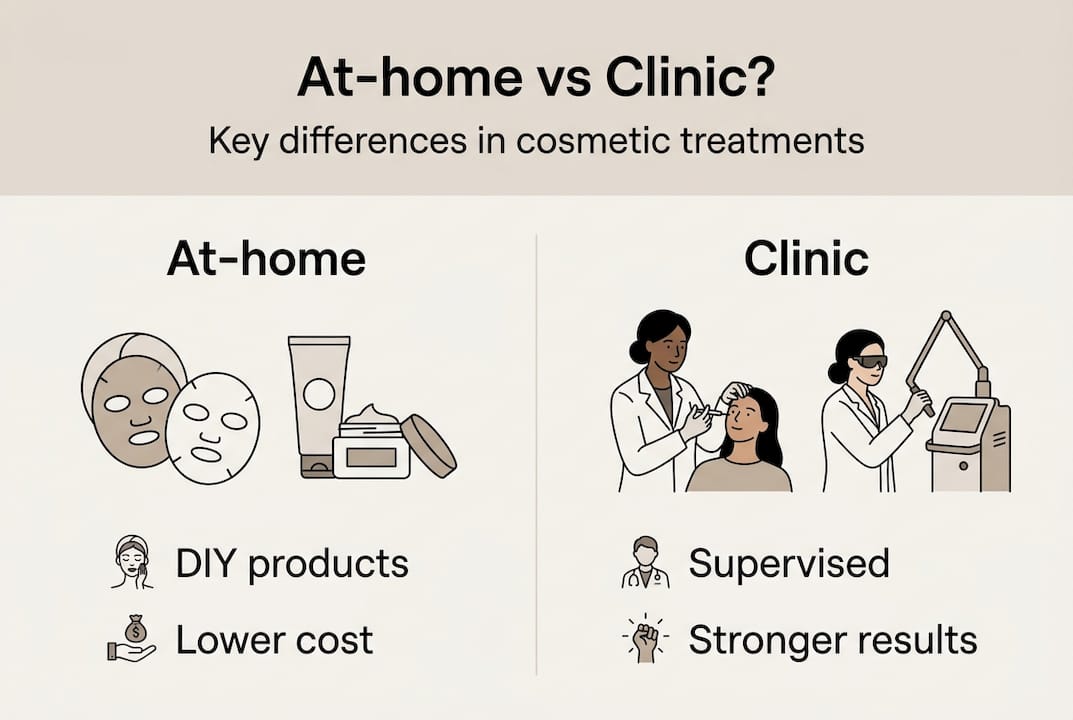
The at-home cosmetic market has grown enormously in recent years. At-home cosmetic products are widely available and increasingly sophisticated, spanning everything from hydrating sheet masks and vitamin C serums to microneedling rollers and LED therapy devices. These products are designed for self-administration, require no clinical training, and are typically regulated as cosmetics rather than medical devices.
Clinic treatments occupy an entirely different tier. At a reputable aesthetics clinic in London, you encounter injectables such as Botox and hyaluronic acid dermal fillers, clinical facials, laser resurfacing, chemical peels at prescription strength, and body contouring procedures. These require qualified practitioners, sterile environments, and informed consent protocols. When choosing a cosmetic clinic, it is worth understanding exactly which category your desired treatment falls into.
Common at-home treatments:
- Hydrating and clay face masks
- Vitamin C, retinol, and hyaluronic acid topical serums
- At-home LED light therapy devices
- Dermal rollers (0.25 mm to 0.5 mm)
- Exfoliating acids at low concentrations (AHAs, BHAs)
Common clinic treatments:
- Botox (botulinum toxin injections)
- Dermal fillers (hyaluronic acid, calcium hydroxyapatite)
- Laser resurfacing and IPL (intense pulsed light)
- Clinical microneedling and radiofrequency treatments
- Prescription-strength chemical peels
| Feature | At-home treatments | Clinic treatments |
|---|---|---|
| Practitioner involvement | None | Qualified clinician |
| Regulatory oversight | Cosmetic product law | CQC and medical regulations |
| Procedure complexity | Low | Moderate to high |
| Risk profile | Generally low | Higher, but managed professionally |
| Typical cost per session | £5 to £150 | £150 to £2,000+ |
One important boundary worth noting: any treatment that breaks the skin or uses prescription-grade ingredients must only be performed by a registered professional. Attempting clinical-grade procedures at home is not simply inadvisable; in many cases in the UK, it is unlawful.
Safety: risks and regulations compared
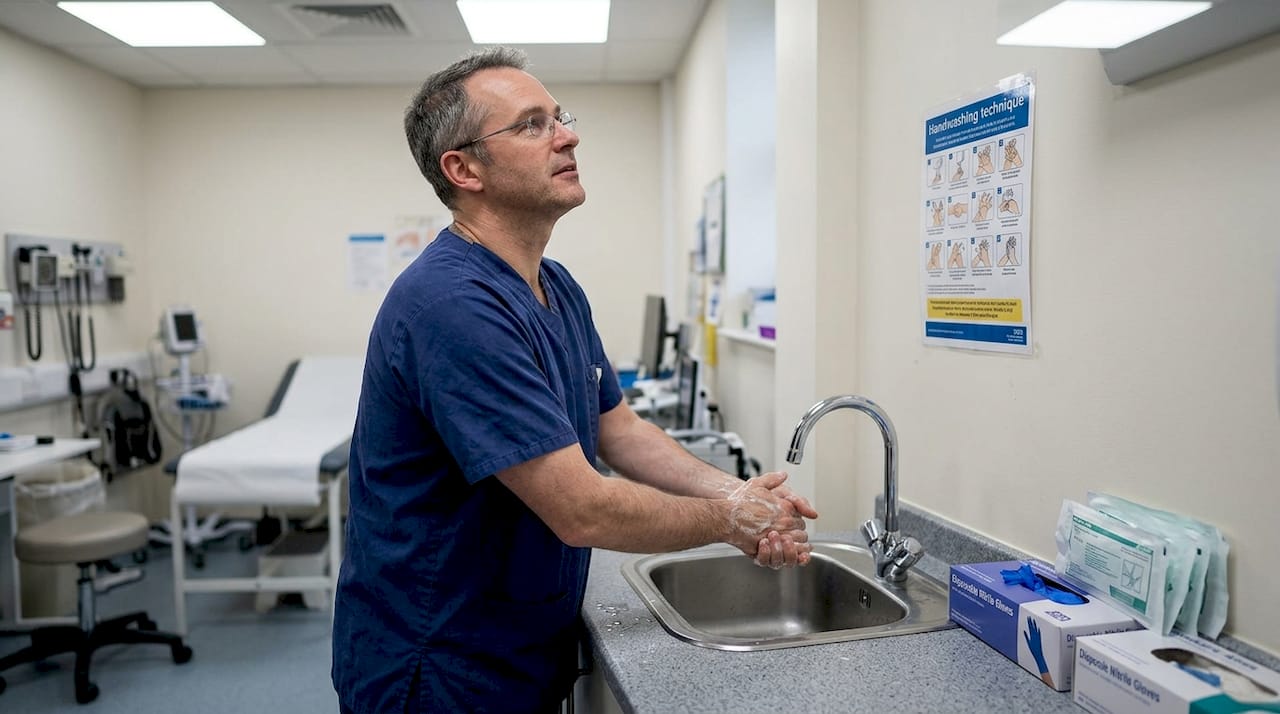
Safety is where the contrast between these two worlds becomes most significant. Professional clinics must comply with UK regulations and regular safety inspections, governed by the Care Quality Commission (CQC). The CQC sets enforceable standards covering hygiene, practitioner qualifications, equipment maintenance, and emergency protocols. Clinics that do not meet these standards face consequences including closure.
At-home products are regulated differently, primarily under the EU Cosmetics Regulation as retained in UK law post-Brexit. This framework ensures products are safe for normal use but does not govern how they are applied, in what combinations, or on which skin types. There is no requirement for a patch test, no professional assessment of contraindications, and no emergency support if something goes wrong.
| Safety factor | Supervised clinic treatment | Unsupervised at-home use |
|---|---|---|
| Infection control | Clinical hygiene standards | Dependent on user |
| Allergy screening | Patch test and consultation | Self-managed |
| Emergency readiness | On-site clinician | None |
| Equipment calibration | Professionally maintained | Variable |
| Aftercare guidance | Personalised plan | Product leaflet only |
Common risks with at-home treatments include contact dermatitis, chemical burns from over-used acids, and infection from improperly sterilised dermal rollers. Our team regularly sees clients who arrive having experienced skin barrier damage from overenthusiastic home routines. Reviewing aesthetics safety tips before starting any new regimen is an important first step. For those considering any clinic procedure for the first time, understanding safety in cosmetic procedures is equally essential.
Pro Tip: Before introducing any new at-home product, always conduct a 48-hour patch test on your inner arm. Check that the product carries a UK-registered responsible person designation on its label, which confirms it has met basic safety standards.
For those exploring options like clinical facial safety, knowing that your practitioner is trained and your environment is inspected provides genuine peace of mind that no home kit can replicate.
Results, longevity, and value: what should you expect?
Clinic treatments typically deliver results that last several months and require professional follow-up, with many patients experiencing effects from injectables lasting three to twelve months depending on the product and area treated. That duration is simply unachievable with at-home tools, which work gradually and require consistent use over weeks or months to produce modest improvements.
This is not a criticism of at-home care. It serves a genuinely useful purpose as a maintenance and enhancement tool between professional appointments. However, expecting a home LED device to replicate the collagen-stimulating power of clinical radiofrequency is like expecting a home espresso machine to match a professional barista. The mechanisms may be similar; the output rarely is.
At-home treatments: pros and cons
- Pro: Convenient, low cost, and good for daily maintenance
- Pro: Low barrier to entry; no appointments required
- Con: Limited penetration depth and clinical power
- Con: Results are gradual and subtle; not suitable for significant concerns
- Con: Risk of product misuse without professional guidance
Clinic treatments: pros and cons
- Pro: Clinically proven, faster, and longer-lasting results
- Pro: Customised to your skin type and goals
- Con: Higher cost per session
- Con: Requires appointments and some recovery time for certain procedures
“The clients who achieve the best outcomes are those who treat professional appointments as the foundation and home care as the follow-through. Most people make the mistake of investing heavily in products while avoiding the one consultation that could genuinely transform their results.”
Exploring the best facial treatments available in London can help you visualise what a personalised programme could achieve. For a broader view, reviewing the skin rejuvenation benefits of clinic care puts the value into context.
Pro Tip: Combining a well-chosen at-home retinol or antioxidant serum with regular professional treatments can genuinely accelerate your results. Ask your practitioner which products will complement your clinic plan rather than conflict with it.
How to choose the right option for you
Armed with a realistic sense of safety and results, here is how you can confidently decide what works for your lifestyle and ambitions.
Steps to making a safe and rewarding choice:
- Define your goal clearly. Are you maintaining good skin or addressing a specific concern such as volume loss, deep lines, or pigmentation?
- Assess your risk tolerance. Procedures involving injectables or lasers carry risks that require professional management.
- Set a realistic budget. Remember to factor in the frequency of sessions, not just the cost of a single appointment.
- Research your practitioner. Verify qualifications, read reviews, and check for CQC registration before booking.
- Book a consultation first. A reputable clinic will always assess your suitability before recommending a treatment.
- Consider the time commitment. Some clinic treatments involve brief downtime, which is worth planning for.
Professional consultation ensures tailored advice and minimises risks, particularly for anyone new to aesthetics or considering combining multiple treatments.
Signs you are better served by a clinic:
- You want to address deep wrinkles, significant volume loss, or pigmentation that topical products cannot resolve
- You are considering anything that involves needles, lasers, or prescription-strength formulations
- Previous at-home treatments have caused irritation or produced no visible improvement
- You want a personalised plan rather than a general product
For broader guidance, reviewing skin treatment tips from qualified practitioners can clarify your options. Understanding the distinction in experience between a medical spa vs regular spa is also helpful when weighing up your environment as much as your treatment.
Personal responsibility matters here. There is no judgement in choosing at-home care if it aligns with your goals. The key is making an informed, honest assessment of what you need.
Expert insight: what most people get wrong about choosing treatments
Here is the perspective we share with clients at The Aesthetics Room, and it is one that tends to surprise them. Most people who invest heavily in at-home devices are not wrong to do so. They are, however, frequently wrong about what those devices can achieve on their own.
The real mistake is treating the choice as binary. High-performing clients rarely choose one or the other; they build a personalised approach that uses clinic treatments to produce transformative change and at-home care to sustain it. The premium value is not in the product range you accumulate but in the expertise of the practitioner who maps out your journey.
We also see people delay clinic consultations out of concern about cost, when in reality a single well-planned professional treatment would have saved them the cumulative spend on ineffective products. Reviewing optimising your aesthetics workflow can help you think about your routine as a considered strategy rather than a series of isolated purchases. Expertise and customisation are what truly separate good results from great ones.
Ready for results? Explore expert treatments in London
If you are ready to move beyond guesswork and invest in results that are genuinely tailored to you, The Aesthetics Room in Knightsbridge is here to help. Our practitioners combine clinical expertise with bespoke care plans, giving you the outcomes that at-home products alone simply cannot deliver.
Whether you are exploring Botox treatments for the first time, considering dermal fillers to restore youthful volume, or curious about the full range of skin rejuvenation benefits available at our clinic, we welcome you to book a consultation. A conversation with our team costs nothing and could change everything about how you approach your skin health.
Frequently asked questions
Are at-home cosmetic treatments as effective as clinic procedures?
Clinic procedures deliver stronger, longer-lasting results because they use advanced technology and trained professionals. Clinic treatments last longer and produce more dramatic outcomes than home-use products can replicate.
What are the biggest risks with at-home cosmetic treatments?
At-home treatments can cause skin irritation, allergic reactions, or infection if not used correctly. Incorrect use of home products can result in complications that may then require professional intervention to resolve.
How do I decide if I need a clinic treatment?
Choose a clinic treatment if you want more dramatic, lasting results or if the procedure involves injectables or lasers. Professional consultation is vital for any advanced treatment to ensure your safety and suitability.
Is it safe to combine at-home care with clinic treatments?
Yes, combining a considered at-home skincare routine with professional clinic procedures is both safe and effective when done under proper guidance from your practitioner. The two approaches complement each other well when coordinated correctly.
Recommended
- How to choose a clinic for premium cosmetic enhancements – The Aesthetics Room
- Medical Aesthetics Workflow Optimisation for Clinics – The Aesthetics Room
- Specialised Skin Treatments for Various Demographics – The Aesthetics Room
- What Is a Skin Clinic and Who Benefits Most? – The Aesthetics Room
- Why Choose At-Home Hospice for Orange County Families | Graceland Hospice Care Blog