
TL;DR:
- Advanced facial analysis uses AI, 3D mapping, and multi-spectral imaging for objective skin and facial assessment.
- These technologies improve personalization, safety, and outcome tracking in luxury aesthetic treatments.
- Limitations include operator dependency, data privacy, AI bias, and inability to predict healing accurately.
What if everything a practitioner can see on your face is only half the story? Advanced facial analysis uses sophisticated imaging and AI-driven technologies to evaluate skin health, facial structure, and ageing signs far beyond visible surface inspection. London’s leading clinics are moving away from guesswork entirely, using precision tools to build personalised, safety-first treatment plans. This guide explains what these technologies actually involve, how they work, what they genuinely deliver for luxury clients, and where their limitations lie — so you can make informed, confident decisions about your care.
Table of Contents
- What advanced facial analysis actually involves
- How advanced analysis works — inside the technology
- Real benefits for luxury clients: Personalised planning, safety, and results
- Caveats and controversies: What advanced analysis doesn’t do
- Our take: Why advanced analysis means more than just technology
- Next steps for your personalised, safe facial enhancement
- Frequently asked questions
Key Takeaways
| Point | Details |
|---|---|
| Objective, in-depth skin analysis | Advanced analysis reveals what traditional inspection misses, supporting personalised and safe enhancements. |
| AI and imaging boost accuracy | Multi-spectral and AI-driven platforms allow precise tracking and bespoke planning for better results. |
| Limits require expert oversight | Technology is powerful but not a substitute for consultation—clinician skill ensures ethical and effective use. |
| Luxury care means science and trust | Top London clinics use advanced tools but always pair them with individualised guidance for true luxury outcomes. |
What advanced facial analysis actually involves
Advanced facial analysis is not simply a high-resolution photograph. It refers to the integration of AI-based evaluation platforms, multi-spectral imaging devices, and three-dimensional mapping tools that assess your skin and facial architecture with scientific objectivity. Where a visual consultation identifies what is obvious, these systems reveal what is invisible to the naked eye.
The most widely adopted technologies include:
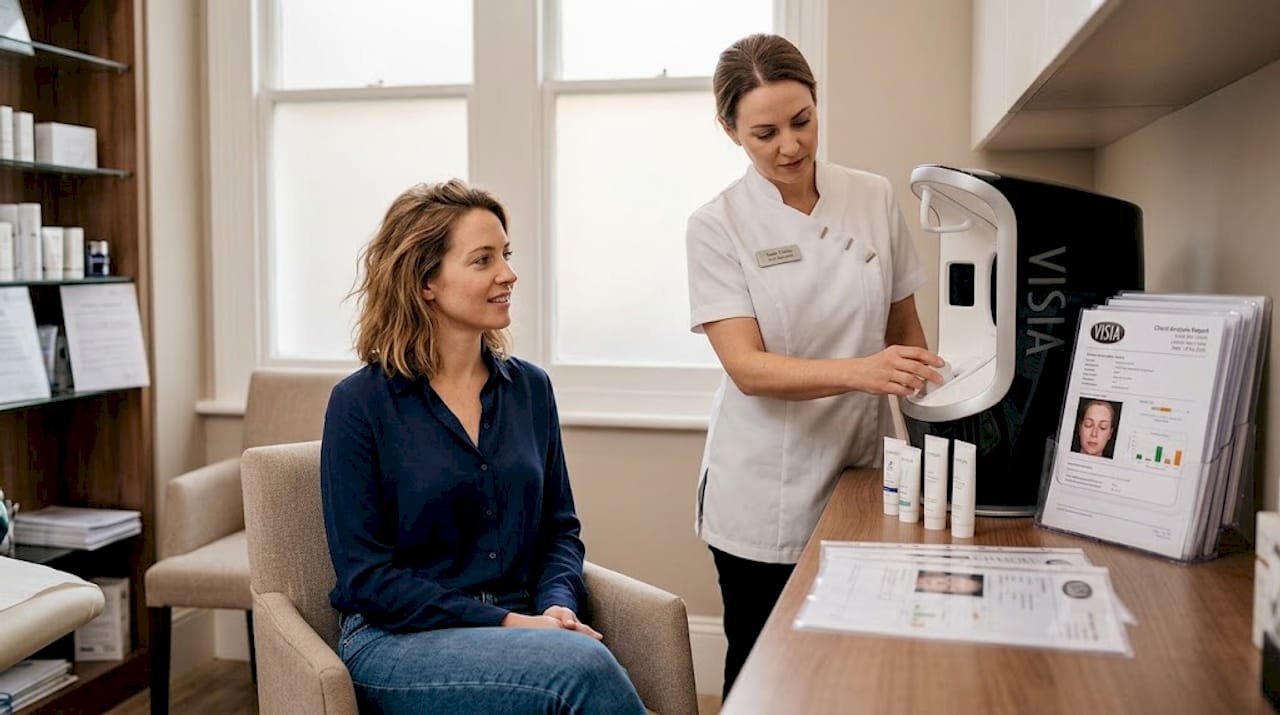
- VISIA Complexion Analysis — measures eight skin metrics including texture, pores, spots, UV damage, brown spots, red areas, porphyrins, and wrinkles using multi-spectral lighting
- 3D mapping systems such as Aura Reality — capture facial volume, symmetry, contour depth, and structural proportions in three dimensions
- AI platforms including Haut.AI Face 3.0 and Face180 — process over 29 parameters from imaging data, flagging deviations from age and gender norms
These tools do not operate in isolation. The most effective clinics integrate them into a holistic assessment approach, combining imaging outputs with clinical history, lifestyle factors, and client goals.
| Technology | Primary function | Key metrics assessed |
|---|---|---|
| VISIA | Multi-spectral imaging | 8 skin metrics incl. UV, texture, pores |
| Aura Reality 3D | Volumetric mapping | Symmetry, contour, volume deficit |
| Haut.AI / Face180 | AI skin scoring | 29+ parameters vs age/gender norms |
What sets the best skincare devices and analysis platforms apart is their ability to quantify. Rather than a practitioner saying your skin looks tired, a VISIA scan scores your UV damage against a database of thousands, giving an objective percentile. That shift from subjective opinion to measurable data is what makes these tools so valuable for tailored skincare in luxury settings.
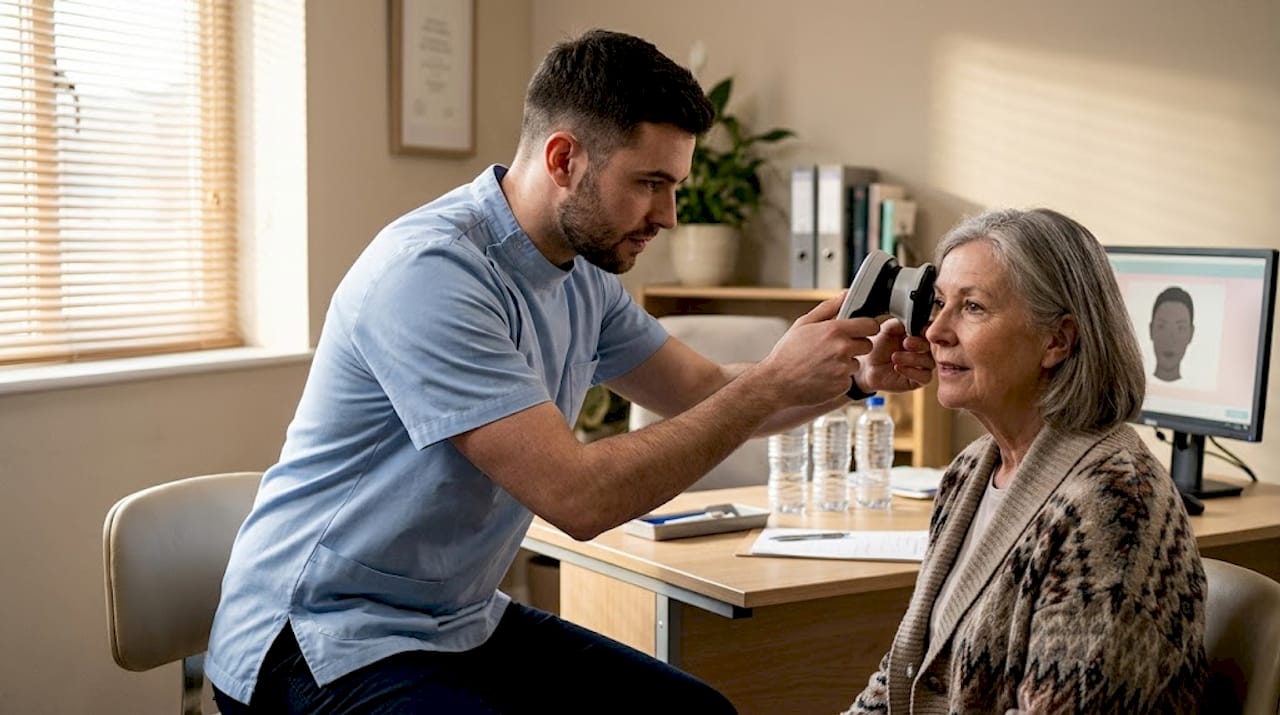
In practice, a London clinic using advanced analysis will typically begin your appointment with an imaging session before a single word about treatment is spoken. The data speaks first. The clinician then interprets that data alongside your concerns, creating a plan that is built on evidence rather than assumption.
How advanced analysis works — inside the technology
Having defined what these systems do, it is essential to look at how their underlying technology delivers reliable insights.
VISIA works by illuminating the face with six distinct light spectra, including UV and cross-polarised light, to capture what lies beneath the skin’s surface. Pigmentation that does not yet appear as visible spots, bacteria linked to breakouts, and early UV damage all become visible and measurable. The review of imaging platforms confirms VISIA achieves less than 2% variation in repeat measurements, making it highly reproducible.
Three-dimensional mapping captures thousands of data points across the face in a single scan. It quantifies volume loss in the cheeks, measures nasolabial fold depth, and assesses facial asymmetry with millimetre-level precision. This is particularly relevant when planning treatments such as facial contouring, where symmetry and proportionality directly affect outcomes.
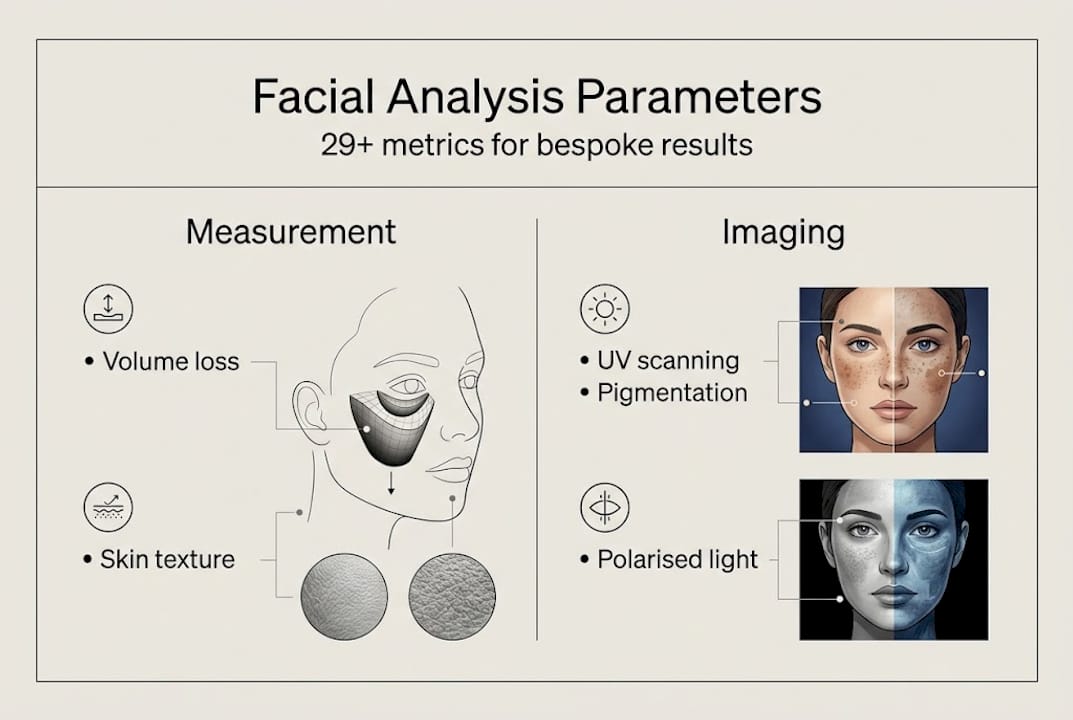
AI platforms add another layer. Face180 stabilises image capture to improve consistency by 30%, while AI scoring systems reach 85 to 95% accuracy in skin age and condition assessment. Feature extraction tools such as RBX technology separate melanin from haemoglobin in pigmentation analysis, enabling more precise identification of the root cause behind redness or brown spots.
Here is how a typical advanced analysis session unfolds:
- Imaging capture — standardised photography and UV scans under controlled lighting
- 3D mapping — volumetric facial scan to assess structure and symmetry
- AI scoring — automated comparison against age, gender, and ethnicity-matched databases
- Clinician review — expert interpretation of all outputs in context of client history
- Treatment planning — bespoke plan developed from objective data and client priorities
Pro Tip: Ask your clinic which specific platform they use and how results are stored. Clinics using standardised imaging protocols, including those incorporating ultrasound in facial safety, can monitor your progress with far greater precision between appointments.
The mechanics matter because they determine whether results are reproducible and trustworthy. A system with less than 2% measurement variation means your six-month follow-up scan genuinely reflects change, not camera angle.
Real benefits for luxury clients: Personalised planning, safety, and results
Understanding the technology is one thing; seeing its value in luxury client care is another.
Structured facial assessment boosts six-month patient retention by 2.5x and significantly improves the tracking of measurable outcomes.
That statistic reflects something deeper than business performance. It means clients who receive data-driven assessments are more satisfied, see clearer results, and trust the process enough to return. For London’s luxury clientele, that trust is earned through transparency.
Here is how advanced analysis translates into real-world benefit:
- Bespoke treatment plans — imaging data eliminates the one-size-fits-all approach, matching specific concerns to the most appropriate interventions
- Safer procedures — objective volumetric data reduces the risk of over or under enhancement, a critical factor in skin analysis for visible results
- Progress tracking — repeat scans at six or twelve weeks provide measurable confirmation of improvement, not just a client’s impression
- Reduced consultation guesswork — practitioners spend less time estimating and more time planning with precision
- Aligned expectations — seeing your skin data helps you understand why specific treatments are recommended, building genuine confidence in your plan
Pro Tip: Before your first advanced analysis appointment, compile a brief timeline of any treatments you have had in the past two years. Clinicians using a holistic treatment planning model will integrate this history alongside your imaging data for a far richer picture.
The reduction in risk is particularly significant. Without objective volume mapping, a practitioner estimating filler placement relies heavily on experience alone. With 3D data, they can identify the precise area of volume deficit, plan the appropriate product and quantity, and assess symmetry before and after. That is a meaningful safety upgrade for any client seeking enhancement.
Caveats and controversies: What advanced analysis doesn’t do
While advanced tools offer much, it is just as important to recognise their limitations and controversies in real-world practice.
No AI system is neutral. AI diversity challenges are well documented in aesthetic medicine. Training datasets used to build these platforms have historically over-represented Western phenotypes, which means scoring comparisons may be less accurate for clients of East Asian, South Asian, or African heritage. Responsible clinics acknowledge this openly.
Key limitations to be aware of include:
- Operator dependency — imaging quality and interpretation still depend significantly on practitioner skill and experience
- Data privacy — facial scans are biometric data and must be stored and processed under strict GDPR compliance; always ask how your data is managed
- Black-box algorithms — some AI platforms cannot explain why a score is generated, making clinician oversight non-negotiable
- Healing and scarring prediction — AI underperforms in predicting individual healing responses or anatomical reactions post-treatment
- Not a diagnostic tool — advanced analysis is for aesthetic planning only and cannot diagnose dermatological or medical conditions
“AI-driven facial analysis must be used as a clinical aid, not a replacement for qualified medical judgement. Its value lies in augmenting expertise, not substituting it.”
This is why choosing the right clinic is not a secondary consideration. A sophisticated imaging platform in the hands of an inexperienced or unsupervised practitioner does not guarantee better outcomes. The technology must sit within a framework of genuine clinical expertise, rigorous patient safety protocols, and honest communication about what the data can and cannot tell you.
Our take: Why advanced analysis means more than just technology
The aesthetics industry in 2026 is quick to celebrate AI and imaging as revolutionary. And they are, in the right hands. But we believe the conversation too often centres on the tool rather than the practitioner holding it.
At The Aesthetics Room, we see advanced analysis as the beginning of a dialogue, not the end of one. Imaging data tells us what is happening on and beneath your skin. It does not tell us what matters most to you, how you feel about ageing, or what outcome would genuinely improve your confidence. That requires conversation, clinical experience, and trust.
Our honest view: the clinics delivering the best results in London are not the ones with the most sophisticated hardware. They are the ones where advanced tools amplify expert judgement rather than replace it. A personalised skincare approach that combines rigorous imaging with genuine clinical partnership is the real marker of luxury care in aesthetic medicine. Technology earns your trust. People keep it.
Next steps for your personalised, safe facial enhancement
If you are ready to move beyond surface-level assessments, advanced facial analysis at The Aesthetics Room offers a precise, data-driven starting point for your treatment journey.
Our Knightsbridge clinic combines leading imaging technology with expert clinician interpretation, building bespoke plans around your unique skin profile and goals. Whether you are considering dermal fillers, exploring skin rejuvenation options, or simply want a thorough, honest assessment of where your skin is today, we are here to guide you. Book a consultation with The Aesthetics Room London and experience the clarity that precision-led, luxury aesthetic care provides.
Frequently asked questions
Is advanced facial analysis safe?
Yes. When performed in reputable clinics, advanced facial analysis is safe and non-invasive. Clinician supervision and robust clinic protocols ensure imaging technologies are used responsibly, with data privacy maintained at every stage.
Does facial analysis replace the need for a consultation?
No. Imaging data provides detailed objective measurements, but clinician interpretation remains essential to translate those findings into a safe, personalised treatment plan aligned with your individual goals.
What results can I expect from an advanced facial analysis?
You will receive a comprehensive, data-driven profile of your skin health and facial structure. This enables tailored treatment plans, clearer progress tracking, and measurably improved outcomes over time.
Can advanced analysis predict how my skin will heal after treatment?
Not reliably. Current AI systems underperform on healing and individual scarring prediction, which is why experienced clinician judgement remains a non-negotiable part of any treatment plan.
Recommended
- Holistic facial assessment for truly personalised beauty – The Aesthetics Room
- Facial harmonization: personalised non-invasive solutions – The Aesthetics Room
- Skin profiling guide: unlock radiant, tailored skin – The Aesthetics Room
- Skin analysis: The key to radiant, effective results – The Aesthetics Room
- Free Body Language Checklist for Interviews | Pavone