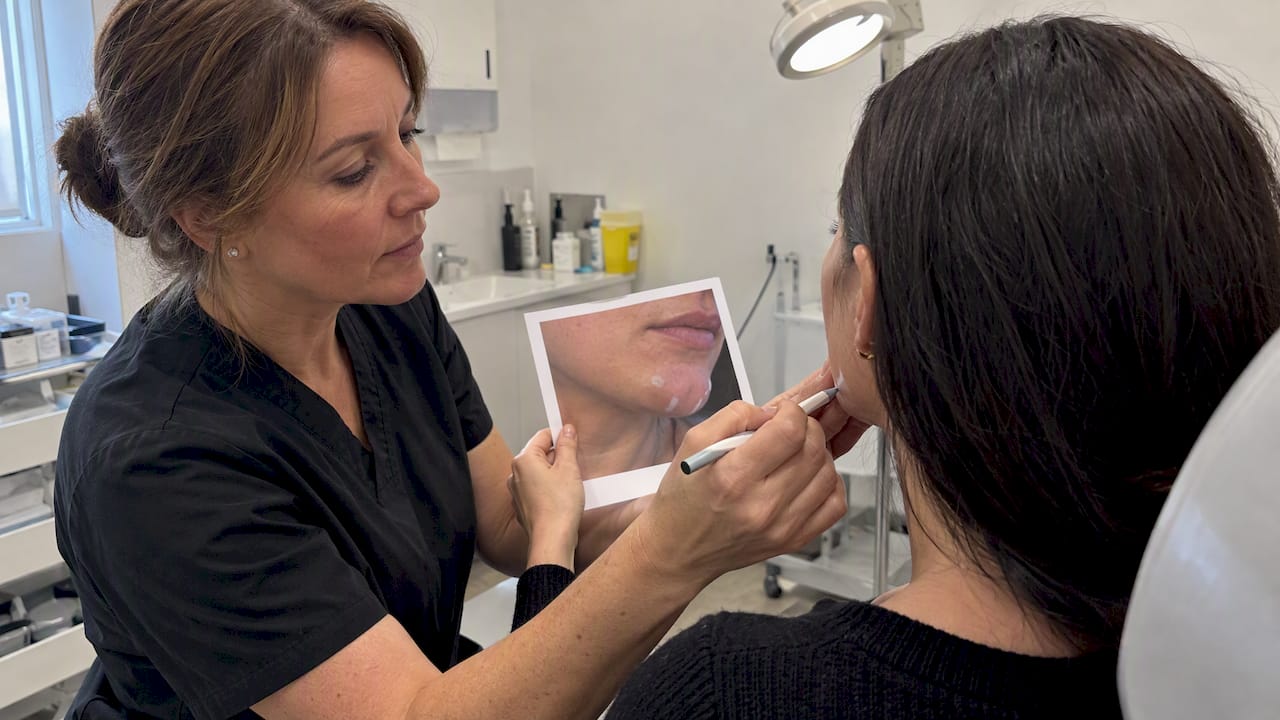


A sharper jawline is rarely created by simply placing the firmest filler along the lower face. The most refined results come from choosing a product and treatment plan that respects your bone structure, skin quality, facial proportions and the way your face moves. Understanding how to choose filler for jawline contouring begins with that principle: the right filler is the one that supports your individual anatomy, not the one with the strongest reputation online.
For some patients, the aim is a cleaner angle beneath the ear. For others, it is a more defined transition from chin to jaw, improved symmetry, or a subtle restoration of structure lost with age. These are different concerns, and they may require different products, placement techniques and even alternative treatments.
How to choose filler for jawline contouring safely
Jawline contouring usually calls for a dermal filler with sufficient strength to hold its shape against the natural movement and pressure of the lower face. In clinical terms, practitioners often consider a filler’s firmness, cohesivity and ability to provide projection. Yet product properties are only one part of the decision.
A qualified medical practitioner should first assess the whole face, not just the jawline. The chin, cheeks, temples, lips, bite, muscle activity and skin laxity can all influence how a jawline appears. Adding volume directly to the jaw may improve definition for one person, while another may benefit more from chin support or treatment further up the face to restore balance.
The goal should not be a copied, overly angular profile. A well-planned result looks proportionate in conversation, in photographs and from every angle. This is particularly relevant for patients seeking a masculine, structured lower face as well as those wanting a softer, elegant contour. The aesthetic is tailored, but the clinical principles remain the same.
The filler characteristics that matter
Most modern jawline treatments use hyaluronic acid filler. Hyaluronic acid is naturally found in the body, and products made from it can be selected in different consistencies for different areas. A firmer hyaluronic acid filler may be appropriate where structure and projection are needed, while a more flexible product can suit areas where natural movement is a greater priority.
One advantage of hyaluronic acid is that it can be dissolved if clinically necessary. This does not make treatment risk-free, but it is an important safety consideration when used by an experienced practitioner with the appropriate emergency protocols in place.
Some practitioners may also consider other biostimulatory or calcium-based injectable products for selected patients. These options have different behaviours, longevity and reversibility profiles, and are not automatically the best choice for a first jawline treatment. They require careful patient selection, an advanced understanding of anatomy and a clear discussion of the trade-offs. Product choice should never be reduced to a brand name or a promise that one filler lasts longer than another.
Longevity varies between individuals. Metabolism, the amount used, placement depth, facial movement and the specific product all play a role. A longer-lasting result is not necessarily better if it is poorly matched to the face or leaves little flexibility to refine the outcome over time.
Firmness is useful, but subtlety still matters
It is easy to assume that jawline filler must always be very firm. In reality, the ideal product should provide support without creating visible edges, lumps or an unnaturally heavy lower face. The skin over the jaw, existing tissue volume and degree of laxity affect what can be achieved cleanly.
A patient with good skin elasticity and a naturally defined bone structure may need relatively small, strategic amounts. Someone with more pronounced volume loss or early jowling may require a staged approach, combining structural support with an honest conversation about what filler can and cannot improve.
Your facial anatomy should lead the plan
The jawline is not an isolated line. It is a three-dimensional framework that connects the chin, mandibular angle, lower cheeks and neck. Treating only one point can make an imbalance more obvious.
For example, a retrusive chin can make the jawline look less defined even when the jaw itself is strong. In this case, chin enhancement may form part of the treatment plan. Conversely, placing too much volume in an already broad lower face can make it appear heavier rather than more sculpted.
Masseter muscle activity also deserves consideration. If teeth grinding or naturally strong jaw muscles are contributing to a square or wide lower face, anti-wrinkle injections into the masseters may be discussed as an alternative or complement to filler. This is not suitable for everyone, and it will not create bony projection, but it can change lower-face proportions where muscle bulk is the main issue.
Skin laxity is another important factor. Filler can offer support and improve shadowing in carefully selected cases, but it cannot tighten significant loose skin in the same way as surgery. A responsible consultation identifies when another treatment, a combination approach or no injectable treatment at all is likely to offer the better outcome.
Why the assessment matters more than the syringe
The safest and most attractive jawline contouring starts with a detailed consultation. Your practitioner should ask about previous aesthetic treatments, medical history, allergies, medications, dental work and any history of cold sores or autoimmune conditions where relevant. They should also assess facial symmetry, tissue quality and your expectations.
Photographs may be taken to support treatment planning and to help you see changes objectively over time. This is useful because facial asymmetry is normal, and a good result often means improving balance rather than trying to make both sides identical.
You should also be able to discuss your preferred level of definition. Some patients want a discreet refinement that colleagues will not identify as treatment. Others prefer a more editorial, sculpted finish. Both may be possible, but the amount of filler, product selection and number of appointments should be planned accordingly.
At The Aesthetics Room, a consultation-led approach allows the practitioner to assess the full facial picture before recommending a bespoke treatment plan. This is particularly valuable for jawline work, where precision and restraint tend to produce the most sophisticated results.
Questions to ask before choosing jawline filler
A good consultation should leave you feeling informed rather than persuaded. Ask which type of filler is being recommended and why it suits your anatomy and goals. Your practitioner should be able to explain whether the product is intended for projection, contour, support or a combination of these effects.
It is also sensible to ask how much product may be required, whether the treatment is best completed in one appointment or built gradually, and what degree of swelling or bruising is realistic. More filler is not always the answer. Staging treatment can allow the tissue to settle and gives you time to decide whether additional definition is genuinely needed.
Ask about aftercare and the clinic’s approach to complications. Jawline filler is a medical procedure, not a beauty treatment. Although serious complications are uncommon, filler can carry risks including infection, nodules, vascular compromise and unwanted asymmetry. A medically led clinic should have clear protocols, suitable training and the ability to recognise and manage complications promptly.
Be cautious of packages that promise a fixed number of millilitres for every face or heavily discounted treatments that prioritise quantity over assessment. The correct amount depends on your starting point, not a standard menu. Equally, avoid treating a jawline repeatedly without reviewing the existing filler. Over time, excessive volume can blur rather than enhance the contour you were hoping to achieve.
Preparing for treatment and allowing for refinement
Before your appointment, follow the advice provided by your practitioner. You may be advised to avoid alcohol and certain supplements or medications that can increase bruising, but never stop prescribed medication without medical guidance. Arrive with a clear sense of your priorities, alongside an openness to professional advice if your original plan is not the safest or most flattering route.
Following treatment, mild swelling, tenderness and bruising can occur. The final contour should not be judged immediately, as early swelling can temporarily make the jaw look stronger or less even than it will once settled. Avoid pressing or massaging the area unless specifically instructed to do so, and contact the clinic promptly if you have concerns.
The best jawline filler is not defined by a single product, a dramatic before-and-after image or the largest possible volume. It is the product selected with care, placed with anatomical precision and reviewed with your long-term facial balance in mind. A thoughtful consultation gives you the space to choose enhancement that feels polished, safe and recognisably you.