


TL;DR:
- Lip augmentation enhances lip volume and shape primarily using hyaluronic acid fillers, with results lasting six to twelve months. Patients seek it to restore aging-related volume loss, correct asymmetry, or boost confidence, with safe procedures performed by qualified practitioners. The best outcomes come from staged treatments, careful consultation, and choosing clinics with proper medical credentials.
Lip augmentation is defined as a cosmetic procedure that enhances lip volume, shape, and definition, most commonly using hyaluronic acid dermal fillers. It is the most requested non-surgical aesthetic treatment in the UK, with results lasting 6–12 months before maintenance is needed. People choose it for reasons ranging from natural volume loss caused by ageing to a desire for better facial symmetry and a quiet confidence boost. Understanding why get lip augmentation, and what it realistically achieves, is the first step to making a decision you will feel good about long term.
What are the common reasons people choose lip augmentation?
The motivations behind lip enhancement are more varied than most people expect. Very few patients arrive wanting dramatically larger lips. Most want something far more specific.
Natural volume loss with age is the most common driver. Lips lose collagen and hyaluronic acid from the mid-twenties onwards, causing them to flatten and the border to soften. A well-conducted consultation that includes facial anatomy assessment helps practitioners identify exactly where volume has been lost and restore it proportionally.
Asymmetry and disproportion are the second most cited reasons. Many people have a noticeably thinner upper lip relative to the lower, or one side that sits slightly higher than the other. Fillers placed with anatomical precision can correct both without making the lips look treated.
The remaining reasons cluster around aesthetics and confidence:
- Sharpening a softened vermilion border for cleaner lip definition
- Adding subtle volume to lips that have always been naturally thin
- Improving the appearance of the Cupid’s bow without surgical intervention
- Aligning lip appearance with personal beauty goals and current aesthetic trends
- Restoring pre-pregnancy or post-weight-loss lip fullness
The confidence dimension is real and well documented. Patients consistently report that even modest enhancements produce a meaningful shift in how they feel about their appearance. That outcome is not vanity. It is the legitimate goal of medical aesthetics.
What are the lip enhancement options available today?
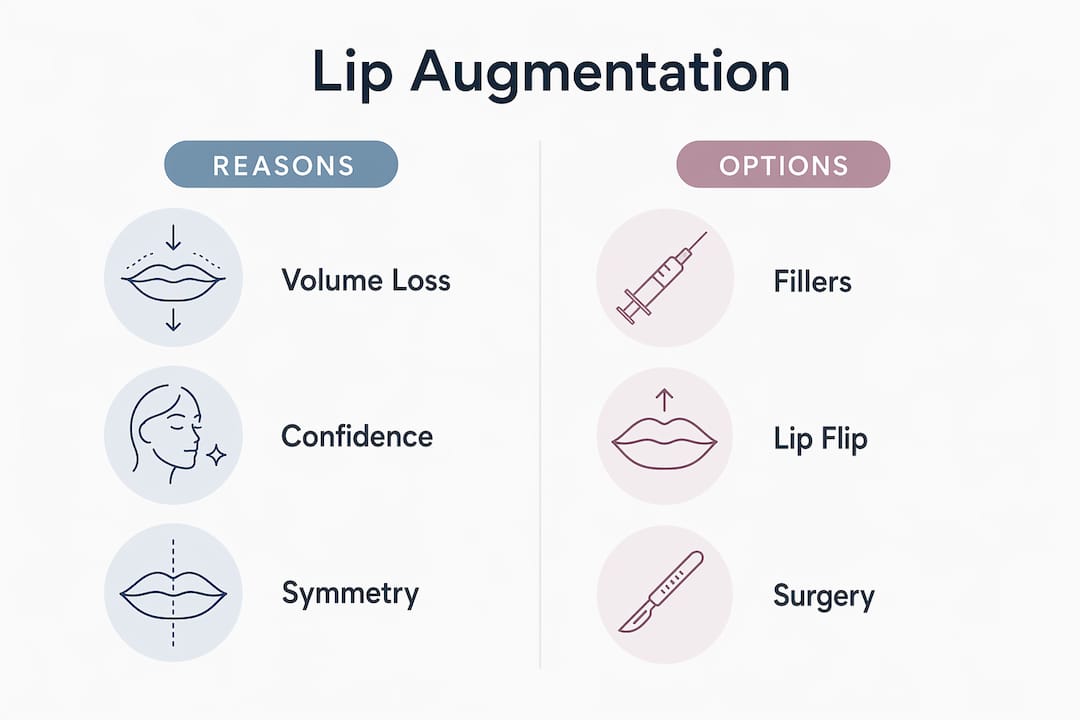
Lip enhancement options span non-surgical and surgical approaches, each with distinct trade-offs in longevity, recovery, and reversibility.

| Treatment | Method | Duration | Reversible | Recovery |
|---|---|---|---|---|
| Hyaluronic acid fillers | Injectable gel | 6–12 months | Yes, via hyaluronidase | 1–2 days |
| Lip flip | Botulinum toxin injection | 2–3 months | Partially | Minimal |
| Surgical lip lift | Skin excision under nose | Permanent | No | 1–2 weeks |
| Lip implants | Silicone implant | Permanent | Surgically reversible | 1–2 weeks |
Hyaluronic acid fillers are the dominant choice in the UK because they integrate with lip tissue, attract water to add volume and softness, and can be dissolved with hyaluronidase if the result is not right. That reversibility is a significant safety advantage no other option offers.
The lip flip uses botulinum toxin to relax the muscle just above the upper lip, causing it to roll slightly outward. It adds the appearance of volume without adding actual filler. Results are subtle and short-lived, making it a useful option for patients who want a trial before committing to fillers.
Surgical options such as lip lifts offer permanent results but require anaesthesia, a visible incision, and a recovery period of one to two weeks. They suit patients who want a lasting structural change and are comfortable with a surgical pathway. For most adults considering lip enhancement for the first time, non-surgical fillers remain the appropriate starting point.
Personalised treatment plans matter here. The right option depends on your anatomy, your goals, and how much downtime you can accommodate. A practitioner who assesses all three before recommending a treatment is one worth trusting.
What are the benefits of lip fillers specifically?
The benefits of lip fillers go beyond simple volume addition. Hyaluronic acid is naturally present in the body, and synthetic HA fillers work by integrating with existing lip tissue and drawing in moisture. The result is lips that look fuller and feel softer, not stiff or artificial.
Specific aesthetic benefits include:
- Volume restoration: Fillers rebuild the natural plumpness lost through ageing or genetics.
- Border definition: Precise placement along the vermilion border sharpens the lip edge and makes lipstick sit more cleanly.
- Cupid’s bow enhancement: Small amounts of filler can accentuate the natural arch of the upper lip without distorting it.
- Symmetry correction: Targeted placement addresses uneven upper and lower lip proportions.
- Hydration and softness: HA attracts water into the tissue, improving lip texture as well as appearance.
The temporary and reversible nature of HA fillers is itself a benefit. Results from natural-looking lip filler treatments typically last 6–12 months, giving patients the flexibility to adjust volume at each appointment as their face changes with age.
Pro Tip: Ask your practitioner to show you before-and-after images of patients with a similar lip shape to yours, not just the most dramatic transformations. The results that suit your anatomy may look very different from the ones that photograph well on social media.
Over-filling lips limits movement and softness and creates an unnatural appearance. Gradual, considered volume increases focused on enhancing your natural features produce far better long-term outcomes than attempting maximum volume in a single session.
What safety considerations should you know before getting lip augmentation?
Lip augmentation is a medical procedure. Treating it as anything less is the single most common mistake patients make when researching their options.
-
Choose a medically qualified practitioner. The UK lip filler market remains largely unregulated for non-surgical treatments. Patients should seek practitioners registered with the GMC, NMC, or GDC, and verify accreditation through registers such as Save Face or the Joint Council for Cosmetic Practitioners (JCCP).
-
Insist on a full consultation before treatment. A thorough anatomy assessment and goal discussion significantly improve both safety and satisfaction. Any practitioner who skips this step is not operating to an acceptable standard.
-
Understand common side effects. Temporary swelling, redness, and tenderness lasting one to two weeks are normal after treatment. These are not complications. They are expected tissue responses.
-
Know the serious risks and how they are managed. The lips have a complex vascular anatomy. Safe filler administration requires practitioners with detailed anatomical knowledge and immediate access to hyaluronidase, the prescription-only enzyme that dissolves HA filler in an emergency. Only medically qualified practitioners can hold and administer this medication.
-
Respect staged treatment. Practitioners favour under-treating initially and reviewing results after two weeks. This approach respects tissue capacity, avoids overfilling, and produces more natural, harmonious outcomes.
Pro Tip: Before booking, ask your practitioner directly: “Do you carry hyaluronidase on site?” If the answer is no or uncertain, book elsewhere. This is a non-negotiable safety requirement for any practitioner administering lip fillers.
Excessive filler placement causes product migration and uneven lip appearance over time. Staged treatment is not a commercial tactic to bring you back for more appointments. It is the clinically correct approach to maintaining facial harmony and tissue health.
Key takeaways
Lip augmentation is most effective when it is subtle, staged, and delivered by a medically qualified practitioner with access to emergency reversal medication.
| Point | Details |
|---|---|
| Most popular non-surgical treatment | Hyaluronic acid lip fillers are the UK’s most requested non-surgical aesthetic procedure. |
| Results last 6–12 months | HA fillers require maintenance appointments but remain fully reversible throughout. |
| Staged treatment produces best results | Under-treating initially and reviewing after two weeks protects tissue and ensures natural outcomes. |
| Practitioner credentials are non-negotiable | Seek GMC, NMC, or GDC registration and verify accreditation via Save Face or JCCP. |
| Consultation determines suitability | A full anatomy assessment before treatment improves both safety and patient satisfaction. |
What I have learnt from years of watching patients choose lip augmentation
The patients who are happiest with their results share one thing in common: they came in wanting to look like themselves, only better. They were not chasing a specific celebrity’s lips or a social media trend. They wanted their own lips back, or a version of their own lips that felt more balanced.
The patients who struggle are almost always those who arrive with a reference image of someone else’s face. Lips exist in proportion to the rest of your features. What looks extraordinary on one face can look entirely wrong on another. A practitioner’s job is to assess your anatomy honestly, not to deliver whatever volume a patient requests.
I have also seen how the consultation separates good clinics from poor ones. A practitioner who spends time understanding your face, your history, and your expectations will sometimes advise you not to have treatment at all. That is not a failure. That is the highest expression of clinical judgement. If a practitioner agrees to everything you ask without question, that is the moment to pause.
The reversibility of hyaluronic acid fillers is genuinely reassuring, but it is not a reason to be careless. Dissolving filler with hyaluronidase is a medical intervention, not a simple undo button. Getting the treatment right the first time, with a qualified practitioner and a conservative approach, is always the better path. If you want to understand how long results last before committing, that is exactly the kind of question worth raising in your consultation.
— Vishul
Expert lip augmentation at Theaestheticsroom
Theaestheticsroom offers medically led lip augmentation at its Knightsbridge clinic, with practitioners who hold full medical qualifications and carry hyaluronidase on site. Every treatment begins with a detailed consultation covering your facial anatomy, aesthetic goals, and medical history, so the plan is built around you rather than a standard template.

The focus at Theaestheticsroom is on natural, proportionate results that respect your existing features. Whether you are addressing age-related volume loss, correcting asymmetry, or simply wanting a little more definition, the team works within your anatomy rather than against it. Explore the full range of dermal filler treatments and book a consultation to discuss what is right for your face.
FAQ
What is lip augmentation?
Lip augmentation is a cosmetic procedure that enhances lip volume, shape, and definition. The most common method in the UK uses hyaluronic acid dermal fillers injected by a medically qualified practitioner.
How long do lip filler results last?
Hyaluronic acid lip fillers typically last 6–12 months before a maintenance appointment is needed. Results vary depending on the filler used, the volume placed, and individual metabolism.
Is lip augmentation reversible?
Yes. Hyaluronic acid fillers can be dissolved using hyaluronidase, a prescription-only enzyme available only to medically qualified practitioners. This reversibility is one of the key safety advantages of HA fillers over surgical options.
What are the risks of lip fillers?
Common side effects include temporary swelling, redness, and tenderness lasting one to two weeks. Serious complications are rare but require immediate management by a practitioner with access to hyaluronidase and detailed anatomical knowledge.
Is lip augmentation worth it?
For patients with realistic expectations and a qualified practitioner, lip augmentation consistently produces meaningful improvements in lip definition, symmetry, and confidence. The key is choosing a medically accredited clinic and committing to a staged, conservative approach.