
Swelling after double chin fat dissolving injections typically peaks between 24 and 72 hours and settles within a median of 9 to 10 days in clinical trials, with visible improvement often continuing for 2 to 4 weeks. Most swelling is a normal part of how the treatment works. If you notice spreading redness, fever, worsening pain, or any difficulty breathing or swallowing, contact your clinic or seek urgent medical care straight away.
TL;DR:
- Swelling peaks between 24 and 72 hours, typically lasting a median of 9 to 10 days, with most side effects resolving within four weeks.
- Inflammatory responses caused by fat cell disruption lead to firmness, warmth, and bruising, which are normal; worsening symptoms indicate potential complications.
- Multiple treatment sessions (usually 2 to 4) are needed for optimal results, with each subsequent session often causing milder swelling and shorter recovery.
- Severe or worsening swelling, spreading redness, fever, or difficulty breathing require immediate medical evaluation and are not part of normal healing.
- Using cold compresses, analgesics, and avoiding heat or heavy exercise in the first 48 hours support a safer, smoother recovery.
Table of Contents
- What is the expected timeline for swelling after treatment?
- Why does the chin swell after fat dissolving injections?
- What’s normal and what’s a red flag after treatment?
- How should you manage swelling at home safely?
- How does swelling change across repeat treatment sessions?
- How do we support patients through the swelling phase?
- Who should avoid treatment because of swelling risks?
- Does repeated swelling over several sessions cause lasting effects?
- How does swelling compare with other double chin treatments?
- Does the injection substance affect how much you’ll swell?
- A clinician’s view on managing expectations
- Book a consultation for fat dissolving treatment
- FAQ
- Sources
What is the expected timeline for swelling after treatment?
Swelling follows a fairly predictable pattern, though every patient’s chin responds slightly differently depending on treated volume and individual healing.
- Day 0 to 1: mild to moderate swelling begins almost immediately as the solution disperses through the treatment area.
- Day 1 to 3: swelling typically reaches its peak, often accompanied by firmness, tightness, and some bruising.
- Week 1 to 2: firmness and numbness commonly begin softening, though the area may still feel thicker than usual.
- Week 2 to 4: most transient effects resolve, with many patients noticing a visibly slimmer profile.
Phase III trial data show the median duration of swelling was 9 to 10 days for deoxycholic acid treatment groups, compared with 3 days for placebo, and most injection-site reactions resolved within the 28 day interval used between sessions. Persistent swelling beyond this window, or new swelling appearing well after the initial reaction has settled, is uncommon and worth a follow-up check with your treating clinician.
Why does the chin swell after fat dissolving injections?
The swelling you see is largely the intended effect of the treatment working, not a complication. Deoxycholic acid, the active ingredient in fat dissolving injections, disrupts the membrane of fat cells (adipocytes), causing them to break down. Your body then mounts a controlled inflammatory response to clear this cellular debris, and that process produces the swelling, firmness, and warmth many patients notice in the days afterwards.
- Firmness or induration is common and often part of the expected healing process; it usually softens gradually over several weeks as the body clears the treated fat.
- Localised warmth and tenderness reflect normal inflammatory activity rather than infection.
- Spreading redness beyond the treatment area, fever, or increasing pain point towards a non-treatment cause such as infection or an allergic reaction, and these need clinical assessment rather than home management.
What’s normal and what’s a red flag after treatment?
Distinguishing expected downtime from something that needs review protects you from unnecessary worry and from missing a genuine complication.
- Pain and tenderness: usually mild to moderate and manageable with simple analgesia for the first few days.
- Numbness: common around the treated area and typically resolves over one to two weeks.
- Bruising: often appears within 24 hours and fades over one to two weeks, following the usual pattern of any bruise.
- Temporary firmness or lumpiness: expected in the first fortnight and should gradually soften.
- Spreading warmth, redness, blistering, high fever, or swelling that worsens after day 4 to 5: these are not typical and warrant prompt contact with your clinic, NHS 111, or A&E if breathing or swallowing is affected.
Redness can look different depending on skin tone, which is one reason an in-person or photo-based review by your treating clinician matters more than comparing your chin to someone else’s.
Pro Tip: Take a clear photo of your chin each morning during the first week. It makes it far easier for your clinician to judge whether swelling is progressing normally or needs a closer look.
How should you manage swelling at home safely?
Most of what helps in the first few days is simple, and a few common habits can actually slow things down.
- Cold compresses: apply intermittently (around 10 to 15 minutes at a time) in the first 24 to 48 hours to ease discomfort and reduce visible puffiness.
- Analgesia: paracetamol or ibuprofen, used as directed on the packaging, generally manages discomfort well.
- Hydration and rest: both support the body’s natural clearance process during the acute inflammatory phase.
- Gentle lymphatic support: light, non-aggressive stroking motions can be introduced once the acute swelling phase has passed, helping with comfort and the sensation of fullness.
Avoid deep or forceful massage while the area is still acutely inflamed, as this can irritate rather than soothe treated tissue. Steer clear of hot tubs, saunas, and heavy exercise for the first 24 to 48 hours, since heat and increased blood flow tend to worsen swelling. Unproven topical remedies and any medication not cleared with your treating clinician are best avoided too.
Pro Tip: If you’re tempted to try a new supplement, cream, or anti-inflammatory regimen to speed recovery, check with your clinic first. Some products can interfere with normal healing or mask a symptom that actually needs review.
If swelling feels unusually severe, is accompanied by fever, or simply isn’t following the pattern you were told to expect, contact the clinic that treated you before trying anything new.
How does swelling change across repeat treatment sessions?
Most patients need more than one session to see their full result, and swelling tends to behave differently each time.
- Session count: many people notice meaningful improvement within 2 to 4 sessions, though trial protocols allowed for up to six.
- Reduced reaction over time: adverse-event incidence and severity generally decline after the first session(https://pubmed.ncbi.nlm.nih.gov/29401213/), largely because there’s less treated fat volume left to provoke an inflammatory response.
- Spacing: sessions are typically spaced around 28 days apart, giving tissue time to fully settle before further treatment.
Patients often describe their second and third sessions as noticeably easier than the first, with milder swelling and a shorter downtime window. If swelling seems to be worsening rather than lessening with each subsequent session, that pattern is unusual and worth discussing with your injector before continuing.
How do we support patients through the swelling phase?
Setting realistic expectations before treatment reduces anxiety during recovery far more than any aftercare product can.
- We talk through expected downtime, including peak swelling days and a realistic timeline for firmness to soften, as part of the consent conversation before treatment.
- We offer follow-up options, including virtual reviews and in-person checks, so any concerns can be assessed without needing to guess whether something is normal.
- Our clinicians escalate promptly to in-person assessment if a patient reports signs that fall outside the usual pattern, such as spreading redness or fever.
Readers who want more detail on the treatment itself can visit our fat dissolving injections for the chin page.
Who should avoid treatment because of swelling risks?
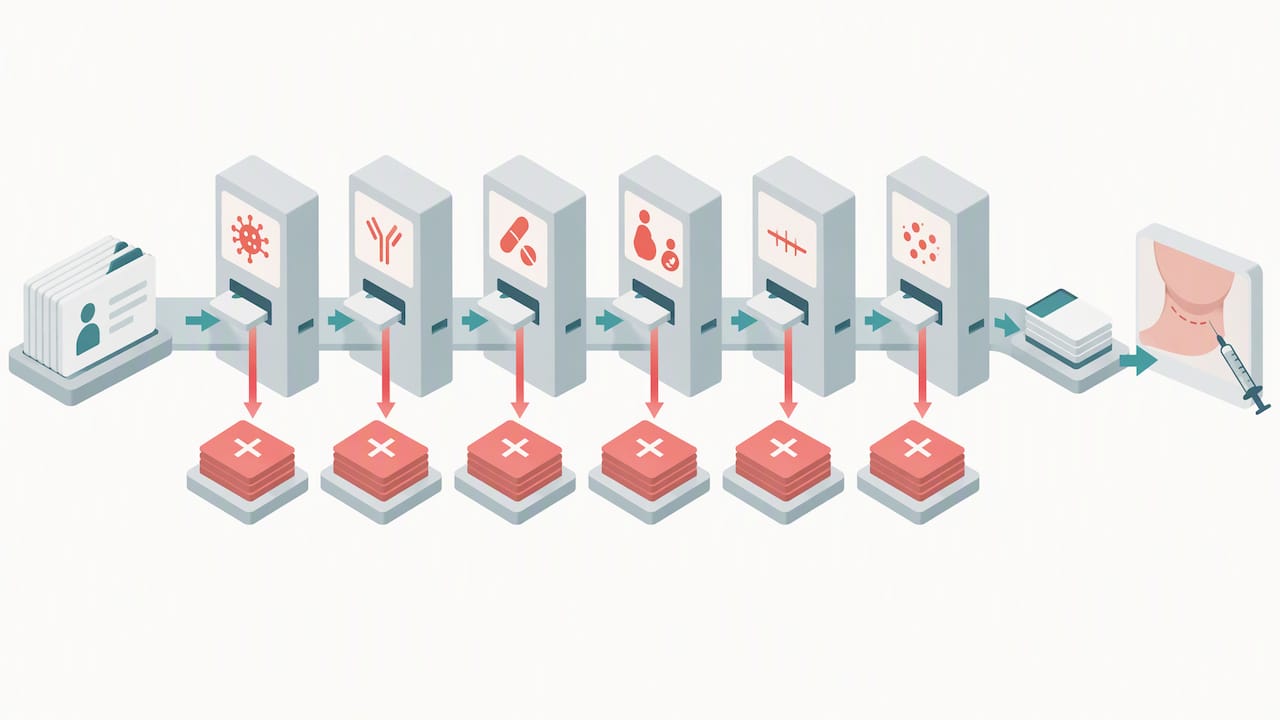
Certain factors raise the likelihood of a more pronounced or prolonged swelling response, and a thorough consultation should screen for them before any injections are given.
Current infection in or near the treatment area is a reason to delay treatment, since adding an inflammatory procedure on top of active infection increases risk of complications. A known allergy to any component of the injection solution is a contraindication. Blood clotting disorders or use of blood-thinning medication can increase bruising and swelling severity, so this should always be disclosed during consultation.
Pregnancy and breastfeeding are generally treated as reasons to postpone, since safety data in these groups is limited. Anyone with a history of poor wound healing, or skin conditions active in the treatment area, should flag this clearly, as healing time and swelling resolution may be affected.
Uncommon but serious adverse events, including skin necrosis, neuropraxia (temporary nerve weakness), and vascular injury, have been reported in postmarketing and case-series data. These remain rare, but they underline why treatment by a medically trained injector who understands facial anatomy, and who screens carefully for contraindications, matters more than price or convenience. Our facial anatomy for injectables guide covers why anatomical knowledge reduces risk during these procedures.
A thorough pre-treatment consultation should always cover your medical history, current medications, and any previous reactions to injectable treatments.
Does repeated swelling over several sessions cause lasting effects?
For most patients, swelling across a course of treatment sessions does not leave lasting changes to the skin or underlying tissue once the full course is complete. Each round of inflammation does its job, clearing a portion of treated fat cells, and then resolves, typically leaving no permanent mark once healing finishes.
What does tend to change across sessions is how pronounced the swelling feels each time. Because there’s progressively less fat volume to break down, the inflammatory response, and the resulting downtime, generally becomes milder with each subsequent treatment. This is a reassuring pattern rather than a concerning one.
Rare but documented longer-term tissue effects, such as localised skin irregularity or firmness that persists well beyond the expected window, have been reported in postmarketing data, though these remain uncommon. Anyone noticing firmness, lumps, or asymmetry that hasn’t softened months after their final session should raise this with their treating clinician rather than assuming it will resolve on its own.
Spacing sessions appropriately, generally around 28 days apart, allows each round of swelling to fully resolve before the next treatment begins, which appears to support more predictable healing overall. Rushing sessions closer together, without allowing tissue to recover, is not something trial protocols support and isn’t something we’d recommend in practice.
How does swelling compare with other double chin treatments?
Swelling severity and duration vary quite a bit depending on which approach you choose for reducing a double chin, and that’s worth weighing alongside cost and downtime preferences.
Fat dissolving injections using deoxycholic acid produce a median swelling duration of 9 to 10 days per session, spread across several sessions over a period of months. Surgical options such as liposuction or submental excision typically involve a more intense initial swelling and bruising phase, often with a longer single recovery period, but may need only one procedure rather than a course. Non-invasive energy-based treatments, such as cryolipolysis or radiofrequency-based fat reduction, generally cause milder swelling than injectable fat dissolving, though they may require more sessions to achieve a comparable result and the evidence base for chin-specific outcomes is less extensive.
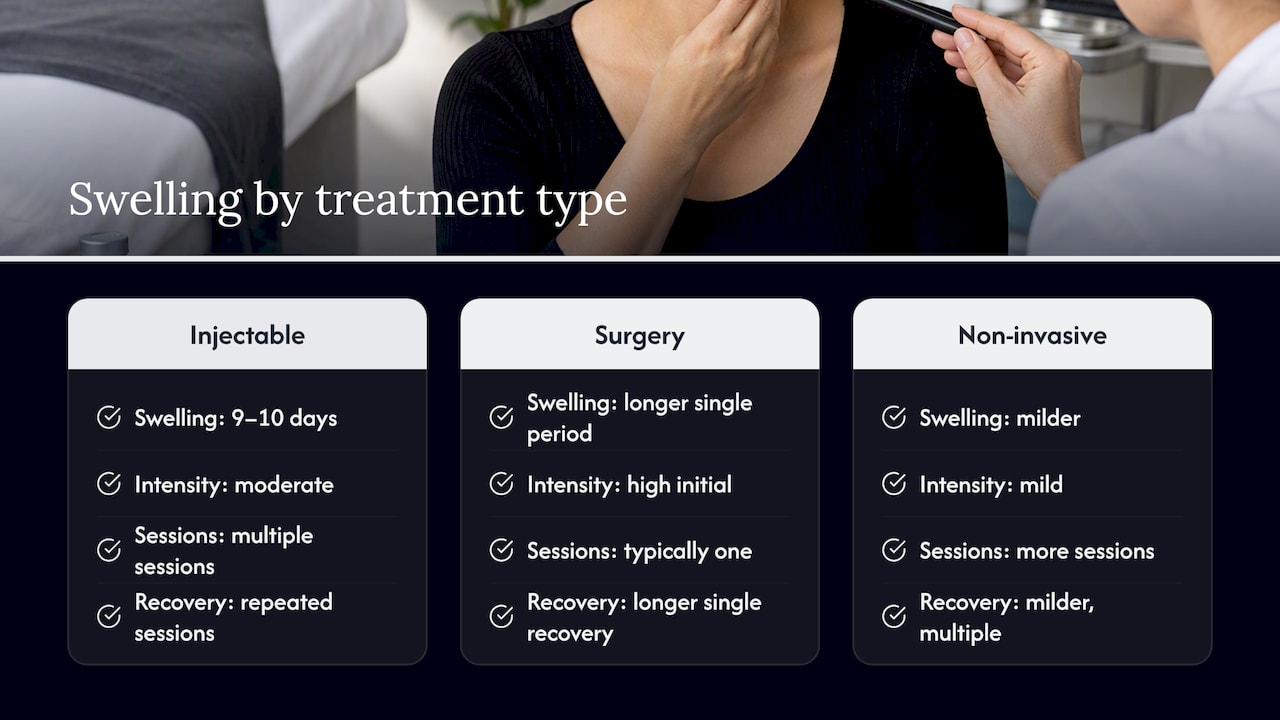
The right comparison depends on how much downtime you can tolerate, how many sessions you’re prepared to commit to, and how your own tissue responds. Readers comparing options in more depth may find our fat dissolving versus body sculpting comparison useful, and our double chin page covers the full range of non-surgical choices available.
Does the injection substance affect how much you’ll swell?
Not every fat dissolving injection uses the same active ingredient, and this affects both swelling intensity and how long it lasts. Deoxycholic acid, the ingredient behind Kybella and similar branded treatments, has the most robust trial data: a median swelling duration of 9 to 10 days compared with 3 days for placebo, with most injection-site events resolving within 28 days.
Other injectable fat-dissolving agents, sometimes marketed under different formulations, generally report similar patterns of transient swelling, bruising, and firmness, though the depth and consistency of published trial data varies considerably between products. This is one reason we’d encourage asking exactly which active ingredient is being used before booking anywhere, since the evidence behind deoxycholic acid is considerably more established than for some alternatives. Patients researching Kybella specifically may find patient-facing information on Kybella swelling timelines a useful general reference point, alongside guidance from your own treating clinician.
A clinician’s view on managing expectations
Transient swelling is a normal, expected part of how fat dissolving injections work, not a sign that something has gone wrong. If your recovery doesn’t match what you were told to expect, or you’re simply unsure, speak to the clinician who treated you rather than guessing from general advice online.
— Vishul
Book a consultation for fat dissolving treatment

We offer fat dissolving injections for the chin delivered by medically trained, registered professionals and supported by membership of a patient safety group. Every consultation includes a full medical history review, a discussion of realistic downtime and swelling expectations, and a bespoke plan for how many sessions suit your goals.
- A consultation covers your suitability for treatment, including any contraindications we need to screen for.
- Follow-up is arranged in advance, whether that’s a virtual check-in or an in-person review during your swelling peak.
- Pricing and full details sit on our fat dissolving treatment page, alongside our complete price list.
If you’re ready to discuss a treatment plan tailored to your chin and your timeline, book a consultation with our team today.
This article is general information, not a substitute for advice from a qualified doctor. Consult a qualified healthcare professional about your own circumstances before acting on anything here.
FAQ
How long does it take for swelling to go down after a Kybella injection?
Swelling from deoxycholic acid injections, the active ingredient in Kybella, typically peaks within 24 to 72 hours and has a median duration of 9 to 10 days in clinical trials. Most patients see continued improvement over the following 2 to 4 weeks as residual firmness softens.
Is it normal to have a swollen chin after fat dissolving injections?
Yes, swelling is one of the most common and expected effects of fat dissolving injections, reflecting the body’s natural inflammatory response as it clears treated fat cells. It’s generally considered part of normal healing rather than a complication, provided it follows the typical pattern of peaking early and gradually easing.
Why does my double chin look swollen?
Swelling occurs because deoxycholic acid disrupts fat cell membranes, triggering a controlled inflammatory response that causes temporary puffiness, firmness, and sometimes bruising. This usually peaks within the first few days and settles over the following one to two weeks as the body clears the affected cells.
How long do the results of fat dissolving injections on the chin typically last?
Once fat cells are broken down and cleared by the body, the reduction in submental fullness is generally considered long-lasting, since those specific cells don’t regenerate. Most patients achieve their full result after 2 to 4 treatment sessions, spaced roughly a month apart, with results becoming apparent as swelling from each session resolves.
Sources
- Reduction of unwanted submental fat with ATX‑101 (deoxycholic acid) — British Journal of Dermatology / PubMed PMC
- REFINE trials with ATX‑101 — PubMed
- Uncommon adverse effects of deoxycholic acid injection — PubMed
- Cellulitis — NHS