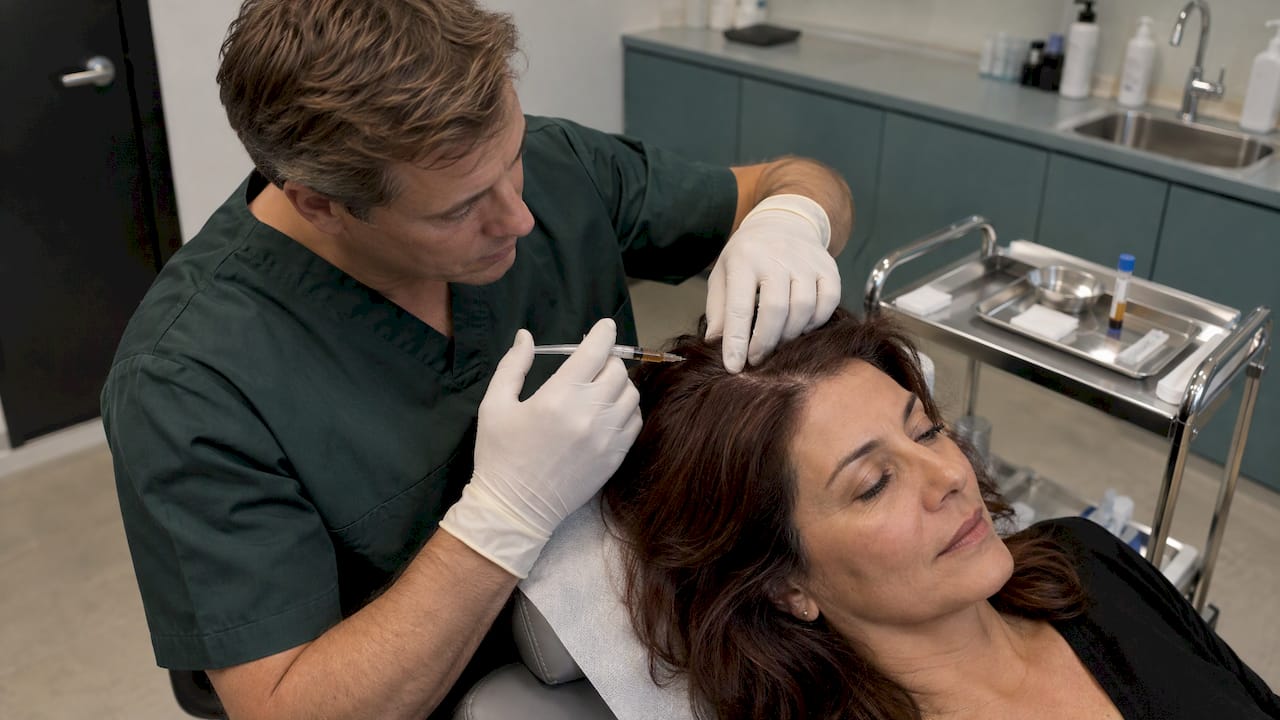
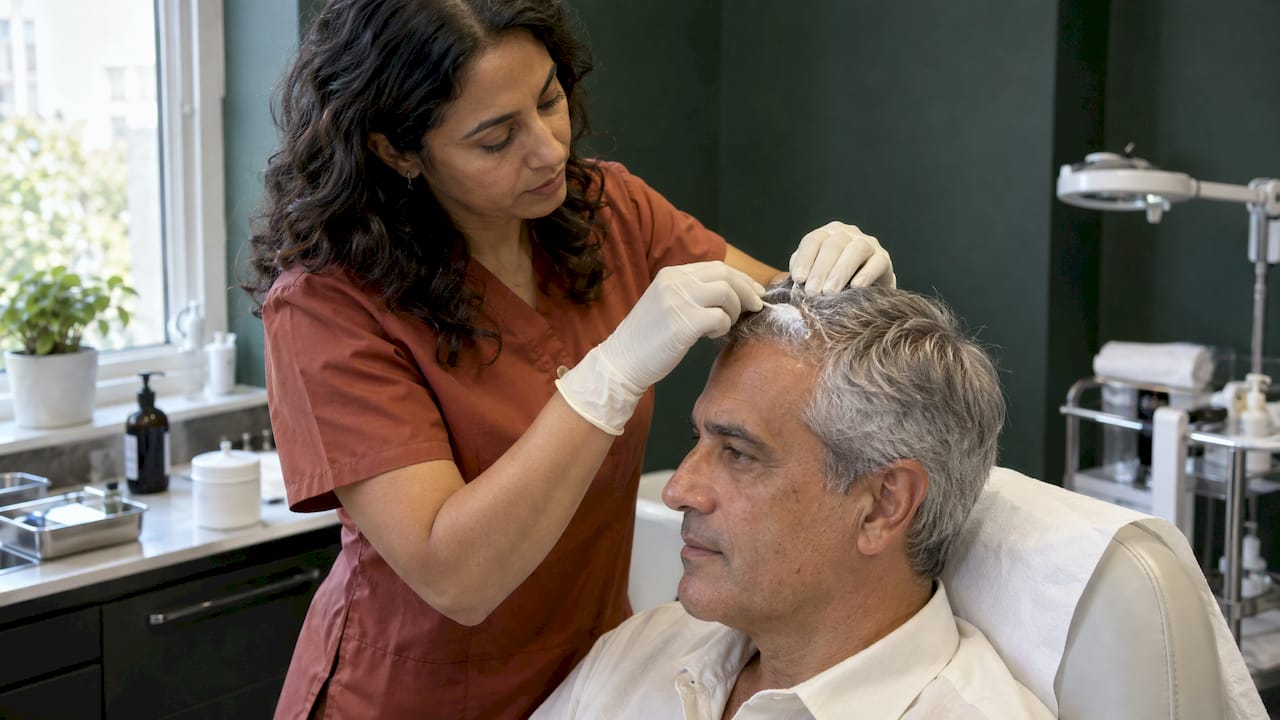

PRP for hair is a series of small injections across the scalp, so yes, you will feel it. Most people describe a mix of pinpricks, pressure and a warm, tight ache that is uncomfortable rather than unbearable, and that settles within hours. How much you feel depends on your scalp, the area treated, how anxious you are and the comfort measures used on the day. Below we explain what to expect before, during and after, what the research shows about reducing discomfort, and how to prepare.
TL;DR
- Expect pinpricks and pressure during the injections. Research on scalp PRP shows that discomfort is common even with local anaesthetic, so planning for comfort is part of good treatment.
- Soreness afterwards is usually mild and short. In one study, mild pain lasted up to 2 hours in a minority of patients.
- Numbing cream alone does not always give full relief. Cooling, nerve blocks and calm technique can all help, and the choice is made with your practitioner.
- Anxiety, age and a large treatment area can raise pain scores, so tell your practitioner how you feel.
- At The Aesthetics Room, PRP for hair is £450 per session, and a consultation is the place to discuss comfort before you commit.
Table of Contents
- What PRP hair treatment feels like
- What the research says about pain levels
- How discomfort can be reduced
- What to expect afterwards
- How to prepare for a more comfortable session
- Is the discomfort worth it?
- Our perspective
- PRP for hair at The Aesthetics Room
- FAQ
- Sources
What PRP hair treatment feels like
PRP stands for platelet-rich plasma. A small sample of your own blood is taken, spun in a centrifuge to concentrate the platelets, and the resulting plasma is injected into the scalp where hair is thinning. The aim is to support the follicles and the quality of the hair they grow.
The blood draw feels like any routine blood test. The scalp injections are the part people ask about. Typical descriptions include:
- Sharp pinpricks as the needle enters the skin, repeated across the treated area.
- Pressure or a burning sensation as the plasma is delivered, often strongest in bony areas such as the temples, the hairline and the crown, where there is little tissue between skin and bone.
- A tight, warm ache that can build as more areas are treated.
These are descriptions of common experience, not a promise. Pain is personal, and two people having the same session can rate it very differently.
What the research says about pain levels
The honest picture from clinical studies is that scalp PRP is felt, and that comfort measures matter.
A 2024 study in Current Medical Issues tested a standard numbing cream (20 g applied to 200 cm² for one hour) before scalp PRP injections. Patients still reported moderate to severe pain, with an average end-of-procedure score of about 6.28 out of 10, and discomfort lasted around 90 minutes afterwards. The same study found that pain scores were higher in younger and more anxious patients, and that higher pain straight after the procedure predicted higher pain at 24 hours. Previous PRP sessions did not significantly change how patients rated pain, so a second session is not automatically easier or harder.
A smaller 2020 study of 24 patients with androgenetic alopecia reported that every patient felt at least mild pain during injections despite local anaesthesia. That is useful to know: feeling something does not mean something has gone wrong.
The point is not that PRP is too painful to be worthwhile. It is that the numbing method is a real decision, and a clinic that discusses it with you before the day is doing its job properly.
How discomfort can be reduced
Research has compared several approaches. None is universal, and the right one depends on the area, your sensitivity and clinical judgement.
| Approach | What the research found |
|---|---|
| Topical numbing cream | Helpful for the skin surface, but one 2024 study found it gave inadequate relief on its own for scalp injections |
| Ring block (local anaesthetic injected around the scalp) | In a 2024 study of 60 patients across four sessions, ring block had the highest patient acceptance and lowest pain after the procedure |
| Vibration | In the same study, vibration anaesthesia had the highest average pain during and after the procedure |
| Topical liquid nitrogen | A 2022 study of 64 patients found a significant improvement in pain tolerance versus saline, with a median score of 4 against 5 |
| Frozen scalp cap (cryoanaesthesia) | A cap kept below 10°C for 30 minutes before injection, with the hair dampened first so the scalp cools faster |
The authors of the 2024 ring block study also note that the type of anaesthesia is usually chosen by preference rather than a fixed protocol, and that better comfort improves how well patients keep to a course that involves several sittings. In other words, comfort is not a luxury: it helps you finish the course.
The Current Medical Issues authors add that inflammation from activated platelets contributes to pain, which is why they suggest thinking about the period after the procedure too, not only the minutes before it. For larger areas they point towards nerve blocks, ice-assist devices and planned pain relief afterwards. Which of these is suitable for you is a decision for a medically trained practitioner after a conversation about your health, medicines and allergies.
What to expect afterwards
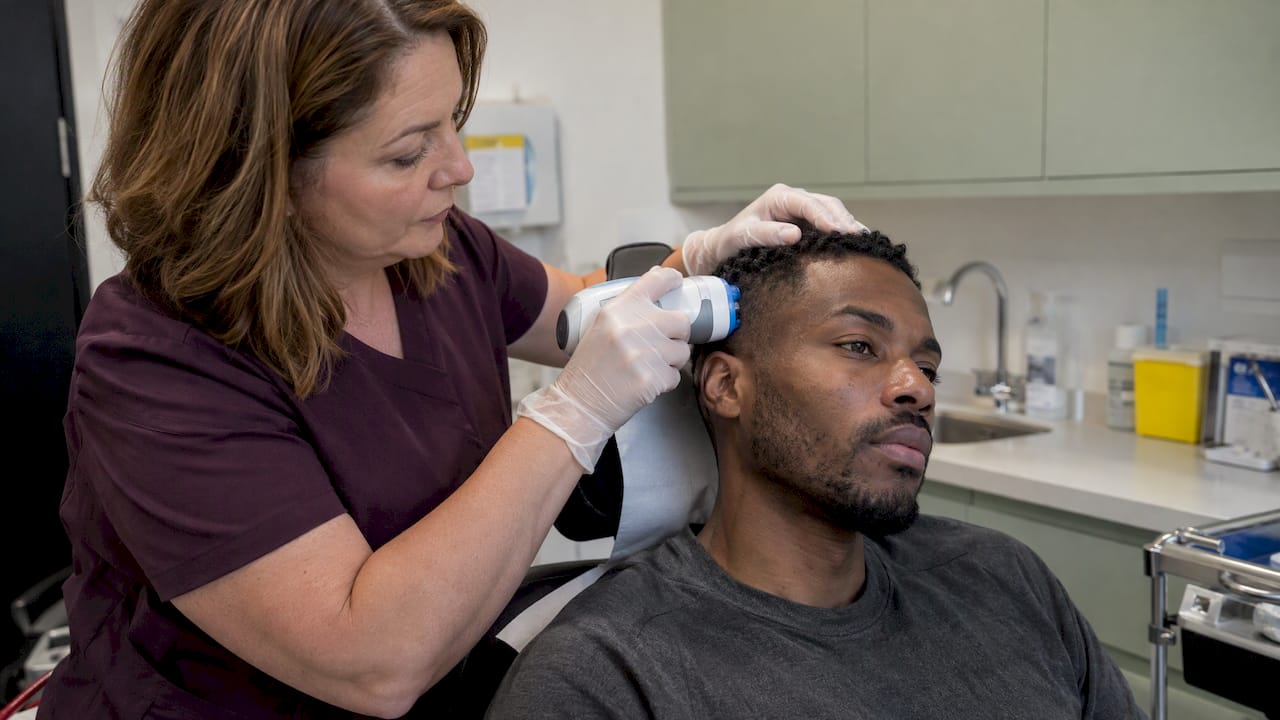
Most soreness is local and short-lived.
- The first hours: a tight, tender or sore scalp. In the 2020 study, 29.17% of patients had mild pain after the procedure, lasting up to 2 hours.
- The first day: a 2024 systematic review and meta-analysis of 21 studies and 628 participants found that the commonly reported effects were headache, scalp tightness, swelling, redness, bleeding at the injection site and tingling, all mild and settling within 24 hours. That review found no significant difference in pain or discomfort between PRP patients and controls.
- Up to three days: a 2026 narrative review describes most adverse events as mild, temporary and confined to the treated area, resolving within 24 to 72 hours without intervention.
Swelling can sometimes appear around the forehead if the hairline is treated. If that happens, our guide on reducing post-treatment swelling safely covers sensible steps.
When to get medical advice
Soreness that fades is expected. Soreness that does not is a reason to call. Northwestern Medicine advises contacting your healthcare provider if you develop a fever of 100.4°F (38°C) or higher, symptoms that do not improve or get worse, or new symptoms. If you have had treatment with us, contact the clinic that treated you. If you feel seriously unwell, contact your GP or NHS 111.
How to prepare for a more comfortable session
You cannot remove every sensation, but preparation changes how the session feels.
- Talk about pain at the consultation. Say if needles worry you or if you have found injections painful before. Younger and more anxious patients scored higher for pain in the research, so being open helps your practitioner plan.
- Tell your practitioner about your health. Medicines, allergies, blood conditions and previous reactions to local anaesthetic all affect which comfort options are suitable.
- Eat beforehand and drink water. A blood draw is part of the appointment, and arriving hungry or dehydrated makes any needle procedure feel worse. This is general good practice rather than a clinical rule.
- Allow time. Rushing raises tension. Plan a quiet hour afterwards, with no tight hat or hairstyle that pulls on the scalp.
- Ask what the plan is for afterwards. Know in advance what to expect, how long soreness should last and whom to call.
If you want to understand what a first appointment involves, our guide to London aesthetic consultations explains the process.
Is the discomfort worth it?
That depends on what you want from the treatment, and it is a fair question. PRP for hair is usually delivered as a course of sessions, so the short-term discomfort repeats. The research on comfort exists because patients complete a course more reliably when sessions are tolerable.
A few things shape the decision:
- Reason for thinning. Pattern thinning, thinning after childbirth and thinning at the temples all have different causes and timelines. Our pages on postpartum hair loss and PRP and male hair thinning at the temples explain how each is approached.
- Area treated. A smaller area means fewer injections and, generally, less cumulative discomfort. The research notes that large treatment areas are where stronger pain control matters most.
- Your own tolerance. If you cope well with a blood test and a dental injection, you are likely to cope with scalp PRP. If not, say so early and plan accordingly.
As a sense of scale, PRP is a medical treatment that uses your own blood, and research reviews describe its side effects as mild and short-lived. The 2024 meta-analysis also notes that its minimally invasive nature makes it a preferred option for many patients compared with treatments such as minoxidil and finasteride, which can carry more severe side effects.
Our perspective
We never treat discomfort as something a patient should simply put up with. A PRP course for hair involves several sittings, and a session you can settle into is a session you will return for.
That is why we begin with a conversation, not a needle. Our practitioners are medically trained, and the clinic is CQC registered and a member of the ACE Group, which exists to support patient safety. We ask about your health, your history with injections and what is worrying you, then build a plan around you. Bespoke planning is how we approach every treatment, and PRP for hair is no exception.
Our advice is to book a consultation before the treatment itself. You can ask every question about sensation, aftercare and timing in person or virtually, then decide when you are ready. We would rather you arrive informed and relaxed than surprised.
Vishul
PRP for hair at The Aesthetics Room
We offer PRP for hair at £450 per session, and PRP for facial hair at £258. If you are exploring other hair support, we also offer Vitamin Hair Therapy at £218. These prices are published on our price list.
You can see us in Knightsbridge, Harley Street or Mayfair, or begin with a virtual consultation. Tell us about your hair, your concerns about pain and what you hope to achieve, and we will walk you through the options. Book your consultation with The Aesthetics Room.
FAQ
Is PRP hair treatment painful?
It is uncomfortable for most people and painful for some. Studies of scalp PRP report that patients feel at least mild pain during injections even with local anaesthetic, and one study using only numbing cream recorded moderate to severe scores. The discomfort is short, and comfort options exist, so raise it at your consultation.
How long does soreness last after PRP for hair?
Usually hours to a day or so. In one study, mild pain lasted up to 2 hours, and a large meta-analysis found common reactions settling within 24 hours. A narrative review describes most effects resolving within 24 to 72 hours. Contact your practitioner if soreness worsens or you develop a fever.
Does numbing cream make PRP painless?
Not reliably. A 2024 study found that numbing cream alone gave inadequate relief for scalp injections. Other approaches, including ring blocks and cooling methods, have been studied, and your practitioner will advise which suits you and your health.
Which areas of the scalp hurt most?
Bony areas such as the temples, hairline and crown tend to feel sharper because there is little tissue beneath the skin. This is a common description rather than a measured finding, so it is worth asking your practitioner which areas they expect to be most sensitive for you.
Does PRP hurt less the second time?
Not necessarily. In the 2024 Current Medical Issues study, previous PRP sessions did not significantly change pain ratings. Anxiety did make a difference, so knowing what to expect and having a clear comfort plan can still help.
Sources
- Effect of Topical Anesthetics on Pain Perception during PRP, Current Medical Issues (2024)
- Comparison of different methods of local anesthesia for PRP, Asian Journal of Medical Sciences (2024)
- Effect of Topical Liquid Nitrogen on Pain Reduction during PRP, PAFMJ (2022)
- Cryo-Cap Anesthesia to Minimize Scalp Discomfort during PRP (2022)
- The Clinical Efficacy and Safety of Autologous Activated PRP (2020)
- Effectiveness of platelet-rich plasma in treating female hair loss, Skin Research and Technology (2024)
- Effectiveness of platelet-rich plasma, PubMed Central version (2024)
- Therapeutic Efficacy and Safety of Platelet-Rich Plasma, SCIRP (2026)
- Platelet-Rich Plasma for Hair Loss, Northwestern Medicine