
TL;DR:
- Cosmeceuticals are cosmetic products with biologically active ingredients that produce measurable skin benefits beyond surface effects. Although unregulated as a distinct category, evidence supports their effectiveness when used properly under professional guidance to target aging, acne, and pigmentation. Selecting ingredients like retinoids, hyaluronic acid, and vitamin C, along with personalized advice, enhances outcomes and ensures safe, long-term skin health.
Skincare shelves are crowded with products that promise pharmaceutical-level results in a moisturiser bottle. If you have ever wondered what is cosmeceuticals and why they seem to sit somewhere between your daily face cream and a prescription treatment, you are not alone. Cosmeceuticals occupy a genuinely fascinating middle ground. They are cosmetic products formulated with biologically active ingredients designed to exert a measurable effect on skin biology, not just its surface appearance. This article cuts through the confusion, explaining how they work, what the science actually supports, and how to choose wisely.
Table of Contents
- Key takeaways
- What is cosmeceuticals: definition and origins
- Cosmeceuticals vs pharmaceuticals: regulation and claims
- Evidence-based benefits of cosmeceuticals
- How to choose and use cosmeceuticals safely
- Market trends shaping cosmeceuticals
- My honest view on cosmeceuticals
- Restore your skin with expert support
- FAQ
Key takeaways
| Point | Details |
|---|---|
| Cosmeceuticals defined | They are cosmetic products containing bioactive ingredients that influence skin function beyond surface-level effects. |
| No formal regulation | Neither the FDA nor the EU recognise cosmeceuticals as a legal category; they are classified as cosmetics or drugs by intended use. |
| Evidence-backed results | Retinoids can improve skin elasticity by 30% and hyaluronic acid may reduce fine lines by up to 40% with consistent use. |
| Professional guidance matters | Ingredient concentration and formulation quality vary widely, so expert advice is critical for safe, effective use. |
| Market is expanding fast | The global cosmeceuticals market is projected to reach US$72.7 billion in 2026, reflecting strong consumer demand. |
What is cosmeceuticals: definition and origins
The cosmeceuticals definition starts with a single pivotal moment. The term was coined in 1984 by Dr Albert Kligman, a dermatologist at the University of Pennsylvania, to describe products that behave unlike ordinary cosmetics. Dr Kligman recognised that certain formulations could penetrate the skin deeply enough to produce biological change, yet were not potent enough to require a prescription. That distinction created an entirely new product category.
At their core, cosmeceuticals are cosmetics with biologically active ingredients that deliver pharmaceutical-like benefits. What separates them from a standard moisturiser is ingredient quality, concentration, and the ability to interact with skin cells beneath the stratum corneum, the outermost layer of skin. A standard cosmetic sits on the surface. A cosmeceutical works deeper.
The most commonly used cosmeceutical ingredients include:
- Retinoids (including retinol and retinaldehyde): stimulate collagen production and accelerate cell turnover
- Peptides: short chains of amino acids that signal skin cells to repair and rebuild
- Antioxidants (vitamin C, vitamin E, niacinamide): neutralise free radicals and brighten skin tone
- Hyaluronic acid: binds water molecules in the dermis to plump and hydrate
- Alpha and beta hydroxy acids (AHAs and BHAs): exfoliate dead skin cells and improve texture
- Salicylic acid: penetrates pores to reduce oil and fight acne
Each of these ingredients has peer-reviewed research behind it. That is not something you can say about most high-street beauty products.
Pro Tip: When reading product labels, look for the active ingredient listed near the top of the INCI list. The closer it is to the top, the higher the concentration, and generally, the more effective the product will be.
Cosmeceuticals vs pharmaceuticals: regulation and claims
This is where it gets important for anyone spending money on these products. The FDA and EU do not recognise cosmeceuticals as a formal legal category. In law, a product is either a cosmetic or a drug. There is no third option.
What this means in practice is that cosmeceutical products are marketed and sold as cosmetics, yet make claims that gesture towards therapeutic effects. The classification can shift the moment marketing language suggests a structural or physiological change. A moisturiser that claims to “hydrate skin” is a cosmetic. The same moisturiser claiming to “repair the epidermal barrier” risks being classified as a drug under regulatory scrutiny.
| Feature | Cosmetic | Cosmeceutical | Pharmaceutical |
|---|---|---|---|
| Legal classification | Cosmetic | Cosmetic (in practice) | Drug |
| Regulatory approval needed | No | No | Yes |
| Claims permitted | Appearance only | Appearance with biological hints | Therapeutic/medical |
| Prescription required | No | No | Sometimes |
| Ingredient transparency | Variable | Generally higher | Strict |
“The term ‘medical-grade’ is marketing language, not a regulatory designation. No authority certifies a cosmeceutical as medical-grade. Dermatologists stress patient education precisely because the absence of regulation means product quality varies enormously.” — Cosmeceuticals in hyperpigmentary disorders
This does not mean cosmeceuticals are ineffective. It means you need to evaluate them critically rather than taking label claims at face value. Understanding the gap between marketing and regulation protects your skin and your wallet.
Evidence-based benefits of cosmeceuticals
So, what does the science actually show? Quite a lot, when you look at the right ingredients at the right concentrations.

The benefits of cosmeceuticals are most clearly documented in these areas:
Anti-ageing and skin elasticity. Retinoid-based products have among the strongest evidence of any skincare ingredient. Consistent use can improve skin elasticity by 30% over three months. Hyaluronic acid formulations show measurable results too, with studies demonstrating fine line reduction of up to 40%. If you are researching how to reduce fine lines, these two ingredients are your strongest starting point.
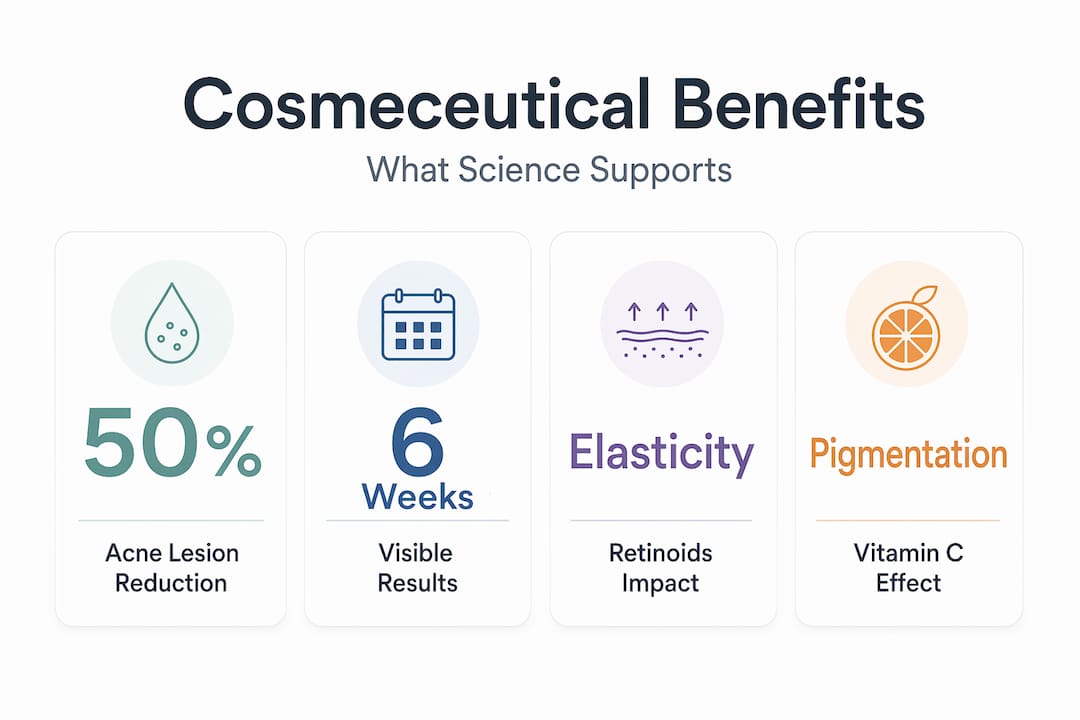
Acne management. Salicylic acid reduces acne lesions by approximately 50% within six weeks of consistent use. That is a genuinely significant result for a non-prescription product.
Pigmentation and skin tone. Vitamin C serums have been shown to improve skin tone and reduce dark spots noticeably. Around 20% of users see measurable improvement in pigmentation with regular use. Not everyone responds identically, which is why personalisation matters.
There are limitations worth acknowledging. Long-term, consistent use is required to see results, and the quality of supporting studies varies considerably between products. No cosmeceutical works overnight. The products that claim otherwise are almost always overstating their evidence base.
The table below summarises the strongest evidence by ingredient:
| Ingredient | Primary benefit | Typical timeframe |
|---|---|---|
| Retinoids | Improved elasticity, reduced fine lines | 8 to 12 weeks |
| Hyaluronic acid | Hydration, reduced surface lines | 4 to 8 weeks |
| Salicylic acid | Reduced acne lesions | 4 to 6 weeks |
| Vitamin C | Improved tone, reduced dark spots | 8 to 12 weeks |
| Peptides | Collagen support, firming | 12 weeks or more |
How to choose and use cosmeceuticals safely
The gap between a cosmeceutical that transforms your skin and one that does nothing comes down largely to how you select and use it. The breadth of products available makes this both exciting and confusing.
Start with professional advice. Patient education and professional guidance are the most consistent recommendations in dermatological literature on cosmeceuticals. A dermatologist or trained aesthetics practitioner can assess your specific skin type, concerns, and existing routine before recommending products. Self-prescribing high-concentration actives without guidance is how people end up with irritation, barrier damage, or worsened pigmentation.
Practical principles to follow when using cosmeceutical products:
- Introduce one new active at a time. Adding retinol, vitamin C, and an AHA simultaneously makes it impossible to identify what is working or causing a reaction.
- Understand concentrations. A 0.025% retinol product and a 1% retinol product are not interchangeable. Start low and build gradually.
- Read the full INCI list. Ingredients appear in descending order of concentration. An active buried at the bottom may be present in amounts too small to have any effect.
- Pair with appropriate support. Many actives increase sun sensitivity. Daily SPF 30 or higher is non-negotiable alongside retinoids and vitamin C.
- Give products time. Skin cell turnover takes approximately 28 days. You need at least two full cycles, ideally three or four, before drawing conclusions about a product’s efficacy.
Pro Tip: When introducing retinol for the first time, use the “sandwich method”: apply a light moisturiser, then your retinol, then another layer of moisturiser. This reduces the likelihood of irritation while still allowing the active ingredient to penetrate.
For personalised guidance on selecting active skincare, speaking with a specialist before committing to a routine makes a measurable difference to outcomes.
Market trends shaping cosmeceuticals
The cosmeceuticals sector is not standing still. The global market is projected to reach US$72.7 billion in 2026 and continue growing at a 4.1% compound annual growth rate through 2033. That kind of expansion reflects genuine consumer appetite, not just marketing spend.
Several clear trends are shaping where this category is heading:
- Organic and natural formulations. 74% of consumers in 2025 rated organic ingredient content as important when choosing skincare. Brands responding to this preference are expanding plant-derived active ingredient ranges significantly.
- AI-powered personalisation. Several skincare platforms now use artificial intelligence to analyse skin images and recommend specific formulations. This is narrowing the gap between professional advice and consumer self-selection.
- Advanced ingredient combinations. Formulation science is producing more sophisticated delivery systems, including encapsulated retinol that releases gradually to reduce irritation and liposomal vitamin C that penetrates more deeply than standard ascorbic acid.
- Informed consumers. Buyers are reading ingredient lists, consulting dermatologists, and demanding clinical evidence. This shift is pushing brands towards greater transparency and scientific rigour.
The cumulative effect is a market where product quality is improving and consumers are becoming more discerning. That is genuinely good news for anyone trying to make sense of what is cosmeceutical products and which ones are worth investing in.
My honest view on cosmeceuticals
I have worked alongside clients navigating the cosmeceuticals space for years, and there is one pattern I see consistently. People spend significant money on products they believe are medically validated, without realising that the term “medical-grade” carries no regulatory weight whatsoever.
In my experience, the best outcomes happen when cosmeceuticals are used as one part of a broader, professionally guided skincare strategy rather than a standalone solution. I have seen retinoids genuinely transform skin texture when used correctly and consistently. I have also seen clients arrive with compromised skin barriers from layering too many actives without guidance. The product itself is rarely the problem. The approach is.
What I would encourage anyone to do is resist the pull of trends and focus on ingredients with genuine evidence behind them: retinoids, hyaluronic acid, vitamin C, and salicylic acid. These are not exciting or new, but they are reliable. Selecting appropriate dermal treatments in combination with a well-constructed cosmeceutical routine consistently outperforms either approach alone.
Skin health is cumulative. The choices you make today compound over months and years. Prioritise science over marketing, and professional input over packaging.
— Vishul
Restore your skin with expert support

At Theaestheticsroom, we understand that great skin rarely comes from one product alone. Our practitioners at our Knightsbridge and Harley Street clinics work with clients to build personalised treatment plans that combine the best of professional aesthetic care with informed cosmeceutical guidance. Whether you are exploring Botox treatments to complement your skincare routine, considering dermal fillers for deeper volume restoration, or simply want expert advice on which skin rejuvenation approach suits your skin goals, we are here to help. Book a consultation online or contact us today to take the next step towards healthier, more confident skin.
FAQ
What is the cosmeceuticals definition?
Cosmeceuticals are cosmetic products formulated with biologically active ingredients that exert measurable effects on skin biology. The term was coined by Dr Albert Kligman in 1984 to describe this hybrid category.
Are cosmeceuticals regulated differently to pharmaceuticals?
No. Neither the FDA nor the EU formally recognise cosmeceuticals as a category. They are legally classified as cosmetics, though their claims and ingredient concentrations are often closer to those of pharmaceutical products.
How do cosmeceuticals work on skin?
Cosmeceutical ingredients such as retinoids, peptides, and hyaluronic acid penetrate below the skin’s surface to interact with cells, stimulate collagen production, or bind moisture at the dermal level, producing results beyond what surface-only cosmetics achieve.
Are cosmeceuticals safe to use?
Most cosmeceuticals are safe when used correctly. However, professional guidance is strongly recommended because ingredient concentrations vary widely and incorrect use can cause irritation or barrier damage.
What are the best cosmeceutical ingredients for ageing skin?
Retinoids and hyaluronic acid have the strongest clinical evidence for anti-ageing results. Retinoids can improve elasticity by 30% and hyaluronic acid formulations may reduce fine line appearance by up to 40% with consistent use.
Recommended
- Medical-grade skincare explained: unlock transformative results – The Aesthetics Room
- What is personalised skincare? A 2026 guide for London – The Aesthetics Room
- Clinical Facials: Enhancing Skin Safely in London – The Aesthetics Room
- Glowing skin guide: achieve radiance with expert treatments – The Aesthetics Room