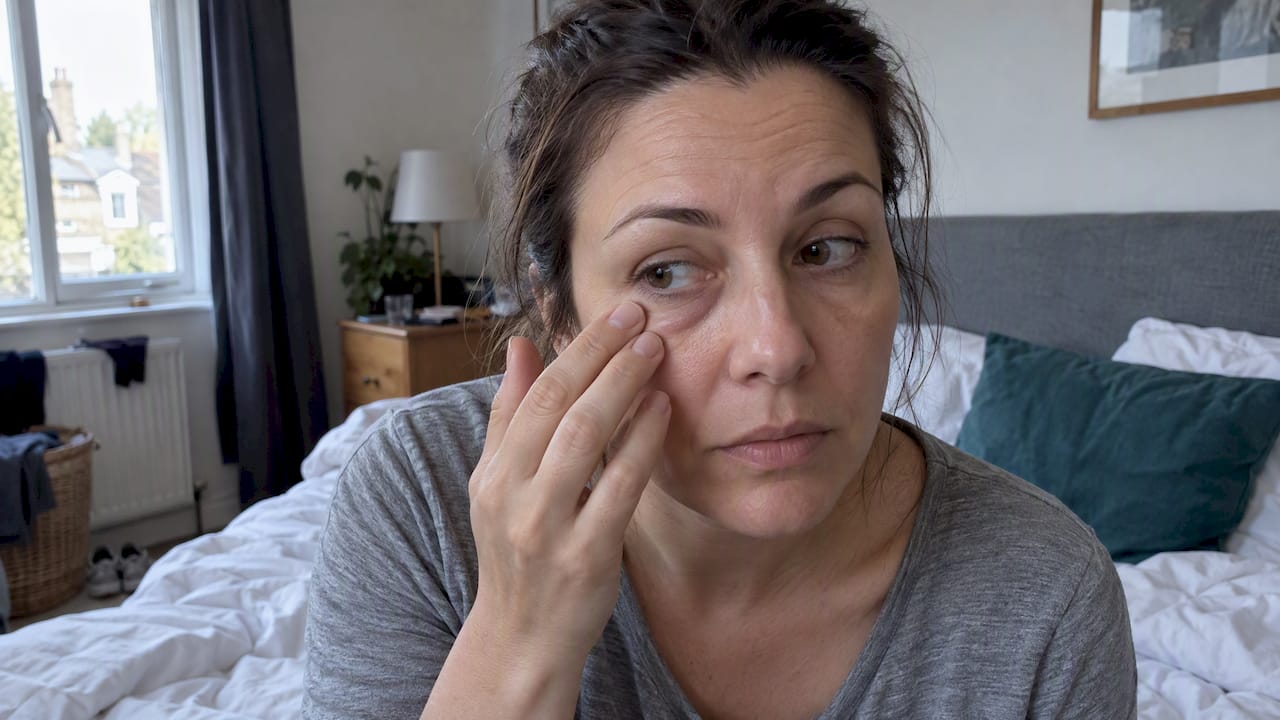
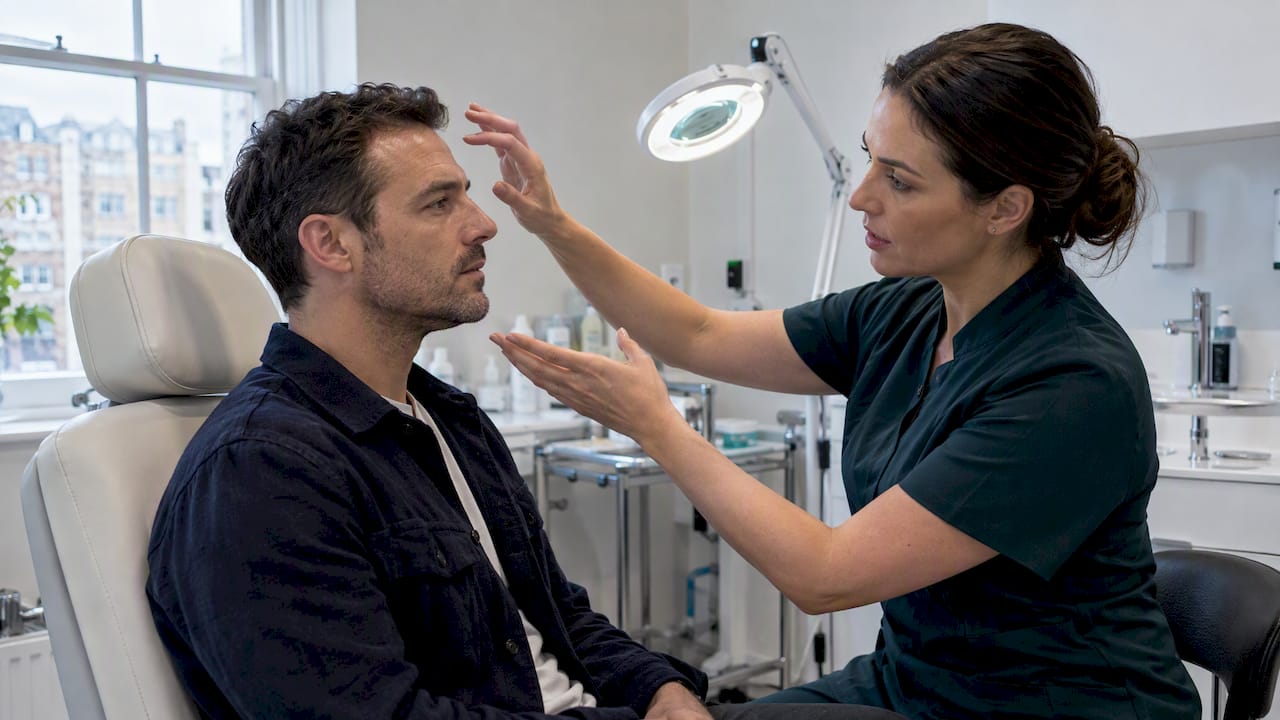

Most men get results from three treatment groups: injectables (botulinum toxin and dermal fillers) for lines and lost volume, collagen-stimulating procedures (microneedling, PRP and biostimulators) for texture and skin quality, and laser or energy devices for pigment and resurfacing. Each targets a different problem: dynamic wrinkles, structural volume, or surface texture. Choose a regulated, medically trained provider before anything else.
TL;DR:
- Men typically need repeat botulinum toxin treatments every three to four months to maintain wrinkle reduction results.
- Dermal fillers last roughly six to eighteen months, while biostimulators require several weeks to show gradual skin improvements.
- Combining procedures, such as injectables with laser or microneedling, often extends treatment timelines and increases overall costs.
- Sun protection and gentle skincare habits significantly prolong the effects of all non-surgical treatments and improve long-term skin quality.
- Choosing a regulated, experienced provider who explains treatment scope and safety measures is essential to avoid risks from illicit or poorly performed procedures.
Table of Contents
- A quick map of non-surgical treatment categories
- Botulinum toxin: what it fixes and how long it lasts
- Dermal fillers and biostimulators for volume and contour
- Microneedling and PRP for texture and collagen
- Laser and energy devices for pigment, texture and tightening
- Topicals and peptides: supporting, not replacing, procedures
- Choosing a provider and avoiding risky treatments
- The Aesthetics Room: credentials and how a consultation works
- Pre- and post-treatment care tailored for men
- Lifestyle factors behind male skin ageing
- The psychological and social upside of looking after your skin
- How male skin differs and why that changes treatment choice
- What treatment actually costs over time
- What the research actually supports, and what gets oversold
- Book a consultation with The Aesthetics Room
- Sources
- FAQ
A quick map of non-surgical treatment categories
Men typically arrive at a clinic with one of four concerns: deep expression lines across the forehead or around the eyes, a jawline that has lost definition, rough or uneven texture, or patches of pigment from years of sun exposure. The treatment categories below map fairly cleanly onto those complaints, though many men end up combining two or three for a fuller result.
- Injectables (botulinum toxin): relax the muscles behind dynamic wrinkles such as frown lines and crow’s feet.
- Dermal fillers and biostimulators: restore lost volume and improve skin quality in the jaw, cheeks and under-eye area.
- Microneedling and PRP: stimulate collagen and elastin to improve texture, scarring and fine lines.
- Lasers and energy devices: target pigment, rough texture and mild skin laxity.
- Peels: lift dull, congested skin and even out tone.
- Topicals and peptides: maintain and extend results between procedures.
Combining treatments is common because each one solves a narrow problem. A man treating both forehead lines and sun damage will often need an injectable alongside a laser session, which extends the overall timeline and the total cost. For a broader look at how these pair together for men specifically, see our guide to facial treatments for men.
Botulinum toxin: what it fixes and how long it lasts
Botulinum toxin type A, the active ingredient in Botox-type treatments, works by temporarily relaxing the muscles that cause dynamic wrinkles, the lines that appear when you frown, raise your eyebrows or squint. BAAPS patient guidance notes that it is primarily effective for expression lines caused by muscle contraction rather than lines caused by sun damage or lost volume, and it does not correct sagging caused by gravity.
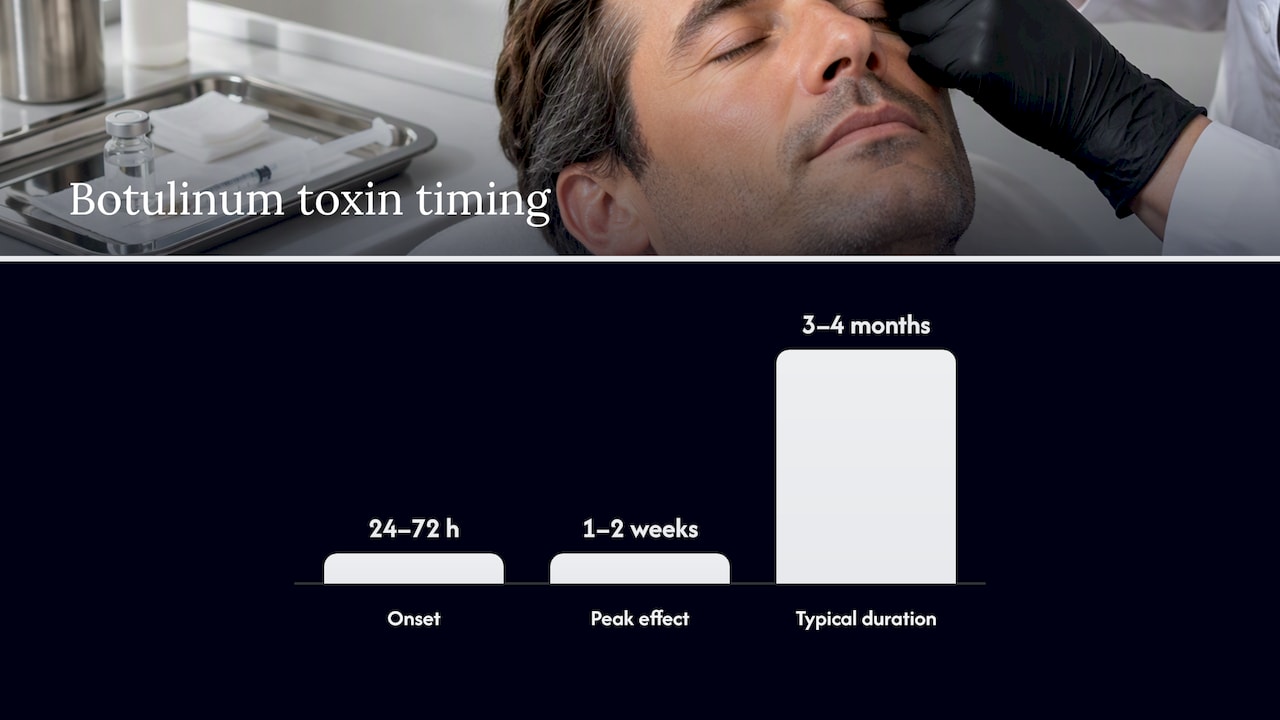
Effects typically begin within 24 to 72 hours, peak at one to two weeks, and last around three to four months according to BAAPS. A systematic review on PubMed confirms measurable wrinkle reduction versus placebo at four weeks, alongside a higher chance of some adverse effects, including eyelid drooping.
Before booking, ask:
- Who is injecting, and are they a regulated prescriber?
- Is the product licensed, and can the clinic show packaging and batch details?
- What follow-up or touch-up schedule should you expect?
Statistic to weigh up: botulinum toxin’s effect typically lasts three to four months, meaning most men need repeat sessions roughly three to four times a year to maintain results.
Overuse or poor technique can lead to a flattened, overworked look, so dose and frequency matter as much as the product itself. For men curious about how injection patterns differ by area, our Botox tutorial for men breaks down placement for the forehead, corrugators and crow’s feet.
Dermal fillers and biostimulators for volume and contour
Where botulinum toxin relaxes muscle, dermal fillers add structure. Hyaluronic acid fillers restore volume lost with age, most commonly in the jawline, cheeks, and under the eyes, and can sharpen a jaw that has started to soften. For men wanting a stronger jawline without surgery, filler placed along the mandible gives an immediate, visible change.
Biostimulators work differently. Profhilo and Sunekos do not add bulk; instead, they stimulate the skin’s own collagen and elastin production, improving overall skin quality, hydration and firmness. Men with early skin laxity but no major volume loss often choose a biostimulator instead of, or alongside, filler.
- Fillers: immediate volume change, lasting roughly six to eighteen months depending on the product and area.
- Biostimulators: gradual improvement in skin texture and firmness over several weeks, typically given as a short course.
- Common side-effects: swelling, bruising and temporary lumps at the injection site.
- Safety checks: confirm the product is licensed, ask about the injector’s experience with male facial anatomy, and avoid providers who cannot explain safe placement around major vessels.
The Aesthetics Room’s dermal fillers page and its introduction to filler basics are useful starting points if you are deciding between the two approaches.
Microneedling and PRP for texture and collagen
Microneedling uses fine needles to create controlled micro-injuries in the skin, which triggers the body’s own collagen and elastin repair process. Adding PRP, platelet-rich plasma taken from the patient’s own blood, introduces growth factors that may support that repair further, which is why the combination is sometimes called a vampire facial.
According to a patient leaflet from Chelsea and Westminster NHS Foundation Trust, a typical course runs:
- Four to six sessions in total.
- Sessions spaced at least six weeks apart.
- Visible improvement that may take up to three months to appear.
Expect temporary redness and pinpoint bleeding straight after treatment, settling within a few days. Men with darker skin tones face a higher risk of pigment change if sun exposure is not strictly avoided before and after sessions, the same leaflet notes.
Pro Tip: Avoid sun exposure and fake tan for one to three weeks before microneedling or PRP, and wear a high-factor sunscreen religiously afterwards to protect the new collagen and avoid pigment flare-ups.
Men interested in the collagen mechanism in more depth can read our PRP facial step-by-step guide.
Laser and energy devices for pigment, texture and tightening
Lasers and radiofrequency devices cover a wide spectrum, from gentle non-ablative treatments with almost no downtime to deeper ablative resurfacing that removes the outer skin layer entirely. BAAPS notes that these devices are effective for fine wrinkles, uneven pigmentation and rough skin, but significant sagging usually still needs a surgical lift rather than an energy-based device.
- Non-ablative lasers: minimal downtime, gradual improvement over several sessions.
- Ablative resurfacing: more dramatic results for deep texture or scarring, with a longer recovery.
- Radiofrequency devices: mild tightening, often used alongside other treatments rather than alone.
Initial healing after resurfacing typically takes seven to ten days, with some redness lingering longer. Men with darker or olive skin tones carry a higher risk of pigment change or scarring with certain laser types, which makes an experienced operator essential. Strict sun avoidance before and after treatment reduces that risk considerably.
Topicals and peptides: supporting, not replacing, procedures
No injectable or laser session works in isolation. Daily skincare determines how long a result lasts and how well skin tolerates a procedure in the first place.
- Sunscreen: broad-spectrum SPF 30 or higher daily is, according to dermatology commentary from Ultrasun, the single most important anti-ageing step and protects the results of any procedure.
- Retinoids: support cell turnover and can smooth texture over months of consistent use.
- Vitamin C: supports collagen and helps protect skin from oxidative stress during the day.
- Peptide serums: offer a supportive improvement in skin quality rather than a dramatic correction. They work best as a maintenance layer, not a substitute for a procedure.
Pro Tip: If budget is limited, put it into a broad-spectrum sunscreen before anything else. A fading peptide serum is forgivable; sun damage is not.
Retinoids are usually paused for several days around microneedling, peels or laser sessions, since they can increase sensitivity during healing. For more on how skin ages and which interventions actually slow it, see ageing and skin: the science and best treatments.
Choosing a provider and avoiding risky treatments
Picking the right clinic matters more than picking the right product. The MHRA has taken enforcement action against illicit botulinum toxin supplies, warning that unlicensed products and informal settings carry serious health risks.
Before booking, work through this checklist:
- Confirm the practitioner is a regulated prescriber, not just a beauty therapist offering injectables.
- Check for CQC registration where the clinic operates as a registered medical provider.
- Ask what alternatives exist, how many sessions you will need, and what the realistic timeline for results looks like.
- Confirm the product is licensed and ask to see packaging or batch numbers.
- Ask what aftercare looks like and what happens if something goes wrong.
Red flags to walk away from:
- Treatments offered in a home, hotel room or pop-up setting.
- Prices that look implausibly low compared with the market.
- A provider who cannot or will not show you product packaging.
NHS guidance on choosing a cosmetic practitioner echoes this, and the credential checks apply across clinical fields: guidance on choosing a cosmetic dentist sets out a similar vetting process worth applying to any provider working on your face. Our own piece on why registered practitioners matter goes into more detail on what to verify before you book.
The Aesthetics Room: credentials and how a consultation works
The Aesthetics Room is registered with the CQC and holds membership of the ACE Group, a body focused on patient safety in aesthetic medicine. Practitioner information is published rather than hidden, which lets you check qualifications before booking.
A consultation typically covers your concerns, realistic options, and a bespoke plan rather than a one-size approach. Service names map directly onto the categories above: Anti Wrinkle for dynamic lines, Jaw Definition & Contouring and Lip Filler for volume work, Profhilo and Sunekos for biostimulation, Micro-needling and Vampire Peel (PRP) for texture, and Medium/Deep Peel for resurfacing.
Pre- and post-treatment care tailored for men
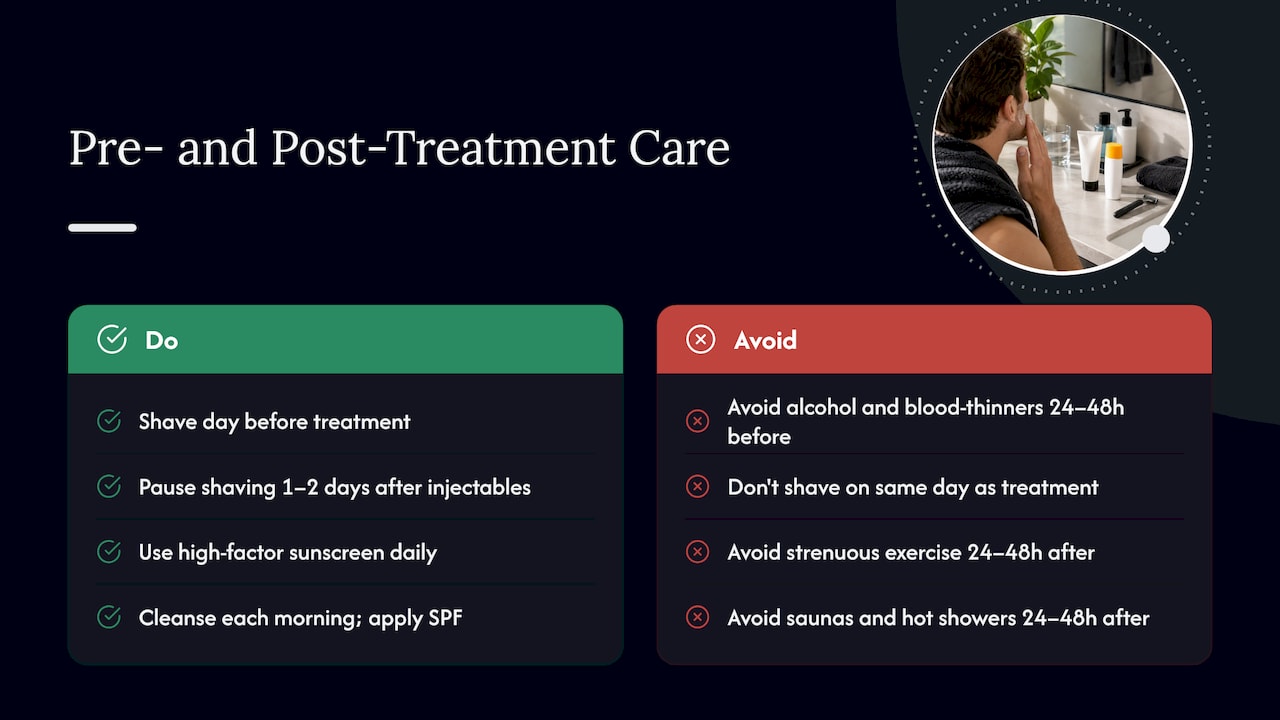
Men’s skin tends to be thicker and oilier than women’s, which affects how it responds before and after a procedure. Before any injectable or energy-based treatment, avoid alcohol and blood-thinning medication such as aspirin or ibuprofen for 24 to 48 hours where medically appropriate, since these increase bruising risk. Shaving the treatment area the day before, rather than the same day, reduces the chance of irritation meeting a fresh injection site.
After treatment, swelling and redness are common and usually settle within a few days for injectables, slightly longer for microneedling or laser work. Avoid strenuous exercise, saunas and hot showers for 24 to 48 hours, since heat and increased blood flow can worsen swelling. Shaving should generally be paused for a day or two after injectables around the jaw or cheeks to avoid disturbing the treated area.
Sun protection after any procedure is non-negotiable. Freshly treated skin is more vulnerable to pigment change, and a high-factor sunscreen applied daily, not just on treatment days, protects both the healing skin and the result you paid for.
Men are often less used to a structured skincare routine than they assume, so a simple regimen works better than a complicated one: cleanse, protect with SPF each morning, and apply any prescribed retinoid or repair product in the evening once healing allows. Our skin rejuvenation tips guide sets out a fuller aftercare routine by treatment type.
Lifestyle factors behind male skin ageing
Daily habits do more to age or protect male skin than most men realise. Shaving, done several times a week for most men, causes repeated micro-trauma to the skin’s surface. Over years, that friction can thin the skin’s protective barrier and make it more reactive to new products or procedures, which is part of why men sometimes experience more irritation from active skincare ingredients than they expect.
Sun exposure is the other major factor, and arguably the biggest one within a man’s control. Years of unprotected exposure, whether through outdoor work, sport or simply skipping sunscreen, show up as pigment patches, deeper static lines and rougher texture, exactly the concerns that bring most men into a clinic in the first place. Smoking accelerates collagen breakdown and dulls skin tone, compounding the same ageing pathways that sun damage drives.
None of this means procedures are pointless if these habits continue. It does mean results last longer, and skin quality holds up better between sessions, when sun protection becomes a daily habit rather than an occasional one and shaving technique is gentle rather than aggressive. A good aftershave balm, a sharp blade, and daily SPF do more for long-term skin quality than any single procedure.
The psychological and social upside of looking after your skin
Men booking aesthetic treatments are often doing so quietly, without discussing it widely, which can make the decision feel more significant than it needs to be. The motivation is rarely vanity in the way it is sometimes framed. It is more commonly about looking as current and alert as they feel, particularly in competitive professional environments where appearance can shape first impressions in meetings, interviews or client-facing roles.
Confidence tends to follow visible, modest change rather than a dramatic transformation. Softening a deep frown line or restoring some jaw definition does not alter identity, but it often removes a small, persistent source of self-consciousness, whether that is looking tired in photos or looking older than a man feels. That subtle shift, from noticing a flaw every time you catch a mirror to simply not thinking about it, is frequently the actual outcome men describe after treatment, more than any specific measurement of a line or wrinkle.
How male skin differs and why that changes treatment choice
Male facial skin is generally thicker and has more sebaceous activity than female skin, which affects both how it ages and how it responds to treatment. Thicker dermis can mean static lines take longer to become visible, but it also means some procedures need slightly different depth or dosing to achieve a comparable result.
Facial hair adds another layer of complexity. Bearded men may need treatment areas mapped carefully around hair growth, and men who shave daily have more frequent micro-trauma to account for in aftercare timing. Testosterone-driven collagen density also means male skin can hold volume differently, which is one reason jawline and chin treatments are approached with male-specific proportions in mind rather than simply scaled-down female protocols.
Practitioners experienced in treating men typically adjust injection patterns and energy settings accordingly, which is part of why asking about a provider’s experience with male anatomy specifically, not just aesthetic medicine in general, is a reasonable question to raise at consultation.
What treatment actually costs over time
Most non-surgical treatments are one-off payments rather than subscriptions, but nearly all require repetition to maintain results. Anti Wrinkle treatment at The Aesthetics Room runs from £200 to £358 per session, and since effects last roughly three to four months, a man maintaining results might book three to four sessions a year.
Dermal filler work such as Jaw Definition & Contouring is priced at £310, while Lip Filler ranges from £215 to £300, both one-off costs that typically need repeating every six to eighteen months depending on the area and product.
Biostimulators and texture treatments are priced per session but often sold as a course: Profhilo is £350, Sunekos is £450, and Micro-needling is £300 per session, with the four to six session course mentioned earlier meaning the realistic total cost is several multiples of a single visit.
Budgeting for ongoing maintenance, rather than a single purchase, is the more honest way to think about non-surgical rejuvenation. A single Botox session or filler appointment solves a problem temporarily; the real cost is the repeat visits needed to keep it that way.
What the research actually supports, and what gets oversold
The evidence behind botulinum toxin, fillers and microneedling is solid for what they are designed to do: soften dynamic lines, restore volume, improve texture. Where the conventional advice goes wrong is in implying that a single treatment, or a single miracle product, solves ageing skin comprehensively. It does not. Sun protection, consistent habits and realistic expectations do more for long-term skin quality than any one procedure, however well marketed.
The other place expectations run ahead of reality is sagging. Injectables and lasers are genuinely good at lines, pigment and texture. They are not a substitute for surgical lifting once gravity has taken real structural hold, and a provider who implies otherwise is overselling.
What should come first is not the flashiest treatment but the most basic discipline: daily sunscreen, a provider who can explain exactly why a particular treatment suits your anatomy, and a willingness to treat results as something maintained over months and years rather than fixed in a single visit. Men who approach this that way tend to be the ones genuinely satisfied with the outcome.
— Vishul
Book a consultation with The Aesthetics Room
A premium medical aesthetics clinic offers Anti Wrinkle treatment, dermal fillers, Profhilo, Sunekos, Micro-needling and PRP, each matched to a bespoke plan built around individual skin and anatomy. 
Browse the full price list and treatment menu to see current costs, and bring your credential checklist to your consultation regardless of where you book.
Sources
- Botulinum toxin injections | BAAPS
- Microneedling patient leaflet | Chelsea and Westminster NHS Foundation Trust
- Botulinum toxin type A for facial wrinkles (systematic review) | PubMed
- Gov
FAQ
What is the best treatment for skin rejuvenation?
There is no single best treatment: the right option depends on the concern. Botulinum toxin suits dynamic lines, fillers and biostimulators suit lost volume and skin quality, and microneedling or laser treatment suits texture and pigment, so most men see the fullest result from a combination chosen at consultation.
How to get tighter skin on face for men?
Radiofrequency devices and collagen-stimulating treatments such as microneedling or Profhilo offer mild to moderate tightening by encouraging the skin’s own collagen production. BAAPS guidance notes that significant sagging generally still needs a surgical lift, since energy-based devices work on skin quality rather than structural laxity.
How long does Botox last for men?
Effects typically begin within 24 to 72 hours, peak at one to two weeks, and last around three to four months, after which the muscle activity gradually returns and the lines reappear. Most men booking regular maintenance have three to four sessions a year.
Is microneedling safe for darker skin tones?
Microneedling can be used on darker skin tones, but the risk of temporary pigment change is higher if sun exposure is not avoided before and after treatment, according to Chelsea and Westminster NHS Foundation Trust. An experienced practitioner will adjust settings and aftercare advice accordingly.
Does The Aesthetics Room offer treatments for men?
Yes, The Aesthetics Room provides Anti Wrinkle treatment, dermal fillers, Profhilo, Sunekos and Micro-needling among other services, each delivered through a bespoke plan agreed at consultation. Current pricing for each treatment is listed on the clinic’s price list.