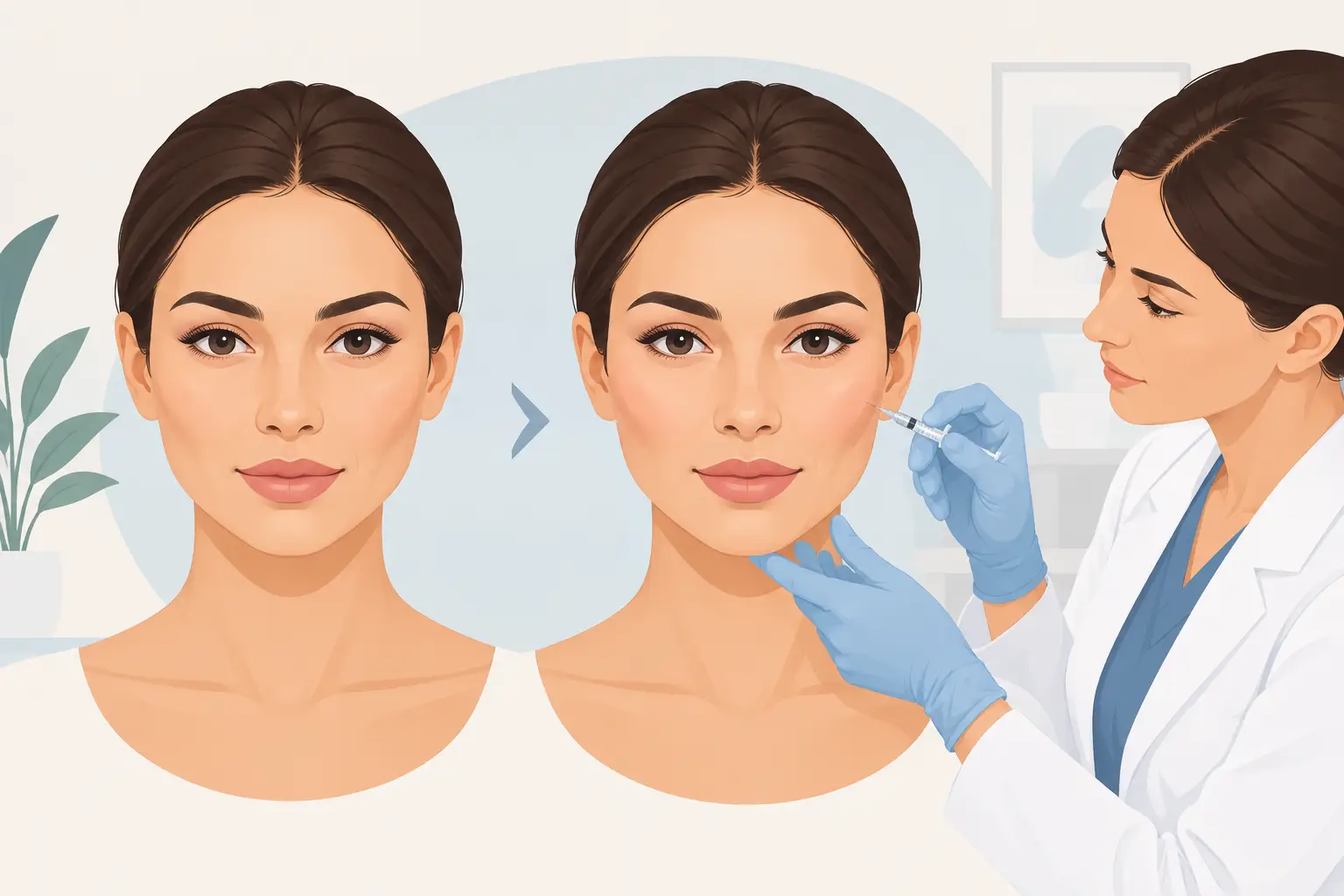


A lip filler correction case study is rarely about simply making lips smaller. More often, it is about restoring proportion, softness and confidence after a result no longer feels like the patient. The concern may be migration above the upper lip, unevenness, a firm texture, an over-projected profile or filler that has been layered over several appointments without a clear long-term plan.
For patients who have invested in treatment and feel disappointed or uncomfortable with the outcome, correction deserves a considered clinical approach. At a medically led aesthetic clinic, the goal is not to chase a trend or rush towards a new shape. It is to understand what is present, why the lip has changed and what will create the safest, most natural-looking path forward.
The starting point: when fuller no longer feels balanced
This representative case reflects a common correction journey. Personal details have been changed, but the treatment considerations are those regularly seen in practice.
Our patient was in her thirties and had received lip filler gradually over approximately two years at different clinics. Initially, she wanted subtle definition and hydration. Over time, however, she noticed that the upper lip appeared heavier in photographs, with fullness extending beyond the natural vermilion border. Her lips also felt firmer than she expected, particularly when applying make-up or smiling.
She did not want an extreme reversal. She wanted to look refreshed, balanced and recognisably herself. This distinction matters. A successful correction is not defined by a single aesthetic ideal. It is defined by whether the treatment plan reflects the patient’s anatomy, preferences and comfort, while protecting lip health and facial harmony.
At consultation, we discussed her treatment history, the likely type and timing of products used, any previous complications and her medical history. We also assessed the lips at rest and in movement, as a smile can reveal asymmetry, muscle pull and product placement that are not obvious in a still image. The surrounding area was equally important: the philtrum, upper-lip length, dental support, chin projection and overall facial profile all influence how lip volume is perceived.
Lip filler correction case study: the clinical assessment
The assessment suggested a combination of residual hyaluronic acid filler and migration in the upper lip. This can happen for several reasons. Repeated product placement, unsuitable filler choice, injections placed too superficially, natural tissue characteristics and insufficient time between top-ups can all contribute. It is not always possible to identify one cause, especially where treatment has been performed by multiple practitioners.
The patient’s lower lip remained relatively well proportioned, while the upper lip had lost crispness at the border. There was no indication of an acute vascular complication or infection. Those issues require urgent assessment and management, rather than an elective correction plan.
The most appropriate recommendation was a staged approach: dissolve the unwanted upper-lip filler first, allow the tissue to settle, then reassess before deciding whether any replacement filler was necessary. This can feel frustrating for patients who want an immediate fix, but it is often the more refined and safer option. Adding more filler to camouflage migrated or uneven product can create further heaviness and make accurate correction harder later.
Why dissolution is not a casual treatment
Hyaluronidase may be used to break down hyaluronic acid filler, but it is a prescription-only medicine and should be administered following a thorough clinical assessment. It is not suitable for every situation, and it will not dissolve permanent fillers or all non-hyaluronic acid products. The practitioner must establish, as far as possible, what has previously been injected.
We discussed the expected effects, limitations and risks, including swelling, tenderness, bruising and the possibility that more than one session may be needed. In some cases, dissolving can temporarily leave lips looking flatter or less defined than expected. This is not necessarily the final outcome. It can reveal the patient’s natural anatomy and allow residual swelling and stretched tissue to recover before any further treatment is considered.
An appropriate waiting period is part of the treatment, not dead time between appointments. It gives both patient and practitioner a clearer view of the lip’s true baseline.
The correction plan: remove, settle, reassess
The patient underwent a carefully targeted dissolution treatment focused on the migrated upper-lip product. A conservative approach was selected rather than attempting to dissolve every trace of filler in one appointment. This reduced the risk of over-correcting and allowed the response to be monitored closely.
In the days after treatment, mild swelling made the area appear temporarily more uneven. This is one reason patients should not judge the result too early. We provided clear aftercare advice and arranged review, with instructions to contact the clinic promptly if she had any concerns.
At her review several weeks later, the upper-lip border looked more defined and the previously raised area had softened. Crucially, her facial profile appeared lighter and more balanced. She reported that her lips felt more comfortable and that lipstick no longer caught on the uneven contour.
At this point, she had a choice. She could retain her natural lip shape without further treatment, or proceed with a modest amount of carefully placed filler after sufficient healing. A correction plan should always leave room for this decision. Dissolving filler is not a commitment to reinjecting it.
The patient chose a small, staged refinement. The objective was hydration and gentle restoration of shape, not additional volume. Product was placed conservatively within anatomical boundaries, with particular attention to the central upper lip and lower-lip balance. The result was intentionally understated: a smoother outline, improved symmetry and a relaxed appearance in motion.
What made the result feel more natural
Natural-looking lip filler is not simply a matter of using less product, although restraint is often valuable. It depends on respecting the lip’s existing architecture. The ideal amount and placement will differ for every patient according to tissue quality, facial proportions, age-related change and the way they express themselves.
In this case, several choices made the difference. We avoided rebuilding the previous upper-lip volume, gave the tissue time to settle before reinjecting and used a measured amount of filler only where it would support shape. The patient’s aim also guided every decision. She wanted to look rested, not noticeably treated.
This is why a consultation-led approach is particularly valuable for corrective work. A photograph of a preferred lip shape can be useful, but it cannot replace an in-person assessment of anatomy and movement. A result that looks flattering on one face may look overfilled or structurally unsupported on another.
Is dissolving always the right answer?
Not necessarily. Some concerns can be improved without dissolution, particularly where there is minor asymmetry, a small deficit in hydration or an area that has settled unevenly. In other situations, residual filler may be contributing to puffiness, migration or distortion, making dissolution the more predictable route.
It also depends on the type of filler used, its location and how long it has been present. Ultrasound assessment may be helpful in selected complex cases, particularly where the previous treatment history is unclear or where product placement needs more precise evaluation. The correct plan should be based on clinical findings, rather than an assumption that every unwanted result needs either more filler or full dissolution.
Patients should be cautious about correction appointments that promise a complete transformation in a single sitting. While some changes are immediate, polished results often require patience, review and staged decision-making. This is especially true in an expressive area such as the lips, where swelling and tissue behaviour can influence the apparent result.
Choosing care after an unsatisfactory filler result
Feeling unhappy with previous filler can make it difficult to trust another practitioner. A respectful consultation should make space for that experience. You should feel able to explain what has changed, what you would like to regain and what you are worried about, without pressure to book treatment on the spot.
Look for a practitioner who takes a full medical history, asks about previous products and treatment dates, explains realistic options and has a clear protocol for managing complications. A premium setting should never be used as a substitute for medical standards. Safety, product knowledge and clinical judgement remain the foundation of any aesthetic outcome.
At The Aesthetics Room, correction is approached as a bespoke clinical plan, with patient wellbeing and long-term balance at its centre. For some patients, the best result is a refined reinjection. For others, it is choosing to pause and appreciate a more natural baseline.
If your lips no longer reflect the result you originally wanted, the most helpful next step is not another impulsive top-up. It is a thoughtful consultation that gives your anatomy, your concerns and your confidence the attention they deserve.