
Facial lymphatic drainage reliably reduces short-term puffiness within hours, but it does not permanently reshape facial fat or structure. The evidence is strongest for genuine medical uses, lymphoedema and post-surgical swelling, where manual lymphatic drainage (MLD) is a recognised clinical tool. For everyday de-puffing and skin brightness, expect a visible but temporary lift rather than a lasting facelift. Done carelessly, it also carries real safety caveats around infection and clotting risk.
TL;DR:
- Facial lymphatic drainage provides only temporary relief from puffiness, lasting around four to six hours after a session, without offering permanent fat reduction.
- It is most effective for managing short-term swelling due to factors like travel, hormonal shifts, or post-cosmetic procedures, especially when performed by trained professionals.
- Careful technique with light pressure is crucial, as improper massage can cause skin irritation or spread infection, with specific safety concerns for those with active infections or blood clotting issues.
- Home routines require gentle sweeping motions starting at the neck and jawline, but they offer limited benefit beyond immediate de-puffing and should avoid overpressure.
- Professional lymphatic drainage sessions are recommended after aesthetic treatments, typically scheduled two to three times weekly during initial recovery, and should be avoided if signs of infection or unexplained swelling occur.
Table of Contents
- What is facial lymphatic drainage and how does the lymphatic system work?
- What does the evidence say about facial lymphatic drainage benefits?
- Who benefits most, and who should avoid it?
- How do you do lymphatic drainage on your face at home?
- What happens during a professional lymphatic drainage session?
- When should you stop and see a doctor instead?
- How we use lymphatic drainage in practice
- Book professional lymphatic drainage aftercare in London
- Sources
What is facial lymphatic drainage and how does the lymphatic system work?
Your face is threaded with a network of superficial lymphatic vessels that sit just beneath the skin, far shallower than blood vessels. Fluid, waste and immune cells drain along these channels towards larger nodes near the jaw, neck and collarbone (the cervical and supraclavicular nodes). Unlike the circulatory system, lymph has no central pump. It relies on muscle movement, breathing, and gentle external pressure to keep flowing.
This is why technique matters more than strength here. Medical lymphatic drainage massage uses slow, directional strokes and rhythmic pressure to encourage that natural flow toward the nodes, according to Cleveland Clinic’s patient guidance on the technique. That is fundamentally different from deep tissue or abrasive facial massage, which works muscle and fascia rather than lymphatic vessels, and can bruise delicate superficial tissue if applied to a lymphatic routine.
What does the evidence say about facial lymphatic drainage benefits?
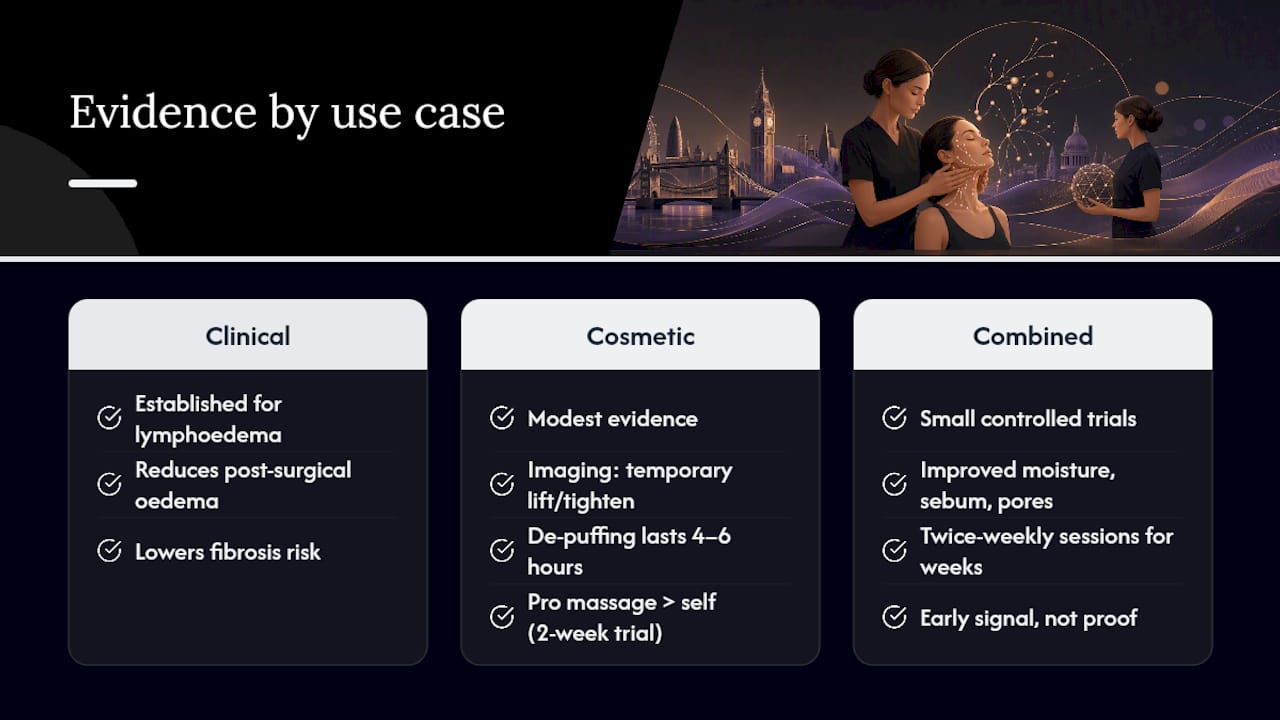
MLD has a genuine clinical track record. A clinical review of lymphatic massage in cosmetic procedures confirms its established role in managing lymphoedema and post-surgical oedema, where reducing fluid build-up also lowers the risk of fibrosis during healing.
For cosmetic, non-surgical use, the picture is more modest but still real. Small imaging studies using CT scans have recorded measurable soft-tissue changes after regular facial massage, including temporary lifting and tightening effects. One trial found that self-massage performed twice daily for two weeks produced changes visible on imaging, with professional massage producing a more pronounced effect than the self-administered version.
Reality check: de-puffing from a single session typically lasts around four to six hours, according to expert commentary on the technique. There is no evidence it dissolves fat or delivers a permanent lift.
Separately, small controlled trials combining lymphatic massage with topical cosmetics have reported improvements in skin moisture, sebum balance and pore appearance after several weeks of twice-weekly sessions, per research published in the Journal of the Korean Society of Cosmetology. Treat that as encouraging early signal rather than proof, given the small sample sizes involved. Healthline’s review of the evidence reaches the same balanced conclusion: real short-term benefit, limited proof of lasting aesthetic change.
Who benefits most, and who should avoid it?
Good candidates include anyone dealing with transient morning puffiness, fluid retention from travel or hormonal shifts, or a face that looks tired rather than aged. If you have recently had a cosmetic procedure, facial lymphatic drainage can also support recovery, provided your practitioner has given the go-ahead first.
Certain groups should steer clear or seek clearance before starting:
- Active skin infection or open wounds on the face, since massage can spread bacteria through the lymphatic network.
- Clotting disorders or a history of deep vein thrombosis (DVT), where encouraging fluid movement carries added risk.
- Uncontrolled heart failure, where redirecting fluid volume can strain an already compromised system.
- Unexplained or one-sided swelling, which needs medical assessment before any massage, since it can signal something beyond simple fluid retention.
If any of these apply to you, speak to a GP or a qualified aesthetic practitioner before attempting a routine, and read our safety guidance for aesthetic treatments for a fuller checklist.
How do you do lymphatic drainage on your face at home?
Preparation matters as much as the technique itself. Wash your hands and cleanse your face first, then apply a light, slippery emollient or facial oil so your fingers glide rather than drag. Take a few slow breaths before you start; deep breathing itself helps activate lymph flow through the chest and neck.
Pressure should be far lighter than most people expect, closer to stroking a butterfly’s wing than kneading dough. Because lymphatic vessels sit so close to the surface, heavy pressure does nothing extra and can bruise or irritate the skin.
- Start at the neck and collarbone, sweeping gently downward and outward to open the pathway fluid will drain into.
- Work along the jawline, using flat fingers to stroke from chin towards the ears.
- Move to the cheeks, sweeping upward and outward toward the hairline and ears.
- Use your ring finger, the lightest-pressure digit, to gently pat and sweep under the eyes from inner to outer corner.
- Finish back at the neck and supraclavicular nodes above the collarbone, clearing the fluid you have just encouraged to move.
Hands are generally the better tool here; practitioner guidance on the technique notes that because lymphatics are so superficial, gua sha or rollers add friction risk without adding benefit unless you have been trained to use them correctly. A daily routine of a few minutes maintains baseline reduction in puffiness, while a focused session before an event gives the fastest visible de-puff, a trade-off echoed in Healthline’s guidance on the topic. For a broader facial massage sequence, our step-by-step facial massage guide is a useful companion routine.
Pro Tip: If your skin reddens or feels tender afterwards, you are pressing too hard. Correct pressure should feel almost too gentle to be doing anything, that is the sign you are moving lymph rather than bruising tissue.
What happens during a professional lymphatic drainage session?
A clinic MLD session is typically carried out by a trained therapist or aesthetic practitioner and lasts 30 to 45 minutes, using slow, rhythmic strokes mapped to your specific lymphatic pathways rather than a generic routine. Sessions often start at the neck to clear the main drainage points before working outward across the face.
For post-procedure recovery, MLD is commonly recommended two to three times per week during the first three to four weeks after cosmetic surgery, according to the same clinical review, to reduce lymphostasis and lower fibrosis risk during healing. That schedule is often paired with compression garments, topical care, and careful timing around other treatments. If you have had recent dermal filler or injectable work, always disclose it before an MLD session, since timing and technique need adjusting around treatment sites. Our guide to aftercare following aesthetic treatment covers how this fits into a broader recovery plan, and compression-based adjuncts are covered well in this clinical guide to lymphatic compression therapy.
When should you stop and see a doctor instead?
Stop self-massage immediately if you notice pain, spreading redness, fever, or swelling that worsens rather than improves; these can signal infection or a circulatory problem that massage will not fix. Anyone with a history of DVT, heart failure, or unexplained swelling on one side of the face only should get medical clearance before trying MLD in any form. Always tell your practitioner about recent facial treatments, injectables, or surgery before a professional session.
How we use lymphatic drainage in practice
Vishul, reviewing the evidence for this piece, notes that the biggest misconception clients bring in is expecting facial lymphatic drainage to replace injectables or surgery rather than support them. It does neither job well when asked to do the other’s work.
At Theaestheticsroom, MLD sits inside recovery plans after filler, skin rejuvenation, and other procedures, not as a standalone miracle. If swelling persists beyond what feels normal, or looks unexplained, book a consultation rather than massaging through it.
— Vishul
Book professional lymphatic drainage aftercare in London
Facial lymphatic drainage works best as part of a supervised recovery plan, not a routine improvised after a late-night search. Theaestheticsroom is the alternative to guessing at pressure and technique alone at home: our CQC-accredited practitioners map your specific drainage pathways and time sessions around your actual treatment history, whether that is dermal filler aftercare or a broader skin rejuvenation programme.

Based across Knightsbridge, Harley Street and Mayfair, our clinics offer virtual and in-person consultations, so you can get a proper assessment before deciding whether self-massage, professional MLD, or a combined plan suits your situation. Sessions commonly pair with our Botox and filler aftercare programmes for clients managing post-treatment swelling. If you are dealing with persistent puffiness or planning a procedure and want a recovery plan built around it, book a consultation with Theaestheticsroom and get a technique that matches your actual anatomy, not a generic routine.
Sources
- The Utility of Lymphatic Massage in Cosmetic Procedures – PMC
- Lymphatic Drainage for Face: What Are the Benefits? — Healthline