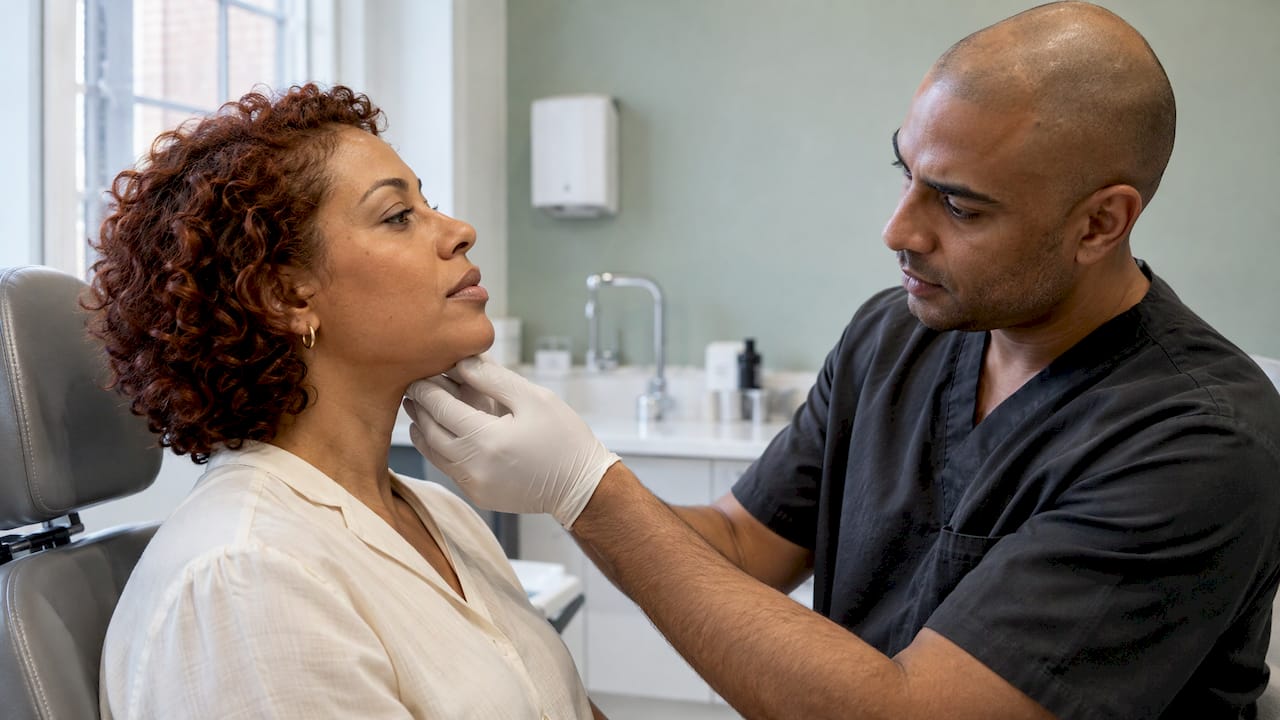
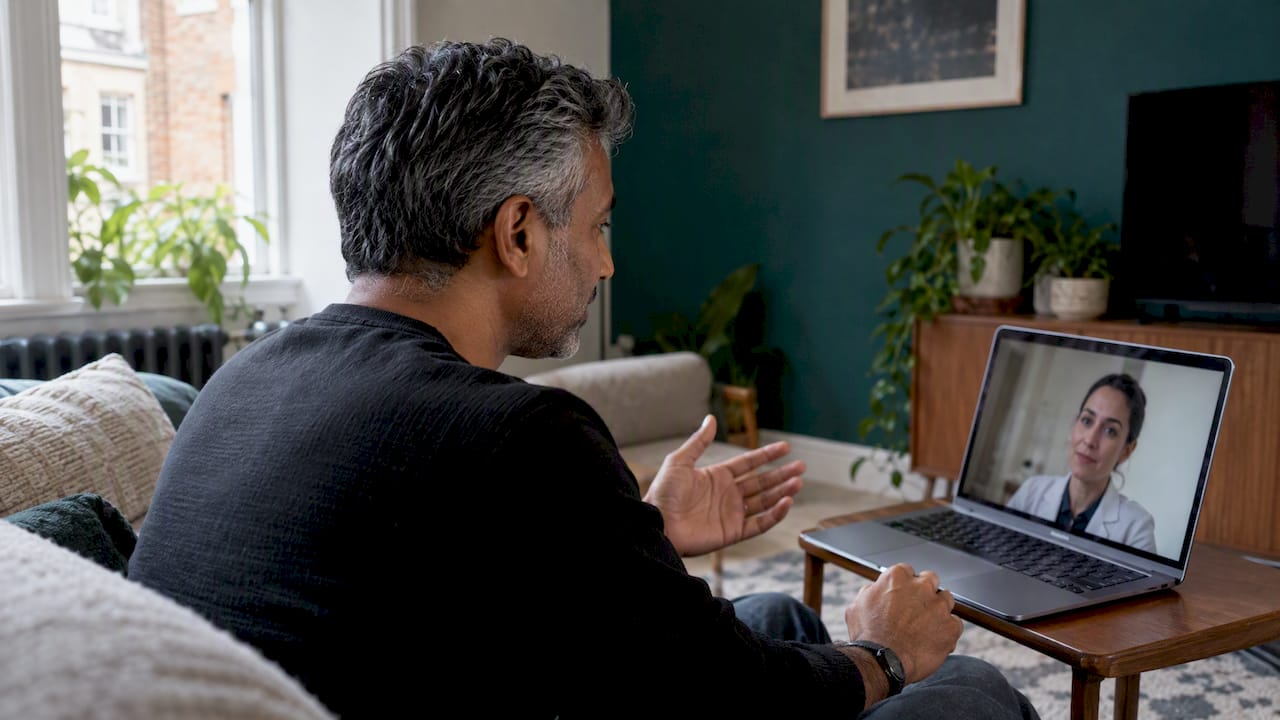

A virtual consultation is a good first step for questions, planning and follow-up. It cannot replace a face-to-face assessment before injectable treatments such as Botox or dermal fillers. In the UK, professional bodies are clear that injectable cosmetic medicines need an in-person assessment first. So the real choice is not one or the other. It is knowing which conversation belongs on screen and which belongs in the treatment room.
Below, we explain what each format does well, what UK guidance says, how to prepare, and how to decide.
TL;DR
- Virtual consultations suit early questions, treatment planning, aftercare checks and follow-up conversations.
- For injectables such as anti-wrinkle treatment and fillers, UK guidance requires a face-to-face assessment before anything is prescribed.
- Each new prescribing episode needs its own in-person assessment, including repeat treatment.
- Check your practitioner’s registration, insurance and the clinic’s CQC status before you book, whichever format you choose.
- Start virtually if you are unsure, then book in person for the assessment and treatment.
Table of Contents
- What a virtual consultation is, and how it differs
- What UK rules say about injectables
- What a virtual consultation does well
- What a screen cannot show
- When virtual is enough, and when you need to attend
- How to prepare for each type
- How to check a consultation is safe and legitimate
- What happens after a virtual consultation
- Our perspective
- Book your consultation with us
- Which should you choose?
- FAQ
- Sources
What a virtual consultation is, and how it differs
The General Medical Council describes remote consultations as appointments by phone, internet or video link. They may be appropriate when the patient does not need an examination. Face-to-face consultation may be preferable where needs are complex or higher risk.
In aesthetics, that gives two distinct conversations:
| Virtual consultation | In-person consultation | |
|---|---|---|
| Format | Video call from home or work | Appointment at the clinic |
| Best for | Questions, goals, treatment options, planning, follow-up | Assessment, examination, prescribing, treatment |
| Can the practitioner examine your skin and face? | Only as far as the camera allows | Yes, in good light and by touch |
| Travel | None | You travel to the clinic |
| Can it lead to a prescription for injectables? | No | Yes, where suitable |
The difference is not quality. It is what each format can safely do.
What UK rules say about injectables
This is the point most articles on this topic skip, and it decides everything else.
The GMC’s guidance says injectable cosmetic products must not be prescribed on the basis of phone, video or online consultations. A joint advisory notice from BAMAN and the JCCP states that the NMC prohibition on remote prescribing for cosmetic procedures came into force on 1 June 2025. It requires face-to-face assessment before prescribing any medicine for a cosmetic procedure.
The JCCP’s earlier prescribing statement goes wider than Botox. It says remote prescribing is not endorsed for injectable medicines and devices used in non-surgical cosmetic procedures. That covers botulinum toxin, dermal fillers, hyaluronidase, tissue stimulants, vitamin injections and lipolysis agents. The JCCP and CPSA code of practice also expects prescribers to take a full clinical history and carry out a face-to-face physical and emotional wellbeing examination before injectable cosmetic medicines or other invasive procedures.
In practice:
- A video call alone cannot lead to a Botox prescription. If a service offers to prescribe injectables after a call with no in-person assessment, treat that as a warning sign.
- Repeat treatment is not exempt. The same notice says a new face-to-face assessment is needed for every new prescribing episode, including retreatment after three months. A further review may skip another in-person consultation only where the existing supply and directions adequately cover an uncomplicated adjustment.
- Not every treatment is a prescription treatment. Skincare planning, aftercare and lifestyle advice can be handled remotely. The practitioner decides what is appropriate for your case.
What a virtual consultation does well
A virtual appointment is not a lesser version of the real thing. For the right questions it is the better tool.
Convenience and access
The Aesthetic Surgery Journal describes online video consultations as useful for patients who would otherwise travel long distances, and says they can save time and money. A 2024 peer-reviewed review of cosmetic dermatology in the digital age likewise finds that virtual cosmetic consultations improve convenience and access, especially for remote or underserved patients.
You do not need to be in Knightsbridge to ask a question. If you live outside London, are travelling, or have a tight working day, a 20-minute video call can narrow your options before you commit to a journey.
Planning without pressure
It is easier to talk about what bothers you at home, with your own mirror and photos, than in an unfamiliar room. A virtual call is a low-stakes way to:
- explain your concerns and what you would like to change
- hear which treatment types could address them
- learn about downtime, timing and how treatments might fit around events
- ask about cost ranges and what the plan could involve
Follow-up and complications
The same journal identifies post-treatment follow-up and prompt recognition of complications as useful applications of video consultation. A quick call, with a photo of the area, can reassure you about normal swelling or flag something that needs to be seen. Our guide on reducing post-treatment swelling safely explains what is typical in the days afterwards.
What a screen cannot show
The 2024 review is balanced on the downside. Virtual consultations can miss in-person information such as skin texture, tone and subtle facial movement. Its conclusion is that clinicians must balance the convenience of telehealth against in-person examination where safety, diagnostic accuracy or cosmetic expectations require information that is not available on screen.
That matches what we see in practice. Some things only show up in the room:
- Skin quality. Texture, laxity and pigment change under different light and under touch.
- Movement. Expression lines are about how muscles behave. The way your brow lifts or your smile pulls is hard to judge through a laptop camera.
- Facial structure and symmetry. Cheek, jaw and chin planning depends on seeing and feeling the face from several angles.
- Medical history in context. A practitioner can ask follow-up questions face to face and see how you respond.
- Safety checks. Examination before injectables is the point of the rule, not a formality.
When virtual is enough, and when you need to attend
The GMC infographic gives a useful test. Remote consultation may be appropriate when the need or request is straightforward, records are available, treatment information can be given remotely, no examination is needed, prescribing systems are safe and the patient has capacity. Face-to-face is preferable for complex or higher-risk needs, missing records or where an examination is required.
Translated into everyday situations:
| Your situation | Sensible format |
|---|---|
| First enquiry, unsure what you need | Virtual |
| Comparing treatment options and costs | Virtual |
| Wanting Botox, anti-wrinkle or filler | In person for the assessment and treatment |
| Retreatment after a few months | In person |
| Checking normal healing after treatment | Virtual, with photos, unless something looks wrong |
| Swelling, asymmetry, pain or anything worrying | In person, promptly |
| Skincare plan or prescription skincare review | Often virtual, at the practitioner’s discretion |
| Hair loss or excessive sweating assessment | Virtual to start, in person before injectable treatment |
If you have a complicated medical history, are pregnant or breastfeeding, take regular medication, or have had previous reactions, tell the practitioner. They will want to see you in person.
How to prepare for each type
Before a virtual consultation
The BAMAN and JCCP notice says a prescribing assessment should cover medical, physical and psychosocial history, allow sufficient time and support a shared understanding of options, risks and benefits. Even a preliminary call goes better if you have prepared:
- Find good light. Sit facing a window, with a plain background and a steady camera.
- Take clear photos. Front and side views, without makeup or filters.
- List your concerns in order of priority. What bothers you most is where to start.
- Write down your medical history. Include medication, allergies, supplements, previous treatments and any skin conditions.
- Note your timeline. Events, holidays or work commitments affect treatment timing.
- Prepare questions. Ask about risks, downtime, aftercare and what happens if something goes wrong.
Before an in-person consultation
- Arrive without heavy makeup so the practitioner can see your skin.
- Bring a list of current medication and any records of previous treatments.
- Bring a photo of how you looked when you were happy with your appearance, if that helps explain your goals.
- Allow time. A proper assessment should not feel rushed.
Our guide to London aesthetic consultations walks through what happens in the room.
How to check a consultation is safe and legitimate
Whether you meet online or in a clinic, the checks are the same. The NHS advises checking the practitioner’s training, skills and insurance, and asking about qualifications, experience, complications, aftercare, what to do if something goes wrong, and the total cost including any further treatment.
For England, the NHS also says independent hospitals and clinics providing cosmetic surgery must be registered with the CQC. You can check the CQC register and ratings, and look up doctors on the GMC register. One caution: CQC registration depends on the activities a service provides. A non-regulated aesthetic service should not be assumed to have been inspected, so ask what a clinic is registered for rather than relying on a badge.
A short checklist for any virtual consultation:
- You can see the practitioner’s name and professional registration number.
- The clinic has a physical address where you can be seen in person.
- You are told clearly that injectable treatment needs a face-to-face assessment first.
- The call is private, with a clear explanation of how your photos and records are stored.
- You are given the total cost, including any follow-up, in writing.
- Nobody pressures you to book treatment on the call.
What happens after a virtual consultation
A good virtual consultation ends with a plan, not a sales push. Typically you will leave with:
- a clear idea of which treatments suit your concerns, and which do not
- a recommendation to book an in-person assessment where one is required
- guidance on timing, preparation and what to avoid beforehand
- an explanation of costs, so you can budget
At the in-person appointment, the practitioner takes your history, examines you, discusses risks and benefits, and decides whether treatment is suitable. Treatment may happen at the same visit if it is appropriate and you are comfortable.
After treatment, follow-up can often be virtual. Questions about makeup, activity and normal healing are well suited to a call. Our guides on makeup after Botox and fillers, alcohol after fillers and the filler breakdown timeline cover the most common questions.
Our perspective
We offer both virtual and in-person consultations, and we use them for different jobs.
A virtual consultation is where we listen. You tell us what you want, we explain what is realistic, and we say honestly when a treatment is not the right answer. It saves you a journey and gives you room to think before you commit.
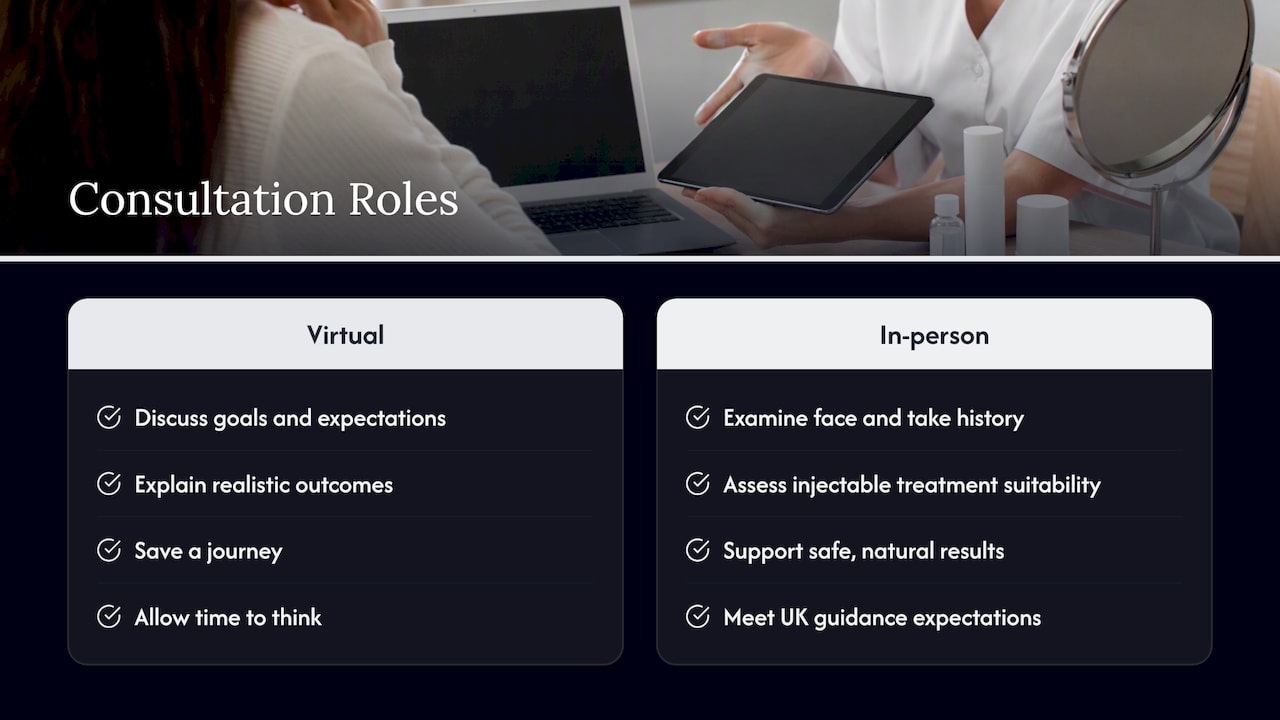
An in-person consultation is where we assess. For injectables we examine your face, take a full history and decide with you whether treatment is appropriate. We do not treat that as a hurdle. It is how we keep results natural and treatment safe, and it is what UK guidance expects.
We are CQC registered and members of the ACE Group, which is dedicated to patient safety. All treatments are performed by medically trained professionals, and each plan is bespoke. Our clinics are in Knightsbridge, Harley Street and Mayfair. Our view is simple: start where you feel comfortable, but never skip the assessment. A confident, well-informed decision gives better results than a quick one.
— Vishul
Book your consultation with us
If you would like to talk through your options, you can book a virtual or in-person consultation with us. We will tell you what can be discussed remotely and what needs an assessment in the clinic. Treatment prices are published openly: for example, anti-wrinkle treatment is £200 to £358, lip filler £215 to £300 and Profhilo £350. You can see the full list on our price list.

If filler is on your mind, our Harley Street dermal filler price guide explains what affects cost. For anti-wrinkle treatment, our Botox maintenance schedule shows how often top-ups are usually needed. Ready to start? Book through our website.
Which should you choose?
Use these questions to decide:
- Do you want an injectable treatment? Plan on an in-person assessment. A virtual call can still help you prepare.
- Are you just exploring? Start virtually. It costs you little time and commits you to nothing.
- Do you live far away? Do the planning online and travel once, for the assessment and treatment.
- Is this a follow-up? A virtual check is often enough, unless something looks or feels wrong.
- Is it a repeat treatment? Expect a fresh face-to-face assessment each time.
The best approach for most people is a hybrid one: virtual for conversation, in person for clinical decisions.
FAQ
Can I get Botox after a video consultation alone?
No. UK guidance requires a face-to-face assessment before any medicine is prescribed for a cosmetic procedure, and the NMC prohibition on remote prescribing for cosmetic procedures has applied since 1 June 2025. A video call can help you plan, but the prescribing assessment must be in person.
Do I need a new in-person consultation for every top-up?
Usually, yes. The BAMAN and JCCP notice says each new prescribing episode needs a face-to-face assessment, including retreatment after three months. A further review may not need one only where the existing supply and directions adequately cover an uncomplicated adjustment, and your practitioner decides that.
Are virtual consultations less safe than in-person ones?
Not when used for the right purpose. They are well suited to planning, questions and follow-up. Their limit is that a screen can miss skin texture, tone and subtle facial movement, which is why examination comes before injectables.
How do I know a virtual consultation provider is legitimate?
Check the practitioner’s registration on the relevant professional register, such as the GMC for doctors, and ask about insurance, aftercare and complications. In England, also check the clinic’s CQC registration and what it covers. Be wary of anyone who offers injectables without any in-person assessment.
Is a virtual consultation free?
Fees vary between clinics, and some may offer an initial conversation without charge. Ask what the fee includes and whether it is deducted from treatment before you book.
Sources
- GMC: Remote consultations infographic
- Joint BAMAN and JCCP advisory notice
- JCCP and CPSA Code of Practice
- JCCP Guidance Statement: Responsible Prescribing
- Aesthetic Telemedicine: Designing the Patient Experience, Aesthetic Surgery Journal
- Cosmetic Dermatology in the Digital Age, 2024
- NHS: Choosing who will do your cosmetic procedure