
Most people top up Botox every three to four months, though results can last up to six. Your own interval depends on the area treated, your dose, your muscle strength and how you respond. The best schedule is one set after a consultation and adjusted as you go, not one copied from a chart.
This guide explains when Botox starts to work, when it peaks, when it fades and how to build a routine that keeps results natural. It also covers the safety points that matter for anyone having repeat anti-wrinkle injections in the UK.
TL;DR
- Botox usually takes effect within 3 to 5 days and reaches full effect by around 14 days, so judge your result at the two-week mark, not before.
- Results typically last 3 to 6 months, and movement starts to return from about 8 to 12 weeks.
- A first-year routine of one treatment every 3 to 4 months suits most people. Your practitioner may lengthen or shorten that gap based on your response.
- Botox is a prescription-only medicine, so choose a CQC-registered clinic that uses UK-authorised, licensed products.
- At The Aesthetics Room, anti-wrinkle treatment is priced from £200 to £358, depending on the treatment plan agreed at consultation.
Table of Contents
- How Botox works and why it wears off
- When Botox kicks in: onset time and peak effect
- How often to get Botox
- A sample Botox maintenance schedule for your first year
- Can you get Botox too often?
- How to make results last as long as possible
- Safety: what to know before every top-up
- Our perspective on Botox maintenance
- Plan your Botox maintenance with us
- FAQ
- Sources
How Botox works and why it wears off
Botox relaxes the muscles that create expression lines, such as the frown, forehead and crow’s feet. The effect is temporary and always reversible: the treated muscles are inactive for a period, which also helps you break the habit of overusing them.
The body gradually restores the nerve signal to the muscle. That is why movement returns slowly, not overnight, and why lines reappear gradually. A maintenance schedule is simply a plan to treat again before the muscles are fully back to their old pattern, or at the point where you prefer to.
When Botox kicks in: onset time and peak effect
Many people expect to see a change the next day. It does not work that way.
- Days 3 to 5: the first softening appears. NHS trust guidance gives 3 to 5 days for initial effects.
- Days 7 to 10: the effect builds steadily. Lines at rest begin to soften and expressions feel lighter.
- Day 14: full effect. The same NHS source says it takes up to 14 days to see the full outcome, and another NHS trust says benefits can take up to two weeks to show.
This matters for scheduling. A touch-up booked at day five would be based on an unfinished result. If you want a review appointment, book it for around two weeks after treatment, when the peak effect has settled and your practitioner can see any asymmetry or areas that need a small adjustment.
What the peak looks like
At peak, treated muscles move noticeably less, but a well-planned treatment should still let you look expressive. If your forehead feels frozen or your brows feel heavy, tell your practitioner at the review. Dose and injection sites can be refined next time, which is one reason a consistent practitioner helps.
How often to get Botox
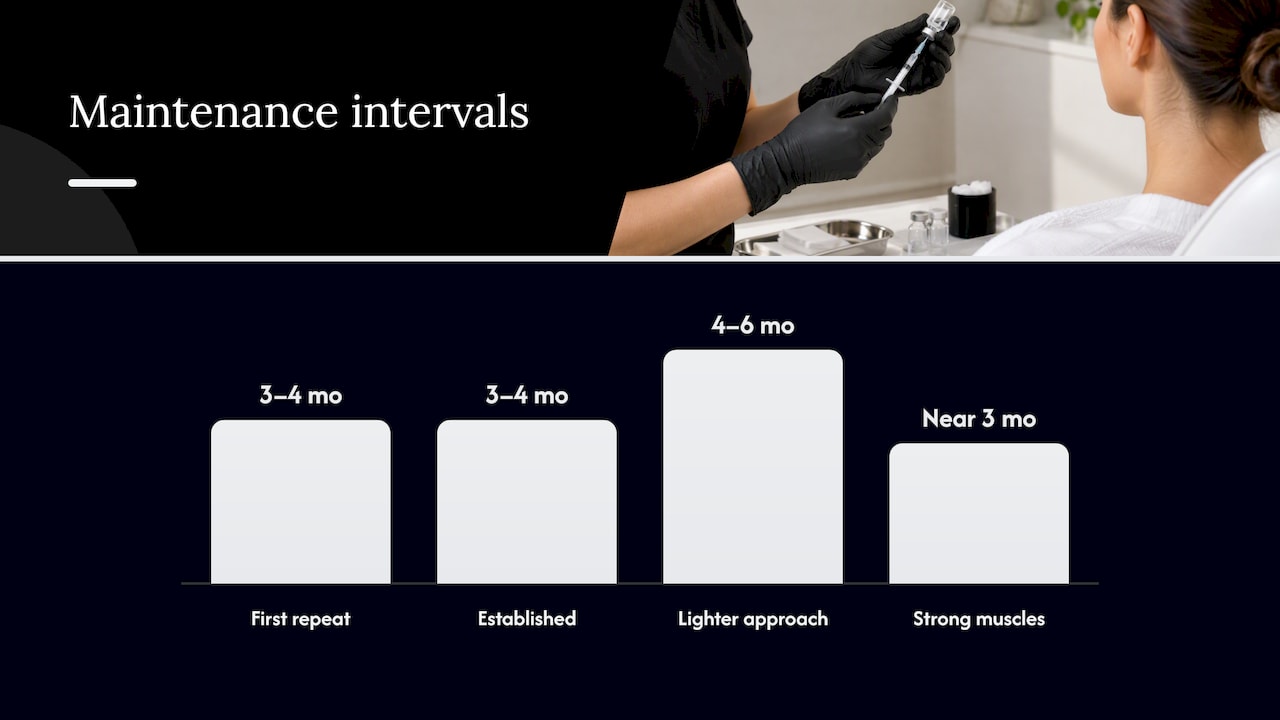
The honest answer is a range. NHS guidance says aesthetic Botox generally lasts 3 to 6 months, with movement returning from 8 to 12 weeks. Another NHS patient leaflet puts the typical effect at around 3 to 4 months.
In practice, the common intervals look like this:
| Situation | Typical rhythm | Why |
|---|---|---|
| First treatment | Review at 2 weeks, repeat at 3 to 4 months | You are learning how your muscles respond |
| Established routine | Every 3 to 4 months | Keeps lines softened without full return of movement |
| Lighter, preventative approach | Every 4 to 6 months | Lower doses or slower muscle recovery can stretch the gap |
| Strong facial muscles | Closer to 3 months | Stronger muscles tend to overcome the effect sooner |
These are general patterns for planning, not promises. Your own interval can be shorter or longer, and your practitioner should say so.
Why ‘every 12 weeks’ is not a rule
Clinical guidance is clear that a schedule cannot be one-size-fits-all. Patient information from Queen Victoria Hospital NHS Foundation Trust notes that your dose and sites depend on your response, and that your plan is adjusted through review.
Factors that tend to change your interval:
- Treatment area. Crow’s feet, frown lines and the forehead do not always fade at the same speed.
- Dose. A conservative dose usually wears off sooner than a fuller one.
- Muscle strength. Strong expression muscles can need more product or more frequent visits.
- Your metabolism and personal response. Two people with the same dose can have different results.
- Your goals. Some people want smooth skin at rest all year, others are happy to let movement return partially.
A sample Botox maintenance schedule for your first year
Here is an example of how a first year can run. Your plan will be set by your practitioner, but this shows the logic.
- Consultation. Discuss your concerns, medical history, medications and the look you want. Virtual consultations suit this stage if you cannot visit first.
- Treatment day. Injections are quick, usually with no recovery time needed.
- Day 3 to 5. First effects appear. Avoid judging yet.
- Day 14. Full effect. Review the result and decide whether a small adjustment is needed.
- Month 3 to 4. Movement is returning. Book your second treatment as lines start to reappear, not after they are fully back.
- Months 6, 9 and 12. Repeat at your agreed interval, with a consultation each time to check dose, sites and any changes in your face.
Booking the next appointment before your results fully fade is the simplest way to keep a steady look. Waiting until everything has worn off can mean you start from scratch each time, which some people prefer, but it is a choice, not a requirement.
Can you get Botox too often?
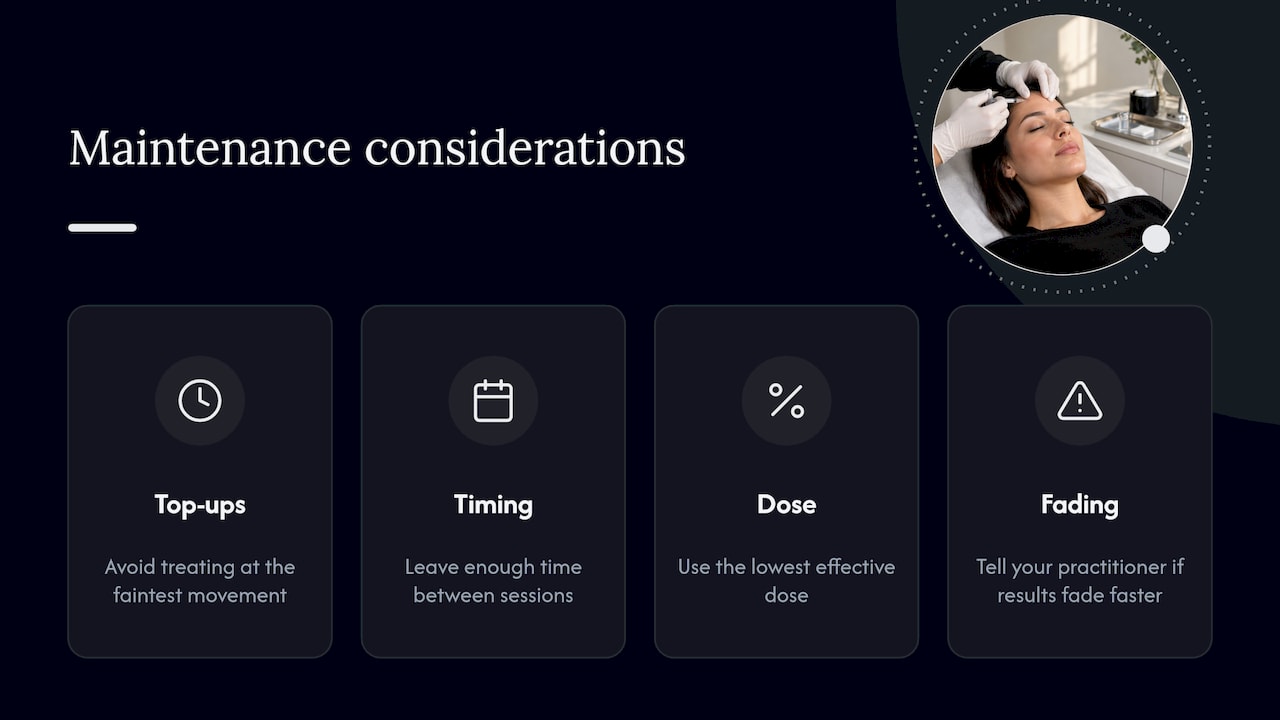
You can, and it is worth knowing. Queen Victoria Hospital’s patient information says some people who have had frequent treatment may develop resistance over time, so that it works less well. Discuss your full history with your practitioner at every consultation.
A responsible schedule therefore avoids topping up the moment you see the faintest movement. It uses the lowest effective dose and leaves enough time between sessions. If you find your results fading faster than before, say so. Your practitioner may adjust the dose, change the injection pattern or suggest a longer gap.
How to make results last as long as possible
No habit will double the life of your treatment, and you should be wary of anyone who says otherwise. Some sensible steps do help you get the full benefit and avoid problems.
Before treatment
- Hospital guidance advises avoiding alcohol for 24 hours before treatment, because it thins the blood and can raise the risk of bruising.
- The same leaflet lists blood-thinning supplements and over-the-counter medicines to avoid for about two weeks beforehand, including vitamin E, ibuprofen, ginseng, fish oils and aspirin. Never stop a medicine your GP has prescribed without asking them first.
After treatment
- Follow the aftercare your practitioner gives you. It usually covers keeping upright for a few hours, avoiding hard exercise on the day, and not massaging the area.
- Look after your skin between appointments. Sun protection, a good skincare routine and a balanced diet all matter. Some patients also read up on choosing a collagen supplement in the UK as part of supporting their skin from within, but this is separate from Botox and does not change how long it lasts.
- Do not rely on tips alone. Your dose, your anatomy and your practitioner’s technique matter far more than any aftercare trick.
Safety: what to know before every top-up
Botox is a prescription-only medicine, and repeat treatment should never feel casual. The MHRA has updated warnings on botulinum toxin products about rare cases of iatrogenic botulism, where the toxin’s effect spreads beyond the treated area.
If you develop difficulty swallowing, slurred speech or breathing difficulties after treatment, treat it as an emergency and call 999. Symptoms can start within days and in some cases up to several weeks after injection, so do not dismiss them because the appointment was a while ago.
To lower your risk:
- Choose a practitioner who is properly qualified and insured. The JCCP register was set up so the public can identify practitioners who meet standards for qualifications, safety and insurance.
- Check that the clinic is CQC-registered and uses UK-authorised, licensed products. Be cautious of heavily discounted offers, treatment at home parties or sellers who cannot show you the product.
- Tell your practitioner about pregnancy or breastfeeding, neuromuscular conditions, and every medicine you take, before each treatment, not just the first.
Our perspective on Botox maintenance
We see maintenance as a conversation, not a calendar. At The Aesthetics Room, every plan is bespoke: your anatomy, muscle strength and previous response decide your dose and injection sites, so we do not hand out one interval for everyone.
Our treatments are performed by medically trained professionals, and we are CQC-registered and members of the ACE Group, which is dedicated to patient safety. For us that means a proper consultation before each course, honest advice about when not to treat, and a review so you can see how your result settles.
We also look at the wider picture. Lines are shaped by muscles, but also by skin quality, so many patients combine anti-wrinkle treatment with skin rejuvenation options in a plan suited to them. Our aim is a natural result that still looks like you, kept up at the lightest schedule that works.
— Vishul
Plan your Botox maintenance with us
We offer anti-wrinkle treatment from £200 to £358, with in-person and virtual consultations available at our Knightsbridge, Harley Street and Mayfair locations. You can see our full range, including Profhilo at £350 and Mild Skin Peel at £120, on our price list. To discuss a schedule that fits your face and your calendar, start at The Aesthetics Room and book your consultation.
FAQ
How often should you get Botox?
Most people repeat treatment every 3 to 4 months, and some stretch to 6. NHS guidance says effects generally last 3 to 6 months. Your practitioner will set your interval from your response and dose.
When does Botox kick in?
The first effects usually appear within 3 to 5 days. Full results take up to 14 days, according to NHS trust information. Wait the full two weeks before deciding whether you need an adjustment.
Is it better to top up before Botox wears off completely?
Many people book as movement starts to return, around 8 to 12 weeks after the first treatment, then treat at 3 to 4 months. This can keep results consistent. It is not compulsory, and your practitioner should advise whether it suits your dose and muscles.
Can Botox stop working if you have it often?
It can for some people. Patient information from a UK NHS trust notes that resistance may develop with frequent treatment. Share your full history at each visit so your dose can be tailored.
What should I do if I feel unwell after treatment?
If you have trouble swallowing, slurred speech or breathing difficulty, call 999 straight away. The MHRA safety update explains that rare symptoms of botulism can appear after injection. For anything milder, such as asymmetry or a heavy brow, contact your clinic.
Sources
- Botox Treatment, Doncaster and Bassetlaw Teaching Hospitals
- Botulinum toxin injections, United Lincolnshire Hospitals
- Treatment with Botulinum Toxin Type A, Queen Victoria Hospital
- Having Botulinum Toxin A in the facial muscles, Leicester’s Hospitals
- Botulinum toxin type A products: updated warnings, GOV.UK
- JCCP register launch, British Association of Dermatologists