

Avoid alcohol for at least 24 hours after dermal filler, and treat 48 hours as the safer line if you bruise easily or have had lips, tear troughs or cheeks treated. The bigger point most guides miss is the other side of the appointment: UK professional guidance asks you to stay off alcohol for 3 days before filler too. Below we explain what alcohol does to a fresh injection site, how to plan around a drink, and what matters just as much as alcohol in the first days.
TL;DR
- Skip alcohol for at least 24 hours after filler. Allow 48 hours if you bruise easily or had a vascular area such as lips or under-eyes treated.
- Avoid alcohol for 3 days before filler as well, according to ACE Group guidance. That is when it does most to prevent bruising.
- Alcohol thins the blood and widens blood vessels. That raises the chance of bruising and swelling, but it does not damage the filler itself.
- Keep alcohol-free time in your diary: do not book filler within 2 weeks of a wedding, holiday or big event.
- Alcohol is one part of aftercare. Not touching the area, skipping make-up and choosing a regulated clinic matter just as much.
Table of Contents
- Can you drink after fillers?
- How long to avoid alcohol before filler
- A practical timeline
- Does it matter which area was treated?
- What about anti-wrinkle injections?
- Beyond alcohol: what protects your result
- Planning around a social event
- What we say as a clinic
- What to do if you already had a drink
- Book your consultation
- FAQ
- Sources
Can you drink after fillers?
Not on the day, and ideally not the next day either. The reasoning is simple. Filler is placed through tiny punctures, and the face is a very vascular area. Alcohol acts as a mild blood thinner, so a drink in the first hours can mean a bigger bruise, more swelling and a slower settle.
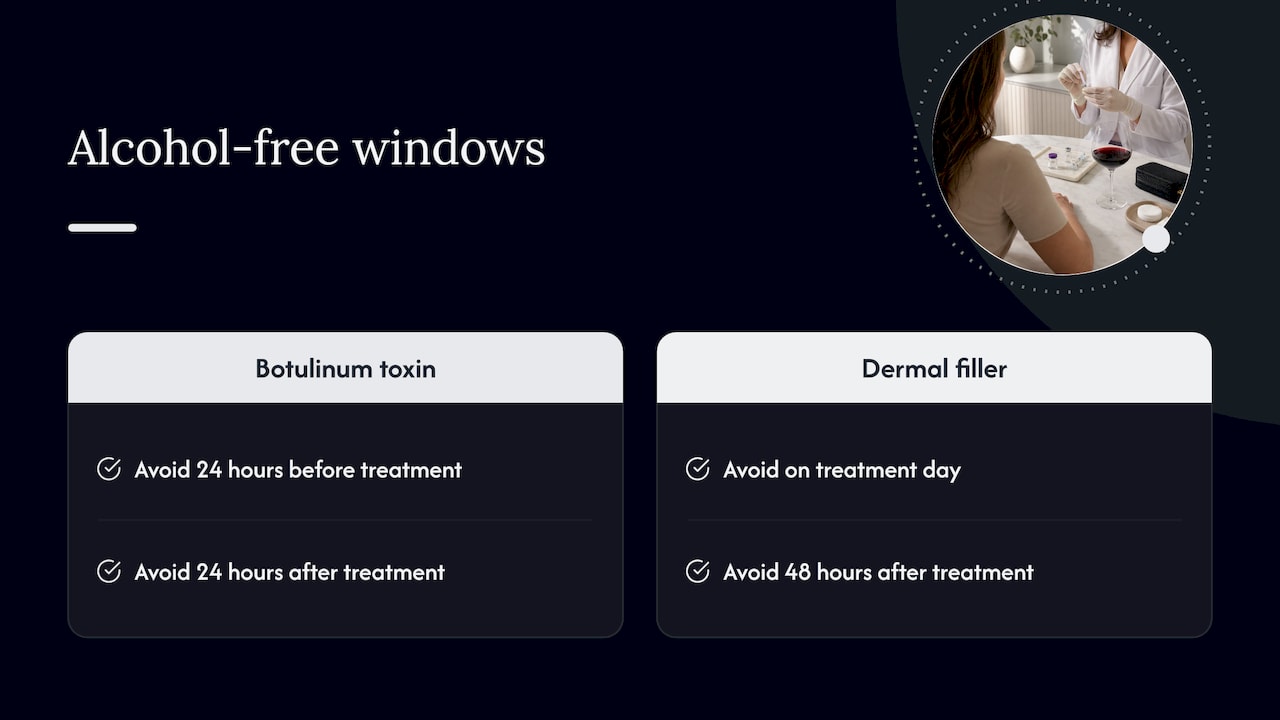
The same logic appears in NHS patient leaflets for botulinum toxin, which is a different injection but has the same bruising risk. One NHS hospital trust advises avoiding alcohol for 24 hours before and after the procedure, because alcohol thins the blood and can increase bruising at the injection site.
For dermal filler, many UK clinics extend this to 48 hours. We would rather you wait the extra day than spend a week covering a bruise with concealer, particularly as you are asked to leave make-up off the area at first.
What alcohol actually does to fresh filler
It helps to be precise, because the myth is that a glass of wine “melts” or ruins filler. It does not. The risk is to the healing tissue around it:
- More bruising. Alcohol thins the blood slightly, so a punctured vessel can leak more.
- More swelling. Alcohol dilates blood vessels, which can add to the natural puffiness after injection.
- Dehydration. A dehydrated face looks flatter and less even while the product settles, which makes it harder to judge your result.
- Harder review. If swelling is exaggerated, your practitioner cannot judge the final result as clearly at your follow-up.
None of this is permanent. It is a question of how smoothly the first week goes.
How long to avoid alcohol before filler
This is the part people miss. Bruising is largely decided before you sit in the chair. The ACE Group patient leaflet on hyaluronic acid fillers lists alcohol among the things to avoid for 3 days prior to treatment, alongside fish oils, St John’s Wort and vitamin E, all of which can thin the blood. It also asks you to avoid anti-inflammatories such as aspirin, ibuprofen and naproxen for 3 days beforehand, unless a doctor has prescribed them.
The ACE lip filler leaflet gives the same pre-treatment advice. In practice, that means:
- Count back 3 days from your appointment and treat that as your alcohol-free start.
- Check your supplements. Fish oil and vitamin E are easy to forget.
- Do not stop any prescribed medication yourself. Tell your practitioner at consultation and let them advise.
Many online guides only mention 24 hours after treatment. Following the stricter pre-treatment window is the more useful habit, because it reduces the number of blood vessels likely to leak when the needle or cannula passes through.
A practical timeline
Use this as a guide and always put your own practitioner’s written aftercare first.
| When | Alcohol | Also avoid |
|---|---|---|
| 3 days before | None | Aspirin, ibuprofen, naproxen, fish oils, St John’s Wort, vitamin E (unless prescribed) |
| Day of treatment | None | Touching the area, make-up on the injection sites, strenuous exercise |
| First 24 hours | None | Hot baths, saunas and anything that raises facial blood flow |
| 24 to 48 hours | Best avoided, especially after lips, tear troughs or if you bruise easily | Heavy exercise if swelling persists |
| After 48 hours | Usually fine in moderation if swelling and bruising have settled | Anything your practitioner has specifically flagged |
The heat and exercise advice is general good practice rather than a rule from one source, so ask which instructions your clinic wants you to follow.
Does it matter which area was treated?
Yes, a little. Areas with thin skin or lots of small vessels tend to bruise more.
- Lips: the most commonly bruised area. If you are weighing it up, our lip filler is priced from £215 to £300 depending on the treatment. If you are deciding between options, our guide to lip flip or lip filler explains the difference.
- Under-eyes: swelling here is common and can look more dramatic, so patience with alcohol and salt matters. We cover the timeline in our guide to tear trough filler recovery.
- Cheeks and jawline: usually less bruising, but swelling can still be visible. Our page on cheek filler before and after shows what a settled result can look like.
Whatever the area, the 24-hour minimum is the floor, not the target.
What about anti-wrinkle injections?
The advice is almost identical. The NHS leaflet we cited above recommends no alcohol for 24 hours before and after botulinum toxin. If you are on a regular schedule, it is worth building alcohol-free windows into your routine. Our Botox maintenance schedule guide explains how often top-ups usually fit in.
Beyond alcohol: what protects your result
Avoiding a drink is easy to do and easy to talk about, which is why it dominates search results. But safety does not come from alcohol avoidance alone. ACE Group guidance on delayed onset nodules and reactions names infection control as the single most important risk factor for preventing them, meaning a clean environment and as aseptic a technique as possible.
Your part in that is simple:
- Do not touch or massage the area unless your practitioner tells you to.
- Leave make-up off the treated skin for the period your clinic specifies. The same guidance refers to 6 to 12 hours without make-up after the procedure.
- Wash your hands before cleansing the face.
- Report anything unusual, such as increasing pain, a hot, red or hard area, or colour changes, to your clinic straight away.
If you feel unwell after any non-surgical procedure, the advice is to get medical help. A rash or alarming symptoms after treatment should not wait for a convenient appointment: contact your clinic, your GP, or NHS 111, and call 999 for breathing difficulty or swelling of the face and throat.
Planning around a social event
The most common reason people ask about drinking is a party, wedding or holiday. ACE Group lip filler guidance advises not having treatment within 2 weeks of an important social event or holiday, to allow bruising to settle and a review appointment if needed.
A workable plan:
- Book filler at least 2 weeks before the event.
- Go alcohol-free for 3 days before and at least 24 to 48 hours after.
- Keep your review appointment, then enjoy the event.
If the event is sooner than two weeks, talk to your practitioner about whether to treat now or wait. A good clinician will tell you honestly when waiting is the better option.
What we say as a clinic
We are a medically led clinic in Knightsbridge, with locations on Harley Street and Mayfair too. We are CQC registered and members of the ACE Group, which is a body focused on patient safety. Our approach is bespoke: every plan is built around the individual, and every treatment is performed by medically trained professionals.
That is why we do not treat aftercare as a list of rules handed over at the door. Alcohol is a good example. It is a small decision with a visible effect, and the people who follow the advice usually have the smoothest recovery. We talk it through at consultation, so you know your own timeline before you book.
We also want you to feel able to ask questions about the clinic. Experts quoted in public safety advice stress that safety is about choosing the right practitioner, and fillers are not risk-free. Ask about training, the clinical environment and how complications are managed. If a clinic is uncomfortable with those questions, that tells you something.
Regulation is another reason to ask. A government review of cosmetic interventions describes dermal fillers as a non-surgical intervention, and the rules that apply to a product can depend on how it is used. That is why we put weight on voluntary standards such as CQC registration and ACE Group membership, rather than relying on legal definitions alone.
— Vishul
What to do if you already had a drink
It happens. If you had a glass of wine before remembering, do not panic.
- Stop drinking and drink water.
- Keep your head slightly raised when resting, which can help with swelling.
- Avoid heat, exercise and touching the area.
- Take photos if bruising appears, so your practitioner can follow it at review.
- Do not take ibuprofen or aspirin to treat discomfort without checking first, as these are on the avoid list before treatment.
One drink rarely ruins a result. The honest answer is that you have raised the odds of a bruise, not guaranteed one. Tell your practitioner at your review so they have the full picture.
Book your consultation
If you are planning filler and want your timeline mapped around your diary, we offer virtual and in-person consultations. Our price list shows published prices, including anti-wrinkle treatment from £200 to £358, lip filler from £215 to £300 and tear trough treatment at £360. For what to expect before you arrive, read our guide to London aesthetic consultations, or start from our homepage to book.
FAQ
How long after fillers can I drink alcohol?
Wait at least 24 hours, and ideally 48 if you bruise easily or had lips or under-eyes treated. After that, moderate drinking is usually fine once swelling and bruising have settled. Follow your own practitioner’s written aftercare if it differs.
Can I drink before filler?
It is best not to. ACE Group guidance asks you to avoid alcohol for 3 days before dermal filler, because it can thin the blood and raise the risk of bruising. Fish oils, St John’s Wort, vitamin E and anti-inflammatories are on the same list.
Will one drink ruin my filler?
No. Alcohol does not break down or move the filler. The concern is more bruising and swelling in healing tissue. If you slipped, rest, avoid heat and mention it at your review.
Is the advice the same for Botox?
Broadly, yes. An NHS hospital leaflet for botulinum toxin recommends avoiding alcohol for 24 hours before and after treatment, for the same reason: bruising at the injection site.
Can I have filler before a party?
It is better to book at least 2 weeks ahead. That gives bruising and swelling time to settle and leaves room for a review appointment before your event.
Sources
- ACE UK: Hyaluronic Acid Dermal Fillers
- ACE UK: Lip Fillers
- Lancashire Teaching Hospitals NHS: Botulinum Toxin A injections in the head and neck region
- ACE UK: Management of Delayed Onset Nodules and Reactions
- Oxfordshire Family Information Service: Botox, peels, fillers and dermabrasion
- Review of the Regulation of Cosmetic Interventions