

TL;DR:
- Consultation forms in aesthetic practice serve as vital clinical tools that ensure safety, personalise treatments, and document informed consent. They contain comprehensive medical histories, allergies, and goals, which help practitioners assess risks and tailor procedures effectively. Using digital, well-designed forms enhances record accuracy, supports ongoing client relationships, and protects both clients and practitioners legally.
Consultation forms are one of the most misunderstood elements in aesthetic practice. Most people see them as administrative paperwork to tick before a treatment begins. In reality, the role of consultation forms goes far deeper than that. These documents are the foundation of safe, personalised, and legally sound cosmetic care. Whether you are considering Botox, dermal fillers, or a skin rejuvenation treatment, what you disclose on a consultation form directly shapes the quality and safety of your results.
Table of Contents
- Key takeaways
- The role of consultation forms in aesthetic practice
- Informed consent and client safety
- Consultation form best practices for aesthetic clinics
- Forms as tools for ongoing client relationships
- My perspective: forms are not a formality
- Start your treatment journey with confidence
- FAQ
Key takeaways
| Point | Details |
|---|---|
| More than paperwork | Consultation forms are clinical tools that protect client safety and guide personalised treatment plans. |
| Legal and medical protection | Properly completed forms document informed consent and reduce liability risks for both client and practitioner. |
| Digital forms outperform paper | Digital consultation forms reduce errors, improve data accuracy, and support secure long-term record keeping. |
| Forms build lasting relationships | Referencing past consultation data helps practitioners tailor follow-up treatments and strengthen client loyalty. |
| Design affects completion | Well-structured forms with conditional logic and clear language improve completion rates and data quality. |
The role of consultation forms in aesthetic practice
A consultation form in an aesthetic clinic is not simply a contact sheet. It is a structured clinical document designed to capture everything a practitioner needs to deliver safe and effective treatment. Understanding its function of consultation forms means recognising what they actually contain and why each section matters.
A complete aesthetic consultation form typically includes the following:
- Full medical history, including current and past conditions such as autoimmune disorders, blood clotting issues, or skin conditions
- Current medications and supplements, since certain drugs interact with injectables or anaesthetic agents
- Known allergies, particularly to lidocaine, latex, or specific filler components such as hyaluronic acid
- Previous cosmetic treatments, including the products used and any adverse reactions experienced
- Client goals and expectations, to align treatment outcomes with realistic results
- Consent and risk acknowledgement, confirming the client has been informed of potential side effects and complications
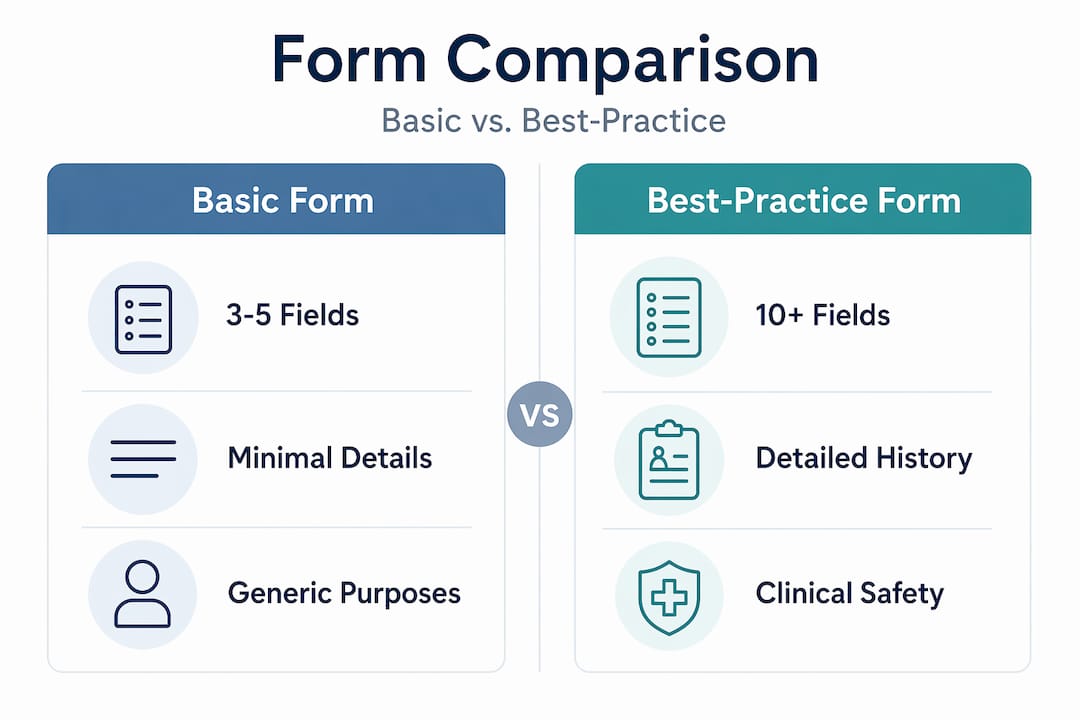
Compare this to a standard contact form, and the difference is significant. Professional intake forms typically contain 10 or more data fields, versus the 3 to 5 fields found in a basic contact form. That depth is what allows a practitioner to assess risk, identify contraindications, and build a genuinely bespoke treatment plan.
| Form type | Typical fields | Primary purpose |
|---|---|---|
| Contact form | 3 to 5 | Name, email, enquiry |
| Consultation form | 10 or more | Medical history, goals, consent, risk disclosure |
Preliminary consultations typically take around 15 minutes, and the form completed beforehand is what makes that time genuinely productive rather than spent collecting basic facts.
Informed consent and client safety
This is where the importance of consultation forms becomes undeniable. A well-completed form does not just inform the treatment. It protects the client and the practitioner.
“Failure to properly document informed consent through consultation forms can result in regulatory sanctions and compromise legal defence in the case of treatment complications.” — Legal standards for consultation documentation
In aesthetic practice, identifying contraindications early is critical. A client who is pregnant, taking blood thinners, or has a history of keloid scarring may not be suitable for certain treatments. Consultation forms gather medical history that helps practitioners avoid these situations before they become clinical problems.
The key safety functions of a consultation form include:
- Contraindication screening, flagging medical conditions that preclude specific treatments
- Allergy identification, particularly relevant for fillers containing lidocaine or animal-derived components
- Chemical and treatment history documentation, capturing previous filler brands or toxin products used
- Informed consent recording, confirming the client understands risks, realistic outcomes, and aftercare requirements
- Legal protection, as forms act as safety nets by documenting client acknowledgement of risks, which reduces liability claims
Pro Tip: Ask clients to complete their consultation form 24 to 48 hours before their appointment. This gives you time to review their responses properly and raises any clinical concerns before they arrive, rather than during a rushed pre-treatment check.
The consultation is also where expectations are managed honestly. Clients who understand what a treatment can realistically achieve are far more satisfied with their results. Clear outcome reporting from consultations builds client trust and provides a defensible record of what was discussed and agreed.
Consultation form best practices for aesthetic clinics
Knowing why consultation forms matter is one thing. Designing and using them effectively is another. Here is how to create consultation forms that genuinely serve both client and practitioner.
-
Include 10 or more fields. Shallow forms miss critical details. Cover medical history, medications, allergies, treatment history, goals, and consent as a minimum.
-
Go digital. Digital consultation forms reduce errors through real-time data input, allow CRM integration, and store client records securely. Paper forms get lost, damaged, or misread.
-
Use conditional logic. Branching question paths show only the questions relevant to a client’s answers, reducing cognitive load and improving completion rates. A client who has never had injectables does not need to answer questions about previous filler brands.
-
Send forms in advance. Completing forms ahead of the appointment on mobile devices reduces wait times and administrative pressure during the visit itself.
-
Integrate scheduling. Embedding calendar tools within the form experience reduces follow-up delays and improves the overall client journey from initial enquiry to booked appointment.
Pro Tip: Review your consultation form template every six months. Regulatory requirements and treatment protocols evolve, and your forms should reflect current best practice. A form designed two years ago may not capture the clinical detail you need today.
| Feature | Basic form | Best-practice form |
|---|---|---|
| Number of fields | 3 to 5 | 10 or more |
| Format | Paper | Digital with CRM integration |
| Logic | Static | Conditional branching |
| Timing | Completed in clinic | Completed 24 to 48 hours before visit |
| Scheduling | Separate process | Integrated within form |
For a thorough walkthrough of how consultation forms fit within a clinical workflow, the aesthetic consultation checklist at Theaestheticsroom offers a practical seven-step framework.
Forms as tools for ongoing client relationships
Here is something most people do not consider: a consultation form is not a one-time document. It is the start of a longitudinal client record. Every treatment decision made over months and years can be traced back to the information captured in those forms.
Secure digital platforms allow longitudinal tracking of client responses, which supports personalised treatment adjustments and long-term risk monitoring. This is where the benefits of consultation forms become truly clear.
In practice, this means:
- Recalling previous product sensitivities before recommending a follow-up treatment, avoiding repeat adverse reactions
- Tracking changes in health status, such as new medications or conditions that affect treatment suitability
- Referencing stated goals from earlier visits to measure progress and adjust the treatment plan accordingly
- Personalising the client experience by demonstrating attention to individual history, which builds genuine trust and loyalty
- Supporting a three-phase workflow that covers pre-visit preparation, in-clinic review, and post-treatment update, optimising both safety and client satisfaction
Practitioners who reference forms from previous visits are better positioned to recall specific sensitivities and tailor recommendations accordingly. Clients notice this. It is the difference between a transaction and a relationship.
The digital shift in consultation forms also aligns with broader healthcare trends. Data security, accessibility, and patient empowerment are now central to clinical standards, and digital records support all three. A client who moves between clinics, or who is seen by a different practitioner, benefits enormously from well-maintained digital consultation records.

For further context on how the full beauty consultation process works in a London aesthetic setting, Theaestheticsroom has published a detailed overview of what clients can expect at each stage.
My perspective: forms are not a formality
I have worked with enough aesthetic clients and practitioners to know that consultation forms are where the real clinical conversation begins. Most people treat them as something to get through before the interesting part starts. That framing is wrong.
In my experience, the quality of a consultation form is one of the clearest signals of how seriously a clinic takes client safety. A rushed, shallow form tells you the practitioner is focused on throughput. A thorough, well-structured form tells you they are focused on you.
What I have found is that consultation forms are business assets, not just compliance tools. When a practitioner references your previous consultation at a follow-up visit, cites your documented sensitivities, and adjusts the plan accordingly, that is not just good medicine. It is the kind of care that turns a one-time client into a long-term one.
The most overlooked benefit is risk avoidance. I have seen cases where a thorough pre-treatment form flagged a medication interaction that would have caused a significant adverse reaction. No dramatic intervention required. Just a well-designed form doing exactly what it was built to do.
My genuine advice: if you are visiting a clinic where the consultation form takes less than five minutes to complete and covers fewer than ten questions, ask more questions yourself. Your safety depends on the depth of that conversation.
— Vishul
Start your treatment journey with confidence
At Theaestheticsroom, every treatment begins with a thorough consultation process. Our forms are designed to capture the clinical detail that keeps you safe and ensures your results are tailored to your specific goals and health profile.
Whether you are exploring Botox for the first time or considering dermal fillers to restore volume and definition, your consultation form is the first step in building a treatment plan that works for you. Our CQC-accredited practitioners review every form with care, using your responses to design a bespoke approach that prioritises safety alongside beautiful, natural-looking results. Book your consultation today, either virtually or in person at our Knightsbridge clinic.
FAQ
What is the main purpose of a consultation form in aesthetics?
A consultation form captures a client’s medical history, allergies, medications, and treatment goals to help a practitioner deliver safe and personalised care. It also documents informed consent, protecting both the client and the practitioner legally.
How many questions should a consultation form include?
Professional aesthetic consultation forms typically contain 10 or more fields to cover all relevant clinical and consent information. Fewer than ten fields generally means critical details are being missed.
Are digital consultation forms better than paper ones?
Yes. Digital forms reduce errors through real-time input, integrate with client management systems, and store records securely for long-term access. They also allow clients to complete forms before their appointment, which improves accuracy and reduces wait times.
Can a consultation form protect me as a client?
Absolutely. By documenting what you disclosed and what you consented to, the form creates a clear record of the discussion between you and your practitioner. This protects you if any disputes arise about what was agreed before treatment.
Why should I update my consultation form for each visit?
Health status, medications, and treatment history change over time. Updating your form at each visit gives your practitioner accurate, current information, which is critical for identifying new contraindications and adjusting your treatment plan safely.
Recommended
- Role of Consultation in Aesthetics: Enhancing Safety and Results – The Aesthetics Room
- Beauty Consultation Process: Ensuring Safe, Tailored Results – The Aesthetics Room
- 7 Key Steps for a Successful Aesthetic Consultation Checklist – The Aesthetics Room
- Safety in Aesthetics – Why It Matters Most – The Aesthetics Room