

TL;DR:
- A structured cosmetic consultation guides patients from initial contact through personalized treatment planning while ensuring compliance with legal standards. Preparing medical histories, reference photos, questions, and clear goals enhances the process, reducing uncertainty and improving outcomes. Effective communication frameworks like AIDET and teach-back improve patient experience and trust during every consultation stage.
A step-by-step patient consultation is a structured clinical process that takes you from initial contact through medical history, goal-setting, and informed consent to a personalised treatment plan. For anyone considering a cosmetic procedure, understanding this process removes uncertainty and helps you arrive prepared. The consultation process steps follow a recognised framework, often documented using SOAP notes (Subjective, Objective, Assessment, Plan), and are shaped by UK legal standards including the Montgomery ruling on informed consent.
What should you prepare before your cosmetic consultation?
Preparation before your appointment directly shapes how productive the consultation will be. Clinicians encourage new patients to complete health history forms before the visit, which speeds up history-taking and allows the practitioner to focus on your specific concerns from the first minute.
Gather the following before you attend:
- Medical history forms: Complete these via the clinic’s patient portal if available. Include all current medications, supplements, allergies, and previous treatments.
- A medication list: Note dosages and frequency. Blood thinners and certain supplements can increase bruising risk with injectable treatments, so your clinician needs this information to advise you correctly.
- Reference photos: Bring images from a time when you felt your best. For skin or face-focused consultations, arriving without makeup and presenting clear photos aids accurate assessment and realistic expectation-setting.
- A written list of questions and concerns: Noting your priorities in advance prevents you from forgetting key points under the pressure of the appointment.
- Your goals, stated clearly: Think about what outcome you want, not just the treatment name. “I want to look less tired” is more useful than “I want Botox.”
Pro Tip: Prepare a short chronological summary of your aesthetic concerns, noting when they started and what has changed. This timeline of concerns speeds up targeted questioning and improves history accuracy significantly.
Arriving prepared signals to your clinician that you are engaged and serious. It also gives you more time to discuss options rather than spending the appointment on administrative catch-up.

Step-by-step overview of the patient consultation process
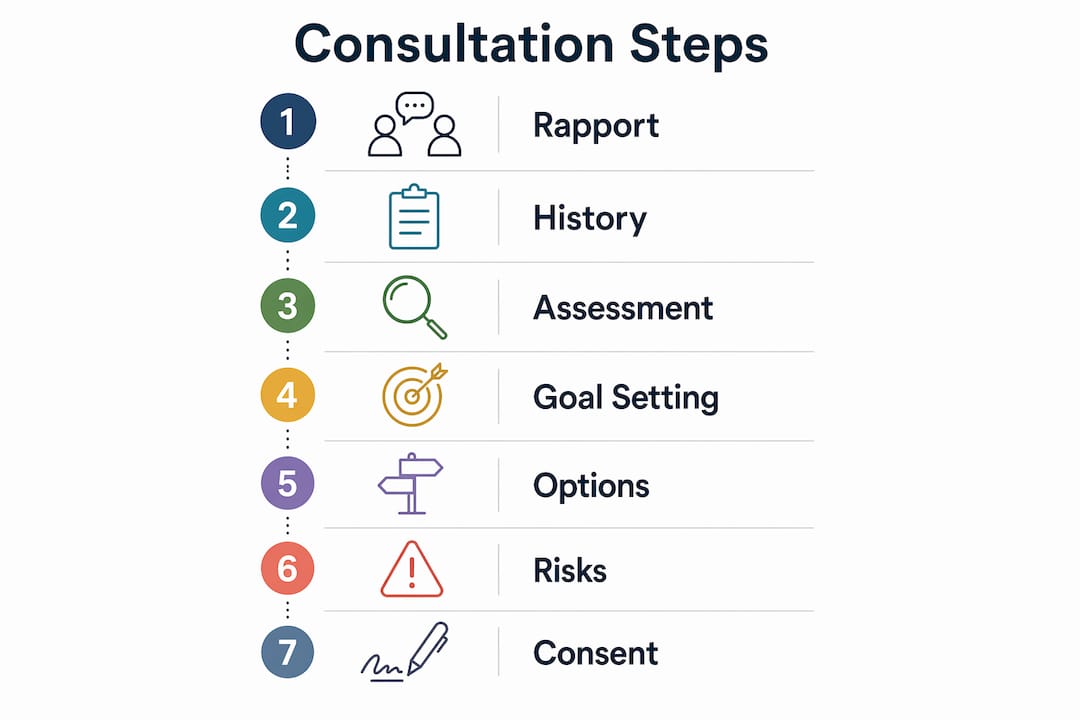
A full cosmetic consultation typically moves through seven sequential stages, each with a distinct purpose and approximate time allocation. Understanding what happens at each stage removes anxiety and helps you participate actively.
The seven stages explained
-
Establishing rapport (5 minutes). Your practitioner introduces themselves, confirms your name, and creates a comfortable atmosphere. This is not small talk. It sets the tone for honest, open communication throughout the appointment.
-
Agenda-setting (5 minutes). The clinician asks what you would like to address today. Inviting patient priorities early in the consultation improves trust and often reveals real concerns beyond the official chief complaint. You should use this moment to raise everything on your list.
-
Medical history review (10–15 minutes). Your completed forms are reviewed and verified. The clinician asks follow-up questions about medications, allergies, previous procedures, and relevant medical conditions. Honesty here is non-negotiable. Undisclosed medications or conditions can affect treatment safety.
-
Physical examination and assessment (10–15 minutes). The clinician examines the area of concern. For facial aesthetics, this includes assessing skin quality, muscle movement, facial symmetry, and volume distribution. Photos may be taken for your clinical record.
-
Goals discussion and treatment options (10–15 minutes). Your practitioner explains what is achievable, presents treatment options, and discusses the likely outcomes of each. This is the stage to ask about alternatives, including doing nothing.
-
Risks, contraindications, and costs (5–10 minutes). All material risks are disclosed. Under the Montgomery ruling, clinicians must disclose risks material to your decision, not just those they personally consider significant. Costs are confirmed at this stage.
-
Consent and closing (5–10 minutes). You receive documentation to review. In the UK, cooling-off periods of 24–48 hours are mandatory for cosmetic procedures. You sign consent forms only after this period, confirming your decision is voluntary and fully informed.
| Consultation stage | Typical duration | Your role |
|---|---|---|
| Rapport and introductions | 5 minutes | Listen, ask clarifying questions |
| Agenda-setting | 5 minutes | Share your full list of concerns |
| Medical history review | 10–15 minutes | Answer honestly, disclose all medications |
| Physical examination | 10–15 minutes | Arrive without makeup if advised |
| Goals and treatment options | 10–15 minutes | Ask about alternatives and outcomes |
| Risks, contraindications, costs | 5–10 minutes | Note all risks discussed |
| Consent and closing | 5–10 minutes | Review documents, ask final questions |
Pro Tip: Do not sign consent forms at the same appointment as your initial discussion. The mandatory cooling-off period exists to protect you. Use it to re-read all documentation and confirm your decision without pressure.
The entire process is typically documented in SOAP format, which structures clinical notes into Subjective (your reported concerns), Objective (examination findings), Assessment (diagnosis or clinical impression), and Plan (agreed treatment). This structure supports continuity of care if you return for follow-up appointments.
How do communication techniques improve your consultation experience?
Effective communication during a cosmetic consultation is not accidental. Clinicians trained in structured frameworks deliver a measurably better patient experience. The AIDET framework is one of the most widely used models in medical settings. It reduces patient anxiety and creates predictable, supportive interactions.
AIDET stands for:
- Acknowledge: The clinician greets you by name and acknowledges your presence and concerns.
- Introduce: They introduce themselves, their role, and their qualifications.
- Duration: They explain how long the consultation will take and what to expect.
- Explanation: They describe each step clearly before proceeding, using plain language.
- Thank You: They close by thanking you for attending and confirming next steps.
Each step serves a specific function. The Duration and Explanation steps are particularly valuable for patients who feel anxious about medical appointments. Knowing what comes next reduces uncertainty.
Alongside AIDET, the teach-back method confirms your understanding. Teach-back improves patient self-efficacy and adherence to post-treatment instructions. Your clinician asks you to repeat key information back in your own words. This is not a test. It is a safety check that confirms both parties share the same understanding. If you cannot recall a key instruction, the clinician clarifies immediately rather than assuming you understood.
Agenda-setting, discussed earlier as a consultation stage, also functions as a communication tool. When a clinician asks “What can I do for you today?” and genuinely listens to the full answer, it shifts the dynamic from a one-way clinical assessment to a collaborative conversation. You become an active participant rather than a passive recipient.
What are the common pitfalls in cosmetic consultations?
Most problems in cosmetic consultations trace back to a small number of avoidable mistakes. Recognising them in advance puts you in a much stronger position.
- Incomplete disclosure. Failing to mention medications, supplements, or previous reactions is the most common and most dangerous error. Clinicians cannot assess your suitability for treatment without complete information. This includes herbal supplements, which many patients overlook.
- Unclear goals. Arriving with a vague idea of wanting to “look better” makes it difficult for your clinician to propose a targeted plan. The more specific your goals, the more useful the consultation becomes.
- Assuming outcomes. Photos of celebrities or influencers are useful reference points, but they are not guarantees. Your anatomy, skin quality, and starting point determine what is achievable. A good clinician will manage expectations honestly.
- Skipping the consent review. Consent documentation exists to protect you. Reading it carefully, including the sections on risks and aftercare, is not optional. If anything is unclear, ask before signing.
- Attending alone when anxious. There is no rule against bringing a trusted person to your consultation. A second pair of ears helps you retain information and ask questions you might otherwise forget.
Pro Tip: Bring a notebook or use your phone to take notes during the consultation. You will retain far more of the discussion, and your notes become a useful reference when reviewing consent documents at home.
Choosing the right clinic matters as much as preparing well. Understanding how to choose an aesthetic clinic before you book ensures your consultation takes place in a regulated, qualified environment where these standards are upheld.
Key takeaways
A structured patient consultation is the single most important safeguard between you and a cosmetic procedure that is right for your goals, health, and anatomy.
| Point | Details |
|---|---|
| Prepare thoroughly beforehand | Complete health history forms, bring photos, and write down your questions before attending. |
| Follow the seven-stage process | Each stage from rapport to consent has a distinct purpose; engage actively at every step. |
| Understand UK consent law | Cooling-off periods of 24–48 hours are mandatory; never sign consent at the same appointment as your initial discussion. |
| Use communication frameworks | AIDET and teach-back exist to support you; ask for clarification whenever something is unclear. |
| Disclose everything honestly | Incomplete medical history is the most common and most preventable consultation risk. |
What I have learned from watching consultations go wrong
After years working in medical aesthetics, the pattern I see most often is not clinical error. It is a breakdown in preparation and communication before anything clinical even begins. Patients arrive having done extensive research online, but they have not written down their actual concerns. They know the name of the treatment they want, but they cannot articulate the outcome they are hoping for. That gap between treatment name and desired result is where most dissatisfaction originates.
The Montgomery ruling changed the consent landscape in the UK permanently. Post-Montgomery, clinicians must disclose all material risks relevant to a reasonable patient’s decision, not just the risks they personally consider worth mentioning. This is a significant shift. It means the consultation is no longer a formality before treatment. It is a legal and ethical process in its own right.
What I find most encouraging is how much power patients actually have in this process when they use it. Agenda-setting, teach-back, the cooling-off period, the right to ask about alternatives including doing nothing. These are not bureaucratic obstacles. They are tools. The patients who arrive prepared, ask direct questions, and take the cooling-off period seriously consistently report better outcomes and higher satisfaction, regardless of the specific treatment they choose.
The consultation is not the preamble to the procedure. It is the procedure’s foundation. Get it right and everything that follows is built on solid ground.
— Vishul
Theaestheticsroom: consultations built around you
At Theaestheticsroom, every cosmetic consultation follows the structured, compliance-led process described in this guide. Our clinicians are trained in informed consent standards aligned with CQC requirements, and we apply the mandatory cooling-off period as standard practice, not as a formality.
Whether you are considering Botox treatments for the first time or returning to explore a new treatment option, your consultation at Theaestheticsroom begins with a thorough assessment of your goals, medical history, and suitability. Our Knightsbridge clinic, with additional locations on Harley Street and in Mayfair, offers both in-person and virtual consultations. Book yours today and arrive knowing exactly what to expect.
FAQ
What happens at a first cosmetic consultation?
A first cosmetic consultation covers medical history, a physical assessment, goal-setting, treatment options, risks, and consent documentation. The full process typically takes 45–60 minutes depending on the complexity of the treatment being discussed.
How long is the cooling-off period for cosmetic procedures in the UK?
The mandatory cooling-off period for cosmetic procedures in the UK is 24–48 hours. Consent must be documented and signed after this period, not at the same appointment as the initial consultation.
What should I bring to my patient consultation?
Bring a completed medical history form, a full medication and supplement list, reference photos, and a written list of your questions and goals. Arriving without makeup is advisable for face-focused assessments.
What is the AIDET framework in patient consultations?
AIDET stands for Acknowledge, Introduce, Duration, Explanation, and Thank You. It is a structured communication model used by clinicians to reduce patient anxiety and improve shared understanding during consultations.
Can I bring someone with me to my cosmetic consultation?
Yes. Bringing a trusted person to your consultation is encouraged, particularly if you feel anxious. A second listener helps you retain information and supports more confident decision-making during the consent process.
Recommended
- What is a medical consultation? A clear guide – The Aesthetics Room
- 7 Key Steps for a Successful Aesthetic Consultation Checklist – The Aesthetics Room
- Role of Consultation in Aesthetics: Enhancing Safety and Results – The Aesthetics Room
- Beauty Consultation Process: Ensuring Safe, Tailored Results – The Aesthetics Room