

You have probably seen the words ‘medical-grade’ on a serum or moisturiser and assumed it meant something official. It does not. The term carries no legal definition in the UK, and the label is unregulated, meaning any brand can print it on packaging regardless of what is inside. That gap between marketing and genuine science is exactly why so many Londoners spend significant sums on products that underdeliver. This guide cuts through the noise, explains what truly separates evidence-backed formulations from cosmetic shelf-fillers, and helps you make confident, informed choices about your skin.
Table of Contents
- What does ‘medical-grade skincare’ actually mean?
- How medical-grade skincare works: Ingredients and science
- Evidence: What do clinical studies and real results show?
- Who benefits most from medical-grade skincare?
- Medical-grade, cosmetic or cosmeceutical: What actually matters?
- How to safely start and optimise a medical-grade regimen
- Your next step: Expert consultation and advanced skin solutions in London
- Frequently asked questions
Key Takeaways
| Point | Details |
|---|---|
| Label is not regulated | The term ‘medical-grade’ is unregulated—evidence and formulation matter most. |
| Active ingredients drive results | High-quality actives at effective concentrations deliver the biggest improvements. |
| Professional support enhances safety | Skincare results and safety are greatly improved by consulting a qualified practitioner. |
| Clinical results require consistency | Best effects are seen with consistent use over 12 or more weeks, not overnight. |
What does ‘medical-grade skincare’ actually mean?
The phrase sounds authoritative, but the term is not regulated by the FDA in the United States or the MHRA here in the UK. Any brand can use it. That is the uncomfortable truth.
What genuinely distinguishes higher-performing products is not the label but the formulation. Medical-grade products typically feature higher concentrations of active ingredients, pharmaceutical-grade purity, advanced delivery systems, peer-reviewed clinical research, and professional dispensing channels. These are meaningful differences, but they must be verified rather than assumed.
The cosmeceuticals category sits between standard cosmetics and prescription medicines, and it is where most ‘medical-grade’ products actually live. Understanding this helps you ask better questions before purchasing.
‘Any brand can use the term — so clinical backing and formulation quality matter most.’
What to look for in evidence-backed products:
- Proven actives at clinically effective concentrations (not trace amounts)
- Peer-reviewed studies supporting the specific formulation
- Pharmaceutical-grade purity with minimal unnecessary fillers
- Professional or clinic-based dispensing with guidance
- Transparent ingredient lists with percentages where possible
How medical-grade skincare works: Ingredients and science
With terms clarified, the next step is understanding the real science, not just the labels.
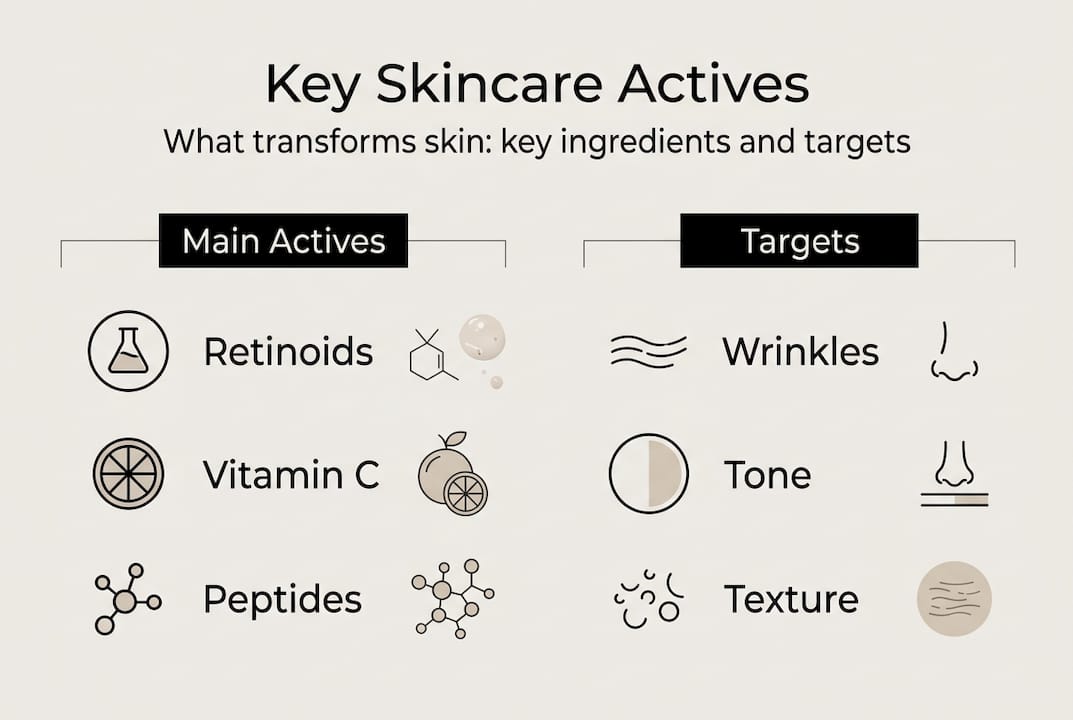
The most impactful actives work at a cellular level. Retinoids boost cell turnover and stimulate collagen production. Peptides send repair signals to fibroblasts, the cells responsible for producing structural proteins. Antioxidants such as vitamin C neutralise reactive oxygen species (ROS), which are unstable molecules that accelerate skin ageing. Each mechanism is distinct, and combining them strategically amplifies results.

Concentration matters enormously. A vitamin C serum at 5% will not produce the same outcome as one at 15% or 20% with the correct pH. Similarly, delivery systems like liposomes and encapsulation technology allow actives to penetrate the dermis rather than sitting on the skin’s surface, which is where real structural change occurs.
If you are unsure whether retinoids are suitable for your skin type, a professional assessment is always the safest starting point. The anti-ageing science behind these ingredients is well established, but individual tolerance varies considerably.
Common actives in medical-grade versus cosmetic products:
- Retinoids (tretinoin, retinol, retinaldehyde)
- Stabilised vitamin C (L-ascorbic acid at effective pH)
- Niacinamide at 5% or above
- Peptides (Matrixyl, Argireline, copper peptides)
- Azelaic acid, kojic acid, and tranexamic acid for pigmentation
- Growth factors and exosomes in advanced formulations
| Active ingredient | Primary target | Typical effective concentration |
|---|---|---|
| Retinoids | Fine lines, cell turnover | 0.025%–1% (prescription up to 0.1% tretinoin) |
| Vitamin C | Brightening, antioxidant | 10%–20% L-ascorbic acid |
| Peptides | Firmness, repair signalling | Varies by peptide type |
| Niacinamide | Tone, pore appearance | 5%–10% |
| Azelaic acid | Pigmentation, redness | 10%–20% |
Pro Tip: When reading a label, ingredients are listed in descending order by concentration. If a key active appears near the bottom of a long list, it is likely present in amounts too small to produce a clinical effect.
Evidence: What do clinical studies and real results show?
Understanding the mechanisms means little without proof, so the evidence must speak for itself.
The data is genuinely encouraging. Thiamidol 0.2% cream produced a 36.1% reduction in hyperpigmentation compared to just 16.1% with placebo at 12 weeks. A multi-product regimen targeting photodamage and hyperpigmentation showed significant improvements sustained over 24 weeks. These are not anecdotal claims; they are controlled trial outcomes.
Separate research found up to 74% wrinkle improvement and a 16.7% gain in skin tone evenness when combining advanced formulations with professional treatments. The lesson is clear: consistency and correct formulation drive results, not price tags alone.
For those exploring retinoids and anti-ageing protocols, clinical evidence consistently supports their use as a cornerstone of any serious regimen. The peptide benefits documented in research further reinforce the value of combining actives intelligently.
| Active or regimen | Outcome measured | Result vs. control |
|---|---|---|
| Thiamidol 0.2% | Hyperpigmentation reduction | 36.1% vs. 16.1% (placebo) |
| Multi-product regimen | Photodamage improvement | Significant at 24 weeks |
| Hydroxypropyl + niacinamide | Wrinkle depth | Up to 74% improvement |
| Combined formulation | Skin tone evenness | +16.7% gain |
Typical improvements with consistent medical-grade use:
- Reduced pigmentation and dark spots within 12 weeks
- Increased skin firmness and elasticity over 16–24 weeks
- Smoother texture and refined pore appearance
- More even skin tone and improved radiance
- Reduced fine line depth with sustained retinoid use
Who benefits most from medical-grade skincare?
Knowing the benefits leads to the personal question: is medical-grade right for you?
Those who see the most meaningful results tend to have specific, persistent concerns. Challenging acne, stubborn pigmentation, and visible age-related changes respond particularly well to higher-strength formulations. If over-the-counter products have consistently failed to move the needle, medical-grade options are worth exploring with professional support.
That said, not everyone should dive straight in. Genetics account for up to 60% of skin response, which means prescription-level strength is not universally necessary or appropriate.
‘Genetics account for up to 60% of how your skin will respond — not everyone needs prescription-level strength.’
Groups who should exercise caution:
- Those who are pregnant or breastfeeding (retinoids and certain acids are contraindicated)
- Individuals with active rosacea or highly reactive, sensitised skin
- Anyone with known allergies to specific actives or preservatives
- Those currently using prescription topicals without medical oversight
- People with compromised skin barriers who have not yet addressed foundational hydration
The essential skincare actives that suit your skin depend heavily on your individual profile. We always recommend seeing an expert before committing to a high-strength regimen, and our aesthetics best practices guide offers further context on safe, personalised approaches.
Pro Tip: Book a skin consultation before purchasing. A trained practitioner can identify your skin type, flag contraindications, and recommend a regimen that is genuinely matched to your concerns rather than a generic off-the-shelf solution.
Medical-grade, cosmetic or cosmeceutical: What actually matters?
To spend wisely and see results, you must know what is mere branding and what delivers true value.
The honest answer is that no FDA or UK regulation enforces the ‘medical-grade’ label. Efficacy relies entirely on peer-reviewed formulation evidence and correct dispensing, not on what the box says. A well-formulated cosmeceutical with published clinical data can outperform a poorly made ‘medical-grade’ product every time.
The cosmeceutical meaning is worth understanding: these are products that bridge cosmetics and pharmaceuticals, often containing bioactive ingredients at concentrations that produce measurable skin changes. They are not prescription medicines, but they are a step above standard cosmetics in formulation intent.
For seasonal adjustments, our autumn skincare tips offer practical guidance on adapting your regimen as conditions change.
| Category | Clinical evidence required | Dispensing channel | Typical cost range |
|---|---|---|---|
| Standard cosmetic | None | Retail, online | £10–£80 |
| Cosmeceutical | Often cited, not mandatory | Clinic, specialist retail | £40–£200 |
| Medical-grade (claimed) | Varies widely | Clinic or professional | £60–£400+ |
| Prescription topical | Mandatory | Pharmacy, prescriber | Variable |
Checklist to verify genuine clinical backing:
- Published peer-reviewed studies on the specific product or formulation
- Active ingredients listed with concentrations, not just names
- Dispensed or recommended by a qualified practitioner
- No vague claims such as ‘clinically inspired’ or ‘dermatologist-tested’ without data
- Transparent brand with accessible research references
How to safely start and optimise a medical-grade regimen
With clarity on choosing wisely, the final step is putting advanced skincare into practical, safe use for visible gains.
Regimen consistency and correct sequencing are what separate those who see transformative results from those who experience irritation and give up. Rushing the process is the most common mistake.
Step-by-step guide to starting safely:
- Patch test first. Apply a small amount of any new active to the inner arm for 48 hours before full facial use.
- Introduce one active at a time. Wait two to four weeks before adding another product to your routine.
- Start low, build gradually. Begin with lower concentrations of retinoids or acids and increase as your skin adapts.
- Consult a professional. A practitioner can map your skin’s baseline and recommend a sequenced plan tailored to your goals.
- Layer correctly. Apply thinnest to thickest consistency: serums before moisturisers, actives before SPF in the morning.
- Protect with SPF daily. Many actives increase photosensitivity; SPF 30 or above is non-negotiable.
Our anti-ageing routine guide and safe skincare steps resource both offer detailed sequencing advice for London clients. For those interested in boosting results further, the ampoule guide explains how concentrated treatment ampoules can complement a regimen.
Pro Tip: Combining medical-grade skincare with professional in-clinic treatments such as laser resurfacing or chemical peels can amplify results significantly. Clinical data shows that the combination approach consistently outperforms either strategy used alone.
Avoid the temptation to layer multiple strong actives from day one. Retinoids, AHAs, and vitamin C used simultaneously without acclimatisation frequently cause barrier disruption, redness, and peeling that sets your skin back rather than forward.
Your next step: Expert consultation and advanced skin solutions in London
You are now equipped with the evidence to make genuinely informed decisions about your skincare. The next step is putting that knowledge into action with professional support.

At The Aesthetics Room, our practitioners in Knightsbridge combine medical-grade product knowledge with advanced in-clinic treatments to create bespoke regimens that deliver real, measurable results. Whether you are considering dermal fillers in London, exploring our skin rejuvenation guide, or simply seeking clarity on where to begin, our trusted medical practitioners are here to guide you safely. Book a consultation today and take the first confident step towards skin that genuinely reflects how you want to feel.
Frequently asked questions
Are medical-grade skincare products safer than regular cosmetics?
They are not inherently safer. Higher concentrations of actives can deliver greater benefit but also carry a higher risk of irritation without proper professional guidance and a structured introduction plan.
What ingredients should I look for in medical-grade skincare?
Prioritise proven actives at effective concentrations. Retinoids, peptides, and antioxidants are the science-backed core trio, supported by the strongest body of clinical evidence available.
Does ‘medical-grade’ guarantee better results for everyone?
Not at all. Results depend on your individual skin type, the product’s actual formulation, and consistent correct use. Genetics and skin type significantly influence how your skin responds, and medical-grade is not always superior to a well-formulated over-the-counter option.
How long before I see effects from medical-grade skincare?
Most people notice initial changes within 4 to 12 weeks, with the most significant improvements appearing at 12 to 24 weeks. Clinical trials confirm that progressive gains continue without plateau up to 24 weeks of consistent use.
Should I consult a professional before starting a medical-grade regimen?
Yes, always. Individual consultations improve safety and allow a practitioner to personalise your regimen, reducing the risk of adverse reactions and ensuring you invest in products that are genuinely suited to your skin.
Recommended
- Why tailored skincare transforms luxury skin health – The Aesthetics Room
- Skin analysis: The key to radiant, effective results – The Aesthetics Room
- Anti-Aging Skincare Workflow for Radiant Complexion – The Aesthetics Room
- Master your at-home skincare workflow for radiant skin – The Aesthetics Room
- Τι είναι τα peptide creams: Οδηγός επιλογής και οφέλη 2026 – MakeUp Closet