
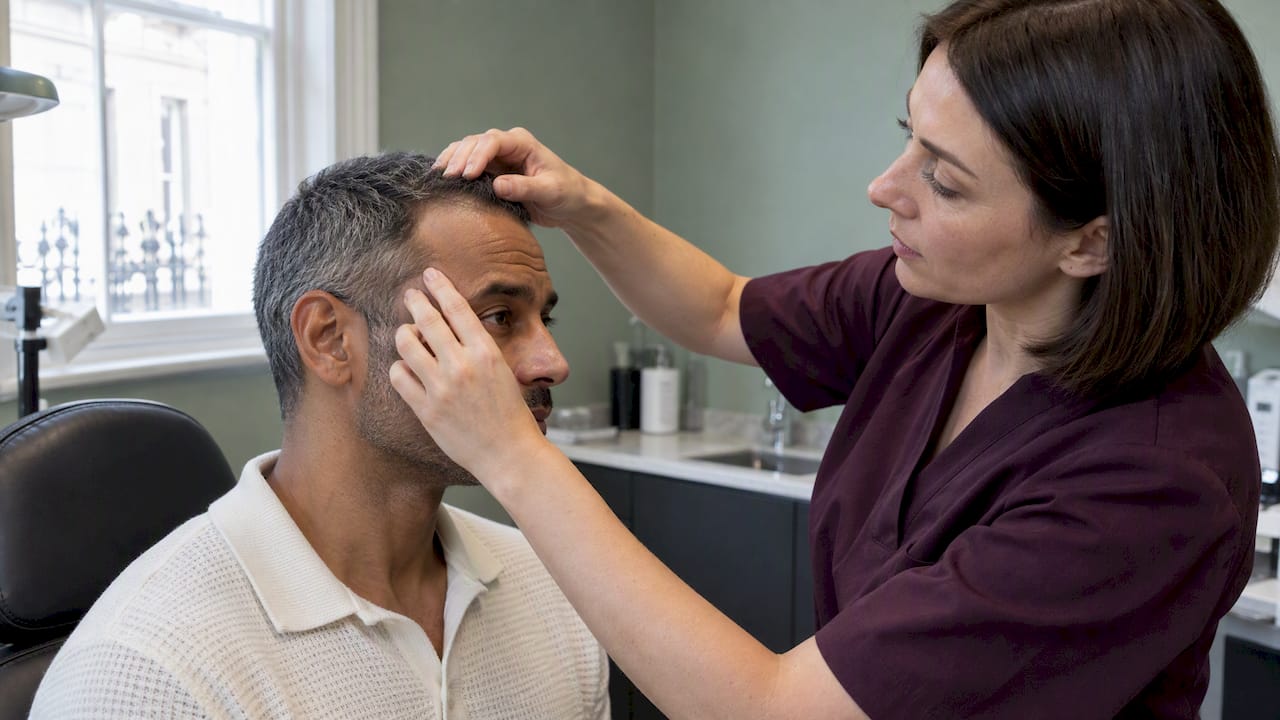

If the hair at your temples is thinning, the most likely cause is male pattern hair loss, also called androgenetic alopecia. It is common, it is slow, and it responds best when it is identified early. The first step is to confirm the cause. The second is to choose a treatment you are willing to keep up for years, because most of them only work while you use them.
This guide explains what is happening at the follicle, how to tell pattern loss from other causes, which treatments have established evidence, where regenerative treatments such as PRP fit, and what to expect from a consultation.
TL;DR
- Thinning or receding at the temples is often the first sign of male pattern hair loss, which affects around 50% of men by the age of 50.
- See your GP first. Sudden, patchy or itchy hair loss can have other causes that need different treatment.
- Finasteride and 5% minoxidil are the established medical treatments. Both need months of use and only work while you continue.
- Finasteride carries MHRA safety warnings that you should read before you start.
- PRP and hair vitamin therapy are supportive options for some men. We offer both in London and will tell you plainly what to expect.
Table of Contents
- What is happening when your temples thin
- Is it receding temples or something else?
- The established medical treatments
- Hair transplants: redistribution, not a cure
- Where PRP and hair vitamin therapy fit
- Our perspective
- What to expect from a consultation
- Practical steps for the next three months
- Our hair treatments and prices
- FAQ
- Sources
What is happening when your temples thin
Male pattern hair loss is caused by a combination of genes and hormones. In susceptible follicles, the hormone dihydrotestosterone gradually shrinks the follicle. Each growth cycle produces a shorter, finer hair, until the follicle may produce little or nothing. This is why the thinning looks like fine, wispy hair first rather than hair suddenly dropping out.
The British Association of Dermatologists describes a recognised pattern: recession often begins at the temples before thinning appears on the crown. It is a slow, progressive condition that can unfold over years or decades. That timescale matters. A bad week in the mirror does not mean you will be bald in a year, and a quick fix is rarely what the evidence supports.
The temples are often first because the follicles there are especially sensitive to hormonal signals. The result is the classic M shape, where the hairline recedes at both sides while the centre holds.
Is it receding temples or something else?
Not all thinning is pattern loss. The NHS notes that it is normal to lose 50 to 100 hairs a day, and that hair loss is usually not a worry but can occasionally signal a medical condition. MyHealth Devon lists common types including male pattern hair loss, alopecia areata (an autoimmune condition) and telogen effluvium, a temporary acceleration of normal shedding.
These clues point towards pattern loss:
- A gradual change over months or years, not days
- Thinning mainly at both temples and later the crown
- Shorter, finer hairs along the hairline
- Close relatives with similar loss
- No pain, scaling, redness or bald patches
These clues suggest you should see a doctor promptly:
- Sudden or rapid shedding after illness, stress, surgery or a new medicine
- Round, smooth bald patches
- An itchy, sore or flaky scalp
- Hair loss alongside tiredness, weight change or other symptoms
NHS and dermatology guidance both point towards a GP assessment before you spend money at a commercial clinic. That is sound advice, and we give it ourselves. A temporary cause will not respond to pattern loss treatments, and treating the wrong thing wastes months.
The established medical treatments
Two treatments are well established for male pattern hair loss, according to the British Association of Dermatologists.
| Treatment | Form | Time before benefit is judged | Key point |
|---|---|---|---|
| Minoxidil 5% | Topical solution or foam | Typically 6 to 12 months | Works only while you keep using it |
| Finasteride | Oral tablet | Up to 14 months | Prescription medicine with MHRA safety warnings |
Minoxidil
Minoxidil is applied to the scalp. Many men are caught off guard by the early phase: an increase in shedding is common in the first 4 to 6 weeks, before new, thicker hair begins to grow. If you stop in week five because it seems to be making things worse, you will never find out whether it would have worked.
Be realistic about timing. Plan to assess results after six to twelve months, ideally with photographs taken in the same light each month.
Finasteride
Finasteride reduces the hormonal effect on follicles. Benefits can take up to 14 months to judge. It is a prescription medicine, and the safety information is important. The MHRA has strengthened its warnings: finasteride is associated with depression, suicidal ideation and sexual dysfunction, which may persist after treatment is stopped. Prescribers should explain the risks at the point of prescribing, and patients are advised to read the patient alert card in the pack.
These effects are reported as rare, but you should know about them. If you notice low mood, thoughts of self-harm, or a drop in libido or erectile problems, the MHRA advises contacting your GP. Do not start finasteride without a conversation with a doctor about whether it is right for you.
They are maintenance, not cures
The British Association of Dermatologists is clear that benefits from both treatments are kept only as long as you continue. Stopping typically lets the underlying process resume. Decide at the outset whether you can commit to daily use for years. If not, that is a perfectly valid reason to consider other routes, including a different styling approach.
What about supplements?
Men often ask whether vitamins can stop temple thinning. Nutrition matters for healthy hair, and deficiencies can cause shedding, but supplements do not switch off the hormonal cause of pattern loss. If you want to understand the evidence on biotin and hair loss, read it before buying anything, and ask your GP about blood tests if you suspect a deficiency.
Hair transplants: redistribution, not a cure
Surgical transplantation is a private, non-NHS procedure. It moves follicles from the back and sides of the scalp, which are more resistant, to thinning areas. As the British Association of Dermatologists makes clear, it redistributes the hair you have. It does not stop the ongoing progression of pattern loss in areas that were not transplanted, which is why many surgeons recommend continuing medical treatment alongside it.
If you are considering surgery, look for a surgeon registered with the General Medical Council, ask to see results on hairlines like yours, and be wary of any clinic that guarantees a full restoration.
Where PRP and hair vitamin therapy fit
Platelet-rich plasma (PRP) uses a small sample of your own blood. It is spun to concentrate the platelets, then injected into the scalp. The aim is to support follicles in thinning areas. We offer PRP for hair at 450 GBP per session, and Vitamin Hair Therapy at 218 GBP.
We want to be straightforward about what these are. PRP is not a replacement for finasteride or minoxidil, and we do not claim it cures pattern hair loss or regrows a hairline that has fully receded. It suits some men who want a supportive, non-surgical option, who prefer not to rely only on daily medication, or who want to use it alongside a medical regime their GP has agreed. Follicles that have already stopped producing hair are unlikely to respond. Results vary between individuals, and a course of sessions is usually discussed during consultation.
If you want to understand how we assess PRP for hair thinning in a different context, our article on PRP and postpartum hair loss explains when it helps and when waiting is the better choice. The same honest principle applies to men: timing and cause matter.
Our perspective
We see many men who come in having waited a long time to ask about their hairline. Most are worried less about the hair itself than about not knowing what is normal. Our view is simple.
First, get the diagnosis right. We will always suggest a GP check where the pattern is not clearly gradual, or where there are other symptoms. A clinic that sells treatment without asking why you are losing hair is not looking after you.
Second, treat the cause with the strongest evidence first. For most men with temple thinning that means a conversation about minoxidil and finasteride with a prescriber. We will explain the MHRA safety information plainly and never push you towards a decision.
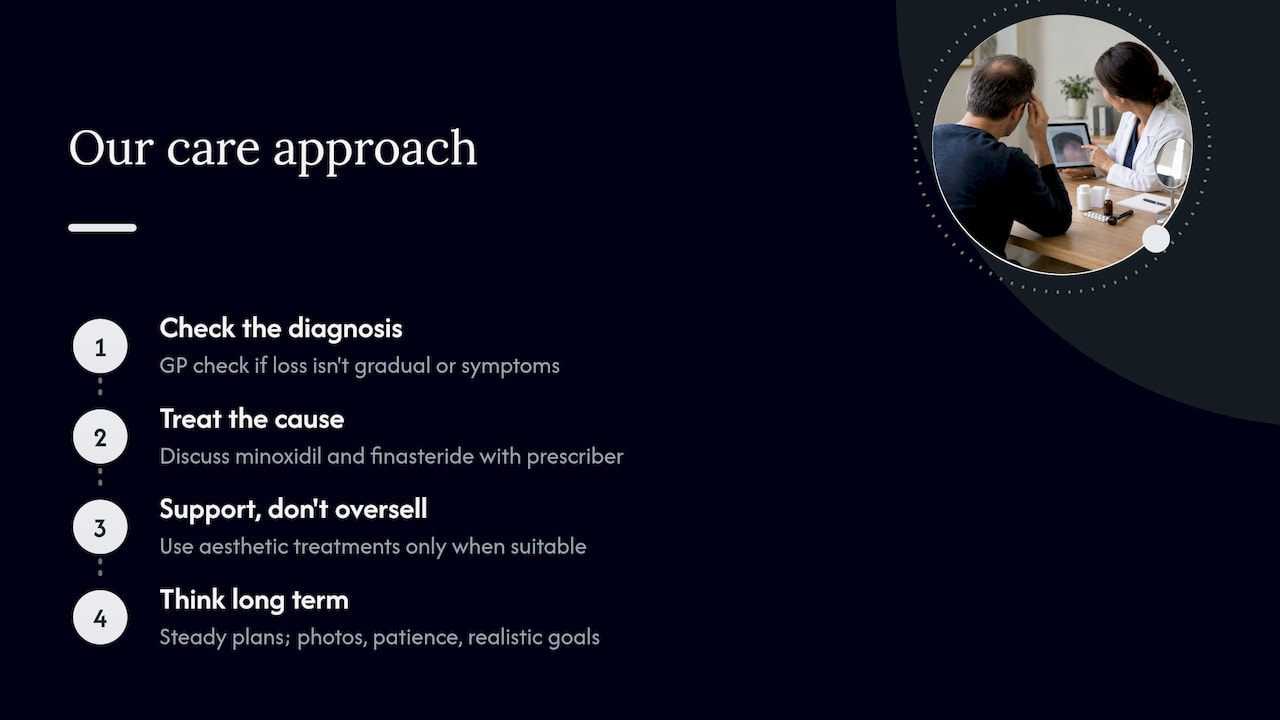
Third, use aesthetic treatments to support, not to oversell. We are a CQC-registered clinic and a member of the ACE Group, which is dedicated to patient safety. All treatments are carried out by medically trained professionals, and each plan is bespoke. If PRP or Vitamin Hair Therapy is not right for you, we will say so.
Finally, think long term. Pattern loss is slow, so the best plans are steady and easy to maintain. Photographs, patience and realistic goals matter more than any single product.
— Vishul
What to expect from a consultation
A good hair consultation should feel like a medical conversation, not a sales pitch. Expect questions about:
- How long you have noticed changes, and how fast
- Family history of hair loss
- Your general health, medicines and any recent illness
- Previous treatments and how long you used them
- Your goals: slowing loss, thickening, or restoring density
The practitioner will examine the scalp and hairline, and may suggest blood tests or a GP referral. You should leave knowing which type of hair loss you have, what each option involves, how long before you can judge results, and what it costs. Our guide to London aesthetic consultations sets out what to ask and what to bring.
We offer virtual and in-person consultations, so you can start with a conversation from home.
Practical steps for the next three months
- Photograph your hairline. Same light, same angle, dry hair, once a month.
- Book a GP appointment if the loss is sudden, patchy or accompanied by other symptoms, or if you want to discuss finasteride.
- Decide on a baseline treatment with a prescriber and commit to at least six to twelve months for minoxidil, or longer for finasteride, before judging.
- Do not stop early because of initial shedding with minoxidil.
- Consider supportive treatment such as PRP once the cause is confirmed.
- Review at six months using your photographs, not memory.
Our hair treatments and prices
If you would like professional support for thinning hair, these are the treatments we list on our price list:
- PRP, Hair: 450 GBP
- Vitamin Hair Therapy: 218 GBP
- PRP, Facial Hair: 258 GBP
Our clinics are in Knightsbridge, Harley Street and Mayfair. You can book a consultation with us online and we will talk through what is realistic for your hairline.
FAQ
Can you reverse temple balding?
Follicles that have fully stopped producing hair are unlikely to recover on their own. Treatments such as minoxidil and finasteride aim to slow loss and may thicken miniaturised hair, but benefits last only while you keep using them. Surgical transplantation is the option that moves hair into receded areas, and it is a private procedure.
Is thinning at the temples always male pattern baldness?
No, though it is the most common cause. Stress, illness, medicines, scalp conditions and alopecia areata can also thin hair. If the change is sudden, patchy or itchy, see your GP before starting any treatment.
How long does it take to see results from treatment?
The British Association of Dermatologists says minoxidil typically needs 6 to 12 months and finasteride up to 14 months. Expect more shedding in the first weeks of minoxidil. Judge progress by monthly photographs rather than daily mirror checks.
Is finasteride safe?
It is widely prescribed, but the MHRA warns that it is associated with depression, suicidal thoughts and sexual dysfunction, which may persist after stopping. Read the patient alert card in the pack, and contact your GP promptly if you notice any of these symptoms. Discuss the risks with a prescriber before you begin.
Sources
- NHS: Hair loss
- British Association of Dermatologists: Male pattern hair loss
- MyHealth Devon: Alopecia (hair loss)
- Gloucestershire Hospitals NHS: Minoxidil for hair loss
- GOV.UK: Finasteride and dutasteride updated safety warnings
- GOV.UK: Men on finasteride asked to stay vigilant