

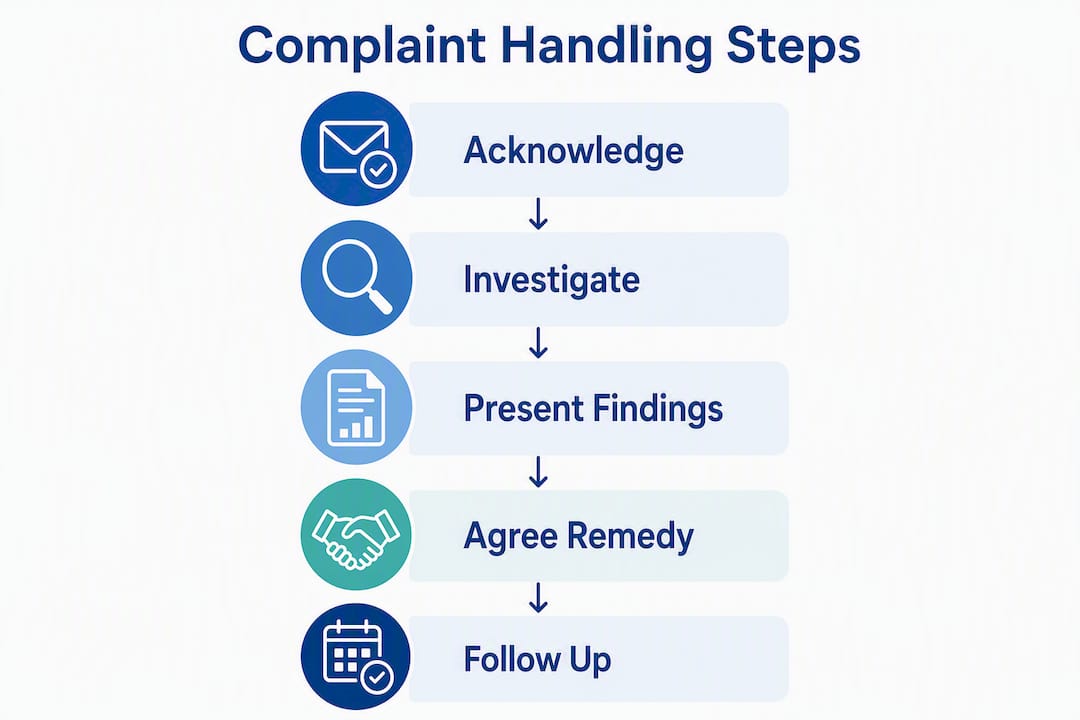
When a complaint arrives, your first 24–48 hours determine whether it resolves quietly or escalates into a formal claim. Acknowledge the concern in writing within 24 hours, triage its severity, notify your indemnity insurer if the issue appears reportable, and commit to a clear next step with a realistic timescale. That sequence — Respond, Investigate, Decide — is the backbone of every effective complaint management process in UK clinical practice.
Immediate action timeline:
- Within 60 minutes: Make first contact by phone where possible. Focus on empathy, not resolution. Practitioner guidance confirms that responding within 60 minutes is significantly more effective at preventing escalation than waiting 24 hours.
- Within 24 hours: Send a written acknowledgement confirming receipt, the name of the person handling the complaint, and a realistic timescale for your response.
- Within 48 hours: Complete initial triage and assign an investigator, and if the complaint involves a possible complication, clinical harm, or financial remedy, and notify your indemnity insurer.
Table of Contents
- How to handle patient complaints: acknowledgement, listening and triage
- How should you design and run a complaint investigation?
- How to present your findings and agree a remedy
- What does good complaint communication actually look like?
- When should you notify your insurer and what are the escalation routes?
- How do complaints drive governance and CQC readiness?
- Objective treatment summary: a template you can use
- Practical templates: acknowledgement letter, outcome skeleton and checklist
- Key takeaways
- Why a prompt, empathetic approach protects everyone
- Useful UK sources for complaint handling
How to handle patient complaints: acknowledgement, listening and triage
The first contact sets the tone for everything that follows. Guidance from Hamilton Fraser recommends acknowledging complaints within 24 hours and offering a realistic timescale, because early acknowledgement measurably reduces escalation risk.
When you receive a complaint, your priorities at first contact are:
- Acknowledge receipt promptly — confirm you have received the concern, who will be handling it, and when the patient can expect a substantive response.
- Listen actively — capture the patient’s stated concern in their own words. Note what outcome they are seeking: an explanation, an apology, a corrective treatment, or a refund.
- Record everything — add a contemporaneous entry to the clinical notes immediately, noting the date, time, channel, and the patient’s exact words as closely as possible.
- Triage the severity — classify the complaint as minor administrative, dissatisfaction with outcome (notable), or possible complication or clinical harm (reportable).
- Inform internally — notify the clinic manager and, where a complication is suspected, the treating clinician and your indemnity insurer without delay.
Pro Tip: Phone first if at all possible. Written messages can be misinterpreted and create a permanent record before you have had the chance to understand the full picture. Reserve text and email for the formal written acknowledgement, not the initial conversation.
How should you design and run a complaint investigation?
A well-scoped investigation protects both the patient and the clinic. Define the boundaries early: does this require a clinical review, a records review, staff interviews, or external clinical advice?

| Investigation element | Responsible person | Typical timescale |
|---|---|---|
| Clinical records review | Treating clinician | Within 48 hours |
| Consent and settings audit | Clinic manager | Within 48 hours |
| Staff interviews (if needed) | Independent investigator | Within 5 working days |
| Photographic evidence review | Treating clinician + manager | Within 48 hours |
| External clinical opinion | Named specialist | Within 5 working days |
| Interim update to patient | Complaint lead | At 5 working days if unresolved |
Assign a named complaint lead who is not the treating clinician where possible. That person coordinates the investigation, keeps the patient updated, and owns the timeline. The treating clinician provides the clinical narrative; the clinic manager ensures records are secured and no files are altered.
Gather all contemporaneous notes, dated photographs, consent forms, treatment settings records, and any written communications with the patient. When a complaint escalates to a formal claim, the patient record is the primary evidence — what is not documented will be difficult to prove later. Keep the patient informed with a brief interim update at five working days if the investigation is still ongoing.
How to present your findings and agree a remedy
Your written outcome must present a factual chronology without admitting legal liability. Frame the summary around what happened, what the records show, and what the clinical rationale was at the time.
Outcome language templates:
- Complaint upheld: “Having reviewed your records and the treatment notes, we accept that [specific issue] did not meet the standard you were entitled to expect. We apologise for the distress this has caused and would like to offer [specific remedy].”
- Complaint not upheld: “Having reviewed your records in full, we are satisfied that the treatment was carried out in accordance with the agreed plan and the consent you provided. We are sorry that the outcome has not met your expectations and would welcome the opportunity to discuss this further.”
- Partially upheld: “Our review found that [element A] was handled appropriately; however, we acknowledge that [element B] fell below the standard we aim for. We apologise for [element B] and propose [remedy].”
Before offering any financial remedy or complimentary treatment, consult your indemnity insurer. Insurer guidance consistently advises against offering refunds or complimentary treatments without prior approval, as these can be interpreted as an admission of liability.
Practical remedy options include a review appointment, a corrective treatment, or a goodwill gesture. Most outcome-dissatisfaction complaints resolve with a thoughtful review conversation and, where appropriate, a minor corrective treatment rather than formal legal action. Document every remedy offered and agreed, and retain a copy of any undertakings made to the patient in the clinical file.
What does good complaint communication actually look like?
An apology and an admission of liability are not the same thing. You can — and should — express genuine regret for a patient’s distress without conceding that the treatment was negligent. Phrases such as “I am sorry you have had this experience” or “I understand this has been upsetting” are empathetic, insurer-safe, and appropriate in almost every situation.

Pro Tip: Before any in-person complaint review meeting, prepare a brief written agenda: the issues to be discussed, the evidence you will refer to, and the outcome you are aiming for. Bring a note-taker. Close the meeting with a clear, agreed next step stated aloud and confirmed in writing within 24 hours.
For de-escalation with upset or aggressive patients, keep your voice calm and your pace slow. Acknowledge the emotion before addressing the facts: “I can hear how frustrated you are, and I want to make sure we address this properly.” If a patient becomes threatening, it is appropriate to pause the meeting, offer to reschedule, and document the behaviour. Preserving professional boundaries protects both parties.
Avoid resolving emotionally charged complaints by text or email. Written messages can be misinterpreted and create a permanent record before the full picture is clear. A structured review appointment, conducted in a private, comfortable space with adequate time, is almost always more productive.
When should you notify your insurer and what are the escalation routes?
Notify your indemnity insurer as soon as a complaint involves a possible complication, clinical harm, a request for financial compensation, or any suggestion of legal action. Do not wait for the complaint to be formally escalated. If a complaint appears reportable or medico-legal, provide the full patient record and follow insurer guidance on all subsequent communications, including the wording of your written response.
Insurer notification checklist:
- Full patient record including contemporaneous notes and photographs
- Chronology of events from first consultation to complaint
- Copies of all communications with the patient
- Consent forms and treatment settings records
- Your initial assessment of the complaint’s severity and likely outcome
UK escalation routes, in order:
- Internal review: A senior clinician or clinic manager not previously involved reviews the complaint and outcome.
- NHS complaints / PALS: For NHS-commissioned services, patients may raise concerns with the Patient Advice and Liaison Service or submit a formal complaint to the relevant integrated care board (ICB) under the NHS England complaints policy updated from 1 July 2023.
- Parliamentary and Health Service Ombudsman (PHSO): If the patient remains dissatisfied after the provider’s final response, they may escalate to the PHSO, which investigates unresolved NHS and public sector complaints.
- Care Quality Commission (CQC): Patients may report concerns about safety or care quality directly to the CQC. The CQC expects providers to have an accessible complaints system, investigate thoroughly, and make information available about escalation routes.
You must inform patients of their right to escalate if they remain dissatisfied. That information belongs in every written outcome letter.
How do complaints drive governance and CQC readiness?
A complaint log is not a liability register — it is one of your most useful quality improvement tools. CQC inspectors view a responsive complaints culture as evidence of safety and quality; failing to demonstrate that complaint data feeds into improvement is a common inspection weakness.
Log every complaint with date received, category, severity, response time, outcome, and any action taken. Review the log quarterly for trends: repeated concerns about the same treatment, the same clinician, or the same administrative process are signals for audit or targeted training.
After each complaint, run a brief root-cause review. Ask: what happened, why did it happen, and what would prevent recurrence? Update your policy or training if the answer points to a systemic gap. Treating complaints as learning opportunities rather than personal attacks reduces defensive behaviour and lowers the risk of formal escalation. Peer review after a clinical complaint is good practice and supports CQC-registered clinic standards.
Key metrics to track: average response time to acknowledgement, escalation rate, proportion of complaints resolved at first contact, and repeat complainants. These figures belong in your governance report and should be available to a CQC inspector on request.
Objective treatment summary: a template you can use
Every formal response should include an objective treatment summary. Below is a standard template and chronology layout.
Objective treatment summary template:
“[Patient name] attended [clinic name] on [date] for [treatment]. The consultation included [consent process summary]. Treatment was carried out by [clinician name/role] using [product/device/settings]. The following was observed at the time of treatment: [contemporaneous observations]. Post-treatment instructions were provided as follows: [aftercare summary]. The patient’s next contact with the clinic was on [date], when [event].”
Chronology layout:
| Date / time | Action | Observed outcome | Source of evidence |
|---|---|---|---|
| DD/MM/YYYY | Initial consultation | Consent obtained, baseline photos taken | Consent form, clinical notes |
| DD/MM/YYYY | Treatment session | [Treatment details, settings, product lot] | Clinical notes, treatment record |
| DD/MM/YYYY | Follow-up contact | [Patient-reported outcome] | Clinical notes, email/phone log |
| DD/MM/YYYY | Complaint received | [Stated concern in patient’s own words] | Written complaint, phone log |
Attachment checklist for formal response:
- Signed consent form
- Treatment settings and product records
- Dated pre- and post-treatment photographs
- Contemporaneous clinical notes
- Copies of all patient communications
Keep your internal investigation notes, root-cause analysis, and any legal advice separate from the documents you share with the patient. Step-by-step consultation records and thorough consent documentation are your strongest defence if a complaint escalates.
Practical templates: acknowledgement letter, outcome skeleton and checklist
Acknowledgement template (send within 24 hours)
“Dear [Patient name], Thank you for contacting us. We have received your concern dated [date] and take all feedback seriously. [Name/role] will be handling this matter and will be in touch with a full response by [date — no more than 20 working days]. If you have any questions in the meantime, please contact us on [phone/email]. Yours sincerely, [Name, Role, Clinic].”
Outcome letter skeleton
- Escalation rights: — Inform the patient of their right to escalate to an independent review, NHS complaints / PALS, or the PHSO if they remain dissatisfied.
One-page operational checklist
- Complaint received: date, channel, patient name, treating clinician noted
- Severity triage completed: minor / notable / reportable
- Acknowledgement sent within 24 hours
- Insurer notified (if reportable or medico-legal)
- Investigator assigned (independent of treating clinician where possible)
- Evidence secured: notes, photos, consent, communications
- Interim update sent at 5 working days if unresolved
- Outcome letter drafted, reviewed, and sent within 20 working days
- Complaint logged in governance register
- Root-cause review completed and actions recorded
For clinic workflow optimisation, consider adding these templates directly to your EHR system so they are available at the point of need.
Key takeaways
Effective complaint management in UK aesthetics practice rests on three principles: respond promptly with empathy, investigate thoroughly with documented evidence, and decide fairly while protecting both the patient and the clinic from unnecessary escalation.
| Point | Details |
|---|---|
| Respond within 60 minutes | First contact within 60 minutes significantly reduces escalation risk compared with waiting 24 hours. |
| Document everything contemporaneously | Dated notes, photos, and consent records are your primary defence if a complaint becomes a claim. |
| Notify your insurer early | Contact your indemnity provider before making any financial offer or admitting liability in writing. |
| Follow the Respond → Investigate → Decide flow | This three-stage sequence meets CQC expectations and gives patients a clear, fair process. |
| Use complaints to improve | Log trends, run root-cause reviews, and update training — CQC inspectors expect to see complaint data driving quality improvement. |
Why a prompt, empathetic approach protects everyone
Complaints are uncomfortable, but they are also one of the clearest signals a clinic receives about where its processes or communication need strengthening, highlighting the importance of defining aesthetic clinic standards for safe results. The clinicians who handle them best are not those who never receive complaints — they are the ones who respond quickly, document carefully, and treat every concern as a genuine opportunity to improve.
At Theaestheticsroom, our CQC-registered practice operates within a clinical governance framework that treats patient feedback as a core quality metric, not an inconvenience. Every complaint is logged, reviewed, and fed back into our training and protocols. That culture of accountability is what allows us to offer patients genuine confidence in the care they receive, whether they are booking a dermal filler treatment or a more complex aesthetic procedure.
The most important thing you can do when a complaint arrives is resist the instinct to become defensive. Acknowledge, listen, and act. The evidence is clear: communication, empathy, and contemporaneous documentation are the most effective tools for preventing a complaint from becoming a medico-legal claim.
Useful UK sources for complaint handling
- Parliamentary and Health Service Ombudsman (PHSO) — independent review of unresolved NHS and public sector complaints; also publishes complaint standards for health services.
- Care Quality Commission (CQC) — regulatory expectations on complaints systems, investigation standards, and use of complaint data for improvement.
- NHS England complaints policy — updated from 1 July 2023 to reflect ICB responsibility for primary care complaints.
- NHS feedback and complaints — patient-facing escalation route and PALS information.
- British Medical Association (BMA) — clinical guidance and medico-legal support for doctors handling complaints and claims.
- NHS Resolution — Saying Sorry — practical guidance on apologising without admitting liability, endorsed across NHS settings.
This article provides general operational guidance for UK healthcare professionals and does not constitute legal or regulatory advice. Confirm current CQC requirements and your indemnity obligations directly with the relevant bodies or a qualified professional.