


A Botox unit is a product-specific measure of biological potency, not a fixed volume of liquid. The number you need depends on the treatment area, your muscle strength and the injector’s plan, not a universal formula. A 50-unit vial reconstituted with 1mL of saline gives roughly 5 units per 0.1mL, but that ratio changes with every dilution a clinic chooses — for example, learn when to consider botoks na włosy treatments in cosmetics. Ask your practitioner which product they use, how they dilute it and why they’ve recommended your specific dose.
TL;DR:
- Units of botulinum toxin measure biological potency uniquely for each product, making them non-interchangeable and specific to individual brands.
- Dilution ratios significantly affect syringe concentration, so the volume of injection does not reflect the true potency or effect.
- Typical doses for common areas range around 40 units for the forehead and glabella, and about 24 units for crow’s feet, with combined treatments rapidly reaching safety limits.
- Safety guidelines recommend spacing treatments at least three months apart and staying within several hundred units to avoid adverse effects and antibody development.
- Practitioners should tailor doses based on individual muscle strength, face anatomy, and prior response, rather than fixed unit counts or price-driven decisions.
Table of Contents
- What a “unit” actually means: potency, not volume
- How units translate into syringes: vials, dilution and dosing maths
- Typical unit ranges by treatment area
- Safety limits and spacing between treatments
- How clinicians actually choose your dose
- How potency is actually measured
- Common misunderstandings worth clearing up
- How unit numbers connect to results and how long they last
- Talking about units with your practitioner
- Why we treat every unit decision as individual, not standard
- Book a consultation for a dosing plan built around your face
- Sources
What a “unit” actually means: potency, not volume
A unit of botulinum toxin measures biological activity, not a dose of liquid. Manufacturers originally calibrated potency using the mouse LD50 assay, a test that determines how much toxin is needed to produce a defined lethal effect in half a group of test mice under controlled laboratory conditions. That figure becomes the reference point for one unit of that specific product. Some manufacturers now supplement or replace this with cell-based potency assays, which measure toxin activity on nerve cells directly rather than through an animal model.
Here’s the detail that catches people out: each manufacturer sets its own reference standard. Allergan’s onabotulinumtoxinA (Botox), Merz’s incobotulinumtoxinA (Bocouture) and other licensed products all use proprietary assays calibrated against their own internal standards. A clinical review on non-interchangeability makes the point plainly: units from one brand cannot be converted or compared with units from another, because the assays measuring them were never designed to align.
This matters more than most patients realise. If a clinic down the road quotes “12 units for crow’s feet” and another quotes “18 units,” that difference doesn’t automatically mean one clinic is using more product or charging more fairly. They may be using entirely different toxins with different potency scales. A unit of one brand is not a smaller or larger dose of another; it’s simply not the same currency. The BOTOX 50 Allergan Units SmPC states this explicitly in its prescribing information, and any reputable clinic should be able to tell you, without hesitation, exactly which product sits in the syringe before you. If they can’t name it, that’s a fair reason to ask more questions before proceeding.
How units translate into syringes: vials, dilution and dosing maths
Botox typically arrives as a freeze-dried powder in vials of 50 units or 100 units. Neither vial contains any liquid until a practitioner reconstitutes it with sterile saline, and this is where the same product can produce very different-looking numbers on paper.
Take a 100-unit vial diluted with 2.5mL of saline. That gives a concentration of 40 units per mL, or 4 units per 0.1mL, a ratio commonly used as a simple teaching example for how syringe labelling works. Dilute the same 100-unit vial with just 1mL instead, and you get 100 units per mL, or 10 units per 0.1mL. Same vial, same total potency, wildly different concentration per syringe mark.
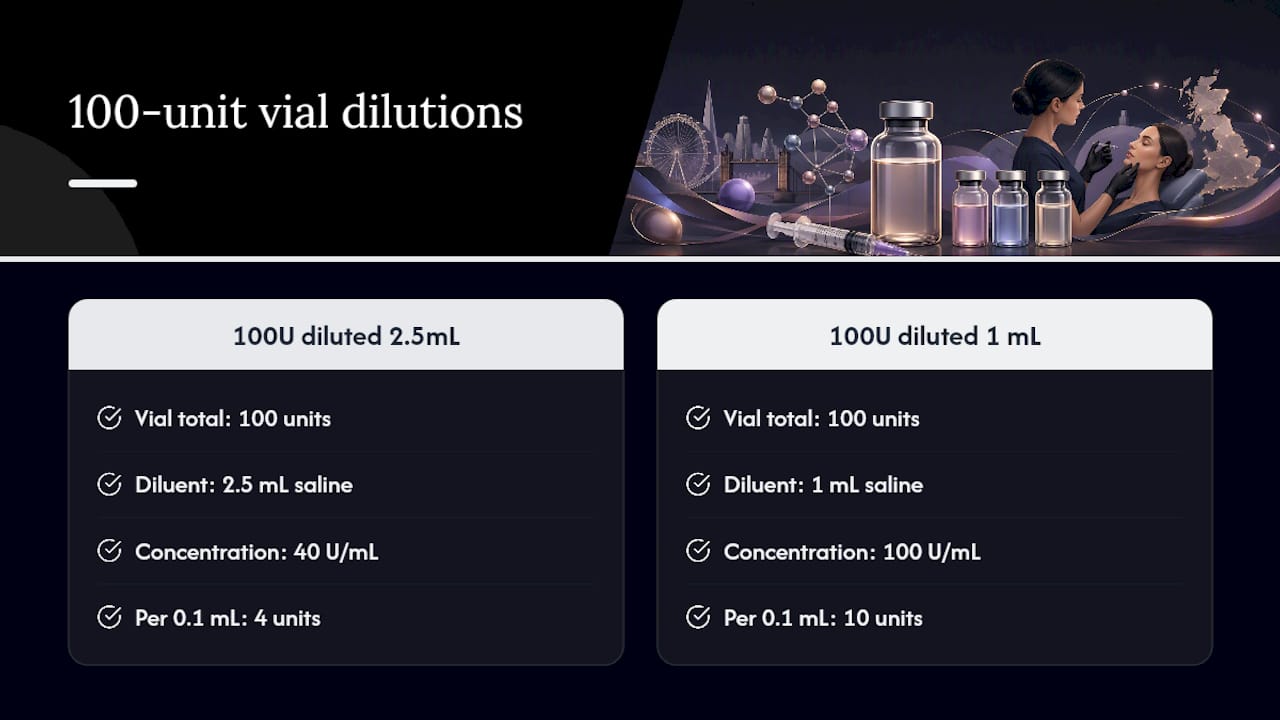
This is why “units per syringe” figures you might see quoted online mean very little in isolation. A syringe reading “0.2mL” could hold 8 units or 20 units, depending entirely on how the clinic diluted the vial. The BOCOUTURE SmPC sets out example dilution schemes for both its 50-unit and 100-unit presentations, and different clinics may reasonably choose different dilutions for the same clinical outcome.
The takeaway worth remembering: liquid volume tells you nothing about potency on its own. A larger-looking injection isn’t automatically a stronger one, and a smaller one isn’t automatically weaker. Units, not millilitres, are what determine the biological effect, which is exactly why a competent injector talks in units, not syringe volume, when discussing your treatment plan.
Typical unit ranges by treatment area
Prescribing information gives a reasonably consistent picture of standard doses across the areas most people book Botox for, though your own plan may sit above or below these figures depending on your anatomy.
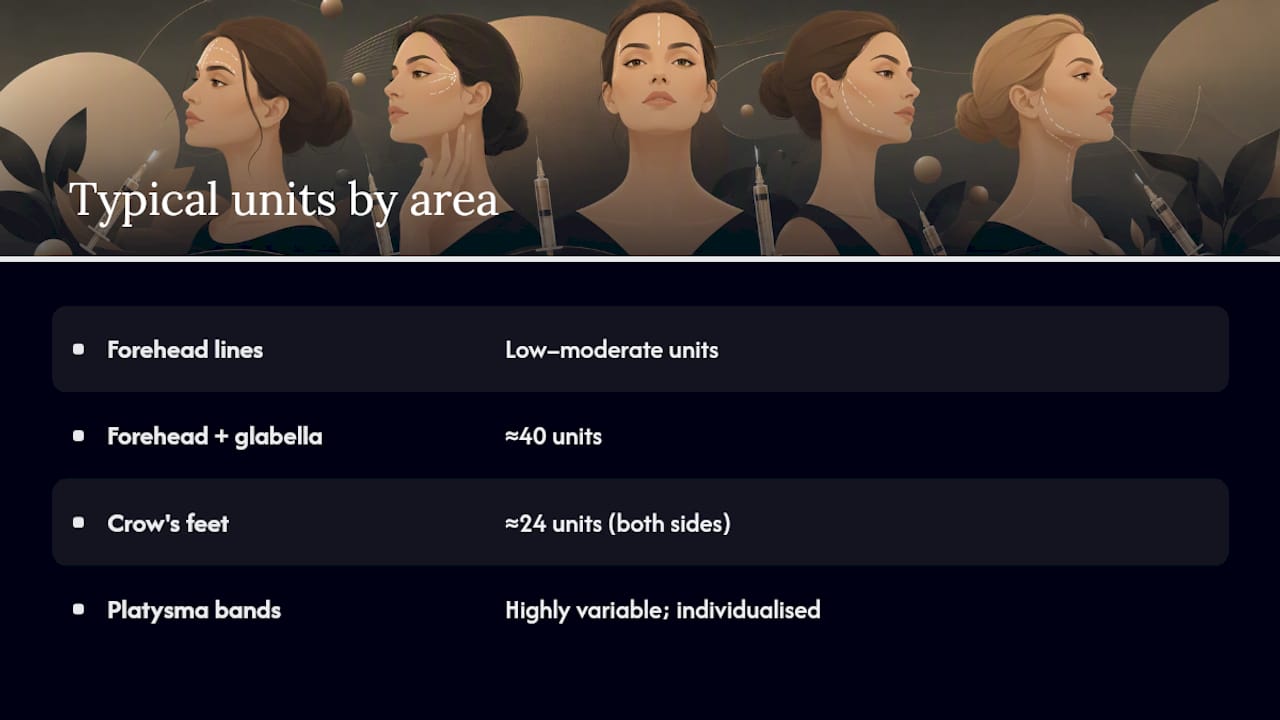
| Forehead lines usually require a dose that ranges from low to moderate units, often adjusted based on individual needs | Often adjusted based on forehead height and muscle strength |
| When forehead and glabella are treated together, the combined dose is commonly around forty units | Common when both areas are treated in one session |
| Lateral canthal lines (crow’s feet) are often treated with doses that total about two dozen units, split between both sides | Injected at multiple points around the outer eye |
| Platysma band treatment doses vary considerably depending on individual severity and number of bands | Individualised more than any facial area |
These figures come from SmPC and prescribing information tables for BOTOX Cosmetic and Bocouture, and they represent standard starting points rather than fixed prescriptions.
Combined treatments add up quickly, and that total matters for reasons beyond cost. If you’re treating glabella and forehead together at roughly 40 units, and your practitioner also wants to address crow’s feet at another 24 units, you’re already at 64 units in a single session. That’s still comfortably within safe limits, but it illustrates why your injector needs to track cumulative dose across every area treated that day, not just each area in isolation.
First-time patients typically start at the lower end of these ranges. There’s a good clinical reason for this beyond caution: it’s far easier to top up a slightly under-treated area at a follow-up visit than to correct over-treatment, which can cause unwanted heaviness or asymmetry that has to be waited out rather than fixed. A practitioner who suggests starting conservative isn’t being tentative; they’re following sound practice.
Safety limits and spacing between treatments
Prescribing guidance recommends not exceeding a cumulative dose beyond several hundred units within any three-month period. This ceiling exists for two connected reasons. First, higher cumulative doses raise the theoretical risk of toxin effects spreading beyond the intended muscles. Second, repeated high-dose exposure increases the chance of the immune system developing antibodies against the toxin, which can make future treatments less effective. A safety-focused review of dosing intervals sets out both mechanisms in detail and is the basis for the widely followed three-month rule.
Spacing treatments at least a few months apart is advised for safety considerations. It reflects how long the toxin’s effect typically lasts for a few months, and adequate spacing before another dose is reintroduced is recommended for safety. Chasing shorter intervals to maintain a “fresher” look continuously raises exactly the antibody-formation risk clinics are trying to avoid.
Most short-term effects are mild and localised: temporary bruising at injection sites, mild headache, or a heavy brow feeling in the first day or two. Genuine red flags are rarer but need immediate attention: difficulty breathing or swallowing, severe or spreading muscle weakness, or drooping well beyond the treated area. The manufacturer’s prescribing information lists these as signs requiring urgent medical review, not a “wait and see” approach. If you notice any of these after treatment, contact your clinic or seek medical attention straight away rather than assuming it will settle on its own.
How clinicians actually choose your dose
Chasing a specific unit number is the wrong way to think about your treatment. A competent injector titrates: starting at a conservative, evidence-based dose, then assessing the result at around two weeks and topping up only if genuinely needed. That staged approach protects against over-treatment far more reliably than aiming for a fixed figure from the outset.
Several factors shift the dose your practitioner recommends, and none of them are visible on a price list:
- Muscle size and strength, which vary considerably between individuals and tend to run higher in men, often requiring more units for the same visual effect
- Metabolic rate, which can influence how quickly the effect wears off
- Face shape and the severity of existing lines at rest and during movement
- Your response to previous treatments, if you’ve had Botox before
Injection precision matters just as much as the total dose. For crow’s feet specifically, points are typically placed roughly 1 to 2cm lateral to the orbital rim, mapped carefully against the muscle fibres beneath the skin, guidance detailed in practitioner-level technique literature. Inject too close to the lid margin and you risk ptosis, a drooping eyelid that can take weeks to resolve. Skill in placement, not just the unit count, is what separates a natural-looking result from an obviously “done” one.
Pro Tip: At your consultation, ask three things directly: which product they’re using, their typical dilution for your treatment area, and their policy on follow-up top-ups if the result isn’t quite where you both want it. A clinic that answers all three without hesitation is one that takes personalised dosing seriously.
How potency is actually measured
Understanding where unit figures come from helps explain why they can’t simply be compared across brands. The original standard, the mouse LD50 assay, defines one unit as the amount of toxin that proves lethal to 50% of a test group of mice under specific injection conditions. It sounds crude by modern laboratory standards, and in some ways it is, but it has remained the historical benchmark because it directly measures biological effect rather than a proxy like protein content.
Newer cell-based potency assays are increasingly used alongside or instead of the animal model. These tests expose nerve cells to the toxin in a controlled laboratory setting and measure the resulting blockade of neurotransmitter release, the same mechanism responsible for muscle relaxation in a patient’s face. The appeal is obvious: no animal testing, and a measurement that more directly reflects the toxin’s actual therapeutic mechanism.
Whichever assay a manufacturer relies on, the result is calibrated against that company’s own internal reference standard, a batch of toxin whose potency was fixed as “one unit” when the product was first developed. Every subsequent batch is measured against that internal yardstick. That’s precisely why a Botox unit and an incobotulinumtoxinA unit will never be mathematically convertible. They’re each measured against a different yardstick, built at a different time, using a different assay in many cases. Trying to convert between them isn’t a rounding problem; it’s comparing two measurements that were never on the same scale to begin with.
Common misunderstandings worth clearing up
The biggest misconception is treating “units” as a universal currency, as if 20 units always means the same thing regardless of brand. It doesn’t, and no reputable practitioner will tell you otherwise once asked directly.
A second common mix-up: assuming more units automatically means a stronger, longer-lasting, or better result. Beyond the dose your specific muscle needs, additional units don’t buy you extra smoothness or extra months of effect. They increase the risk of over-treatment, heaviness, or an unnatural frozen look, without a proportional benefit. Effective dosing is about matching the number to the muscle, not maximising it.
Patients also sometimes compare quoted unit numbers between friends or online reviews as if it’s a fair way to judge value or clinic quality. Two people with different muscle strength, different forehead heights, and different aesthetic goals may need genuinely different unit counts for what looks, superficially, like the same treatment area. A quoted number without context (which product, what dilution, what area exactly) tells you almost nothing about whether it’s the right dose or fair pricing.
Finally, there’s a tendency to assume higher unit totals across a session are automatically riskier. Within the recommended cumulative limits discussed earlier, a well-planned multi-area treatment carrying 60 or 70 units total isn’t inherently more dangerous than a single 20-unit treatment, provided your practitioner is tracking the total and spacing sessions appropriately.
How unit numbers connect to results and how long they last
The dose you receive has a direct relationship with both how complete the muscle-relaxing effect feels and how long it holds. Under-dosing an area tends to produce a partial effect. Lines soften rather than disappear, and movement in the treated muscle isn’t fully restricted, which some patients actually prefer for a more natural look around the eyes or forehead.
Duration tends to sit in a fairly consistent window regardless of exact unit count within the standard range. Prescribing information for BOTOX Cosmetic notes an onset over several days to two weeks, with effects typically lasting for several months, a timeline confirmed in the manufacturer’s prescribing data. Pushing the unit count higher than the standard range doesn’t reliably extend this window much further; it more often just deepens the muscle relaxation within the same time frame, which isn’t always the outcome patients expect when they assume “more units, more months.”
Individual metabolism plays a real role here too. Some patients notice movement returning at the ten-week mark, others still see a strong effect at four months, even at identical doses. This is one of the clearest arguments for staying with the same practitioner over time: they build a record of how your specific muscles respond, which makes each subsequent dosing decision more accurate than the last, rather than starting from a generic average every visit.
Talking about units with your practitioner
Informed consent around Botox works best when unit numbers are explained in context, not handed over as an isolated figure. A patient told simply “we’ll do 20 units” has learned very little. A patient told “we’re using 20 units of onabotulinumtoxinA for your glabella, which is the standard SmPC dose, and we’ll review the result at two weeks before considering any top-up” has actually understood the plan.
Good consultation practice covers four things clearly: which product is being used, the total units proposed for each area, how that compares to standard reference doses, and what the follow-up plan looks like if the result needs adjusting. This isn’t just good manners, it’s the standard patients should expect from any clinic operating to proper regulatory and safety standards, including clear guidance on managing side effects if anything doesn’t go to plan.
Patients are entitled to ask why a particular number was chosen, and a confident practitioner should welcome the question rather than deflect it. If a dose seems unusually high or low compared with the ranges discussed earlier in this guide, that’s worth raising directly rather than assuming the clinic knows best without explanation. Clear communication about units, backed by anatomy and prior response rather than guesswork, is what separates a considered treatment plan from a rushed one.
Why we treat every unit decision as individual, not standard
Working through unit ranges like these makes one thing obvious: the number on a treatment plan means very little without the anatomy, the product, and the goals behind it. I’ve seen enough discussion in clinical literature to be confident that the biggest safety risk isn’t dose itself, it’s dose divorced from context: patients comparing numbers across clinics and brands as if they’re comparable currencies, when they simply aren’t.
At The Aesthetics Room, every consultation starts with facial mapping and an honest conversation about what a conservative starting dose looks like for that individual, not a fixed number pulled from a price list. Patient safety should sit ahead of speed or upsell in reputable clinics accredited with regulatory bodies and safety groups. Our practitioner profiles are available for anyone who wants to see the qualifications behind their treatment plan before booking. If you’re weighing up units and wondering what’s right for your face, that’s a conversation worth having in person.
— Vishul
Book a consultation for a dosing plan built around your face
Reading unit ranges on a page only gets you so far; the number that actually matters is the one your practitioner works out after seeing your muscle strength, your expression lines and your treatment history in person. Theaestheticsroom’s Botox consultations start with exactly that: an assessment of your anatomy, a suggested starting dose based on standard SmPC ranges, and a follow-up plan at around two weeks to check whether any top-up is needed.

There’s no pressure to commit to a maximum dose on day one. Conservative, staged treatment is the approach we recommend for every first-time patient, precisely because it’s easier to add a few units later than to undo an over-treated area. If you’d like a personalised view of what your treatment might look like in units, explore the Botox treatment page and book a consultation to talk through your options with a qualified practitioner.
This article is general information, not a substitute for advice from a qualified doctor. Consult a qualified healthcare professional about your own circumstances before acting on anything here.
Sources
- Update on non-interchangeability of botulinum neurotoxin products
- BOCOUTURE 50 and 100 units powder for solution for injection – SmPC (emc)
- BOTOX Cosmetic prescribing information (manufacturer PDF)