

TL;DR:
- A personalized cosmetic treatment plan identifies goals, interventions, and schedules for measurable progress. Collaborating with a practitioner and setting SMART objectives enhances adherence and achieves better results. Regular reviews every 90 days ensure the plan remains effective and aligned with evolving priorities.
A personalised treatment plan in aesthetics is a structured document that defines your cosmetic goals, the interventions that will achieve them, and the timeline for measuring progress. Without one, treatments become reactive rather than purposeful. The five core elements of any effective plan are: presenting problem, goals, objectives, interventions, and timeline. This treatment plan creation guide walks you through each stage, from setting SMART objectives to selecting evidence-based procedures, so you can approach your cosmetic care with clarity and confidence.
What are the essential components of an effective cosmetic treatment plan?
A well-built cosmetic treatment plan answers five fundamental questions: what do you want to change, what does success look like, how will you measure progress, which treatments will get you there, and when will results be reviewed? Each element depends on the others. Miss one and the plan loses coherence.
The five components are:
- Presenting concern or enhancement goal. This is the starting point. Be specific: “reduce forehead lines” is more useful than “look younger.” Specificity shapes every decision that follows.
- Long-term goals. These define the overall appearance or confidence outcome you want to achieve. A long-term goal might be restoring facial volume lost through ageing, or achieving a smoother skin texture by a set date.
- Short-term, measurable objectives. These are the stepping stones. Using the SMART framework (Specific, Measurable, Achievable, Relevant, Time-bound), each objective tracks progress toward the larger goal. For example: “reduce the depth of nasolabial folds by two grades on the Wrinkle Severity Rating Scale within eight weeks of dermal filler treatment.”
- Evidence-based interventions. These are the named procedures: Botox, dermal fillers, skin rejuvenation treatments, or fat dissolving injections. Each must be matched to your specific concern and supported by clinical evidence.
- Timeline and review schedule. This sets the frequency and duration of treatment, plus the dates when progress is formally assessed and the plan updated.
Pro Tip: Write your presenting concern in your own words before your first consultation. Practitioners at Theaestheticsroom use this to anchor the entire planning process to what genuinely matters to you.
How to set SMART goals for your aesthetic treatment plan

Vague goals are the single biggest obstacle to measurable progress in cosmetic planning. Objectives must be observable and measurable to track treatment effectiveness reliably. A goal like “improve skin tone” gives a practitioner nothing to measure. A SMART objective gives them everything.
Here is how to apply the SMART framework to aesthetic goals:
- Specific. Name the area and the change. “Reduce crow’s feet around the left and right eye” is specific. “Look fresher” is not.
- Measurable. Attach a scale or visible benchmark. Photographic comparison, a validated grading scale, or a percentage reduction all work. “Reduce forehead lines by two grades on the Forehead Line Severity Scale within 12 weeks” is measurable.
- Achievable. Set goals within the realistic capability of the chosen treatment. Botox reduces dynamic wrinkles effectively. It does not replace lost volume. Match the goal to what the intervention can actually deliver.
- Relevant. Align each objective with your personal priorities. If confidence in photographs is your primary concern, focus objectives on the areas most visible in photos.
- Time-bound. Attach a date. “By week eight post-treatment” creates accountability and a clear review point.
Collaborative treatment planning produces better adherence and outcomes because the client shapes the goals alongside the practitioner. This is not a passive process. You should feel that the plan reflects your priorities, not a generic template.
Pro Tip: Bring reference photographs to your consultation at Theaestheticsroom. Visual references make SMART goal-setting faster and more accurate for both you and your practitioner.
Selecting evidence-based interventions for your personalised plan
Choosing the right treatment is not about preference alone. Interventions must be explicitly named, evidence-based, and matched to your specific concern and condition. A plan that lists “facial treatment” as an intervention has no clinical value. A plan that specifies “botulinum toxin type A injected into the frontalis muscle at 20 units” is auditable, safe, and purposeful.
The most common evidence-based interventions in cosmetic planning include:
- Botox (botulinum toxin type A). The gold standard for dynamic wrinkles caused by muscle movement. Effective for forehead lines, crow’s feet, and frown lines. Results typically appear within 7–14 days and last 3–4 months.
- Dermal fillers (hyaluronic acid or calcium hydroxyapatite). Used to restore volume, define contours, and smooth static lines. Hyaluronic acid fillers are reversible, which makes them a lower-risk first intervention for many clients.
- Skin rejuvenation treatments. Procedures such as chemical peels, microneedling, and laser resurfacing address texture, pigmentation, and collagen production. These are often combined with injectable treatments for broader results.
- Fat dissolving injections (deoxycholic acid). Targeted at localised fat deposits such as submental fullness. Results build over multiple sessions.
Matching the intervention to the goal requires understanding how treatments interact. Combining treatments often produces results that neither procedure achieves alone. A practitioner following established treatment protocols will map each intervention to a specific objective in your plan, creating a clear chain from concern to outcome.
How to create a timeline and review schedule for treatment progress
A treatment timeline is not a rough estimate. It is a structured schedule that sets treatment dates, expected result windows, and formal review points. Without it, plans drift and results become difficult to attribute to specific interventions.
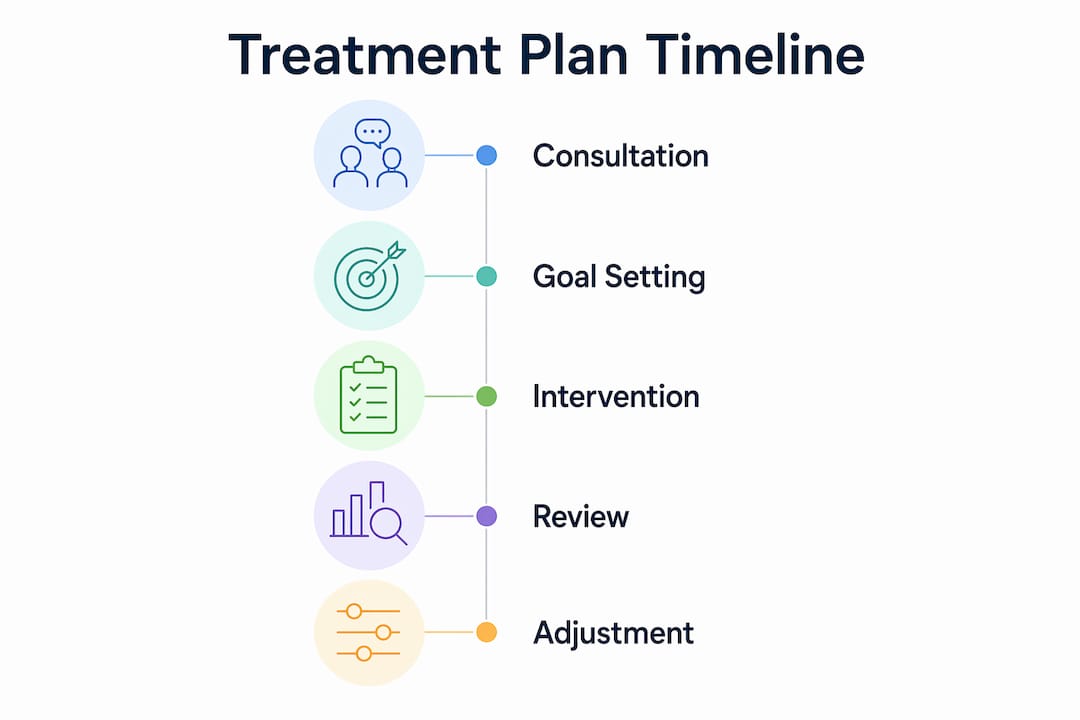
| Phase | Action | Timeframe |
|---|---|---|
| Initial consultation | Assess concerns, set SMART goals, agree interventions | Week 1 |
| First treatment | Administer agreed procedure (e.g. Botox or filler) | Week 1–2 |
| Early review | Photograph and assess initial response | Week 4–6 |
| Follow-up treatment | Adjust or supplement based on early results | Week 6–8 |
| Formal plan review | Reassess all goals, update objectives and interventions | Week 12–13 |
Treatment plans should be reviewed every 90 days to keep goals relevant and maintain compliance with best practice standards. This interval aligns with the natural cycle of most injectable treatments and gives enough time to see genuine results before adjusting the plan. Theaestheticsroom builds this review cadence into every client’s planning process, using it to refine goals and confirm that interventions remain appropriate.
Scheduling and workflow guidance helps clinics and clients alike maintain this rhythm without letting reviews slip. Peer review at key milestones adds an additional layer of quality assurance, particularly for complex or multi-treatment plans.
What are the common mistakes to avoid in cosmetic treatment planning?
Most planning failures trace back to a small number of avoidable errors. Recognising them early saves time, money, and disappointment.
- Vague goals. “Look better” or “feel more confident” cannot be measured. Vague goals hinder progress measurement and make it impossible to know whether a treatment has worked.
- No client involvement. A plan written without your input is a plan you are unlikely to follow. Plans done ‘with’ the client, not ‘to’ them, produce stronger commitment and better results.
- Unnamed or unmatched interventions. Listing “a facial treatment” rather than a specific procedure removes clinical accountability. Every intervention should be named, dosed where applicable, and linked to a specific objective.
- Ignoring the review schedule. Skipping the 90-day review means goals may no longer reflect your current priorities or the results achieved. Plans must evolve.
- Poor documentation. The “golden thread” concept describes the clear linkage between assessment, goals, interventions, and progress notes. Without it, plans fail audits and lose their clinical value.
Pro Tip: Ask your practitioner to show you how each intervention in your plan connects to a specific goal. If they cannot explain the link clearly, the plan needs more work.
Using treatment plan templates and pre-built frameworks speeds up the planning process without reducing quality. Templates provide the structure; your individual goals and chosen interventions provide the substance.
Key takeaways
A personalised cosmetic treatment plan built on SMART goals, named evidence-based interventions, and a 90-day review cycle produces measurably better outcomes than an unstructured approach.
| Point | Details |
|---|---|
| Five core components | Every plan needs a presenting concern, goals, objectives, interventions, and a timeline. |
| SMART objectives | Attach specific measurements and dates to every goal to track progress reliably. |
| Named interventions | Always specify the exact procedure, such as Botox or hyaluronic acid filler, matched to each goal. |
| 90-day review cycle | Formal reviews every 90 days keep goals relevant and interventions appropriate. |
| Collaborative planning | Building the plan with your practitioner improves adherence and produces better results. |
Why I think most people underestimate the power of a written plan
Most clients arrive at a consultation with a feeling rather than a plan. They know they want to look fresher, or less tired, or more defined. That is a perfectly valid starting point. The mistake is leaving it there.
A written plan changes the dynamic entirely. When you can see your goals, your chosen treatments, and your review dates on paper, you stop being a passive recipient of care. You become an active participant. That shift matters more than most people realise. Using a treatment plan as a living document connects each session to the next and prevents care from becoming a series of disconnected appointments.
The other thing I have observed is that clients who co-create their plans with their practitioner at Theaestheticsroom tend to stay the course. They do not abandon their plan after one session because they understand why each step exists. The beauty consultation process at Theaestheticsroom is designed specifically to build this understanding from the very first appointment.
My honest view: the plan is not a formality. It is the treatment. Everything else is just execution.
— Vishul
Theaestheticsroom’s approach to personalised cosmetic care
Theaestheticsroom, based in Knightsbridge and accredited by the CQC, builds every client relationship around a bespoke treatment plan. Whether your goal involves Botox for dynamic wrinkles or dermal fillers for volume restoration, the planning process begins with a thorough consultation to map your concerns to specific, measurable outcomes.
Theaestheticsroom’s practitioners use evidence-based protocols, formal review schedules, and collaborative goal-setting to give every client a plan that reflects their individual priorities. Book a virtual or in-person consultation to start building yours.
FAQ
What does a cosmetic treatment plan include?
A cosmetic treatment plan includes your presenting concern, long-term goals, short-term SMART objectives, named interventions such as Botox or dermal fillers, and a review timeline. These five elements work together to keep your care structured and measurable.
How often should a cosmetic treatment plan be reviewed?
Best practice standards recommend a formal review every 90 days. This interval aligns with the typical cycle of injectable treatments and gives sufficient time to assess results before adjusting goals or interventions.
Why are SMART goals important in aesthetic planning?
SMART goals replace vague aspirations with specific, measurable targets. They make it possible to track whether a treatment has worked and to adjust the plan if results fall short of expectations.
What is the best first treatment to include in a plan?
The best first intervention depends on your specific concern. Hyaluronic acid dermal fillers are often chosen first because they are reversible, while Botox is the standard choice for dynamic wrinkles. A practitioner will match the intervention to your goal, not the other way around.
How does collaborative planning improve results?
When you help shape your own treatment plan, you understand the purpose of each step and are more likely to follow through. Research confirms that plans created with the client rather than for the client produce stronger adherence and better outcomes.