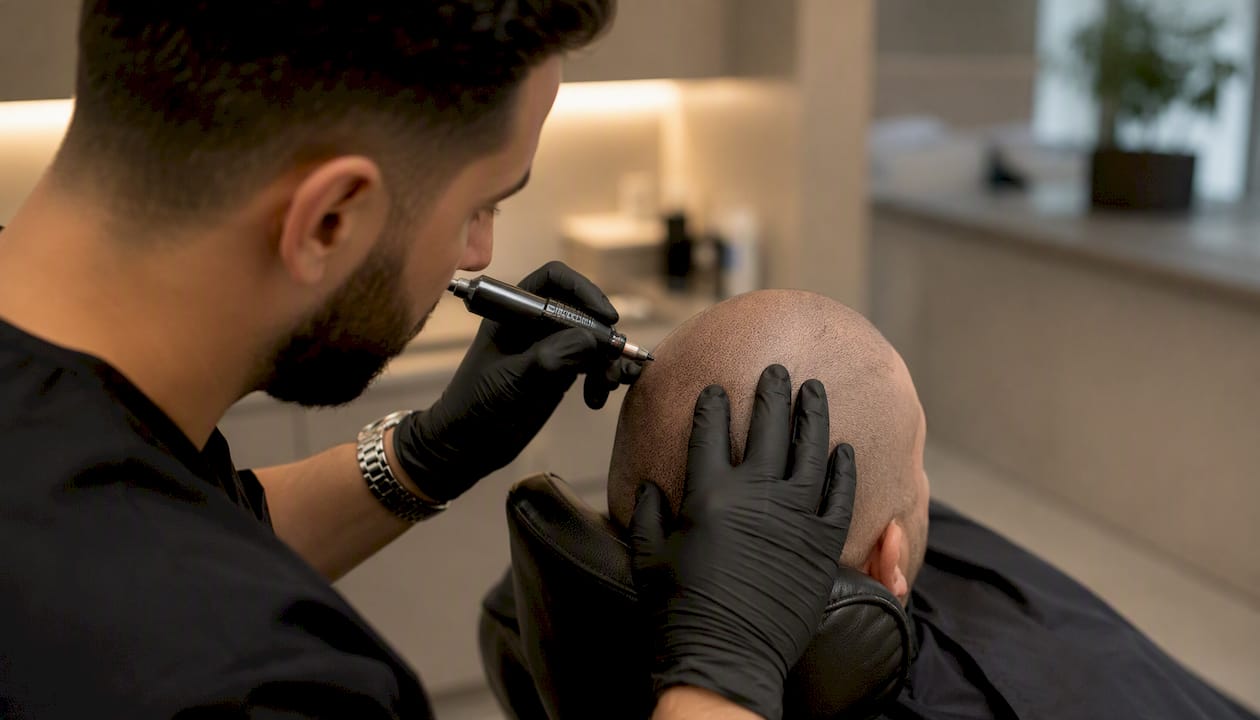

Scalp micropigmentation (SMP) is a non-surgical, semi-permanent cosmetic pigmentation procedure that deposits tiny dots of medical-grade pigment into the upper layer of the scalp to replicate the visual impression of hair follicles. As the ISHRS confirms, SMP is an aesthetic technique, not a hair-restoration therapy. It does not regrow hair. What it does, when performed well, is create a convincing shaved-head appearance, add perceived density beneath thinning hair, or camouflage scarring from surgery or injury.
- What it is: a cosmetic pigmentation procedure using micro-needles to deposit pigment into the scalp
- What it achieves: a shaved-head look, visual density under thinning hair, or scar camouflage
- What it does not do: stimulate or restore hair growth
- UK oversight: premises must register with their local Environmental Health Department under the Local Government (Miscellaneous Provisions) Act 1982
- Quality signal: look for practitioners holding the RQF Level 4 Certificate in Scalp Micropigmentation and clinics that follow JCCP or CPSA guidance
Key takeaways
Scalp micropigmentation is a cosmetic procedure that creates the appearance of hair follicles on the scalp; it does not restore living hair, and its long-term quality depends almost entirely on practitioner skill and clinic standards.
| Point | Details |
|---|---|
| SMP is cosmetic, not medical | It creates the visual impression of hair follicles but does not stimulate or restore hair growth. |
| Multiple sessions are standard | Expect 2–3 sessions spaced 7–14 days apart, with full results visible 4–6 weeks after the final appointment. |
| Longevity requires maintenance | Results typically remain presentable for 3–5 years; top-up sessions and daily SPF use extend the lifespan. |
| UK clinics must be registered | Premises must register with their local Environmental Health Department under the Local Government (Miscellaneous Provisions) Act 1982; verify this before booking. |
| Theaestheticsroom | Offers medically governed consultations for cosmetic treatments including hair procedures, with CQC accreditation and ACE Group membership as patient-safety markers. |
Table of Contents
- What is scalp micropigmentation, and how does it differ from a tattoo?
- What happens before, during, and after each SMP session?
- What can SMP do for you, and where does it fall short?
- What are the risks, and who should avoid SMP?
- How long does SMP last, and what are your options if you want it removed?
- How do you choose a safe SMP clinic in the UK?
- Aftercare: what to do in the days and weeks after treatment
- Will people be able to tell you have had SMP?
- Why practitioner skill matters more than anything else
- A note on safety, consent, and patient-centred practice
- Book a consultation at Theaestheticsroom
- Sources
What is scalp micropigmentation, and how does it differ from a tattoo?
SMP uses micro-needles to deposit pigment into the epidermal-dermal junction of the scalp, creating small, round impressions that mimic the cross-section of a shaved hair follicle. The Cleveland Clinic describes it as a non-invasive “hair tattoo” that covers bald spots or simulates a buzz-cut look without surgery or downtime.
The comparison to a traditional body tattoo is understandable but misleading in practice. Three key differences matter:
- Needle depth: SMP targets the upper dermis, shallower than conventional tattooing, which reduces the risk of pigment migration and colour distortion over time.
- Pigment composition: SMP uses medical or cosmetic-grade pigments formulated to retain a neutral, hair-like tone rather than the carbon-based inks used in body art, which can shift to blue or green on the scalp.
- Dot size and placement: each impression is tiny, typically 1–2 mm, and placed at an angle and density that matches the client’s natural follicle pattern and skin tone.
The three main visual outcomes
Shaved-head (buzz-cut) look. The most common application. Pigment dots are placed across the entire scalp to simulate a closely cropped head of hair. This suits people with advanced or complete hair loss who want a defined, low-maintenance appearance.
Density fill (stipple technique). Pigment is applied beneath existing thinning hair to reduce the contrast between scalp and hair, creating the impression of greater fullness. This works well for androgenetic alopecia in its earlier stages.
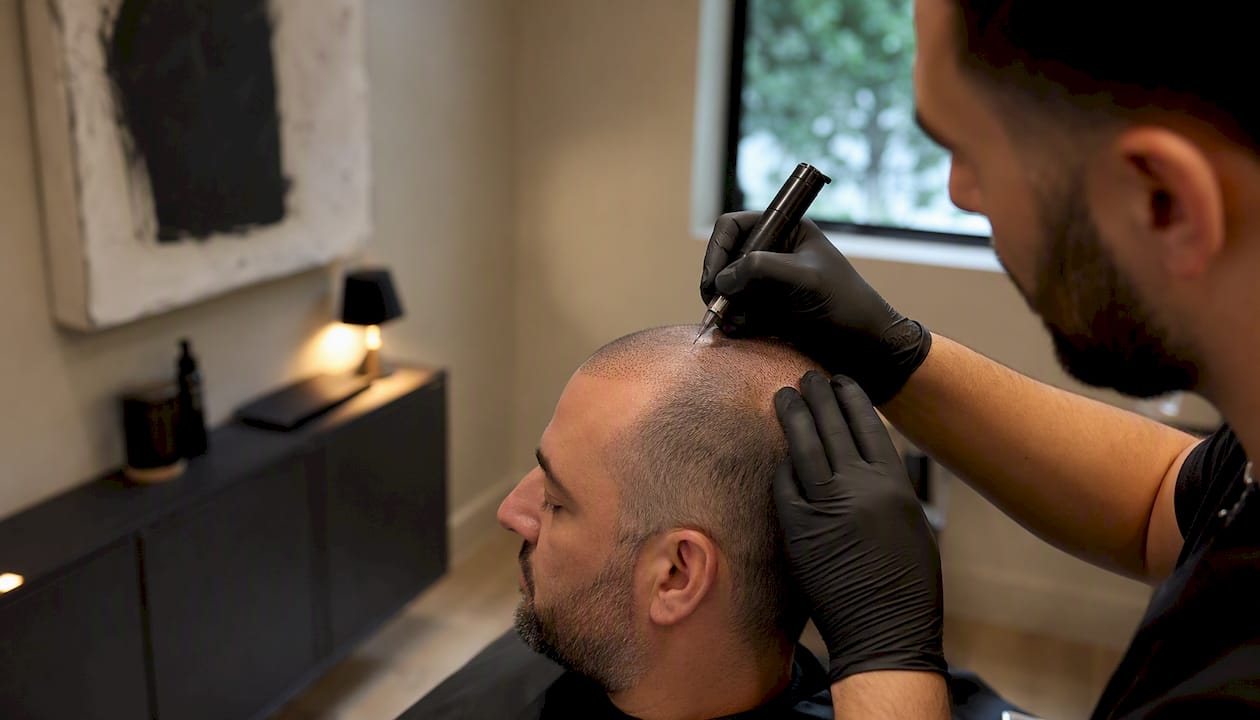
Scar camouflage. SMP can disguise linear scars from follicular unit transplant (FUT) surgery, alopecia areata patches, or scalp injuries by blending pigment into the surrounding skin tone. Colour-matching is especially critical here, as scar tissue absorbs pigment differently from healthy scalp.
What happens before, during, and after each SMP session?
Understanding the scalp micropigmentation process from start to finish helps you prepare properly and set realistic expectations for each visit.
Before your first session
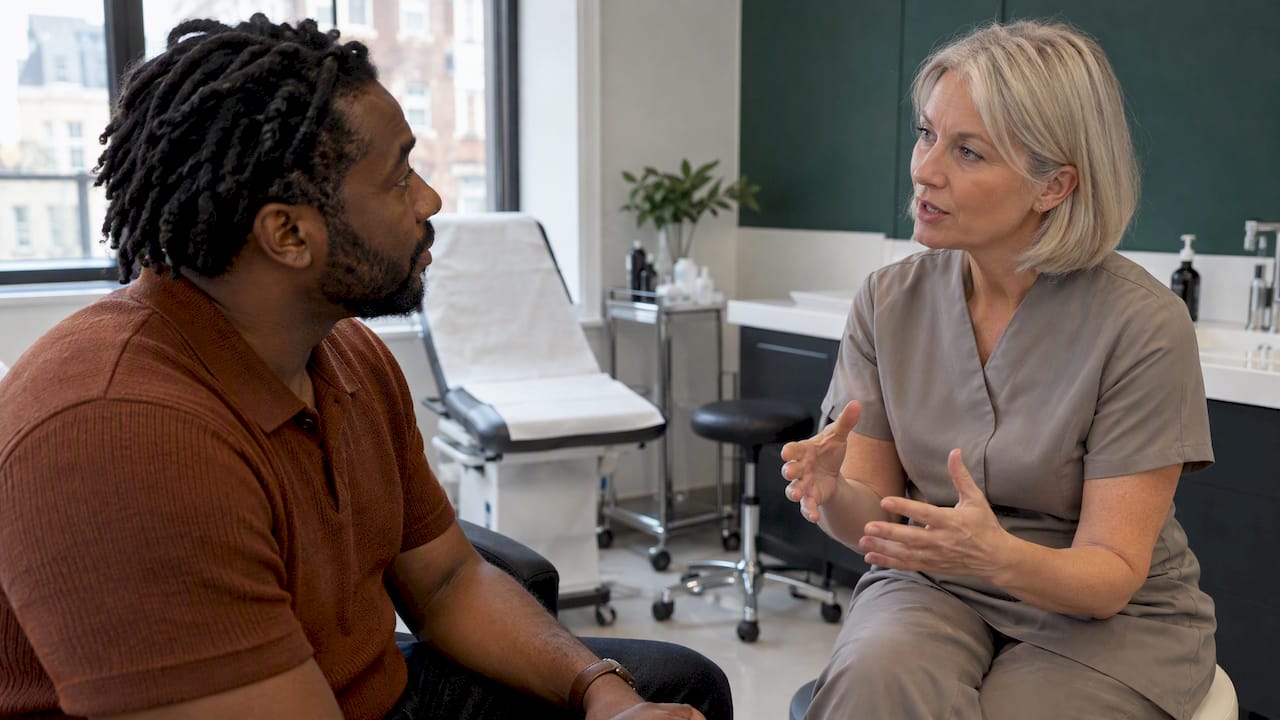
- Initial consultation. A thorough discussion of your hair-loss pattern, skin type, medical history and aesthetic goals. The practitioner should review any medications that affect bleeding or skin healing.
- Patch test. A small amount of pigment is applied to a discreet area of skin, typically behind the ear, and monitored for 24–48 hours to rule out allergic reactions.
- Photographic documentation. Baseline photographs are taken from multiple angles. These form part of your consent record and allow objective comparison after treatment.
- Hairline design. The practitioner sketches a proposed hairline in pencil or marker. You approve it before any pigment is placed. This step is non-negotiable; a hairline drawn too low or too straight looks artificial.
- Written informed consent. You sign a consent form confirming you understand the procedure, its limitations, aftercare requirements and potential risks.
During the session
- A topical anaesthetic cream is applied and left for 20–40 minutes before work begins.
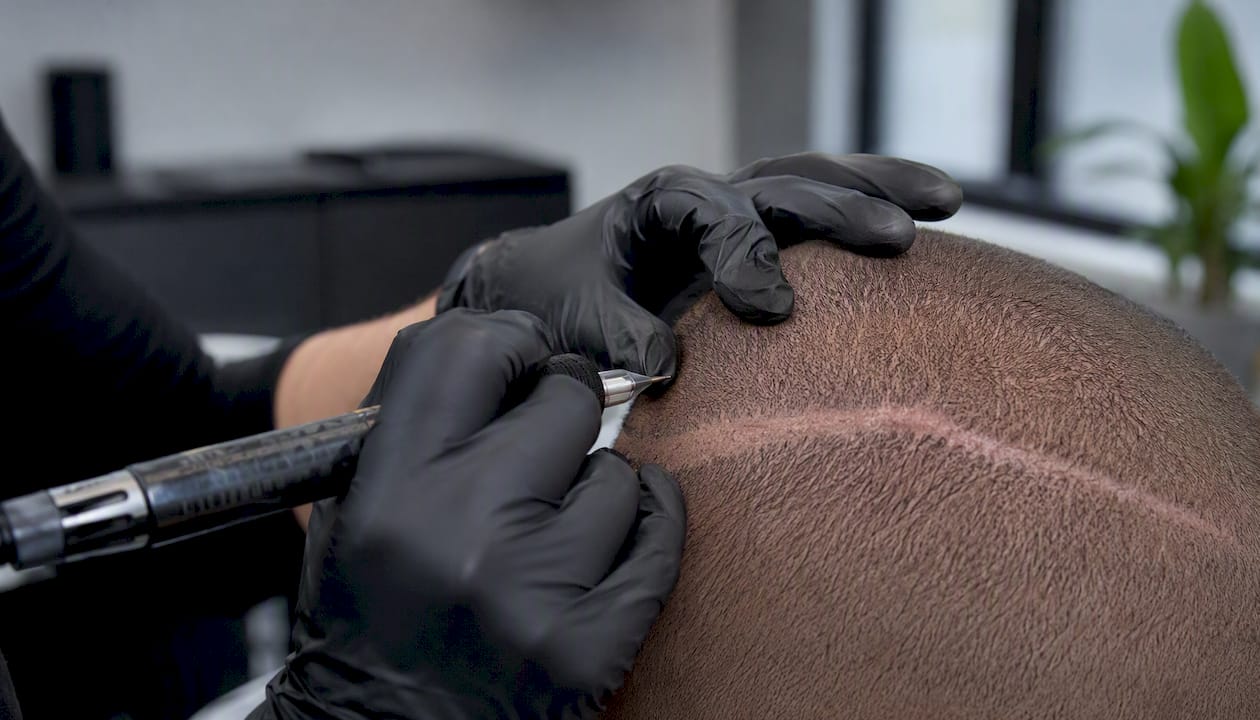
- You lie back in a reclined chair while the practitioner works in sections, placing individual pigment dots using a digital or manual device fitted with a single-use cartridge needle.
- Sessions typically last 2–4 hours depending on the treatment area and the style being created.
- Most people describe the sensation as mild scratching or pressure, similar to a light tattoo. The scalp’s sensitivity varies by area; the temples and crown tend to be more sensitive than the sides.
After the session and the multi-session schedule
Immediately after treatment, the scalp appears darker and more defined than the final result will be. Redness and minor swelling are normal within the first 24 hours. Over days 3–7, small crusts or flakes form as the skin heals; these shed naturally and should not be picked.
This is expected. A standard course involves 2–3 sessions, spaced 7–14 days apart, with each session building density and refining the hairline. The final result is only visible after the last session has fully healed, typically 4–6 weeks from the first appointment.
Pro Tip: Book all your sessions before the first appointment. Gaps longer than 14 days between early sessions can make layering uneven and force the practitioner to compensate in later visits.
What can SMP do for you, and where does it fall short?
The genuine benefits
- Immediate visual improvement. Unlike hair transplants, which require months of growth before results are visible, SMP produces a noticeable change from the first session.
- Low recovery time. There is no surgical downtime. Most people return to desk-based work the following day.
- Effective for advanced hair loss. Candidates who are not suitable for transplantation because of insufficient donor hair can still achieve a defined, confident appearance with SMP.
- Scar coverage. SMP is one of the few cosmetic options that can meaningfully reduce the visibility of FUT strip scars and alopecia patches.
- Gender and hair-type versatility. The technique works across skin tones and hair types, and is used by both men and women.
The realistic limits
SMP is a cosmetic illusion, not a biological intervention. It creates the appearance of hair, not hair itself. Pigment placed on a completely bald scalp will not look like a full head of hair under close inspection; it looks like a closely shaved head. That distinction matters for anyone whose goal is to appear as though they have longer hair.
Maintenance is ongoing. Pigment fades over time and periodic top-up sessions are necessary to keep the result looking fresh. And because SMP is semi-permanent rather than permanent, removal is possible but not straightforward.
How SMP compares with other hair-loss options
| Approach | Regrows hair? | Surgery involved? | Downtime | Suitable for advanced loss? |
|---|---|---|---|---|
| Scalp micropigmentation | No | No | Minimal | Yes |
| Hair transplant (FUE/FUT) | Yes | Yes | Several weeks | Only with sufficient donor hair |
| Hairpiece or wig | No | No | None | Yes |
For people exploring female hair loss causes and treatment options, SMP sits alongside rather than above or below these alternatives. The right choice depends on hair-loss stage, scalp condition, lifestyle and personal preference.
What are the risks, and who should avoid SMP?
When performed by a trained practitioner using sterile equipment, SMP carries a low overall risk profile. That said, complications do occur, and knowing what to watch for protects you.
Common short-term effects
- Redness and mild swelling lasting 24–48 hours
- Crusting and flaking during the first week of healing
- Temporary sensitivity or tenderness at the treated area
Less common but serious complications
- Infection. The primary risk when non-sterile equipment is used. Signs include increasing redness, warmth, swelling, pus or fever appearing after the first 48 hours. A peer-reviewed review of micropigmentation techniques highlights infection control and pigment safety as central concerns in the clinical literature.
- Allergic reaction. Pigment components, particularly certain preservatives or colourants, can trigger localised or systemic reactions. A patch test 24–48 hours before treatment is the standard precaution.
- Hypertrophic or keloid scarring. People with a personal or family history of keloid formation are at elevated risk of raised, thickened scar tissue at needle entry points.
- MRI interactions. Metallic compounds in some pigments can cause localised heating or image artefacts during MRI scans. This is rare but worth disclosing to radiographers before any scan.
- Pigment migration or colour shift. Poor technique or inappropriate pigment depth can cause dots to blur or shift in tone over time, producing an unnatural appearance.
Who should avoid SMP or seek medical clearance first
- People with active scalp conditions such as psoriasis, seborrhoeic dermatitis or eczema in the treatment area
- Those with uncontrolled diabetes, which impairs wound healing
- Anyone with a documented tendency to keloid scarring
- People currently taking blood-thinning medications (discuss with your GP before booking)
- Pregnant or breastfeeding individuals
Safety note: the risks above are substantially reduced when you choose a clinic that uses single-use cartridge needles, medical-grade pigments and a documented sterilisation protocol. Cutting corners on hygiene is where the majority of serious SMP complications originate.
How long does SMP last, and what are your options if you want it removed?
Longevity and fading
SMP is described as semi-permanent because the pigment does fade over time, though it does not disappear entirely. Most people find their SMP remains presentable for several years before a noticeable refresh is needed, though this varies considerably depending on:
- Skin type. Oilier skin tends to break down pigment faster than drier skin.
- Sun exposure. UV radiation accelerates fading. Regular use of SPF 30 or higher on the scalp is one of the most effective ways to extend longevity.
- Pigment quality. Higher-grade pigments formulated specifically for scalp use retain their tone more consistently than generic cosmetic pigments.
- Lifestyle. Frequent swimming in chlorinated water and heavy sweating can both contribute to faster fading.
Top-up sessions
Most clients return for a maintenance session every 2–4 years, though some find they need one sooner. A top-up is a shorter appointment than the original course, typically a single session, and focuses on refreshing faded areas and sharpening the hairline definition.
Removal options
Laser removal of scalp pigments is technically feasible but more complex than removing a standard body tattoo. The peer-reviewed literature on micropigmentation techniques and safety notes that scalp pigment removal can require many sessions and may not fully restore the original skin tone, partly because of pigment composition and the characteristics of scalp skin. Partial removal to correct a poorly placed hairline or uneven density is achievable but requires an experienced laser technician familiar with scalp pigments specifically.
Pro Tip: If you are unsure about committing to SMP long-term, ask your practitioner to start with a conservative hairline and lighter density in the first session. It is always easier to add pigment in subsequent sessions than to remove it.
How do you choose a safe SMP clinic in the UK?
The UK does not have a single mandatory national licence for SMP practitioners, which makes your own due diligence critical. Here is what to verify before booking.
Legal registration
Under the Local Government (Miscellaneous Provisions) Act 1982, any premises offering semi-permanent skin-colouring services, including SMP, must register with their local authority’s Environmental Health Department. Ask the clinic directly whether they are registered. A reputable clinic will confirm this without hesitation and may display their registration certificate.
Practitioner training and qualifications
The RQF Level 4 Certificate in Scalp Micropigmentation is a formally recognised UK qualification that indicates a practitioner has completed structured, assessed training at a level above basic cosmetic courses. Ask to see the certificate, not just a mention of it on a website.
Professional standards: JCCP and CPSA
The JCCP Code of Practice and the Cosmetic Practice Standards Authority (CPSA) set out best-practice expectations for hygiene, informed consent, patch testing and practitioner conduct. Adherence to these standards is voluntary for SMP, but clinics that follow them typically demonstrate clearer consent workflows, mandatory patch testing and single-use cartridge policies. These are practical markers of safer practice.
Hygiene and infection control
- Confirm that single-use, disposable needle cartridges are used for every client
- Ask whether the treatment room meets clinical hygiene standards
- Check that pigments are stored and handled correctly, with batch numbers available
- A clinic that cannot or will not answer these questions clearly is a red flag
Portfolio and consent
- Request an unedited before-and-after gallery showing results for your specific hair-loss pattern and skin tone
- Confirm that a written consent form and patch test are standard practice, not optional extras
- Be cautious of any clinic offering unrealistic guarantees or refusing to discuss complications
Pro Tip: Visit the clinic in person before committing. The cleanliness of the reception area, the practitioner’s willingness to answer questions and the quality of the portfolio on the wall tell you more than any website.
For a broader checklist before any aesthetic treatment, the medical spa checklist at Theaestheticsroom covers the key questions to ask at consultation.
Aftercare: what to do in the days and weeks after treatment
The first seven days
- Keep the scalp clean and dry for the first 4 days. Avoid submerging the head in water.
- Do not use shampoo on the treated area for at least 4 days; when you do resume washing, use a gentle, fragrance-free product.
- Avoid heavy exercise and activities that cause significant sweating for the first week. Sweat can disrupt pigment settling.
- Do not pick, scratch or rub any crusting or flaking skin. Let it shed naturally.
- Stay out of direct sunlight and avoid sunbeds for at least 4 weeks after each session.
Weeks 2–8
- Pigment will appear to soften and lighten as the skin heals. This is normal and expected.
- Flaky skin sheds gradually, revealing the settled pigment underneath.
- By week 4–6, the final tone of the session becomes visible and the practitioner can assess what the next session needs to achieve.
- Your first top-up session within the original course is typically booked for 7–14 days after the previous appointment.
When to contact the clinic or your GP
- Increasing redness, warmth or swelling after the first 48 hours
- Pus, discharge or an unpleasant odour from the treated area
- Fever or flu-like symptoms following treatment
- Unusual pain that worsens rather than improves after day 2
- Pigment appearing in unexpected areas or colours changing rapidly
For practical safety guidance on cosmetic procedures in London, including when to escalate concerns, Theaestheticsroom’s resource covers the key warning signs clearly.
Will people be able to tell you have had SMP?
Detectability depends on four factors: technique quality, pigment-to-skin contrast, the style chosen and how the pigment ages.
- Dot size and placement. A skilled practitioner places impressions at varying angles and densities, mirroring the irregular pattern of natural follicles. Uniform rows of identical dots are the hallmark of poor technique and are immediately noticeable.
- Colour matching. Pigment that is too dark for the client’s skin tone, or that shifts to an unnatural hue as it ages, draws attention. This is why pigment selection and the patch test matter beyond allergy screening.
- Hair contrast. People with very light skin and very dark hair present the highest contrast and require the most precise colour calibration. Those with medium skin tones and mid-brown hair tend to achieve the most naturally blending results.
- Skin oiliness and ageing. Oilier skin can cause pigment to spread slightly over time, softening dot definition. Ageing skin changes texture and tone, which can affect how older SMP reads visually.
For the shaved-head look, detectability at conversational distance is low when the technique is good. Under very close inspection, the absence of actual hair stubble texture is perceptible. The density-fill style, applied beneath existing hair, is the least detectable of the three approaches because the existing hair provides additional visual cover.
Ask for unedited photographs taken in natural daylight, not studio lighting, when reviewing a practitioner’s portfolio. Studio lighting flatters results; daylight reveals them honestly.
Why practitioner skill matters more than anything else
The single most important determinant of your SMP outcome is the person holding the device. Equipment, pigment brands and clinic décor are secondary. A practitioner with strong technical training and genuine artistry will produce a natural result with basic equipment; a poorly trained one will produce an unconvincing result with the most expensive kit available.
What to request at consultation:
- Training certificates, specifically the RQF Level 4 or equivalent, not just a weekend course completion card
- An unedited before-and-after gallery for clients with your hair-loss pattern and skin tone
- A clear explanation of the pigments used, including their composition and whether they are medical-grade
- Confirmation that a patch test is mandatory, not optional
- Written details of the clinic’s sterilisation and infection-control protocol
On the governance side, confirm local authority registration under the Local Government (Miscellaneous Provisions) Act 1982, check whether the clinic follows JCCP or CPSA guidance, and verify that single-use cartridges are standard practice. Understanding why medical practitioners matter in aesthetics helps frame why clinical governance around any cosmetic procedure, including SMP, is worth scrutinising before you commit.
Pro Tip: Ask the practitioner to describe a case where they had to correct a previous SMP result. How they answer, whether they acknowledge complexity or dismiss the question, tells you a great deal about their clinical honesty.
A note on safety, consent, and patient-centred practice
At Theaestheticsroom, we believe that no cosmetic treatment should begin without a thorough pre-assessment. For SMP specifically, that means a detailed consultation to review your scalp condition, medical history and realistic expectations before any pigment is placed. Informed consent is not a formality; it is the foundation of safe practice. We apply the same rigorous standards to every procedure we offer, and we are transparent about what SMP can and cannot achieve. Patient selection matters as much as technique.
Book a consultation at Theaestheticsroom
Theaestheticsroom offers a medically governed approach to non-surgical cosmetic treatments from its Knightsbridge clinic, with additional locations on Harley Street and in Mayfair. For those considering SMP or any other hair or skin treatment, the starting point is a consultation, either in person or virtually, where a trained specialist reviews your goals, scalp condition and medical history before recommending a course of action.
The clinic holds CQC accreditation and is a member of the ACE Group, both of which reflect a commitment to patient safety and clinical governance that goes beyond the minimum legal requirements for cosmetic practice. To prepare for your consultation, bring clear photographs of your scalp in natural light, a list of any medications you take, and any questions about the procedure, pigments or aftercare. You can explore the clinic’s broader range of medical aesthetics treatments or book directly at Theaestheticsroom.
Sources
The following sources underpin the safety, regulatory and clinical claims made in this article.
- Legislation
- Scalp Micropigmentation (SMP): All You Need to Know — ISHRS
- Peer-reviewed article on micropigmentation techniques and safety — NCBI PMC
This article is general information, not a substitute for advice from a qualified doctor. Consult a qualified healthcare professional about your own circumstances before acting on anything here.
Recommended
- What is eyebrow microblading? your complete guide – The Aesthetics Room
- Patient follow-up workflow for UK aesthetic patients – The Aesthetics Room
- What is sclerotherapy: your guide to vein treatment – The Aesthetics Room
- Pigmentation treatments explained: evidence, options and results – The Aesthetics Room