

TL;DR:
- A medical consultation is a structured clinical dialogue where healthcare providers assess symptoms and develop personalized treatment plans. These consultations, conducted in various formats like in-person or telehealth, are essential for safe, effective, and patient-centered care, especially in aesthetics. Preparing thoroughly by noting symptoms, questions, and relevant documents enhances consultation outcomes and supports shared decision-making.
A medical consultation is defined as a focused meeting between a patient and healthcare provider to discuss symptoms, establish a diagnosis, and agree on a treatment plan. This structured dialogue is the cornerstone of both general healthcare and specialist care, including medical aesthetics. Whether you are visiting a GP about persistent headaches, seeking advice on a skin concern, or exploring cosmetic treatments such as Botox or dermal fillers, the consultation is where your care begins. Understanding what to expect from the process helps you engage more confidently, ask better questions, and leave with a plan that genuinely reflects your needs.
What is a medical consultation and why does it matter?
A medical consultation is the formal term for any scheduled appointment in which a clinician gathers information, assesses your condition, and works with you to determine next steps. The industry also uses the term “clinical consultation” interchangeably, particularly in specialist and cosmetic settings. The purpose of a medical consultation extends well beyond a quick chat. It is the moment where information, understanding, and decisions converge to set the direction of your care.
Three core goals define every consultation. The clinician needs to understand your symptoms or concerns, narrow down possible causes, and agree on a management plan that suits your circumstances. In cosmetic medicine, this translates to understanding your aesthetic goals, assessing your suitability for a procedure, and designing a personalised treatment plan. The Aesthetics Room, for example, structures every client consultation around these same principles, regardless of whether the appointment is for skin rejuvenation or a more complex combination treatment.
The importance of medical advice at this stage cannot be overstated. A consultation is not simply a formality before treatment. It is a clinical safeguard that protects you from unnecessary procedures, identifies contraindications, and ensures the proposed plan aligns with your health history.
What happens during a medical consultation?
A well-structured consultation follows a logical sequence that clinicians are trained to follow consistently. Understanding these stages removes uncertainty and helps you prepare.
- Establishing rapport. The clinician introduces themselves, confirms your identity, and creates a comfortable environment for open conversation.
- Reason for visit. You describe your main concern or presenting complaint in your own words. The clinician listens without interrupting to capture the full picture.
- History taking. This is the most information-rich stage. The clinician asks about the onset, duration, and character of your symptoms, your medical history, current medications, allergies, and relevant family or social history.
- Physical examination. Where appropriate, the clinician examines the relevant area. In aesthetics, this includes assessing skin quality, facial anatomy, and muscle movement.
- Explanation and diagnosis. The clinician shares their findings and, where possible, a working diagnosis or assessment of your suitability for a treatment.
- Shared management plan. You and the clinician agree on next steps together. This stage reflects the principle of shared decision-making, which combines clinical expertise with your own preferences and values.
- Closing. The clinician summarises the plan, confirms follow-up arrangements, and invites any final questions.
Clinicians document each stage using structured formats. The SOAP note format organises records into Subjective (what you report), Objective (what the clinician observes), Assessment (the clinical interpretation), and Plan (agreed next steps). This structure reduces the risk of errors and supports continuity of care across multiple providers. Clinicians also gather history and perform a physical exam before ordering tests, which avoids unnecessary investigations and the anxiety that comes with false-positive results.
Pro Tip: Write down your three most pressing questions before the appointment. Patients who arrive with written questions consistently leave consultations with greater clarity and fewer follow-up calls.

What are the different types of medical consultations?
The format of a consultation varies depending on the clinical setting, the nature of your concern, and the technology available. Each type serves a distinct purpose.
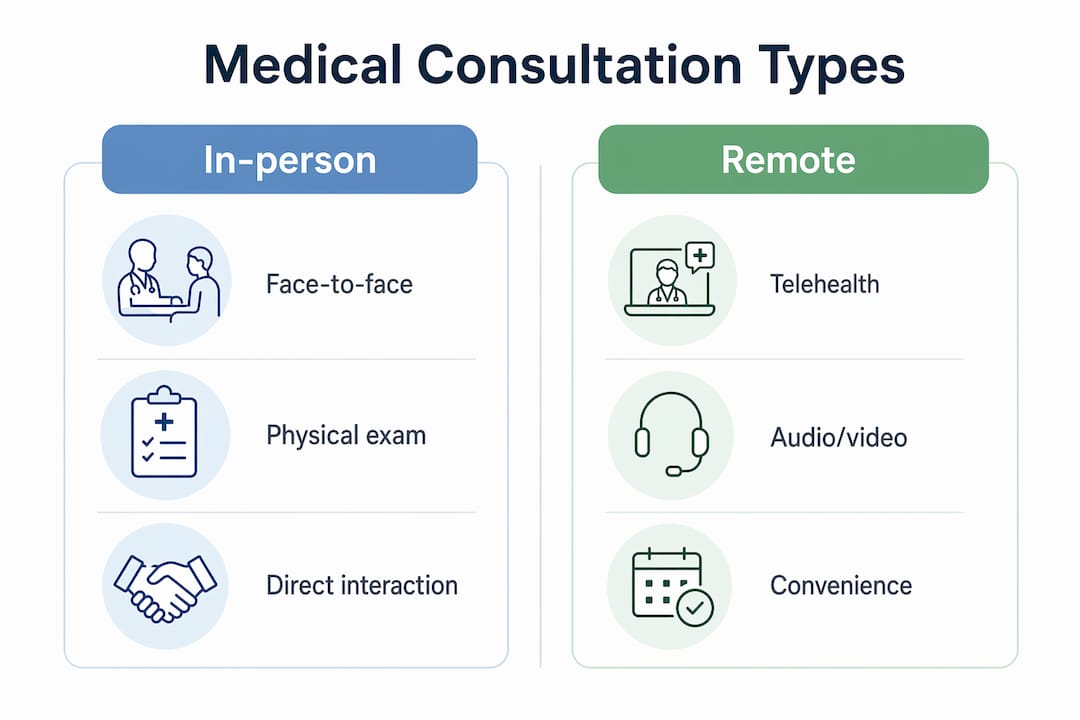
In-person consultations
Face-to-face appointments remain the gold standard for most clinical situations. They allow the clinician to perform a full physical examination, observe non-verbal cues, and build a stronger therapeutic relationship. In cosmetic medicine, an in-person consultation is particularly valuable because the clinician can assess facial symmetry, skin texture, and muscle dynamics directly.
Telehealth and remote consultations
Telehealth provides remote consultations using telecommunications technology, with audio-video or audio-only options depending on clinical need and local regulations. Remote consultations work well for follow-up appointments, prescription reviews, and initial discussions where a physical examination is not required. However, telehealth consultations rely on whether a clinician can perform needed visual or physical assessments remotely, which means a follow-up in-person visit is sometimes necessary. Remote consultations have reshaped patient access significantly since the pandemic-era expansion of digital health services.
Cosmetic and medical aesthetics consultations
Cosmetic consultations share the same clinical rigour as medical appointments but focus specifically on aesthetic goals and treatment suitability. The most valuable aspect of a cosmetic consultation is the detailed explanation and negotiation of an individualised treatment plan. This is where realistic expectations are set, contraindications are identified, and the clinician explains exactly what a procedure such as Botox or dermal fillers will and will not achieve.
| Consultation type | Best suited for | Key limitation |
|---|---|---|
| In-person | Complex assessments, first appointments, cosmetic planning | Requires travel and scheduling |
| Telehealth (audio-video) | Follow-ups, prescription reviews, initial triage | Cannot replace physical examination |
| Telehealth (audio-only) | Straightforward queries, medication checks | Limited visual assessment |
| Cosmetic consultation | Aesthetic treatment planning, suitability assessment | Requires specialist clinician |
- In-person appointments are preferred for any procedure involving injection or physical treatment.
- Telehealth is appropriate for post-treatment check-ins or discussing results.
- Cosmetic consultations should always be conducted by a qualified medical professional, not a beauty therapist.
Pro Tip: If you are considering a cosmetic procedure, book an in-person consultation even if a remote option is available. Photographs and video cannot fully replicate what a trained clinician observes in person.
Should you seek a second opinion?
A second opinion is a consultation with a different clinician to review an existing diagnosis or proposed treatment plan. It is a recognised patient right and a standard part of responsible healthcare. Second opinions influence nearly 28% of patients to decline initial treatment plans when diagnoses or treatments are complex. That figure reflects how often a fresh perspective reveals alternatives worth considering.
Common reasons to seek a second opinion include:
- A diagnosis that feels unclear or unexpected.
- A proposed treatment that carries significant risk or cost.
- A recommendation for surgery or an irreversible procedure.
- A feeling that your concerns were not fully heard during the first consultation.
“Most physicians view second opinions as a respectful part of care planning, not as an indication of distrust.” — Merck Manual, Overview of Medical Decision-Making
In cosmetic medicine, second opinions are equally valid. If a clinic recommends a treatment that feels excessive or misaligned with your goals, consulting a second qualified practitioner is a sensible step. To prepare, bring your existing notes, any imaging or test results, and a clear summary of what you were told. Approach the second consultation with the same openness you brought to the first.
How to prepare for a medical consultation
Preparation directly affects the quality of your consultation. A well-prepared patient gives the clinician better information, which leads to a more accurate assessment and a more relevant plan.
- Record your symptoms. Note when they started, how often they occur, what makes them better or worse, and how they affect your daily life. Specific detail is far more useful than a general description.
- List your medications. Include prescription drugs, over-the-counter medicines, supplements, and topical products. In aesthetics, this includes blood-thinning supplements such as fish oil or vitamin E, which affect treatment safety.
- Prepare your questions. Write down at least three questions in order of priority. If time runs short, you will have covered what matters most.
- Bring relevant documents. Previous test results, referral letters, or photographs of a skin concern all help the clinician build a complete picture quickly.
- Be honest about your history. Disclose previous treatments, allergies, and any concerns about a proposed procedure. Omitting information, even unintentionally, can affect the safety and accuracy of the consultation.
Understanding the role of shared decision-making means recognising that you are an active participant, not a passive recipient. Ask the clinician to explain any terms you do not understand. Confirm the next steps before you leave, including any follow-up appointments or actions you need to take. Clarifying the plan at the end of the appointment prevents confusion and supports better outcomes.
Pro Tip: After the consultation, write a brief summary of what was discussed and agreed. Memory fades quickly, and having a written record helps you follow through on the plan accurately.
Key takeaways
A medical consultation is the structured clinical dialogue that determines the direction of your care, and preparing for it thoroughly is the single most effective way to improve your outcome.
| Point | Details |
|---|---|
| Core definition | A consultation is a focused clinical meeting to discuss symptoms, assess suitability, and agree a treatment plan. |
| Structured process | The SOAP format and seven-stage consultation model ensure consistency, accuracy, and continuity of care. |
| Multiple formats | In-person, telehealth, and cosmetic consultations each serve distinct purposes; choose the format that matches your clinical need. |
| Second opinions | Nearly 28% of patients change their treatment plan after a second opinion; seeking one is a recognised patient right. |
| Preparation matters | Arriving with symptom notes, a medication list, and written questions directly improves the quality of the consultation. |
Why consultations are the most undervalued part of healthcare
From my experience working alongside clinicians in medical aesthetics, the consultation is consistently the stage that patients underestimate and clinicians value most. Patients often arrive focused on the treatment they want. Clinicians arrive focused on whether that treatment is right for this particular person at this particular time. That difference in perspective is exactly why the consultation exists.
The rise of telehealth has made access easier, which is genuinely positive. But it has also created an expectation that consultations can be brief, transactional, and screen-based by default. In my view, that expectation is worth resisting, particularly for cosmetic procedures. A five-minute video call cannot replace the clinical assessment that happens when a practitioner examines your skin in natural light, observes how your face moves, and asks the questions that only arise in person.
What I find most encouraging is the growing awareness of shared decision-making as a clinical standard rather than an optional extra. Patients who understand they have a voice in the management plan are more likely to follow through, ask better questions, and report higher satisfaction. The aesthetic consultation checklist approach used by structured clinics reflects this shift well. It treats the consultation not as a gateway to treatment, but as a clinical event in its own right.
Second opinions remain underused, particularly in aesthetics. If a recommendation does not feel right, seeking another view is not disloyal. It is responsible.
— Vishul
Start your consultation at The Aesthetics Room
Every treatment at Theaestheticsroom begins with a thorough consultation designed to protect your safety and personalise your results. Whether you are exploring Botox treatments for the first time or considering dermal fillers to restore volume, our practitioners take the time to assess your anatomy, understand your goals, and explain exactly what each treatment involves.
Theaestheticsroom holds CQC accreditation and is a member of the ACE Group, reflecting our commitment to patient safety at every stage. Our clinics in Knightsbridge, Harley Street, and Mayfair offer both in-person and virtual consultations, so you can begin the process in whichever format suits you. Book your consultation today and take the first step towards a treatment plan built around you.
FAQ
What is the definition of a medical consultation?
A medical consultation is a structured appointment between a patient and a healthcare provider to discuss symptoms, assess a condition, and agree on a treatment plan. It is the foundational step in both general healthcare and specialist care, including cosmetic medicine.
What is the difference between a consultation and a diagnosis?
A consultation is the process through which a clinician gathers information and assesses your condition. A diagnosis is the clinical conclusion that may result from that process. Not every consultation ends with a definitive diagnosis; some lead to further investigations or referrals.
Can a telehealth consultation replace an in-person appointment?
Telehealth works well for follow-ups, prescription reviews, and initial discussions, but it cannot fully replace in-person appointments where a physical examination is required. For cosmetic procedures, an in-person consultation is strongly recommended before any treatment begins.
How should I prepare for a medical consultation?
Bring a written list of your symptoms, current medications, and at least three questions in order of priority. Relevant documents such as previous test results or photographs of a skin concern will also help the clinician assess your situation more accurately.
Is it acceptable to seek a second medical opinion?
Second opinions are a recognised patient right and are viewed by most clinicians as a constructive part of care planning. Research shows that second opinions lead nearly 28% of patients to revise their initial treatment decisions, which reflects their genuine clinical value.