

TL;DR:
- Non-surgical aesthetic treatments offer subtle, natural results with minimal downtime, fitting seamlessly into busy lifestyles.
- They are safer, reversible, and adaptable, making them ideal choices for discerning clients seeking refinement rather than transformation.
For years, the idea of meaningful aesthetic change came wrapped in images of operating theatres, long recovery periods, and dramatic before-and-after photographs. That assumption is shifting. Across London’s most discerning social circles, affluent individuals are choosing non-surgical aesthetic treatments precisely because they offer something surgery often cannot: subtlety, flexibility, and a seamless fit around a demanding lifestyle. This guide explores what makes these treatments so effective, what the clinical evidence actually says, and how to approach them with confidence and care.
Table of Contents
- Why non-surgical treatments are increasingly popular
- Clinical effectiveness and satisfaction: what the evidence shows
- Beyond the surface: approaches that enhance and future-proof your results
- Safety, reversibility, and future options: what you need to know
- Our perspective: why luxury and subtlety align best with non-surgical aesthetics
- Discover the ultimate non-surgical experience in London
- Frequently asked questions
Key Takeaways
| Point | Details |
|---|---|
| Subtle, natural enhancement | Non-surgical treatments deliver understated, flexible improvements ideal for preserving your unique look. |
| Evidence-backed, safe options | High satisfaction rates and research support the effectiveness and safety of modern non-surgical methods. |
| Tailored treatment planning | Luxury clinics in London offer bespoke strategies for long-term, confident results with minimal disruption. |
| Future flexibility | Treatments are often reversible and can complement or precede surgical options with proper clinical guidance. |
Why non-surgical treatments are increasingly popular
The appeal of non-surgical aesthetics is not simply about avoiding a scalpel. It reflects a broader shift in how high-achieving, appearance-conscious individuals think about their wellbeing and self-presentation. The desire is for refinement, not reinvention.
Clinical research consistently confirms this. Natural results and minimal downtime are the primary factors influencing patients when they choose non-surgical over surgical facial rejuvenation. For those managing full professional calendars, social engagements, and international travel, the idea of weeks of visible recovery is simply not viable.
Here is what makes non-surgical treatments particularly well-suited to a luxury London lifestyle:
- No general anaesthesia: Treatments are performed under topical numbing or without any anaesthesia at all, removing one of surgery’s most significant risks.
- Minimal downtime: Most appointments allow you to return to meetings, events, or travel within hours, not weeks.
- Adjustable results: Unlike surgical changes, many non-surgical outcomes can be refined, layered, or adapted over time as your appearance evolves.
- Plannable: Treatments can be timed deliberately around weddings, galas, holidays, or important professional moments.
- Gradual, natural improvement: Results that develop subtly over days or weeks tend to look more organic than dramatic post-surgical changes.
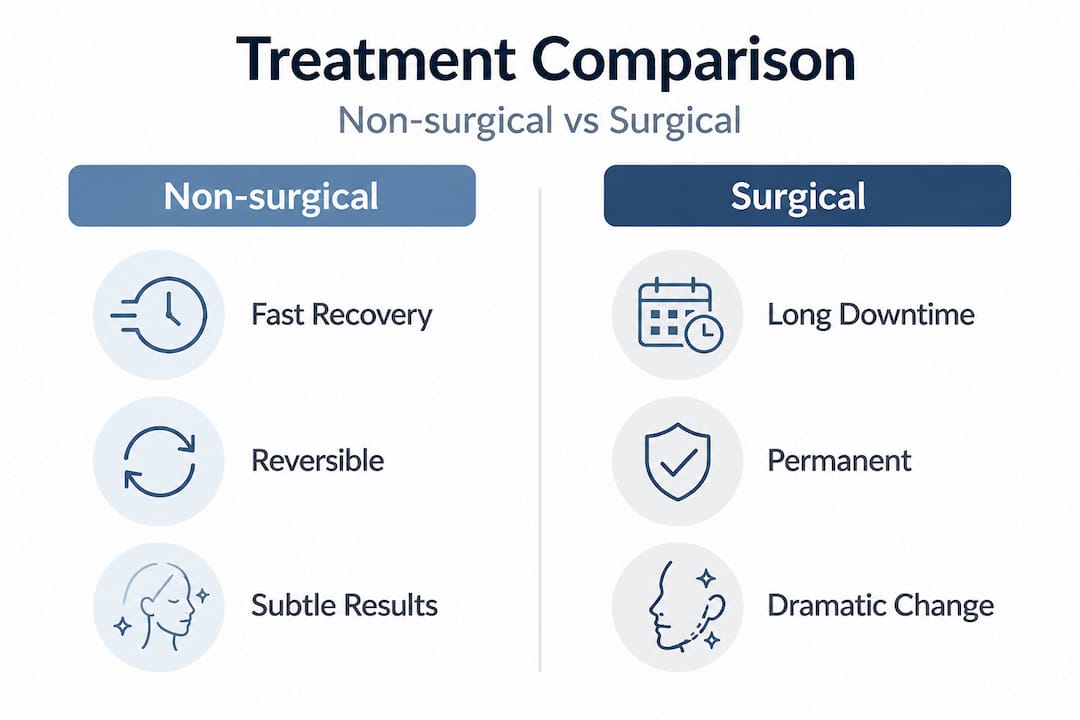
The table below outlines how non-surgical and surgical approaches compare across key lifestyle considerations:
| Factor | Non-surgical | Surgical |
|---|---|---|
| Downtime | Hours to days | Weeks to months |
| Reversibility | Often reversible | Permanent |
| Anaesthesia required | No (typically) | Yes |
| Adjustment over time | Yes | Limited |
| Entry point for results | Lower cost per session | Higher upfront investment |
| Risk of visible scarring | None | Possible |
Exploring top non-surgical treatments available at leading London clinics gives a clear picture of just how broad and effective these options have become. From neuromodulators (treatments that temporarily relax specific facial muscles) to energy-based skin tightening, today’s non-surgical menu is sophisticated, evidence-based, and genuinely transformative.
Clinical effectiveness and satisfaction: what the evidence shows
Choosing a treatment based on how it looks on social media is very different from choosing one backed by randomised clinical trial data. For those who expect rigorous standards in every other area of their lives, the science behind non-surgical aesthetics deserves equal scrutiny.
Hyaluronic acid (HA) fillers, which are gel-like substances injected to restore volume and structure, have an impressive clinical track record. A randomised trial assessing effectiveness and safety for chin retrusion found high responder rates and satisfaction, with adverse events characterised as mild to moderate and largely temporary. These findings align with the broader body of evidence supporting HA fillers as a first-line non-surgical option for facial enhancement.
“Clinical evidence confirms that when performed by skilled practitioners, hyaluronic acid fillers deliver meaningful, measurable improvements in facial harmony with a favourable safety profile.”
Understanding the range of options helps you make informed decisions. The comparison below highlights three of the most commonly chosen non-surgical treatments:
| Treatment | Primary mechanism | Typical longevity | Evidence level |
|---|---|---|---|
| HA dermal fillers | Volume restoration and contouring | 9 to 18 months | Strong (multiple RCTs) |
| Neuromodulators (e.g., Botox) | Muscle relaxation to reduce dynamic lines | 3 to 6 months | Extensive |
| Energy-based devices (RF, ultrasound) | Collagen stimulation and tissue tightening | 12 to 24 months | Growing body of evidence |
It is worth noting that individual results vary depending on three core factors: the expertise of your clinician, your unique anatomy, and your commitment to ongoing maintenance. The best outcomes come from a personalised plan, not a one-size-fits-all approach.
Pro Tip: When consulting a practitioner about fillers for facial enhancement, ask specifically about the brand of filler they use, the concentration, and their technique. These details meaningfully affect both results and safety. You can also explore natural looking filler tips to understand what a high-quality outcome should look like before your appointment.
Side effects across non-surgical treatments are generally mild. Temporary bruising, slight swelling, or redness at injection sites are the most common experiences. Serious complications are rare and are significantly reduced when treatments are performed by fully qualified medical professionals in a regulated clinical environment.
Beyond the surface: approaches that enhance and future-proof your results
What separates today’s advanced non-surgical treatments from older approaches is their ability to do far more than soften a line or add a touch of volume. Modern protocols actively improve the architecture of your skin, stimulating biological processes that deliver results building progressively over weeks and months.
Energy-based devices, including radiofrequency (RF), microfocused ultrasound, and laser technologies, work by delivering controlled energy into the skin’s deeper layers. This triggers the body’s natural healing response, prompting collagen and elastin production. Evidence for energy-based protocols confirms that these modalities support ongoing skin improvement rather than acting as temporary fixes. The distinction matters enormously for those investing in long-term results.
The benefits of this regenerative approach include:
- Progressive improvement: Results continue to develop and improve for up to six months after treatment, not just immediately afterwards.
- Structural support: Treating the skin’s deeper layers builds genuine firmness and resilience, not just surface-level smoothness.
- Longevity: Energy-based treatments typically offer results lasting one to two years, making them cost-effective for those focused on sustained outcomes.
- Compatibility with injectables: These treatments work exceptionally well alongside HA fillers and neuromodulators, creating a layered approach that addresses multiple concerns simultaneously.
For those seeking lasting skin rejuvenation, combining injectable volume restoration with collagen-stimulating energy treatments creates a genuinely synergistic effect. The fillers restore structure and definition immediately, while the energy devices build long-term skin quality from within.
Sculptra for collagen stimulation is another excellent example of this future-focused philosophy. Sculptra uses poly-L-lactic acid (a biocompatible synthetic material) to stimulate the body’s own collagen production gradually over three to six months. It does not simply replace lost volume; it encourages your skin to rebuild itself. For those planning for sustained, natural-looking results over several years, this kind of treatment represents a significant upgrade from reactive, trend-led choices.
Pro Tip: Think of your aesthetic plan the way you would a long-term investment portfolio. Combining quick-acting injectables with slower, structural treatments creates a diversified approach that performs well across different time horizons, immediate visual improvements alongside long-term skin health.
Safety, reversibility, and future options: what you need to know
Making informed decisions about non-surgical aesthetics means understanding not just what these treatments can achieve, but how they interact with your broader health and any future plans you may have. This is where preparation and transparency with your practitioner become genuinely important.
There are four key principles every patient should understand:
-
Many non-surgical treatments are reversible. HA fillers, for example, can be dissolved using hyaluronidase (an enzyme that breaks down hyaluronic acid) if results are unsatisfactory or complications arise. This reversibility is a significant safety advantage that surgery simply cannot offer.
-
Provider expertise is your most important safeguard. The risk profile of non-surgical treatments rises sharply when performed by inadequately trained practitioners outside a regulated medical environment. Choosing a premium clinical setting is not about luxury for its own sake. It is a measurable risk-reduction strategy.
-
Disclose any future surgical intentions. Research confirms that practitioners should counsel patients with future surgical plans carefully, as some non-surgical interventions can affect tissue behaviour and complicate surgical outcomes. Full transparency with your provider protects both your results and your options.
-
Regulatory frameworks are evolving. The UK has made significant progress in tightening regulations around who can administer certain injectable treatments, particularly following recent legislative changes. Ensuring your clinic operates under current regulatory guidance is essential. Reviewing med spa best practices and what separates reputable clinics from less rigorous providers helps you ask the right questions before committing.
“Patients considering non-surgical treatments should view their initial consultation not as a formality, but as a meaningful clinical conversation about their entire aesthetic journey, including any surgical options they may wish to explore in the future.”
Natural product breakdown also plays a role in long-term planning. HA fillers metabolise naturally over months, while neuromodulators wear off predictably. Understanding this timeline helps you plan maintenance appointments proactively, rather than reacting when results fade. A well-structured treatment schedule, agreed with your practitioner, keeps you looking consistently refined without any visible peaks or troughs.
Our perspective: why luxury and subtlety align best with non-surgical aesthetics
Having worked with some of London’s most demanding and discerning clients over many years, we hold a clear view on this: the very definition of luxury in aesthetics is no longer about dramatic transformation. It is about precision, adaptability, and results that enhance who you already are rather than replacing you with someone else.
There is a particular kind of confidence that comes from knowing you look well-rested and naturally vibrant, without anyone being quite certain why. That outcome is not accidental. It results from thoughtful planning, expert technique, and a practitioner relationship built on ongoing dialogue rather than a single appointment. Non-surgical treatments are uniquely suited to this kind of evolving, personalised approach.
We also believe that the highest-performing clients in this space are those who resist trend-led decision-making. The filler shapes or facial proportions that dominate social media in any given year rarely align with what will look genuinely harmonious and timeless on your individual face in five years’ time. Bespoke treatment planning, anchored in anatomy and long-term harmony, consistently outperforms treatments selected because they are fashionable.
The advantages of dermal fillers extend well beyond the immediate visual result when they are applied thoughtfully. Properly placed filler can enhance facial symmetry, restore youthful proportions, and even improve the way you photograph, all without a single visible sign of intervention.
Choosing highly qualified, evidence-focused practitioners is non-negotiable for those who will not accept compromises on safety or quality. Affluent clients in particular should feel empowered to ask detailed questions about training, product provenance, clinical governance, and complication management. The best clinicians welcome this level of scrutiny. It reflects the kind of patient they are best equipped to serve.
Discover the ultimate non-surgical experience in London
If you are ready to move from curiosity to action, The Aesthetics Room offers precisely the kind of bespoke, evidence-based experience that translates the insights in this guide into real, visible results. Our Knightsbridge clinic combines CQC-accredited clinical standards with a genuinely luxurious environment designed for those who expect the very best.
Our practitioners specialise in personalised treatment planning, whether you are exploring Dermal Fillers for volume and structure, Botox treatments for refined muscle relaxation, or a layered approach combining multiple modalities. Every plan begins with a thorough consultation, ensuring your goals, anatomy, and lifestyle all inform the recommended pathway. Book your personalised consultation today and discover what truly expert non-surgical aesthetics can do for your confidence and appearance.
Frequently asked questions
Are non-surgical aesthetic treatments safe?
When performed by expert clinicians in a regulated environment, non-surgical treatments have a strong safety record. Clinical trial data for HA fillers consistently shows mild to moderate adverse events that resolve without lasting effects.
How long do non-surgical results last?
Results vary by treatment, but many options last from several months to well over a year. HA filler effects persist for 48 weeks or longer, while energy-based treatments continue to improve the skin progressively after each session.
Can I combine non-surgical treatments for better results?
Absolutely. Combination approaches are well-supported in contemporary aesthetic medicine, and layering complementary treatments is often the most effective way to address multiple concerns simultaneously.
Will non-surgical treatments prevent me from having surgery later?
In most cases, no. However, some treatments may influence surgical planning, so it is essential to disclose any future surgical intentions to your practitioner during your initial consultation.
Recommended
- Top non-surgical treatments in London: enhance your look – The Aesthetics Room
- 7 Key Advantages of Dermal Fillers for Confident Enhancement – The Aesthetics Room
- Aesthetic Treatments for Women: Enhancing Confidence in Knightsbridge – The Aesthetics Room
- 7 Essential Natural Looking Filler Tips for Subtle Results – The Aesthetics Room
- Naturliga Resultat vid Estetiska Ingrepp – Trygghet och Precision