


TL;DR:
- Effective clinic scheduling combines accurate encounter data, structured templates, and automated communication to maximize patient access and provider productivity. Understanding key metrics like TNAA and utilisation rate, along with implementing wave scheduling, buffer rules, and regular KPI reviews, optimizes clinic performance. Successful management also relies on team understanding, consistent protocols, and balancing automation with manual outreach for high-risk patients.
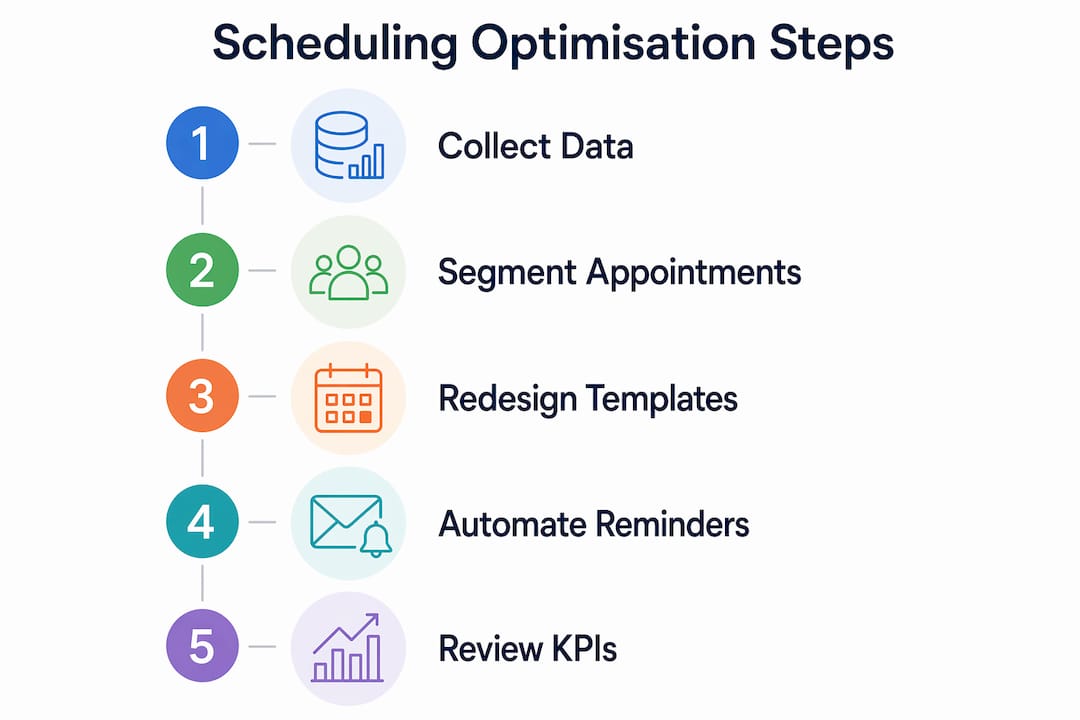
Clinic scheduling optimisation is the process of organising appointments using data analysis, automation, and strategic time management to maximise patient access and provider productivity. The industry standard measures this through two core metrics: the Third Next Available Appointment (TNAA) and the schedule utilisation rate. Clinics that learn how to optimize clinic scheduling effectively target a TNAA under 10 days and a utilisation rate above 90%. Below that threshold, you are either losing revenue to empty slots or turning patients away through poor access. This guide gives clinic managers and healthcare providers a practical, data-driven framework to fix both problems at once.
How to optimise clinic scheduling: prerequisites and tools
Before redesigning any appointment template, you need accurate baseline data. Without it, you are guessing. The three data sets that matter most are actual encounter durations by visit type, historical no-show rates by patient segment, and demand patterns by day and time of week.
Collect actual encounter duration data
Tracking check-in to checkout over a 90-day period per visit type and provider reveals the real picture. Scheduled appointment lengths and actual encounter durations rarely match. A new patient consultation booked for 20 minutes may consistently run 32 minutes with one provider and 18 minutes with another. Using scheduled times alone to build templates creates systemic delays that compound across the day.
Technology you need in place
The right tools make the difference between a schedule that holds and one that collapses by 11am. The core technology stack for efficient clinic management includes:
- Automated scheduling software with online self-booking portals. Self-scheduling reduces booking times from over eight minutes to under 60 seconds and cuts inbound administrative calls significantly.
- EHR or EMR integration with your scheduling system. Disconnected systems create duplicate data entry and booking errors.
- AI-powered triage tools to route appointment requests by urgency and visit type before they reach your front desk.
- Multi-channel reminder platforms capable of sending automated messages via SMS, email, and telephone.
Staff practices that support the system
Technology only works when staff follow consistent protocols. Publishing schedules at least 14 days in advance decreases last-minute changes by 20–30%. That reduction matters because every emergency cover arrangement disrupts the appointment flow for every patient booked that day. Train your team on the reasoning behind scheduling rules, not just the rules themselves. Frontline staff who understand why a buffer slot stays closed until the day are far less likely to fill it prematurely.
Pro Tip: Before purchasing any scheduling software, audit your current no-show rate and average booking lead time. These two numbers tell you which features to prioritise: AI waitlist management or automated reminders.
Redesigning appointment templates for balanced productivity
Appointment template design is where most clinics lose the most time. The default approach of uniform slot lengths for all visit types ignores the reality that a follow-up appointment and a new patient assessment are fundamentally different encounters.

Segment appointments by actual duration and provider pace
Use your 90-day encounter data to assign slot lengths per visit type per provider. A new patient slot for Provider A may need 35 minutes while the same visit type for Provider B needs 25 minutes. Building templates around individual provider pace eliminates the cumulative delays that push afternoon appointments 40 minutes behind schedule.
Wave scheduling: a practical model
Wave scheduling is one of the most effective methods for absorbing the unpredictability of daily no-shows and overruns. The baseline model works as follows:
- Schedule two established patients at the top of the hour.
- Schedule one new patient at the half-hour mark.
- Leave the final 10 minutes of each hour as a soft buffer.
Wave scheduling naturally absorbs the variability of patient arrivals and visit lengths. If one established patient runs long, the new patient slot provides recovery time. If the established patients are quick, the provider gains a natural pause before the more complex new patient encounter.
| Scheduling Method | Best For | Key Benefit |
|---|---|---|
| Wave Scheduling | Mixed new and established patients | Absorbs overruns without cascading delays |
| Modified Wave | High-volume clinics | Adds flexibility at the half-hour mark |
| Open Access | Same-day demand clinics | Maximises daily fill rate |
| Time-Specified | Procedure-heavy clinics | Precise resource allocation |
The noon-backward/forward rule
The Noon-Backward/Forward rule is a surprisingly effective workflow management strategy that most clinic managers have never encountered. Morning appointments are scheduled backward from noon, filling the 12pm slot first and working toward 9am. Afternoon appointments are scheduled forward from noon, filling the 1pm slot first and working toward 5pm. This concentrates patient flow in the middle of the day, protecting the start and end of each session for administrative tasks, urgent calls, and clinical catch-up. The result is a schedule that rarely collapses at either end of the day.
Buffer times as revenue protection
Buffer time protects revenue when treated correctly. The error most clinics make is treating buffer slots as catch-up time throughout the day. Buffer slots should remain closed until the morning of the appointment day. At that point, open them only if an emergency or unavoidable overrun requires it. Unused buffer slots represent protected provider capacity, not wasted time. Clinics that fill buffer slots routinely with routine bookings lose the safety net that prevents provider burnout and schedule collapse.
Pro Tip: Set your scheduling software to flag buffer slots as “hold” rather than “available.” This prevents reception staff from filling them during busy booking periods without clinical authorisation.
What automation strategies reduce no-shows and cancellations?
No-shows are the single largest source of preventable revenue loss in clinic scheduling. Automated scheduling software reduces no-shows by up to 79% when implemented with the right reminder sequence. That figure represents a substantial recovery of both clinical time and income.
The 5-3-1 reminder sequence
The most effective automated reminder cadence follows a structured sequence:
- Five days before: Send a confirmation request via email with a one-click confirm or reschedule option.
- Three days before: Follow up via SMS if no confirmation has been received.
- One day before: Send a final reminder via the patient’s preferred channel, including appointment details and arrival instructions.
Each reminder should include an active rescheduling link. Patients who cannot attend but have an easy way to cancel will do so. That cancellation gives you time to fill the slot through your waitlist.
Ai-powered waitlists and smart triage
AI scheduling tools can autonomously handle 60–80% of routine appointments when triage routing protocols are properly configured. The practical implication is that your front desk team focuses on complex or urgent cases while the system manages routine bookings, confirmations, and waitlist fills. When a cancellation arrives, the AI matches it to the next appropriate waitlist patient and sends an automated offer within minutes. Manual waitlist management, by contrast, often means that slot goes unfilled.
“AI scheduling success depends on well-defined triage protocols to avoid misrouting and maintain clinical safety.” — AI Appointment Scheduling for Healthcare: Complete Setup Guide (2026)
High-risk patient outreach
Automation handles the majority of your patient population well. For high-risk patients, defined as those with a history of no-shows or complex social circumstances, personal phone calls 24 hours prior to appointments substantially reduce no-shows beyond what automated reminders achieve alone. Assign this task to a specific team member each afternoon. The call takes two minutes and can recover a 45-minute appointment slot worth significant clinical revenue. You can read more about how aesthetic clinic booking workflows integrate these automation principles in practice.
How do you measure and continuously improve scheduling performance?
Optimising for utilisation or patient access alone is ineffective. Clinics must balance both simultaneously using data-driven templates reviewed on a regular cycle. The metrics below give you the full picture.
Key performance indicators to track
| KPI | Target | What It Signals |
|---|---|---|
| Third Next Available Appointment (TNAA) | Under 10 days | Demand is within capacity |
| Schedule Utilisation Rate | Above 90% | Slots are being filled effectively |
| No-Show Rate | Below 5% | Reminder and confirmation systems are working |
| Average Patient Wait Time | Under 10 minutes | Template design matches actual encounter durations |
Building a monthly review cycle
Review your KPIs on a monthly cadence rather than reacting to individual bad days. Use rolling four-week averages for no-show rates and TNAA to smooth out weekly variation. Analyse appointment data by time interval, specifically by hour of day and day of week, to identify where bottlenecks consistently appear. A TNAA that spikes every Monday morning, for example, points to a demand pattern that requires a template adjustment, not a staffing crisis.
The review process should follow these steps:
- Pull the previous month’s TNAA, utilisation rate, no-show rate, and average wait time.
- Identify the two or three time intervals with the worst performance.
- Review the appointment types and provider assignments in those intervals.
- Adjust slot lengths or scheduling methods for those intervals only.
- Collect team feedback from reception and clinical staff before finalising changes.
Team feedback is not optional. Reception staff see scheduling problems before the data does. A clinician who consistently runs 15 minutes over in the first slot of the afternoon is a template problem, not a discipline issue. Frontline observations, combined with your medical aesthetics workflow data, give you the complete picture needed to make accurate adjustments.
Key takeaways
Effective clinic scheduling optimisation requires combining accurate encounter data, structured appointment templates, and automated communication to achieve both high utilisation and strong patient access simultaneously.
| Point | Details |
|---|---|
| Use TNAA and utilisation rate | Target TNAA under 10 days and utilisation above 90% to diagnose scheduling gaps accurately. |
| Build templates from real data | Track actual encounter durations over 90 days per visit type and provider before redesigning slots. |
| Apply wave scheduling and buffer rules | Use wave scheduling to absorb overruns and reserve buffer slots exclusively for emergencies. |
| Automate reminders with the 5-3-1 sequence | Send confirmation requests at five, three, and one day before appointments to cut no-shows significantly. |
| Review KPIs monthly, not reactively | Use rolling averages and team feedback to make precise template adjustments on a regular cycle. |
What i have learned about scheduling that most guides miss
Most scheduling guides focus on technology. Buy the right software, configure the reminders, and the problem solves itself. After years of working with clinic operations, I have found that the technology is rarely the limiting factor. The limiting factor is almost always culture.
Clinics where scheduling works well share one characteristic: the entire team understands why the rules exist. When a receptionist knows that a buffer slot left closed until the morning protects the provider from a 6pm finish, they defend that slot. When they see it as an arbitrary rule from management, they fill it the moment a patient asks. That difference in understanding is worth more than any software upgrade.
The other insight I would offer is about administrative time. Protecting the start and end of each clinical session for non-patient tasks is not a luxury. It is the mechanism that prevents the slow accumulation of stress that leads to provider burnout. The Noon-Backward/Forward rule exists precisely because it creates that protection without reducing patient capacity. Clinics that resist it because it feels counterintuitive are the same clinics whose providers are consistently running 20 minutes behind by 3pm.
Finally, do not underestimate the value of manual outreach for high-risk patients. Automation is efficient. A two-minute phone call from a familiar voice is effective. The combination of both is what moves a no-show rate from 12% to under 5%.
— Vishul
How Theaestheticsroom supports optimised patient scheduling
At Theaestheticsroom, we understand that a well-managed appointment schedule is the foundation of an exceptional patient experience. Our Knightsbridge clinic operates with structured booking protocols, trained clinical coordinators, and integrated online booking that reflects the best practices for scheduling described throughout this guide.

Whether you are exploring dermal filler treatments or a full skin rejuvenation programme, our team ensures every appointment is allocated the right time, the right provider, and the right preparation. We apply the same data-driven approach to our own scheduling that we recommend to clinic managers. Book a consultation with Theaestheticsroom today and experience what genuinely efficient clinic appointment management feels like from the patient’s perspective.
FAQ
What is the third next available appointment (TNAA)?
The Third Next Available Appointment is the number of days until the third open slot in a provider’s schedule. A TNAA under 10 days indicates that patient demand is within clinic capacity.
How much can automated reminders reduce no-shows?
Automated scheduling software reduces no-shows by up to 79% when combined with a structured multi-channel reminder sequence. Adding personal phone calls for high-risk patients improves results further.
What is wave scheduling in a clinic context?
Wave scheduling places two established patients at the top of the hour and one new patient at the half-hour mark. This structure absorbs overruns and no-shows without cascading delays across the day.
How often should clinics review their scheduling kpis?
Monthly reviews using rolling four-week averages give the most accurate picture of scheduling performance. Reacting to individual days introduces noise that leads to unnecessary template changes.
What does a healthy schedule utilisation rate look like?
A schedule utilisation rate above 90% indicates that appointment slots are being filled effectively. Rates below 90% typically signal confirmation inefficiencies or poor recall management.
Recommended
- Medical Aesthetics Workflow Optimisation for Clinics – The Aesthetics Room
- Appointment booking workflow for aesthetic clinics – The Aesthetics Room
- How to set treatment pricing for premium aesthetics clinics 2026 – The Aesthetics Room
- How to conduct virtual consultations in 2026 – The Aesthetics Room