
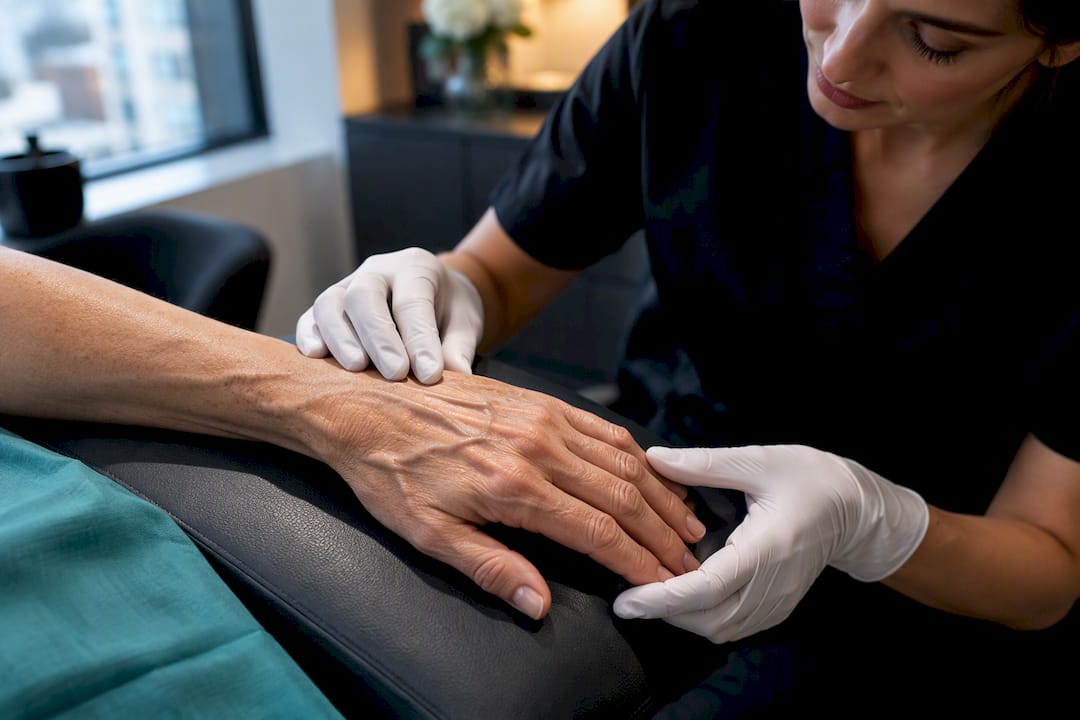

Dermal fillers can restore lost volume on the back of the hands and, depending on the material chosen, improve skin quality at the same time. Hyaluronic acid (HA) and calcium hydroxylapatite (CaHA), sold under the brand name Radiesse, are the two materials with the strongest clinical backing. HA typically lasts several months; CaHA often runs longer because it stimulates the skin’s own collagen. Results depend heavily on a qualified clinician’s technique, so read on for the protocol details before booking anything.
TL;DR:
- Hyaluronic acid fillers provide immediate, reversible volume enhancement but typically last only a few months, especially in faster metabolisers.
- Calcium hydroxylapatite offers longer-lasting results by stimulating collagen and is effective for structural volume and skin quality improvements.
- Proper placement in the superficial dorsal lamina using blunt cannulas, along with detailed documentation, reduces risks and improves outcomes.
- Candidates should undergo objective hand grading and disclose prior procedures, while those with autoimmune conditions or on blood thinners need careful assessment.
- Both fillers show measurable improvement up to 12 months, but longevity depends on product type, dilution, placement, and individual metabolism.
Table of Contents
- Which fillers are used for hand rejuvenation and how they work
- Who is a good candidate for hand fillers?
- How is the procedure performed safely?
- What results can you realistically expect?
- What are the risks and how are they managed?
- How does a medically led clinic approach hand rejuvenation?
- Weighing up hand fillers: a practical view
- Book a hand filler consultation with Theaestheticsroom
- Sources
- FAQ
Which fillers are used for hand rejuvenation and how they work
The hands age differently from the face. Skin thins, veins and tendons become prominent, and volume simply disappears from the dorsal surface, so any filler chosen has to solve a mechanical problem, not just a cosmetic one. Three materials dominate current practice, each with a distinct mechanism.
Hyaluronic acid fillers, of which Juvéderm is a widely used example, work immediately. Once injected, HA draws water into the tissue, plumping the dorsal surface and softening the appearance of tendons and veins on contact. A procedural review published in Plastic and Reconstructive Surgery Global Open sets out a five-step technique for HA hand augmentation and confirms it delivers reliable, visible improvement when injected correctly. HA’s biggest practical advantage is reversibility: hyaluronidase dissolves it if the result looks wrong or a complication arises, which makes it a sensible starting point for first-time patients.
Calcium hydroxylapatite, Radiesse being the recognised brand, behaves differently. It provides structural volume on the day of treatment but also triggers neocollagenesis, meaning the body lays down its own collagen around the microspheres over the following weeks. A dual-approach study followed 40 patients treated with both nondiluted CaHA (for volume in the intermediate lamina) and diluted CaHA (for superficial biostimulation) in the same session, reporting good results and high satisfaction through six months.
Poly-L-lactic acid (PLLA) takes the biostimulation idea further. It contains no immediate filling effect at all. It works purely by provoking collagen production, so results build gradually over two to three months and suit patients whose main concern is skin quality and translucency rather than visible hollowing.
- HA: instant result, fully reversible, best for camouflaging tendons and veins quickly.
- CaHA: structural volume plus longer-term biostimulation; dilution ratio changes whether it behaves as a filler or a skin-quality treatment.
- PLLA: no immediate volume, slow collagen-driven improvement, suited to subtle skin texture concerns.
Handling differs too. HA can feel slightly more palpable under thin dorsal skin immediately after treatment, while CaHA’s structural nature demands more careful placement to avoid visible lumping. A formulation checklist for CaHA hand protocols stresses that mixing ratio, lidocaine content, and time between mixing and injection all change how the product handles and sits under the skin.
Pro Tip: Ask your clinician which exact dilution ratio they plan to use for CaHA and why. A 1:1 saline dilution behaves very differently from an undiluted syringe, and a clinic that can answer this specifically is one that understands the product properly.
Who is a good candidate for hand fillers?
Candidacy starts with an objective measurement, not a mirror check. Most reputable clinicians use the Merz Hand Grading Scale, a validated five-point system that rates visible tendons, veins, and bony prominence against photographic references, alongside similar tools like the Allergan Hand Volume Deficit Scale. Scoring the hand before treatment gives both patient and clinician a documented baseline, which matters enormously when judging results months later.
Several medical and lifestyle factors shape suitability:
- Smokers often see slower collagen response with biostimulatory fillers like CaHA and PLLA.
- Active autoimmune conditions can raise the risk of granuloma formation and usually warrant caution or referral.
- Prior fillers, fat grafting, or hand surgery need full disclosure, since old material or scar tissue changes how a new filler settles and can complicate future procedures.
- Anyone on blood thinners should expect more bruising and a longer recovery window.
Goals matter as much as anatomy. A patient wanting to camouflage prominent veins before a wedding has a different treatment plan from one focused on the crepey, thin quality of ageing skin. The first favours volume; the second favours a biostimulatory approach or a combination. A thorough consultation should include photographic baseline documentation and clear written consent covering expected duration, realistic outcomes, and what happens if a touch-up is needed.
How is the procedure performed safely?
Technique matters more on the hands than almost anywhere else the body is injected, because the dorsal skin is thin and the anatomy underneath, tendons, veins, and superficial nerves, sits close to the surface.
Clinicians generally aim for the superficial dorsal lamina, the layer just above the tendons and veins, rather than injecting directly onto them. Some protocols use the intermediate lamina for structural CaHA placement, reserving the more superficial plane for diluted, biostimulatory product. Getting the plane wrong raises the risk of visible lumping or, in rare cases, vascular compromise.
Most experienced injectors prefer a blunt cannula over a sharp needle for the dorsal hand, typically a 25 or 27 gauge cannula introduced through one or two small entry points. A blunt tip is far less likely to nick a vein or nerve as it travels beneath the skin, which matters given how visible and functionally important the hands are.
- Local anaesthetic or numbing cream is applied, and the hand is cleaned and positioned flat.
- Product is delivered using a fanning technique from a proximal entry point, or a linear retrograde pattern, in small, measured passes rather than one large bolus.
- The clinician massages and moulds the product to distribute it evenly and avoid visible ridging.
- The hand is elevated briefly post-treatment to limit swelling, with cold compresses if needed.
- A follow-up is booked, typically two to four weeks later, to assess whether a touch-up is required.
A well-run clinic will document the exact product, dilution ratio, and volume injected per hand, and keep before-and-after photographs on file. That paperwork trail matters if you ever need a touch-up or want to compare results against your original baseline.
Pro Tip: Ask to see the volume actually recorded on your chart after treatment. A precise number, say 1.5ml per hand, tells you the clinician is tracking dose carefully rather than eyeballing it.
What results can you realistically expect?
A randomised, partially blinded trial comparing Radiesse against Juvéderm Ultra 4 for hand augmentation found both fillers produced significant improvement through 12 months, with high satisfaction from both blinded and unblinded evaluators. Notably, CaHA achieved comparable short-term results using smaller injected volumes than HA, a practical consideration when weighing cost against outcome, according to clinical trial findings.
A separate multinational, multicentre study of CaHA reported strong physician and patient satisfaction at 12 weeks, with only minor, transient adverse events recorded across sites.
Across the CaHA and HA trials reviewed here, both materials showed measurable improvement on validated hand grading scales through 12 months, though CaHA’s biostimulatory effect tends to give it an edge on longevity once the initial volumising effect settles.
Several variables shift how long results actually last:
- Product and dilution: undiluted CaHA generally holds volume longer than a heavily diluted preparation.
- Injection plane: deeper placement tends to persist longer than very superficial injection.
- Individual metabolism: faster metabolisers break down HA more quickly, shortening its practical lifespan.
Most trials rely on the Merz scale, the Global Aesthetic Improvement Scale (GAIS), or occasionally ultrasound measurements of dermal thickness as outcome markers. Worth noting: several of these studies involve modest sample sizes, and some carry manufacturer sponsorship, so treat headline satisfaction figures as encouraging rather than definitive.
What are the risks and how are they managed?
Bruising, mild swelling, and small palpable nodules in the first days are the most common effects, and they usually settle within one to two weeks with cold compresses and gentle massage. These are expected, not a sign anything has gone wrong.
Less common but more troublesome are delayed complications:
- Persistent nodules or granuloma, which can appear weeks or months later and typically need clinical assessment, sometimes steroid injection or hyaluronidase depending on the product involved.
- Delayed oedema, occasionally linked to a viral illness or vaccination well after treatment.
- Infection, rare but requiring prompt antibiotic treatment if it occurs.
Rare but serious vascular events, causing severe pain, skin discolouration, or loss of hand function, require urgent same-day medical attention; these are genuine emergencies, not a wait-and-see situation. The British Association of Aesthetic Plastic Surgeons has raised concerns about possible immune and longer-term anatomical effects of fillers in some patients, underlining why careful candidate selection and an experienced injector genuinely reduce risk rather than simply ticking a box.
UK oversight of this field is tightening. The government’s consultation on licensing non-surgical cosmetic procedures signals a move toward stricter local licensing and formal training standards. Until that regime is fully in place, checking a clinic’s CQC registration and the individual practitioner’s qualifications remains the most reliable safeguard available to patients today.
How does a medically led clinic approach hand rejuvenation?
A properly run clinic treats hand fillers with the same rigour as facial work: pre-assessment against a validated scale, a documented and bespoke plan, the treatment session itself, then structured follow-up. A properly run clinic operates from London locations with this pathway as its baseline. Before choosing anywhere, it is worth asking to see how they document assessment and outcomes, since that paperwork is what separates a considered treatment plan from a rushed one.

Weighing up hand fillers: a practical view
Fillers earn their place when volume loss is the main complaint. If the issue is purely surface texture or fine crepiness, topical retinoids or resurfacing may achieve more for less. Before booking, insist on three things: an objective grading score, not a guess; documented before-and-after evidence from the clinic’s own patients; and confirmation of the practitioner’s registration. Disclose every prior filler or hand procedure honestly. Old product changes how new filler behaves, and no clinician can plan properly around information they were never given.
— Vishul
Book a hand filler consultation with Theaestheticsroom
An advantage of some clinics is that every treatment plan starts with medically led assessment rather than a standard, one-size template, so hand rejuvenation can be scored, documented, and reviewed the same way facial treatments are.

A first consultation covers a hand assessment against a validated grading scale, a discussion of which material suits your goals, camouflage versus longer-term skin quality, and full written consent before anything is booked. You can view the full dermal fillers service page or check treatment costs on the current price list. Ask the team for before-and-after photo sets and clinician credentials when you book, and expect straight answers on both.
Sources
For deeper clinical detail, the five-step HA hand augmentation technique explains procedural steps in full. The CaHA dual-approach study covers combined dilution protocols, and the GOV.UK licensing consultation outlines where UK regulation is heading.
This article is general information, not a substitute for advice from a qualified doctor. Consult a qualified healthcare professional about your own circumstances before acting on anything here.
- The 5‑Step filler hand rejuvenation: filling with hyaluronic acid (Plast Reconstr Surg Glob Open / PMC6382238)
- Gov
FAQ
What is the most effective filler for hand rejuvenation?
Neither HA nor CaHA is universally “better”; a head-to-head trial found both produced significant improvement through 12 months, with CaHA achieving comparable short-term results using smaller volumes. The right choice depends on whether you want immediate, reversible volume (HA) or longer-lasting structural and skin-quality improvement (CaHA).
How much does hand rejuvenation cost in the UK?
Pricing varies by clinic and by the volume and product used, so it is best checked directly against a current price list. Theaestheticsroom’s published treatment fees are available on its price list.
How long do fillers in hands last?
HA fillers typically last several months before needing a top-up, while CaHA often lasts longer because it stimulates the skin’s own collagen alongside its immediate volumising effect. Longevity also depends on the dilution used, the injection plane, and individual metabolism.
Does hand rejuvenation really work?
Yes, clinical studies using validated scales like the Merz Hand Grading Scale confirm measurable improvement with both HA and CaHA fillers. Results depend heavily on correct technique, appropriate product choice, and realistic expectations set during consultation.