
Yes, botulinum toxin can soften bunny lines when it is injected with a conservative, anatomy-led technique that targets the borders of the muscles causing the crease rather than the crease itself. This border-targeted approach, ideally guided by ultrasound, gives more predictable results and a lower risk of unwanted spread than older methods. We always recommend treatment only from a CQC-registered practitioner using a fully authorised product.
TL;DR:
- Border-targeted injections, guided by ultrasound, deliver smaller doses at specific muscle insertions, reducing the risk of unwanted spread and improving predictability.
- The underlying anatomy shows bunny lines form from contraction of muscles outside the crease, so treatment targets border muscles rather than the fold itself.
- Typical doses range from 0.5 to 2 units per injection point, with precise placement and staged treatment recommended for static lines or deep creases.
- Practitioners must map muscle borders actively during assessment, as each patient’s muscle activation pattern varies significantly.
- Confirming the use of a licensed, fully authorized product from a qualified, CQC-registered clinic is essential for safety and effective results.
Table of Contents
- Why do bunny lines form? The anatomy behind the crease
- Where injections actually go: border-targeted technique explained
- How much Botox do bunny lines actually need?
- What actually happens during your appointment
- Aftercare, side effects, and when to seek help
- Choosing a safe, qualified clinic for bunny lines treatment
- When bunny lines Botox works best, and when it does not
- Book a bunny lines assessment with The Aesthetics Room
- Sources
- FAQ
Why do bunny lines form? The anatomy behind the crease
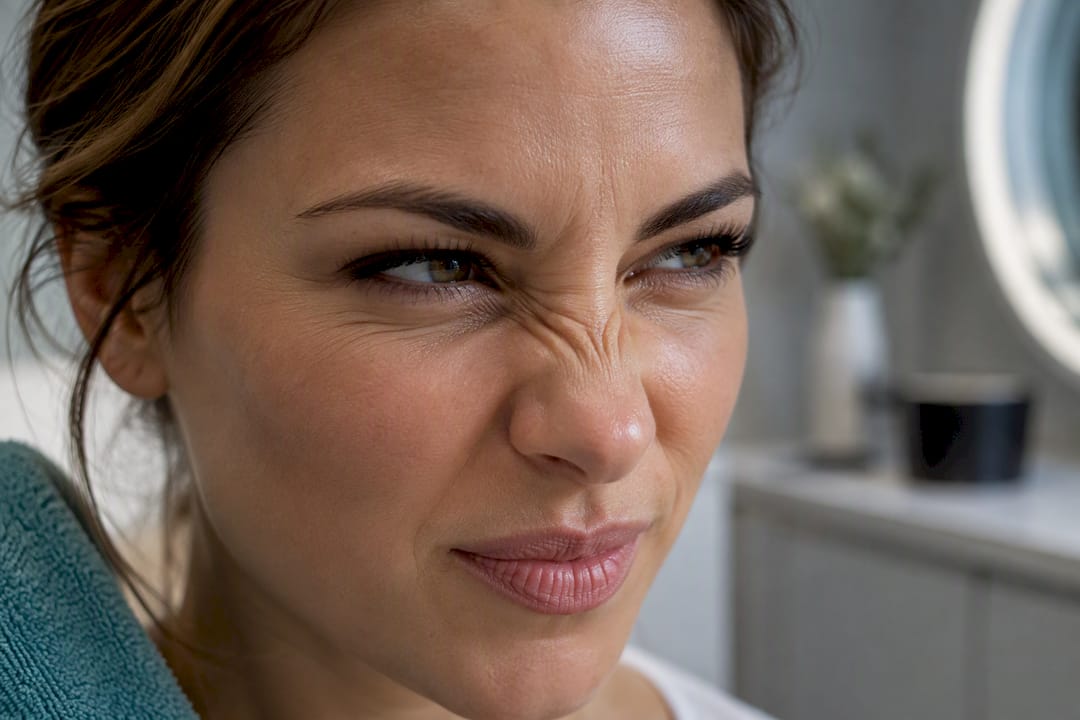
Bunny lines are the diagonal creases that appear across the top of your nose when you scrunch it, laugh hard, or squint into the sun. They sit between your eyes and above your nostrils, and for years the conventional explanation was simple: an overactive nasalis muscle bunches the skin, so you inject the crease.
Cadaveric dissection and ultrasonographic evaluation have shown that explanation is incomplete. The visible fold actually sits inside what researchers call the “bunny triangle”, a non-muscular zone bordered by four separate muscles: the transverse nasalis, the levator labii superioris alaeque nasi (LLSAN), the procerus, and the medial fibres of orbicularis oculi. The anatomical evidence from cadaveric dissection and ultrasonography found that when these neighbouring muscles contract together, they pull the skin at their shared borders and fold the triangle between them like a piece of paper creased by pressure at its edges, not by anything happening inside the triangle itself.
That distinction changes how the treatment should be planned. If the crease is created by adjacent muscle borders rather than a muscle running directly beneath it, injecting into the visible line means placing toxin into connective tissue with no muscle to act on. The muscles doing the actual work sit just outside that fold.
Most people notice bunny lines only when they scrunch their nose. Over time, especially with UV exposure and the natural thinning of the dermis, repetitive movement can etch these dynamic lines into faint static ones visible at rest. That progression matters for treatment planning:
- Early dynamic lines respond best to targeted toxin because the muscle activity driving them is still the dominant cause.
- Static lines that persist at rest often need a longer view, sometimes combining toxin with skin-quality treatments once the muscle activity is addressed.
- Nasal anatomy varies considerably between patients, which is exactly why mapping your own active borders during a consultation matters more than following a fixed injection pattern.
Where injections actually go: border-targeted technique explained
Injecting directly into the bunny line crease, the traditional approach many people still ask for, relies on the toxin diffusing sideways into whichever muscle happens to be nearby. Diffusion is not a precise delivery mechanism. Results vary from patient to patient and appointment to appointment, and the outcome depends heavily on luck rather than technique.
Border-targeted injections work differently. Instead of chasing the crease, the practitioner places tiny amounts of toxin at the specific points where the surrounding muscles insert or overlap, using the underlying anatomy as the map rather than the skin fold as the target. Clinical guidance on where to inject for bunny lines supports this shift, noting that border-targeted micro-aliquots carry a lower risk of functional complications, including unwanted weakness of the upper lip elevator or drooping of the nostril rim, compared with larger-volume injections placed straight into the line.
The primary targets a practitioner will consider include:
- The superior border of the transverse nasalis, where the muscle’s upper edge meets the bridge of the nose.
- The superior-medial point of the LLSAN, close to where it originates near the medial canthus.
- The medial border of orbicularis oculi, near the inner corner of the eye, where its lower fibres contribute to the fold.
- The inferolateral aspect of procerus, used selectively depending on how much that muscle contributes to an individual’s crease pattern.
Depth matters as much as location. Sonoanatomy research on the nasal ala measured consistent injection depths across these landmarks: roughly 1.9mm at the alar groove, around 2.8mm at the lower nasal border, and closer to 4.5mm near the nasal spine. These are shallow, precise placements, not the deeper intramuscular injections used elsewhere on the face.
Ultrasound guidance is where this technique earns its reputation for predictability. Rather than working from surface landmarks alone, an ultrasound-capable practitioner can visualise the muscle layer directly, confirm the depth of the needle in real time, and steer clear of the angular artery, which runs close to several of these injection points. The same sonoanatomy findings point out that ultrasound also lets the clinician tailor depth to each patient’s actual muscle thickness rather than relying on a fixed distance that may not suit every nose.
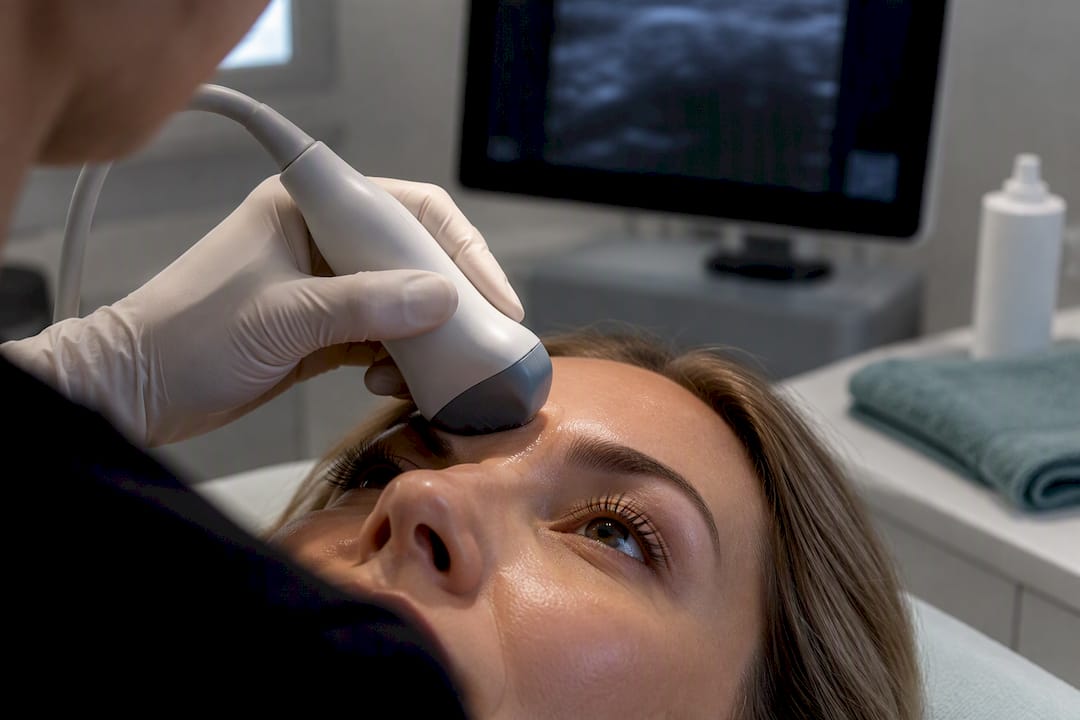
Pro Tip: Ask your practitioner directly whether they use ultrasound or landmark-only technique for bunny lines. It is a fair question, and a confident, detailed answer is a good sign you are in experienced hands.
How much Botox do bunny lines actually need?
Bunny lines need far less toxin than most people expect. This is a small muscle group working over a tight space, so the dosing philosophy is deliberately conservative.
- Typical micro-aliquots range from around 0.5 to 2 units per point, depending on the specific muscle and how pronounced that border’s contribution is to your individual crease.
- Smaller, more delicate sites such as the medial orbicularis oculi border usually receive the lower end of that range, often 0.5 to 1 unit, to reduce the risk of affecting nearby muscles that control eyelid movement.
- Units are specific to each licensed product and are not directly interchangeable between brands, so a dose calculated for one toxin cannot simply be copied onto another.
- Many practitioners deliberately under-treat on a first visit, then assess the result at two to four weeks and top up if the lines have not softened enough.
That staged approach protects against the two failure modes patients worry about most: unnatural stiffness in the muscles around the eye and nose, and an asymmetric result that needs correcting rather than adjusting.
What actually happens during your appointment
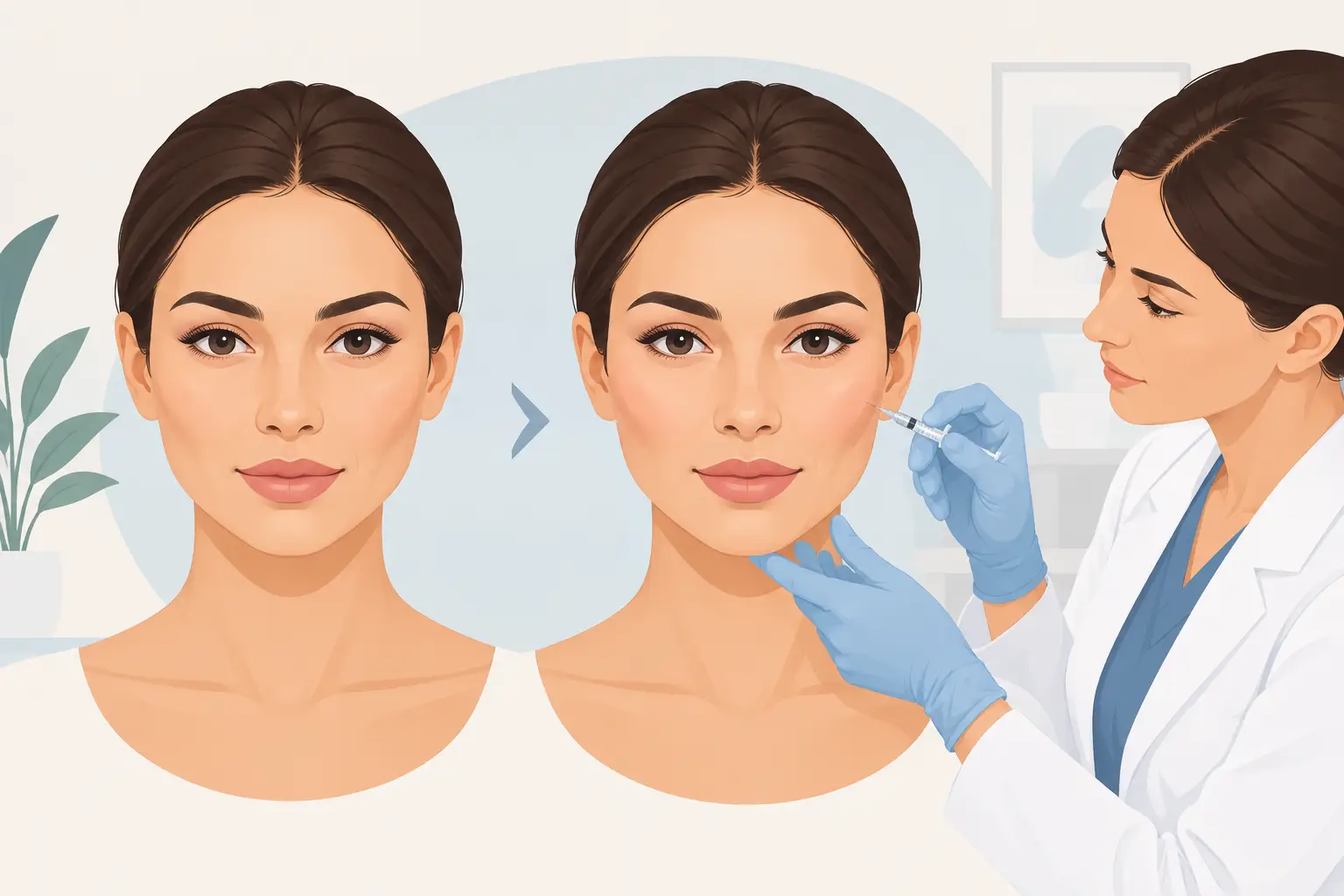
A bunny lines appointment is short, but the assessment stage does most of the important work. Before any needle comes out, the practitioner asks you to scrunch your nose repeatedly so they can watch which muscle borders are actually driving your particular crease pattern. No two patients activate the same combination of muscles in quite the same way, which is exactly why a generic injection map does not serve this area well.
- Dynamic assessment and consent: your active bunny lines are mapped while you scrunch, and the plan is confirmed with you before treatment begins.
- Marking: the practitioner marks the specific border points identified during assessment, sometimes cross-checked with ultrasound.
- Injection: micro-aliquots are delivered at each marked point, a process that typically takes only a few minutes once the assessment is complete.
- Review: some clinics repeat a brief ultrasound check immediately afterwards to confirm placement.
The whole visit, consultation included, usually runs to around thirty minutes. You will not see results immediately. Onset typically begins within a few days, with the full effect settling in at around two weeks. Once established, the softening effect on bunny lines commonly lasts three to four months before the muscles regain their previous activity and a top-up appointment is worth booking. Our step-by-step Botox guide covers this timeline in more detail if you want to plan ahead for repeat visits.
Aftercare, side effects, and when to seek help
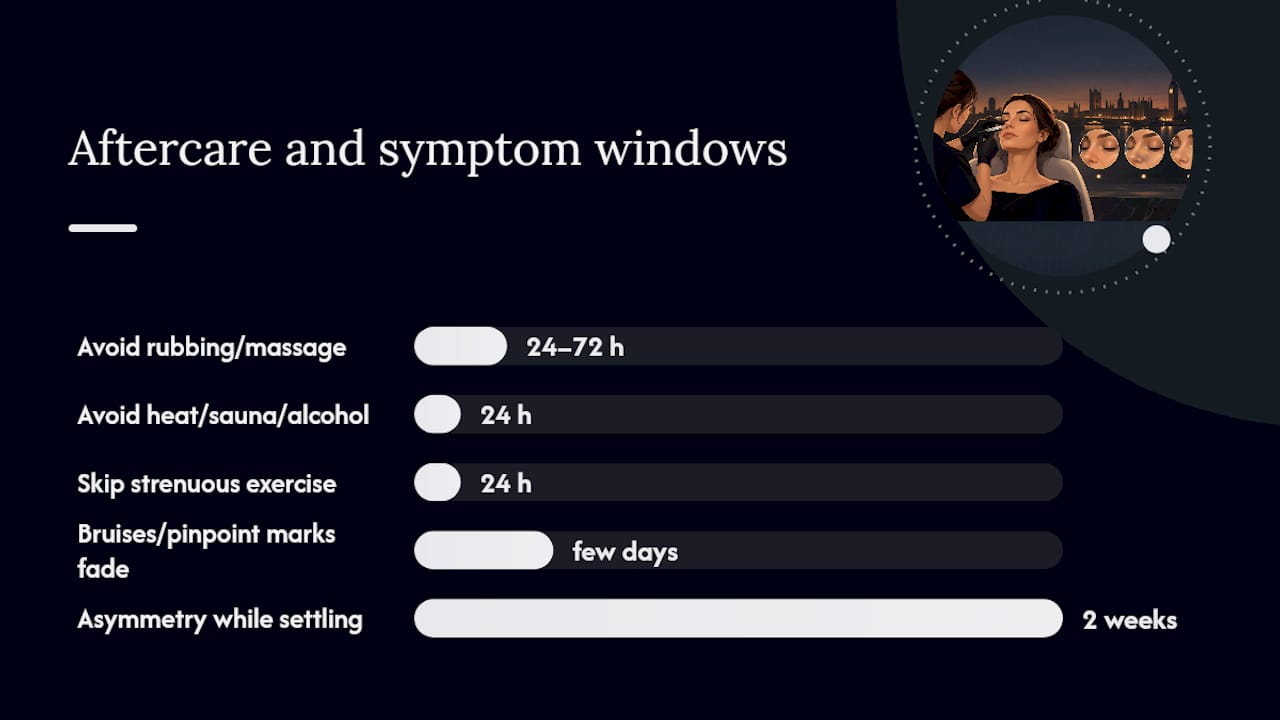
The aftercare rules for bunny lines Botox are the same sensible precautions that apply across the face, and they matter more than people assume in an area this close to the eyes. Avoid rubbing or massaging the treated area for 24 to 72 hours after injection, and steer clear of heat, saunas, hot baths, and alcohol for at least the first 24 hours to limit bruising and reduce the chance of the toxin migrating from its intended spot. Skip strenuous exercise for the same 24-hour window.
Most side effects are mild and short-lived:
- Small bruises or pinpoint marks at the injection sites, usually fading within a few days.
- Mild, localised muscle weakness around the treated area.
- Slight asymmetry while the toxin settles into its final effect over the first two weeks.
- Occasional mild headache or flu-like tiredness in the day or two after treatment.
Serious complications from botulinum toxin are uncommon, but the possibility of toxin spreading beyond the treated area is why regulators take this seriously. Updated MHRA safety guidance confirms that symptoms of wider toxin spread, a condition known as iatrogenic botulism, can take up to four weeks to appear after injection. Warning signs include difficulty breathing, swallowing or speaking, and progressive muscle weakness beyond the treated area. Any of these symptoms need immediate medical attention, not a wait-and-see approach.
This is not a theoretical warning. A 2025 outbreak of iatrogenic botulism in England was traced back to an unlicensed cosmetic product found to contain a higher potency than its label stated. It is the clearest recent case for why confirming your practitioner uses a fully authorised, correctly labelled product is not a box-ticking exercise. Our guide to Botox side effects and regulator warnings covers this in more depth.
Choosing a safe, qualified clinic for bunny lines treatment
The UK has been tightening standards around non-surgical cosmetic procedures for good reason. Government-led proposals on licensing non-surgical cosmetic procedures point toward stricter practitioner standards and age limits, building on the Botulinum Toxin and Cosmetic Fillers (Children) Act 2021. That direction of travel tells you the regulatory bar for this treatment is rising, not staying still.
Before booking anywhere for bunny lines treatment, it is worth checking a short list of credentials rather than taking a clinic’s marketing at face value:
- Confirm the clinic holds current CQC registration, which means it meets inspected standards for safety and patient care.
- Ask about the injector’s specific medical qualification, not just “trained in aesthetics”.
- Ask which product they use by name and confirm it is licensed for use in the UK.
- Check that written consent and a documented treatment plan are standard practice, not an afterthought.
- Clarify the clinic’s follow-up policy in case a top-up or review is needed.
Pro Tip: A practitioner who can immediately name the exact product and dose they plan to use, and explain why, is giving you a far stronger safety signal than one who talks only in general terms about “Botox”.
The Aesthetics Room is CQC-registered and holds membership with the ACE Group, a body focused specifically on patient safety standards in aesthetic medicine. Those two credentials are a reasonable minimum to look for wherever you choose to be treated.
When bunny lines Botox works best, and when it does not
Botox for bunny lines performs best on dynamic lines, the ones that only appear when you scrunch your nose, in skin that still has good elasticity. Younger patients, or anyone catching the lines early before they etch into the skin at rest, tend to see the cleanest results from toxin alone.
Deep static creases that remain visible even with the face relaxed are a different problem. Toxin can still help by reducing the muscle activity that keeps deepening the line, but it will not erase a fold that skin laxity or sun damage has already set. In those cases, staged treatment, sometimes toxin first, followed by a skin-quality treatment once muscle activity has settled, tends to give a more honest, lasting result than promising a single injection will fix everything.
Certain patients should not proceed at all without medical review first: anyone with a neurological condition affecting muscle or nerve function, anyone pregnant or breastfeeding, and anyone with an active skin infection at the injection site. A proper consultation should always screen for these before treatment is agreed.
— Vishul
Book a bunny lines assessment with The Aesthetics Room
Getting bunny lines right depends less on the toxin itself and more on whether the practitioner can actually map your muscle borders instead of guessing at the crease, which is exactly the anatomy-led approach The Aesthetics Room builds every consultation around. Our team offers virtual and in-person consultations, with ultrasound-capable assessment available to confirm muscle depth and placement before a single unit goes in.
Booking starts with a consultation, in person at clinic locations in London, or virtually if you would rather discuss your options first. We will assess your active bunny lines, talk through a border-targeted plan suited to your own anatomy, and agree a realistic dose before treatment begins. Anti-wrinkle treatment pricing, including bunny lines, sits within our anti-wrinkle price list, currently £200 to £358 depending on the areas treated. You can also browse our full Botox treatment page to see how we approach anti-wrinkle injections more broadly before you book.
Sources
For readers who want the primary evidence behind this guide, the MHRA’s safety update on iatrogenic botulism risk, the sonoanatomy research on nasal ala injection depths, and the UKHSA outbreak report on unlicensed products are worth reading in full. NHS follow-up guidance, such as the Oxford University Hospitals patient information leaflet, also covers what monitoring after treatment should look like.
This article is general information, not a substitute for advice from a qualified doctor. Consult a qualified healthcare professional about your own circumstances before acting on anything here.
- Gov
- Sonoanatomy of the nasal ala for botulinum neurotoxin injection – PMC
- Anatomical etiology of bunny lines based on cadaveric dissection and ultrasonographic evaluation
- Botulinum toxin patient information leaflet — Lancashire Teaching Hospitals
FAQ
What does Botox do to bunny lines?
Botulinum toxin relaxes the muscles bordering the “bunny triangle”, the transverse nasalis, LLSAN, procerus and medial orbicularis oculi, reducing the pull that creates the visible crease when you scrunch your nose. A border-targeted technique addresses the actual cause of the fold rather than injecting the crease itself.
Is it normal to have bunny lines after Botox?
Some residual movement is normal in the first few days while the toxin takes effect, since onset typically begins within days and peaks around two weeks. If the lines remain just as visible after two to three weeks, a top-up at your review appointment is the usual next step rather than treatment having failed.
Is Botox for bunny lines worth it?
For dynamic bunny lines in skin with good elasticity, most patients see a meaningful softening that lasts three to four months, making it a reasonable option if the lines bother you when you laugh, scrunch or squint. Deep static creases at rest benefit less from toxin alone and may need a staged plan alongside skin-quality treatment.
How many units of Botox are needed for bunny lines?
Micro-aliquots typically range from around 0.5 to 2 units per injection point, with smaller doses used at more delicate borders near the eye. Total dose depends on how many muscle borders are actively contributing to your individual crease pattern, which is assessed during your consultation.