
Yes, you can lift your brows without surgery, and the results are measurable, not just marketing language. Botulinum toxin, dermal fillers, thread lifts and energy devices like HIFU each work through a different mechanism, but all produce a genuine, if modest, elevation. Expect a lift of roughly 1 to 3 millimetres rather than a dramatic surgical brow raise, and expect it to fade over months rather than last for years.
TL;DR:
- Non-surgical brow lifts through botulinum toxin or dermal fillers typically provide a modest lift of 1 to 3 millimeters lasting around 3 to 4 months.
- Thread lifts, HIFU, and energy devices offer slightly longer-lasting results, with collagen remodeling or mechanical support, but usually require multiple sessions.
- Suitable candidates have mild to moderate brow sagging or early volume loss, while significant excess skin still requires surgical correction.
- Precise assessment of muscle activity and skin laxity by a qualified clinician significantly improves treatment outcomes and safety.
- Maintenance involves repeat treatments every few months for toxins and longer intervals for fillers or threads, but results are inherently temporary.
Table of Contents
- What are your non-surgical brow lift options?
- How does each treatment work, and how long does it actually last?
- Who is a good candidate, and what are the risks?
- What happens after treatment, and how often do you need a top-up?
- How do you choose the right treatment for your brows?
- Why does medically supervised treatment matter here?
- What the evidence actually tells you to prioritise
- Ready to plan your own brow lift consultation?
- Sources
What are your non-surgical brow lift options?
Anyone researching a non-surgical eyebrow lift quickly finds a longer list than expected. A 2022 clinical review covering non-surgical eyebrow lifting groups the credible approaches into seven categories, and most clinics work from a shorter, practical version of that list.
- Botulinum toxin (the “chemical brow lift”): relaxes the muscles pulling the brow down, letting the frontalis muscle do more of the lifting. Sessions take 10 to 15 minutes, with visible change within days.
- Dermal fillers: hyaluronic acid injected beneath the brow or temple adds volume and structural support, lifting the tail of the brow. A session typically runs 20 to 30 minutes.
- Thread lifts: fine dissolvable threads placed under the skin mechanically hoist the tissue upward. Slightly more involved, usually 30 to 45 minutes under local anaesthetic.
- HIFU (High-Intensity Focused Ultrasound): delivers focused energy deep into tissue to trigger collagen remodelling over subsequent weeks. A single session often lasts 30 to 60 minutes.
- Radiofrequency devices: heat the deeper skin layers to encourage tightening, generally as part of a course of treatments rather than a one-off.
- Laser resurfacing: improves skin quality and mild laxity around the brow and forehead, more supportive than a standalone lift.
Botulinum toxin and dermal fillers are the two most frequently combined, addressing both the dynamic pull of overactive muscles and the structural volume loss that comes with age. Clinics increasingly treat this pairing as the practical, evidence-backed starting point rather than a single silver-bullet treatment.
How does each treatment work, and how long does it actually last?
The mechanism behind each option determines both how much lift you get and how long it sticks around, and the gap between methods is bigger than most people assume.
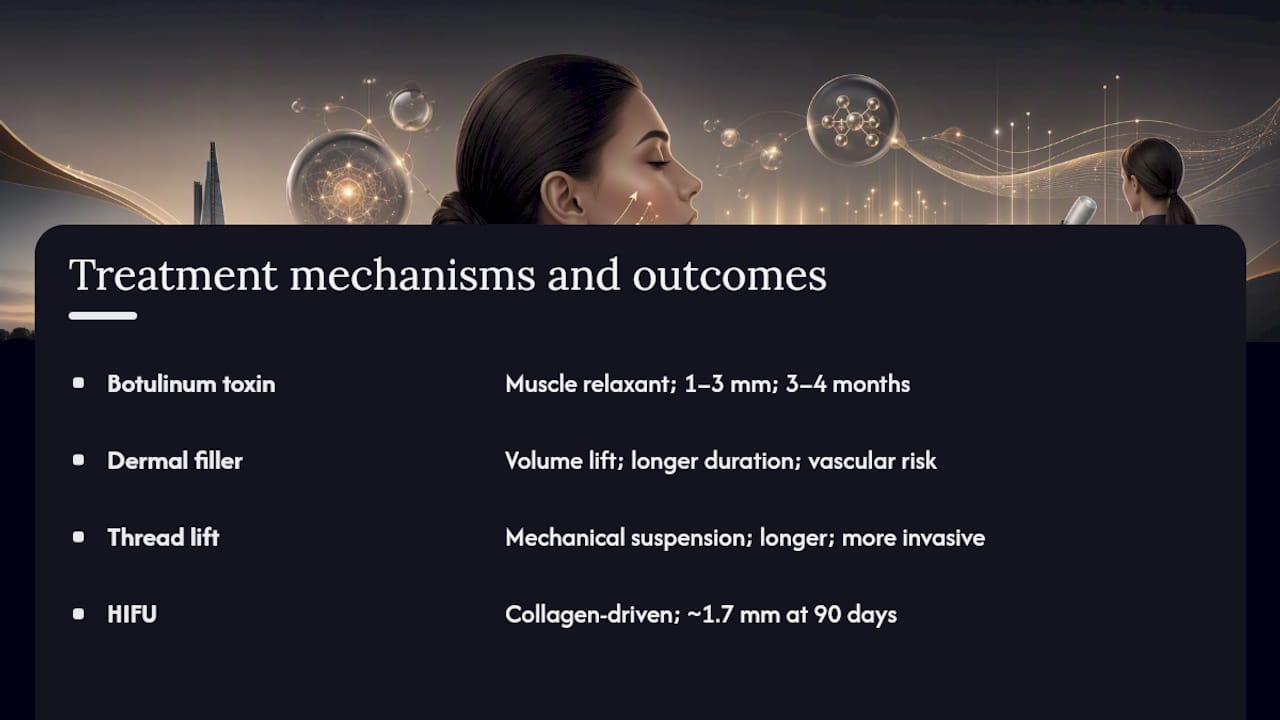
Botulinum toxin works by relaxing the depressor muscles that pull the brow down, freeing the frontalis to hold the brow higher. The American Academy of Ophthalmology notes a typical chemical browlift achieves 1 to 3 millimetres of elevation, lasting around 3 to 4 months before another session is needed. Botox brow lift results settle in fully by about two weeks, once early swelling has faded and the muscle relaxation has taken full effect.
Dermal fillers rely on physical volume rather than muscle relaxation, which is why they tend to outlast toxin, sometimes by several months, depending on the specific product used. That structural approach carries its own safety demands: fillers placed near the brow sit close to blood vessels, so the 2022 review recommends advanced injector training and blunt cannula techniques to reduce the risk of vascular occlusion.
Thread lifts create a mechanical suspension rather than a chemical or volumetric effect, which generally makes the lift last longer than toxin, though the procedure itself is more invasive and carries a longer recovery.
Statistic to note: one HIFU study cited in that same review recorded an eyebrow elevation of roughly 1.7 millimetres 90 days after treatment, evidence of a real but incremental collagen-driven effect rather than an instant lift.
Energy devices often need several sessions to reach that result, and satisfaction data across studies is mixed, which is exactly why most experienced clinicians tailor and combine methods rather than relying on one alone.
Who is a good candidate, and what are the risks?
A non-surgical eyebrow lift suits mild to moderate brow descent, not significant sagging. FACEMED’s guidance on non-surgical brow lifts is direct on this point: where there is substantial excess skin, surgery remains the more effective correction, and no injectable or device will fully replace it.
Good candidates are typically people with early volume loss, mild hooding, or brows that have started to drop asymmetrically with age, rather than deep, heavy folds.
- Full medical history disclosure matters, particularly for neurological conditions, pregnancy, or blood-thinning medication.
- Common side effects include temporary bruising, mild swelling and, occasionally, uneven results in the first week or two.
- Rare but serious risks include vascular occlusion with fillers and infection at injection sites, both of which require immediate clinical attention.
- Reputable clinics work from written consent, a documented emergency protocol and a qualified, experienced injector.
Pro Tip: Ask your practitioner directly what they would do in the first hour if a vascular complication occurred. A confident, specific answer tells you far more about their training than any brochure.
What happens after treatment, and how often do you need a top-up?
Timelines vary by method, but none of these treatments deliver an instant, finished result on the day.
- Days 1 to 3: mild swelling or bruising from injectables typically settles; energy-based treatments show little visible change yet.
- Days 4 to 14: botulinum toxin reaches its full effect, generally settling by around the two-week mark.
- Weeks 4 to 12: HIFU and radiofrequency results build gradually as new collagen forms.
- Every 3 to 4 months: toxin needs repeating to maintain the lift; fillers and threads last considerably longer, though duration depends on the product and technique used.
Contact your clinic promptly if you notice worsening pain, discolouration of the skin, or vision changes after filler, all recognised signs that warrant urgent review.
How do you choose the right treatment for your brows?
The right choice depends on what you actually want corrected, not just the treatment that happens to be trending.
Start with your goal: are you after a subtle lateral lift, more definition to the arch, or lost volume restored across the whole brow? Skin laxity matters too, mild cases respond well to toxin or filler, while looser skin may need threads or, in more advanced cases, surgical referral. Factor in how much downtime you can tolerate and how often you’re willing to return for maintenance.
At consultation, come prepared with direct questions:
- What are your qualifications, and are you working within a CQC-registered clinic?
- Can I see before-and-after photos of brow-specific cases, not just general facial work?
- Which product or brand are you using, and why is it right for my anatomy?
- What’s your plan if I have a complication, and what follow-up is included?
Pro Tip: Walk away from any clinic offering a discounted brow lift with no prior consultation. A proper assessment of your muscle pattern and skin laxity is what actually determines a good result, not the price on the day.
Steer clear of providers who skip the medical consultation altogether, push aggressive discounts, or can’t tell you what aftercare looks like. Those are the clearest warning signs in this entire category.
Why does medically supervised treatment matter here?
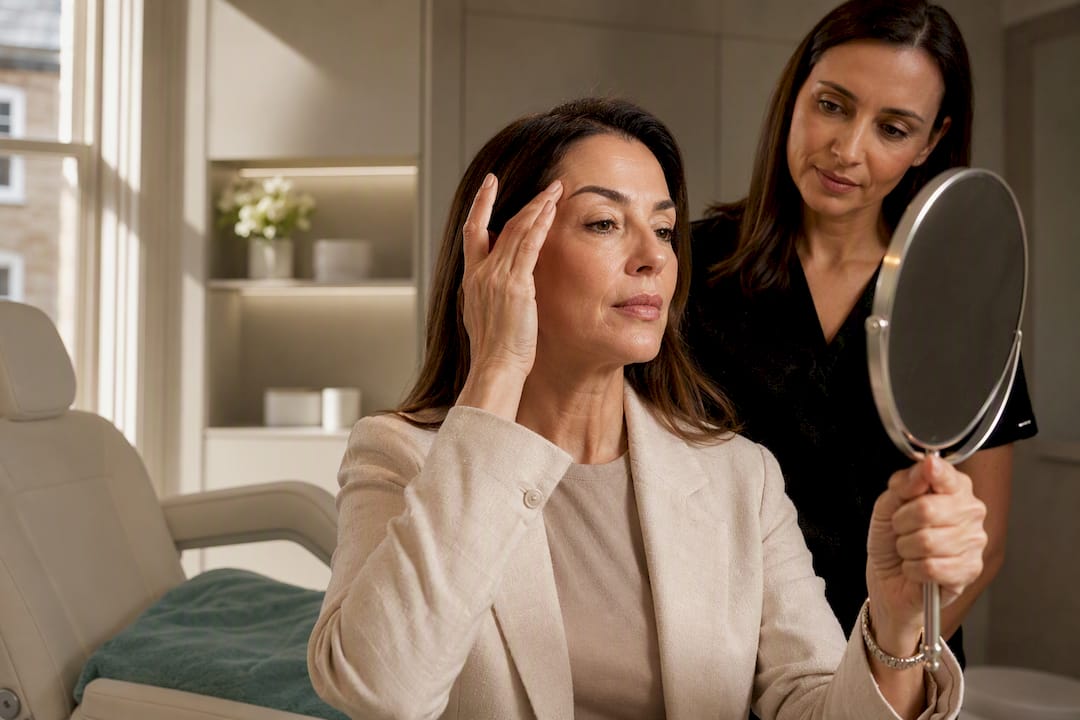
Brow treatments sit close to the eye, the orbital vessels and several small muscle groups, which is precisely why medical oversight matters more here than in many other areas of the face. Doctor-led teams working within CQC-registered clinics bring the anatomical judgement that separates a natural, asymmetry-free lift from a flat or uneven one.
Theaestheticsroom builds every plan around a proper consultation first: assessing muscle activity, skin laxity and facial proportion before recommending botulinum toxin, filler, or a combined approach. Filler and thread work in particular benefit from clinicians trained in cannula technique and vascular anatomy, given how close these treatments sit to sensitive structures.
What the evidence actually tells you to prioritise
Most of what gets written about non-surgical brow lifts overstates the transformation and understates the maintenance. The honest picture, based on the measured outcomes available, is that you’re buying a modest, temporary improvement, not a substitute for surgery. That’s not a disappointing conclusion. It’s simply the one the data supports, and it should shape how you plan and budget for treatment.
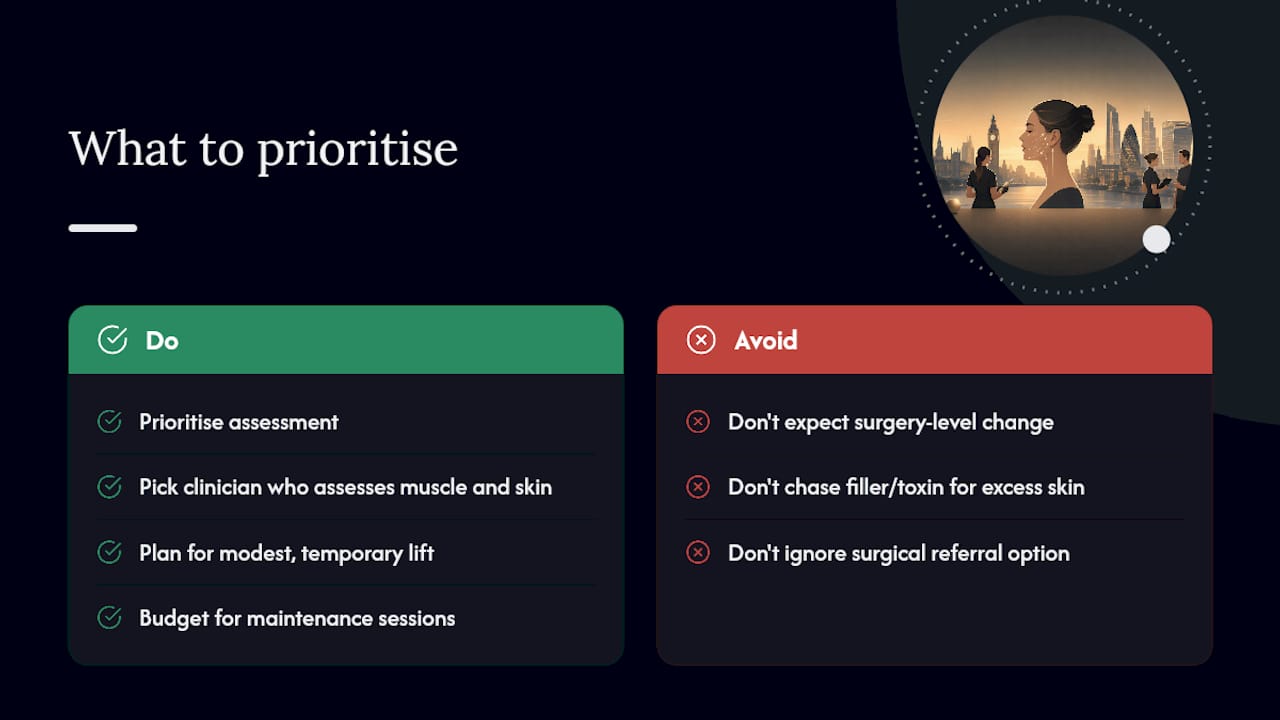
Where conventional advice really falls short is candidacy. Too many people with genuinely significant skin excess spend money on repeated toxin or filler sessions chasing a result those tools were never built to deliver, when surgical referral was the answer from the start. A good clinician tells you this at consultation, even when it costs them the sale.
If there’s one thing to prioritise above the treatment choice itself, it’s the assessment. The device or product matters less than whether the person examining your brow actually understands your muscle pattern and skin quality before recommending anything. Get that right, and the rest follows.
— Vishul
Ready to plan your own brow lift consultation?
Rather than guessing between toxin, filler or a combined plan from an article alone, Theaestheticsroom builds your brow lift around a proper in-person assessment of your muscle pattern, skin laxity and facial proportion, so you’re not paying for a treatment that was never right for your anatomy in the first place.

A consultation at Theaestheticsroom starts with exactly the questions this guide recommends asking: your goals, your medical history, and an honest view on whether toxin, dermal fillers, or a hybrid plan suits you best. The clinic’s doctor-led teams work from London’s Knightsbridge, Harley Street and Mayfair locations, with treatment plans built around your specific brow anatomy rather than a fixed package. If a chemical brow lift sounds like your starting point, you can explore Botox treatments directly, or book a virtual or in-person consultation to get a bespoke assessment before committing to anything.
Sources
- AAO clinical resource (chemical browlift description)
- Expert opinion on non-surgical eyebrow lifting and shaping procedures (2022)
- Botox brow lift: how it works, benefits & how long it lasts | The Women’s Journal
- An introduction to non-surgical brow lifts – FACEMED