

TL;DR:
- Registered practitioners hold a current license from a statutory regulatory body like the GMC, GDC, or NMC, ensuring proper training and accountability. Unregulated providers often operate without proper qualifications, increasing the risk of serious complications or permanent disfigurement. Patients should verify practitioners’ registration online before treatment to ensure safety and legal compliance.
Registered practitioners are defined as healthcare professionals who hold a current licence with a statutory regulatory body, such as the General Medical Council (GMC), General Dental Council (GDC), or Nursing and Midwifery Council (NMC). In aesthetic medicine, this distinction is not a formality. Understanding why registered practitioners matter is the difference between a safe, accountable treatment and one that carries serious, sometimes irreversible, risk. The UK aesthetic market is significantly unregulated: three unregulated providers exist for every one regulated provider. That ratio should give every patient pause before booking a cosmetic appointment.
Why registered practitioners matter: what registration actually requires
Registration is not a certificate you buy online. It is the result of years of degree-level clinical training, assessed competency, and ongoing professional accountability.
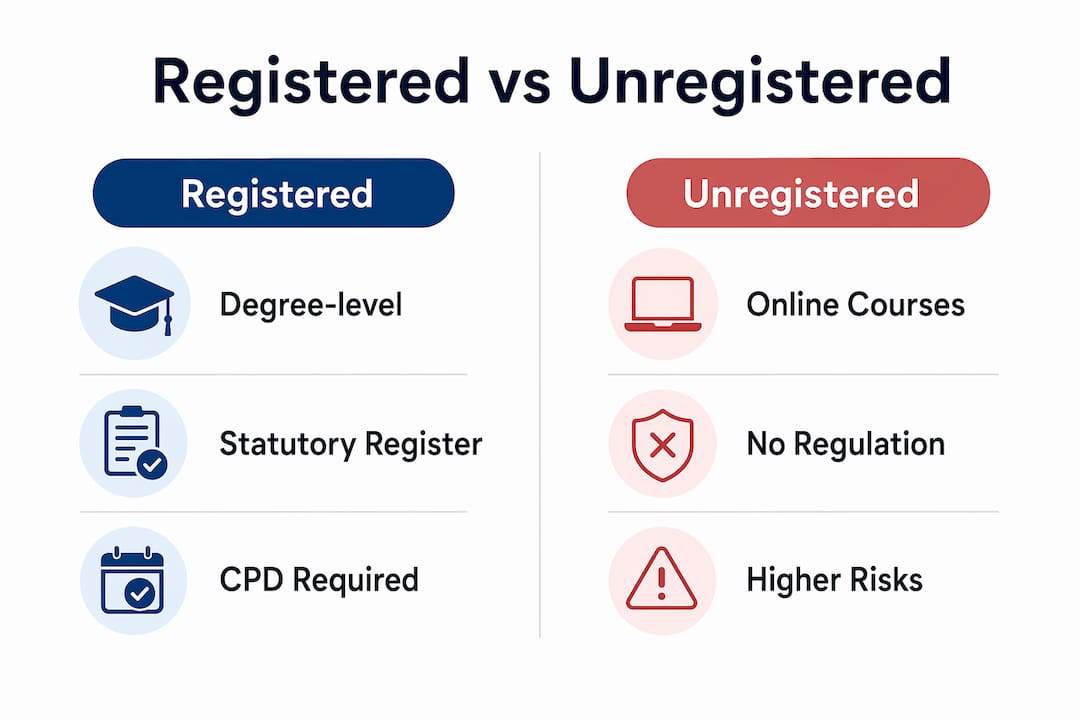
A registered doctor, dentist, or nurse prescriber must complete a recognised healthcare degree before they can join a statutory register. That foundation covers anatomy, physiology, pharmacology, and clinical decision-making. These are not optional extras in aesthetic medicine. They are the baseline skills needed to assess a patient safely, identify contraindications, and manage complications when they arise.
Beyond initial qualification, registered practitioners must meet continuing professional development requirements set by their regulatory body. The GMC, GDC, and NMC each publish conduct standards and hold the power to investigate complaints, suspend licences, and strike practitioners off their registers. That accountability structure does not exist for unregistered providers.
The benefits of licensed professionals extend beyond technical skill. Registration creates a formal complaints pathway. If something goes wrong, you have a defined route to seek redress through an independent regulatory body, not just a social media dispute.
Key requirements for statutory registration in aesthetic medicine include:
- A recognised degree in medicine, dentistry, or nursing
- Formal clinical training in a supervised healthcare setting
- Adherence to a published code of professional conduct
- Ongoing continuing professional development
- Submission to regulatory investigation and sanction if standards are breached
Pro Tip: Before booking any injectable treatment, search the practitioner’s name on the GMC, GDC, or NMC online register. Each search takes under two minutes and gives you a definitive answer, not a marketing claim.
How do registered and unregistered providers differ in cosmetic treatments?
The gap between a registered practitioner and an unregistered provider is wider than most patients realise. It spans qualifications, legal permissions, and accountability.

Online aesthetics certification courses can be as short as 90 minutes with no practical training component. Marketing for these courses often implies equivalence with professional registration. That implication is false and potentially dangerous.
The legal distinction is clearest with botulinum toxin. Botulinum toxin is prescription-only in the UK. Only a registered doctor, dentist, or nurse prescriber can lawfully prescribe it following a clinical assessment. An unregistered provider who administers Botox is operating outside the law and, critically, outside any framework for managing complications such as vascular occlusion.
Dermal fillers present a different but equally serious concern. Currently, no mandatory register exists for filler injectors in parts of the UK, meaning some non-medically qualified individuals can legally administer them. The Health and Care Act 2022 grants powers to introduce mandatory licensing for non-surgical cosmetic procedures in England, but implementation is still in progress. Until that scheme is enforced, the burden of verification falls on you.
| Feature | Registered practitioner | Unregistered provider |
|---|---|---|
| Statutory qualification | Degree-level healthcare training | Short course or no formal training |
| Legal right to prescribe Botox | Yes, following clinical assessment | No |
| Accountability | GMC, GDC, or NMC oversight | None |
| Complaints pathway | Formal regulatory investigation | No independent route |
| Complication management | Trained and equipped | Typically absent |
| Indemnity insurance | Required by regulatory body | Often absent |
Pro Tip: A professional-looking website or Instagram profile is not evidence of qualification. Always cross-reference a practitioner’s claimed credentials against the relevant statutory register before your consultation.
What risks do patients face with unregistered practitioners?
Choosing an unregistered provider does not simply mean accepting a lower standard of care. It means accepting risks that can result in permanent disfigurement or medical emergency.
Unregulated filler products are available online for as little as £20. Products at that price point carry no guarantee of sterility, composition, or suitability for injection into human tissue. A registered practitioner sources pharmaceutical-grade products through regulated supply chains. An unregistered provider may not.
The most serious complication from injectable treatments is vascular occlusion, where filler blocks a blood vessel and cuts off circulation to surrounding tissue. Managing this requires immediate access to hyaluronidase, the enzyme used to dissolve hyaluronic acid filler, and the clinical knowledge to administer it correctly. Only a registered healthcare professional can prescribe and manage this intervention. An unregistered provider has no legal access to it.
The risks patients face with unregistered providers include:
- Unregulated products: Filler sourced from unverified suppliers may contain harmful substances or incorrect concentrations.
- No complication protocol: Unregistered providers lack the training and legal access to medicines needed to reverse serious adverse events.
- No indemnity insurance: If harm occurs, there is no insurance policy to fund corrective treatment or compensation.
- No complaints route: Without regulatory oversight, a formal complaint has no independent body to receive or investigate it.
- Poor hygiene standards: Clinical governance requirements, including sterile technique and infection control, are not enforced for unregistered providers.
Lower prices from unqualified practitioners typically reflect compromised product quality, inadequate training, or the absence of complications protocols. The typical price difference between a qualified and unqualified provider ranges between £50 and £150 per treatment area. That saving is not worth the risk.
For a thorough understanding of what safe filler treatment involves, including the qualifications required to administer it responsibly, the detail matters before you commit to any appointment.
How can you verify a practitioner’s registration before booking?
Verification is straightforward. The tools are free, publicly accessible, and take minutes to use. The challenge is knowing where to look and what questions to ask.
- Search the GMC register at gmcuk.org. Enter the practitioner’s name or GMC number. The result confirms whether they are licensed to practise medicine in the UK.
- Search the GDC register at gdc-uk.org. This covers dentists and dental care professionals offering aesthetic treatments.
- Search the NMC register at nmc.org.uk. This confirms registration for nurses and midwives, including nurse prescribers who administer injectables.
- Check CQC registration for the clinic itself. CQC-registered clinics undergo inspection to confirm they meet fundamental care standards and have clear complaints pathways. Some aesthetic clinics voluntarily register with the CQC to demonstrate clinical governance. Theaestheticsroom holds CQC registration, which provides patients with an additional, independently verified layer of protection.
- Look for voluntary accreditation. Bodies such as Save Face and the Joint Council for Cosmetic Practitioners (JCCP) maintain registers of practitioners who meet defined safety standards. These are not substitutes for statutory registration but add further assurance.
Checking practitioner credentials via GMC, GDC, and NMC online portals is definitive. It takes under two minutes and removes any ambiguity that social media profiles or testimonials cannot resolve.
Ask these questions at your consultation:
- Which statutory register are you on, and what is your registration number?
- Who prescribed the botulinum toxin for my treatment?
- What is your protocol if a complication occurs during or after treatment?
- Does this clinic hold CQC registration?
- Do you carry professional indemnity insurance?
Warning signs of an unregistered provider include: no verifiable registration number, prices significantly below the market rate, no consultation before treatment, and pressure to book immediately. For guidance on checking practitioner credentials across aesthetic and surgical specialties, independent patient guides offer a useful starting point.
Pro Tip: If a practitioner cannot give you their GMC, GDC, or NMC registration number within seconds of being asked, treat that as a definitive warning sign. Registered professionals know their number.
Key takeaways
Registered practitioners are the single most important factor in safe aesthetic medicine, because statutory registration guarantees clinical training, legal accountability, and a formal route for patients to seek redress.
| Point | Details |
|---|---|
| Registration means real qualifications | Statutory registers require degree-level healthcare training, not short online courses. |
| Botox is prescription-only | Only GMC, GDC, or NMC-registered prescribers can lawfully administer botulinum toxin. |
| Unregistered providers carry serious risks | No indemnity, no complaints route, and no legal access to reversal agents like hyaluronidase. |
| Verification takes under two minutes | GMC, GDC, and NMC online registers are free, public, and definitive. |
| CQC registration adds clinic-level protection | Inspected clinics meet fundamental care standards and have formal complaints pathways. |
The regulatory gap patients cannot afford to ignore
The aesthetic industry has a structural problem that no amount of good marketing can paper over. For every one regulated practitioner, there are three unregulated providers operating in the same market, often with similar-looking websites and comparable pricing. That is not a minor discrepancy. It is a patient safety crisis hiding in plain sight.
What concerns me most is not the obviously rogue operators. It is the providers who genuinely believe that a 90-minute online course qualifies them to inject into facial tissue. The confidence is real. The competence is not. And the patient sitting in that treatment chair has no reliable way to tell the difference unless they check the statutory registers first.
The role of certified practitioners goes beyond technical execution. A registered clinician brings anatomical knowledge, clinical judgement, and the legal authority to manage emergencies. Those qualities cannot be acquired in a weekend workshop.
The Health and Care Act 2022 will eventually close the regulatory gap for non-surgical procedures in England. Until it does, the responsibility sits entirely with you as a patient. A beautiful clinic interior, a polished Instagram feed, and a long list of five-star reviews tell you nothing about whether the person holding the syringe is qualified to do so safely.
My advice is simple: check the register, ask for the registration number, and walk away if either is missing. Safety in aesthetics is not a premium feature. It is the baseline.
— Vishul
Theaestheticsroom: registered practitioners, verified standards
At Theaestheticsroom, every treatment is performed by practitioners registered with the GMC, GDC, or NMC. The clinic holds CQC registration and is a member of the ACE Group, a network dedicated to patient safety in aesthetic medicine. That combination of statutory registration and clinic-level governance means you have multiple layers of protection before, during, and after your treatment.
Whether you are considering Botox treatments for fine lines or dermal fillers for volume restoration, every procedure at Theaestheticsroom begins with a thorough clinical consultation. Treatments are carried out at our Knightsbridge, Harley Street, and Mayfair locations. Book a consultation today and experience the confidence that comes from choosing a fully registered, CQC-inspected clinic.
FAQ
What is a registered practitioner in aesthetic medicine?
A registered practitioner is a healthcare professional licensed by a statutory body such as the GMC, GDC, or NMC. Registration confirms they hold a recognised clinical qualification and are subject to professional conduct standards and regulatory oversight.
Why does registration matter for Botox specifically?
Botulinum toxin is a prescription-only medicine in the UK. Only a registered doctor, dentist, or nurse prescriber can lawfully prescribe and administer it following a clinical assessment. Unregistered providers cannot legally offer this treatment.
How do I check if my aesthetic practitioner is registered?
Search the practitioner’s name on the GMC, GDC, or NMC online register. Each search is free, takes under two minutes, and gives a definitive result. Ask the practitioner for their registration number before your appointment.
What is the risk of choosing an unregistered provider?
Unregistered providers may use unverified products, lack complication management protocols, and carry no indemnity insurance. If something goes wrong, there is no regulatory body to investigate your complaint and no formal route to seek redress.
What does CQC registration mean for an aesthetic clinic?
CQC registration means the clinic has been inspected against fundamental care standards set by the Care Quality Commission. It confirms the premises meet clinical governance requirements and that a formal complaints pathway exists for patients.