

TL;DR:
- Knowing your skin type is essential for selecting effective skincare by identifying traits like oiliness, dryness, or sensitivity. Home assessments, including the blotting sheet test, help determine your skin’s oil production pattern, but should be repeated for accuracy and followed by professional advice if needed. Technology offers supplementary insights, yet ongoing observation remains key to tracking skin changes over time.
Knowing your skin type is the single most reliable foundation for choosing skincare and cosmetic treatments that actually work. Skin type assessment, the clinical term used by dermatologists and aestheticians, classifies your skin based on sebaceous gland activity, sensitivity, and moisture balance. The five recognised categories are normal, oily, dry, combination, and sensitive. You can determine your skin type at home using simple, product-free observation methods, and tools like the Baumann Skin Type Indicator and AI-powered scanners such as Sephora’s Smart Skin Scan can refine that picture further. Getting this right saves you money, prevents irritation, and gives every product you apply a genuine chance to perform.
What are the main skin types and their key characteristics?
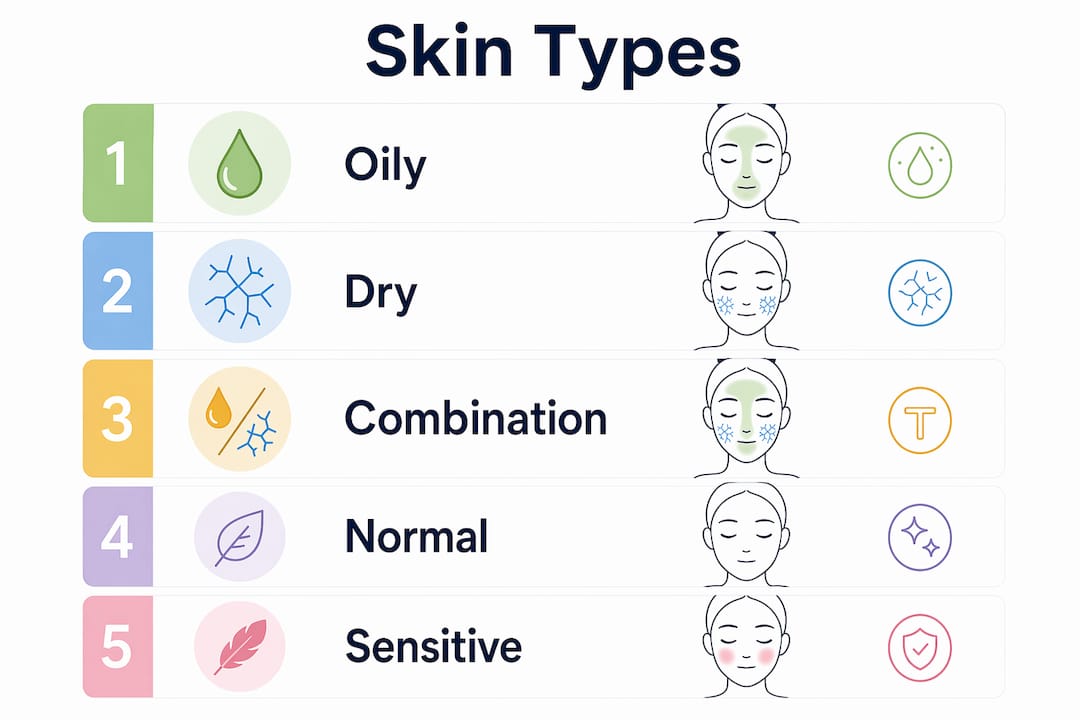
Understanding the traits of different skin types is the first step before any test. Each type has a distinct profile rooted in how actively your sebaceous glands produce oil and how your skin barrier responds to the environment.

Oily skin produces excess sebum across the entire face. The forehead, nose, and chin shine visibly within an hour or two of cleansing, pores appear enlarged, and the skin feels thick or congested. Breakouts and blackheads are common companions.
Dry skin is defined by tight or pulling sensation and visible flaking or peeling, particularly around the cheeks and jawline. Pores are barely visible, and the skin can look dull or feel rough to the touch.
Combination skin presents oiliness in the T-zone (forehead, nose, chin) alongside dryness or normal behaviour on the cheeks. It is the most common skin type globally and often the most misread, because people mistake the dry cheeks for a separate condition.
Normal skin sits in balance. It produces moderate sebum, has small to medium pores, and rarely reacts to new products or environmental changes. Texture is even and the skin feels comfortable throughout the day.
Sensitive skin is characterised by variable reactions including redness, stinging, or irritation that can shift day to day. Sensitivity is not a fixed oil-production category. It is a reactivity trait that can overlay any of the other four types.
One distinction worth locking in early: dehydrated skin is not dry skin. Dehydration is a transient condition caused by insufficient water content in the skin, and it can affect oily skin just as readily as dry. Oiliness patterns driven by sebaceous gland activity are the primary diagnostic criteria separating skin types. Tightness, by contrast, can occur across all types and should not be used alone to conclude you have dry skin.
How to assess skin type at home: three reliable methods
The principle behind every home test is identical: observe your skin in a clean, baseline state without any products applied. Rest time after cleansing is critical for a valid result. Below are the three most widely used methods, followed by a comparison table.
The day test
- Cleanse your face with a gentle, fragrance-free cleanser in the morning.
- Apply nothing afterwards. No moisturiser, no serum, no SPF.
- Go about your normal routine for three to four hours.
- At the end of that period, examine your skin in natural light. Note where shine appears, where tightness or flaking is present, and whether any redness has developed.
- Repeat on two or three typical days to establish a pattern.
The blotting sheet test
- Cleanse your face and wait 30 minutes without applying any products.
- Press separate oil blotting sheets firmly onto your forehead, nose, chin, and both cheeks.
- Hold each sheet up to the light and assess the oil transfer.
Oil blotting sheet results are interpreted as follows: minimal oil on all sheets indicates dry or normal skin; oil only on the T-zone sheets indicates combination skin; heavy oil transfer across all sheets indicates oily skin.
The bare-faced observation method
This is the simplest approach. Cleanse your face in the evening, skip all products, and observe your skin after 30 minutes and again after two hours. Pay attention to whether it feels tight, looks flaky, develops shine, or shows any redness or irritation. This method works particularly well for identifying sensitivity because you are removing all product variables.
| Method | Time required | What to observe | Best for identifying |
|---|---|---|---|
| Day test | 3 to 4 hours | Shine, tightness, flaking | All five skin types |
| Blotting sheet test | 30 minutes post-cleanse | Oil transfer patterns | Oily, combination, dry, normal |
| Bare-faced observation | 30 minutes to 2 hours | Redness, tightness, shine | Sensitive, dry, normal |
Pro Tip: Perform your chosen test on a typical day at home, not after exercise, a long flight, or unusual weather. Environmental extremes skew sebum production and give you a false reading.
Common mistakes when assessing your skin condition
Even a well-intentioned test can produce misleading results if certain pitfalls are not avoided. These are the errors we see most often.
- Testing after active skincare use. Retinoids, AHAs, and BHAs temporarily alter oil production and barrier function. Wait at least 48 hours after using these ingredients before running any test.
- Confusing a single bad day for a pattern. One oily morning after a poor night’s sleep does not confirm oily skin. Repeating tests across multiple ordinary days minimises errors from environmental or product residue influences and gives you a stable baseline.
- Treating dehydration as dry skin type. If your skin feels tight but also looks shiny, you are likely dealing with dehydration rather than a dry skin type. Adjusting your water intake and using a hyaluronic acid serum for a week before retesting can clarify the picture.
- Ignoring seasonal change. Skin types are dynamic. Cold, dry winters increase transepidermal water loss, making normally balanced skin behave like dry skin. Reassess at the start of each new season.
- Misreading sensitivity. Sensitive skin shows variable reactions like redness or irritation that can shift day to day, which means a single observation is rarely conclusive. Track reactions over at least a week before drawing conclusions.
Pro Tip: If your skin consistently reacts to new products with burning or prolonged redness, read this guide on managing sensitive skin before selecting any new skincare.
When home tests remain inconclusive or skin problems persist, consulting a dermatologist is the appropriate next step. A medical examination can confirm findings and rule out conditions such as rosacea or seborrhoeic dermatitis that mimic common skin types.
How does modern technology compare to traditional skin type analysis?
Technology has added a useful layer to skin type analysis without replacing the fundamentals. The comparison below shows where each approach excels.
| Approach | Strengths | Limitations |
|---|---|---|
| Home tests (day test, blotting) | Free, repeatable, product-free baseline | Subjective interpretation, no imaging |
| AI skin scanners (e.g., Sephora Smart Skin Scan) | Rapid, multi-category analysis, visual data | Focuses on concerns, not classic skin type labels |
| Baumann Skin Type Indicator | Clinically validated, 16-type framework | Requires questionnaire completion, not tactile |
| Professional skin analysis | Combines imaging, tactile exam, medical history | Requires clinic visit |
AI skin analysis tools like Sephora’s Smart Skin Scan provide rapid assessments across multiple categories with high accuracy, but they focus on concerns such as pigmentation, fine lines, and texture rather than classic oil-based skin type labels. This makes them excellent for product recommendations but less precise for the foundational classification you need before building a routine.
The Baumann Skin Type Indicator takes a more clinical approach, categorising skin across four parameters: dry or oily, sensitive or resistant, pigmented or non-pigmented, and tight or wrinkled. This produces 16 possible skin type combinations and explicitly acknowledges that skin type changes over time, requiring periodic reassessment. For anyone with complex or shifting skin, this framework is considerably more useful than a single five-category label.
Technology works best as a supplement. Use home tests to establish your baseline, then use an AI scanner or validated questionnaire to refine your understanding of specific concerns. Theaestheticsroom offers advanced facial analysis across 29 parameters for those who want a clinically precise picture.
How to build your skincare routine based on your skin type
Once you have identified your skin type, the goal is to select products and ingredients that support your skin’s natural balance rather than work against it.
- Oily skin benefits from lightweight, non-comedogenic moisturisers, gel-based cleansers, and ingredients such as niacinamide and salicylic acid to regulate sebum and minimise pore appearance. Avoid heavy occlusives like petrolatum as a daily moisturiser.
- Dry skin requires richer emollients and humectants. Ceramide-based moisturisers, hyaluronic acid serums, and cream cleansers help restore and maintain the lipid barrier. Avoid foaming cleansers with sulphates, which strip residual oils.
- Combination skin calls for a zone-based approach. A balancing gel moisturiser works well across the face, with a richer cream applied only to dry cheek areas. Gentle exfoliation with lactic acid two to three times per week keeps the T-zone clear without over-drying the cheeks.
- Normal skin is the most forgiving. A simple routine of a gentle cleanser, a balanced moisturiser with SPF, and a vitamin C serum in the morning is sufficient. Avoid overcomplicating with unnecessary actives.
- Sensitive skin requires the shortest ingredient lists. Fragrance-free, alcohol-free formulations with calming actives such as centella asiatica, allantoin, or colloidal oatmeal are the safest starting point. Always patch test new products on the inner arm for 24 hours before applying to the face.
Skin types are dynamic, influenced by environmental, hormonal, and lifestyle shifts and should not be treated as permanent labels. Reassess every three to six months, or whenever you notice a consistent change in how your skin looks and feels. Pregnancy, menopause, a change in climate, and significant dietary shifts are all common triggers for a shift in skin behaviour.
Key takeaways
Accurate skin type assessment relies on observing your skin’s natural oil production in a clean, product-free state across multiple typical days, not from a single test.
| Point | Details |
|---|---|
| Use product-free observation | Cleanse, apply nothing, and observe for at least 30 minutes to several hours for a valid baseline. |
| Repeat tests across multiple days | A single test is unreliable. Repeat on ordinary days to establish a stable pattern. |
| Separate dehydration from dry skin | Tightness alone does not confirm dry skin. Oiliness patterns are the primary diagnostic marker. |
| Skin types change over time | Reassess every three to six months and after major hormonal or environmental shifts. |
| Use technology as a supplement | AI scanners and clinical tools like the Baumann Skin Type Indicator refine, but do not replace, home observation. |
Skin type assessment: what I have learned from working with clients
The most common mistake I see is people treating their skin type as a fixed identity rather than a current condition. Someone who had oily skin at 22 will often arrive at a consultation in their late 30s still buying oil-control products, wondering why their skin feels tight and looks dull. Their skin type shifted years ago. They just never reassessed.
The second thing I would push back on is the idea that technology makes home assessment obsolete. AI scanners are genuinely impressive for identifying pigmentation patterns and texture concerns, but they do not replace the simple, honest information you get from pressing a blotting sheet to your face after 30 minutes. One gives you a data-rich snapshot. The other gives you a repeatable, real-world baseline.
My practical advice: run the blotting sheet test on three consecutive ordinary days, note the pattern, and then use a validated questionnaire like the Baumann Skin Type Indicator to add nuance. If the results still feel unclear, or if your skin reacts unpredictably to most products, book a professional consultation rather than continuing to guess. The cost of one appointment is far less than months of buying the wrong products. Skin assessment is not a one-time event. It is an ongoing conversation with your skin, and the more fluently you learn to read it, the better every product decision becomes.
— Vishul
Discover personalised skin analysis at Theaestheticsroom
Understanding your skin type at home is a strong starting point, but a professional assessment takes that knowledge considerably further.

At Theaestheticsroom, our specialists in Knightsbridge use advanced imaging and clinical evaluation to build a precise picture of your skin across multiple parameters. Whether you are exploring dermal fillers for volume restoration, considering Botox for skin rejuvenation, or simply want a bespoke skincare plan grounded in accurate skin type analysis, our team will guide you from assessment to treatment with full transparency. Book a virtual or in-person consultation today and take the guesswork out of your skincare decisions.
FAQ
What is the most reliable way to identify your skin type at home?
The blotting sheet test performed 30 minutes after cleansing, with no products applied, is the most reliable home method. Pressing sheets onto the forehead, nose, chin, and cheeks reveals your oil production pattern clearly and quickly.
Can your skin type change over time?
Yes. Skin types are dynamic and shift with hormonal changes, ageing, climate, and lifestyle. The Baumann Skin Type Indicator explicitly accounts for this by recommending periodic reassessment rather than treating skin type as a permanent classification.
What is the difference between dry skin and dehydrated skin?
Dry skin is a skin type defined by low sebum production, while dehydrated skin is a temporary condition caused by insufficient water content. Dehydration can affect oily skin just as readily as dry skin, and the two require different treatment approaches.
How do I know if I have sensitive skin?
Sensitive skin is identified by variable reactions such as redness, stinging, or irritation that appear inconsistently in response to products or environmental triggers. Track your skin’s reactions over at least one week before concluding you have a sensitive skin type.
When should I see a professional instead of relying on home tests?
Consult a dermatologist or aesthetician when home tests remain inconclusive after multiple attempts, when skin problems persist despite appropriate product choices, or when you notice persistent redness, breakouts, or unusual texture changes that do not resolve.