


IV therapy for fatigue is not routinely recommended by UK clinical guidance, and there is no good evidence it treats persistent tiredness or ME/CFS in people without a diagnosed deficiency. It may still have a place when blood tests confirm something specific, such as B12 or iron deficiency, and only when delivered by a regulated, clinician-led provider. If you are exhausted and considering a drip, the first step is testing, not a cannula.
TL;DR:
- IV therapy is only supported for treating confirmed deficiencies such as B12 or iron, not for providing energy boosts in healthy individuals without deficiencies.
- Most evidence shows that vitamin infusions do not improve fatigue or ME/CFS symptoms unless related to a documented blood deficiency.
- Unregulated IV clinics carry risks including infection, thrombosis, allergic reactions, and improper formulation that could cause organ damage.
- Proper IV treatments are delivered by regulated professionals with prior blood testing, not as walk-in services with no clinical oversight.
- For casual tiredness, starting with blood tests and addressing any deficiencies is more effective and safer than seeking unverified IV infusions.
Table of Contents
- What is IV vitamin therapy and what do energy drips actually contain?
- Does IV therapy actually help fatigue or ME/CFS?
- Who might genuinely benefit from IV therapy?
- What are the risks of unregulated IV drips?
- How do you choose a safe IV therapy provider?
- What actually happens during and after an IV session?
- How does a regulated clinic approach IV therapy differently?
- Is IV therapy worth it for ordinary tiredness?
- Considering IV therapy? Start with an assessment, not an infusion
- Sources
- FAQ
What is IV vitamin therapy and what do energy drips actually contain?
IV vitamin therapy delivers fluids, electrolytes and vitamins straight into a vein, bypassing the gut entirely. Supporters argue this means better absorption than swallowing a tablet, since nothing has to survive digestion first. That is true in principle for certain compounds, but it does not automatically translate into more energy for someone whose blood levels were normal to begin with.
Clinics market several formulations under the “energy” banner:
- Myers’ cocktail — a mix of magnesium, calcium, B vitamins and vitamin C in saline, originally used by Dr John Myers for a range of chronic complaints.
- NAD drip — nicotinamide adenine dinucleotide, promoted for cellular energy and recovery, though robust human trials in fatigue are scarce.
- High-dose vitamin C infusions — sometimes marketed for immunity and tiredness.
- B-complex or B12 infusions — often positioned as an energy boost even in people with no confirmed deficiency.
- Hydration-only drips — plain saline, useful for genuine dehydration but not a vitamin treatment at all.
Some of these ingredients, including certain injectable B vitamins and prescription saline, are prescription-only medicines. Others are sold more loosely as supplements, which is part of why quality and oversight vary so much between providers.
Does IV therapy actually help fatigue or ME/CFS?
The clearest and most authoritative statement on this comes from the National Institute for Health and Care Excellence guideline NG206, which advises clinicians not to offer people with ME/CFS medicines or supplements as a cure. That guidance was written precisely because so many unproven remedies, including vitamin infusions, circulate as promised fixes for a condition with no single known cause.
A Drug and Therapeutics Bulletin review published in the BMJ looked specifically at intravenous vitamin injections and found a lack of high-quality evidence that high-dose infusions improve energy or immunity in people who are otherwise well. The same review flags real potential for harm, from infection to metabolic disturbance, when infusions are given without clear clinical justification.
The evidence gap in one line: guidance and published review both conclude there is no solid proof that vitamin drips relieve fatigue in people without a diagnosed deficiency, while flagging genuine safety concerns from unnecessary infusions.
None of this means IV vitamins are useless everywhere. Confirmed conditions such as severe malabsorption, some post-surgical states, or Wernicke’s encephalopathy have an established case for parenteral treatment. The distinction that gets lost in marketing is between “IV therapy treats a diagnosed deficiency” and “IV therapy boosts energy in a healthy person,” and only the first has support.
Who might genuinely benefit from IV therapy?
The people most likely to see a real change are those with a confirmed deficiency, not those hoping a drip will fix unexplained exhaustion. Testing comes first, treatment second.
Useful baseline tests before considering any vitamin therapy include:
- Serum B12 and folate — to check for a true deficiency rather than assumed low levels.
- Ferritin and iron studies — iron deficiency is a common, correctable cause of fatigue.
- Thyroid function — an underactive thyroid produces symptoms almost identical to chronic tiredness.
- Renal function — relevant both to fatigue causes and to whether IV fluid loads are safe.
Regional clinical guidance from the SW London Integrated Medicines Optimisation Committee is explicit that B12 deficiency needs laboratory confirmation, and that intramuscular hydroxocobalamin, the injectable form of B12, is indicated for confirmed deficiency, not prescribed on the assumption that tiredness equals low B12.
Pro Tip: Oral B12 or iron supplements work perfectly well for many mild deficiencies. Injections tend to be reserved for malabsorption problems, severe deficiency, or when oral treatment has already failed.
What are the risks of unregulated IV drips?
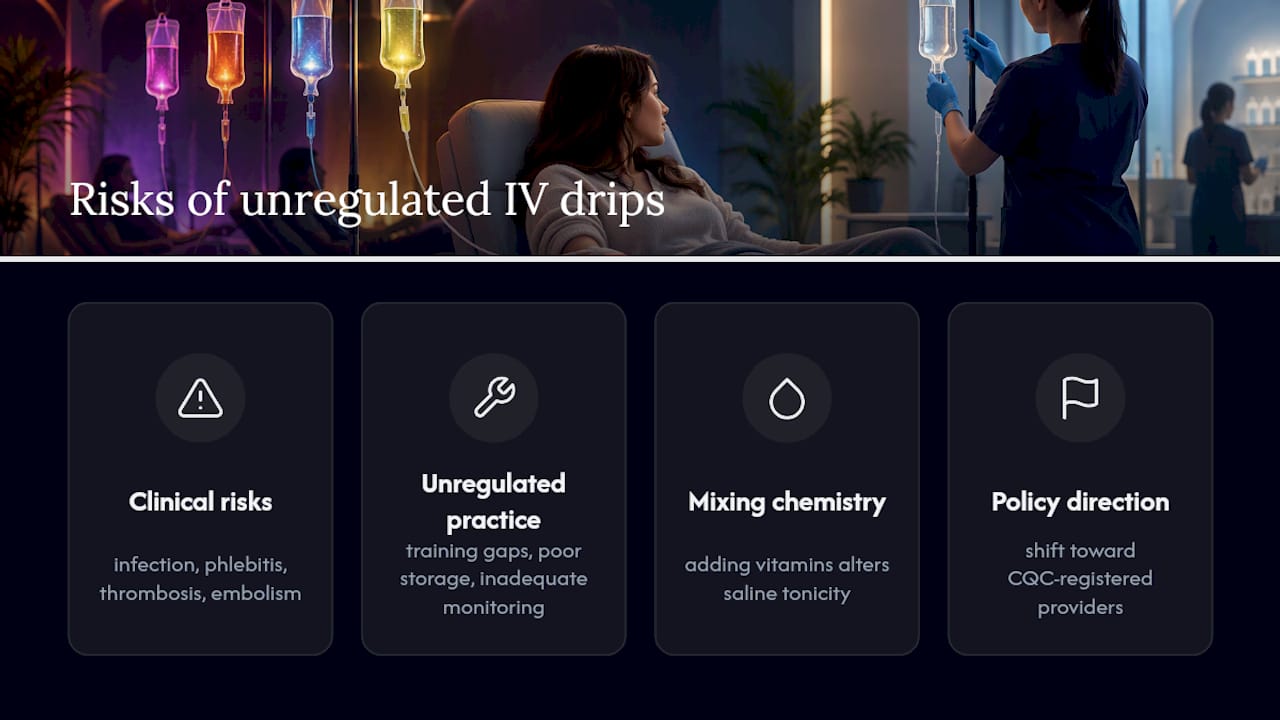
Any cannula into a vein carries clinical risk, and the risk rises sharply when the person inserting it lacks proper training or the product lacks proper sourcing. Recognised complications include infection at the injection site, phlebitis, thrombosis, air embolism, fluid overload, electrolyte imbalance, and allergic reaction. There is also a subtler danger: an unnecessary infusion can mask or delay diagnosis of a more serious underlying illness causing the fatigue in the first place.
A 2025 employment tribunal judgment concerning an Edinburgh provider laid out exactly what unregulated practice looks like in reality: training gaps, storage failures and inadequate monitoring that led to a prohibition notice. The judgment also touched on a technical point worth knowing: adding vitamins to prescription saline changes its tonicity, and formulating that incorrectly risks organ damage if the person mixing it does not fully understand the chemistry involved.
The government’s own direction of travel backs this concern. Its crackdown on unsafe cosmetic procedures signals tighter oversight of higher-risk treatments, pushing toward a future where procedures like IV therapy sit with CQC-registered providers rather than untrained operators working from a back room.
How do you choose a safe IV therapy provider?
Choosing well means asking questions before you ever see a needle, not after.
- Check clinician registration. Confirm the person delivering or supervising your infusion is a registered nurse, doctor, or other regulated healthcare professional.
- Ask about CQC status. Where relevant, a provider registered with the Care Quality Commission has been assessed against safety standards, not simply self-certified.
- Ask how vitamins and saline are sourced and stored. Prescription-only products need a documented supply chain and correct cold storage, not a fridge in a back office.
- Ask what happens if something goes wrong. A credible clinic has a written emergency protocol and staff trained to use it.
- Ask whether blood testing precedes treatment. A provider offering the same drip to everyone regardless of test results is treating symptoms blindly.
Red flags include one-day “certificate” training claims, prescription-only products advertised directly to the public, and no visible monitoring during the infusion itself.
Pro Tip: A reputable clinic will happily discuss your blood results and explain why a specific formulation suits your case. Reluctance to discuss testing or sourcing is itself a warning sign.
What actually happens during and after an IV session?
A properly run session follows a fairly consistent pattern: a pre-assessment covering your history and any recent bloods, a consent conversation, cannulation, the infusion itself, then a short monitoring period before you’re discharged.
- Most infusions typically run for a duration that varies depending on the formulation used.
- Many people feel a genuine sense of rehydration and a short-term lift during or shortly after, particularly if they were mildly dehydrated beforehand.
- Some experience mild side effects such as bruising at the cannula site, a metallic taste, or light-headedness.
- Costs vary by clinic and formulation, so any price mentioned should be confirmed directly with the provider.
The honest takeaway is that repeat, unverified infusions are not a substitute for follow-up blood tests. If fatigue persists, re-testing and reviewing results with a clinician matters more than booking another drip.
How does a regulated clinic approach IV therapy differently?
A properly governed IV service starts with the same question every time: what does the blood work actually show? The Aesthetics Room operates as a CQC-registered clinic and ACE Group member, which means its IV protocols sit under clinician supervision rather than being offered as a walk-in add-on. That includes a documented pre-assessment, a clear cold-chain storage process for prescription-only ingredients, and structured aftercare and follow-up rather than a one-off appointment with no review.
Is IV therapy worth it for ordinary tiredness?
For most people with everyday tiredness, the honest answer is: probably not, at least not as a first move. The evidence base simply does not support IV vitamins as a routine fatigue treatment, and NICE’s own position on ME/CFS is unambiguous about not using supplements as a cure. Where I’d push back on the wellness-industry narrative is the framing of fatigue itself, as something a drip can shortcut past rather than a symptom that deserves proper investigation. Confirmed deficiency, delivered by a regulated clinician, is a defensible reason for IV treatment. Unexplained tiredness treated with an untested infusion is not evidence-based care, whatever the marketing promises.
— Vishul
Considering IV therapy? Start with an assessment, not an infusion
Theaestheticsroom’s advantage for anyone weighing up an energy drip is straightforward: everything runs through clinician-led assessment first, under CQC registration and ACE Group membership, rather than offering the same formulation to every walk-in regardless of what their bloods actually show.

The clinic’s IV therapy service includes NAD drips and vitamin infusions delivered as part of a wider assessment, not as a standalone quick fix, and follow-up is built into the process rather than left to chance. To be clear: this is not positioned as a routine energy top-up for otherwise healthy people. It suits those who have had testing done, or want a proper clinical consultation before deciding whether infusion therapy is appropriate for them at all. Full pricing for treatments, including the current price list, is available on the site, and the sensible next step is booking a consultation to discuss your blood results and whether IV therapy fits your situation.
Sources
- Myalgic encephalomyelitis (or encephalopathy)/chronic fatigue syndrome: diagnosis and management | NICE
- Gov
- Employment tribunal judgment — Serene Essence Ltd / Prohibition notice (Edinburgh) — 18 July 2025
- Intravenous vitamin injections: where is the evidence? | Drug and Therapeutics Bulletin
- Vitamin B12 deficiency – SW London Integrated Medicines Optimisation Committee
FAQ
Can IV therapy help you recover from days of extreme fatigue?
If severe fatigue follows dehydration, such as after illness or heavy exertion, a fluid infusion can address dehydration itself, but it will not resolve an underlying cause like infection, anaemia, or thyroid dysfunction. Persistent extreme fatigue lasting several days warrants a GP assessment and blood tests before any infusion is considered.
Is it possible to recover from chronic fatigue syndrome?
Recovery patterns vary considerably between individuals, and NICE guidance focuses on symptom management rather than a cure, explicitly advising against medicines or supplements as curative treatments. Management typically centres on pacing, energy management and individualised care planning with a healthcare professional.
How do you combat extreme fatigue safely?
Start with basic blood tests covering B12, ferritin, thyroid function and general health markers, since correctable deficiencies are common and treatable. IV therapy is not the recommended first step for fatigue treatment options; testing and addressing any identified cause come first.
What helps you wake up feeling less exhausted with chronic fatigue?
Consistent sleep routines, pacing activity to avoid post-exertional crashes, and treating any confirmed deficiency all matter more than a single intervention like an infusion. If mornings remain consistently exhausting despite these steps, a GP review of thyroid function and sleep quality is a more useful next move than booking an IV drip for energy.
Does The Aesthetics Room offer IV therapy for energy?
Yes, The Aesthetics Room provides clinician-led IV therapy including NAD drips, delivered as part of a clinical assessment rather than as a routine energy top-up. Pricing for individual treatments is listed on the clinic’s price list.