
Getting ready for microneedling comes down to one rule: give your skin at least seven days free from sun, active ingredients and anything that thins the blood. That single change prevents the two most common reasons treatments get cancelled or produce disappointing results: post-inflammatory pigmentation and excess bruising.
Before your appointment, you should:
- Stop retinoids, strong exfoliants and acid serums several days beforehand.
- Avoid sun exposure, sunbeds and fake tan for at least seven days 7 days.
- Pause blood-thinning medicines and supplements (NSAIDs, aspirin, fish oil) for around 5–7 days, checking with your prescriber first.
- Drink plenty of water and skip alcohol and cigarettes in the days before treatment.
- Tell your practitioner immediately if you’ve taken oral isotretinoin (Roaccutane) within the last several months.
Hold onto those timeframes. They form the backbone of everything that follows.
Key Takeaways
Proper microneedling preparation hinges on stopping active skincare and blood thinners in the days beforehand and avoiding all sun exposure for at least seven days.
| Point | Details |
|---|---|
| Seven-day sun rule | Avoid sun, sunbeds and fake tan for at least 7 days to prevent pigmentation issues. |
| Pause actives early | Stop retinoids and strong acids 3–7 days before, following your clinician’s exact guidance. |
| Disclose medications | Pause blood thinners and supplements 5–7 days out only after checking with your prescriber. |
| Isotretinoin waiting period | Wait a minimum period after finishing oral isotretinoin before booking treatment. |
| Choose a regulated clinic | Theaestheticsroom is CQC registered and ACE Group affiliated, with single-use cartridges as standard. |
Table of Contents
- Preparation steps and timeline before microneedling
- How to prep your skin in the week before treatment
- Medical history, medications and reasons to postpone treatment
- Getting ready for your appointment day
- Questions to ask before choosing a microneedling clinic
- What to expect in the first 48 hours after treatment
- Your seven-day and day-of checklist
- Why regulated clinics and trained practitioners matter
- Book a consultation that starts with your skin, not a script
- Sources
Preparation steps and timeline before microneedling
Good microneedling preparation isn’t a single day’s effort. It’s a staged wind-down that starts weeks out and tightens as your appointment approaches.
Four or more weeks before, book your consultation and use the time to pause any intensive professional treatments, such as strong peels or laser courses, that might still be settling into your skin. This is also the point at which a clinic should be asking about your medical history, not the morning of your appointment.
Two weeks before, steer clear of chemical peels, laser resurfacing and intensive exfoliation treatments. Stacking one resurfacing procedure on top of another leaves skin with two overlapping healing responses, which raises irritation and unpredictable pigment changes. If you’re deciding between a peel and microneedling for the same concern, it’s worth reading how the two compare before scheduling either.
Drop all sun exposure, sunbeds and fake tan at least one week before treatment. Tanned or sun-sensitised skin carries a much higher risk of post-inflammatory hyperpigmentation once the microneedling device creates thousands of controlled micro-injuries, and this is one of the most common reasons clinics reschedule appointments on the day.
Stop topical retinoids, strong exfoliating acids and any harsh actives several days before treatment. Guidance on the exact number of days varies slightly between clinics, so follow whatever your practitioner specifies rather than assuming a blanket rule applies everywhere.
Pause blood-thinning medicines and supplements where it’s clinically safe to do so for several days before treatment, including NSAIDs, aspirin, fish oil and vitamin E. Never stop a prescribed medication without checking with the person who prescribed it.
Six months is the rule for anyone who has taken oral isotretinoin. This must be disclosed at consultation, as needling too soon after finishing the course carries a higher risk of poor healing and scarring.
| Timeframe before treatment | Action required |
|---|---|
| 4+ weeks | Book consultation; finish any resurfacing treatments |
| 2 weeks | Avoid peels, lasers and heavy exfoliation |
| 7 days | No sun, sunbeds or fake tan |
| 3–7 days | Stop retinoids and active acids |
| 5–7 days | Pause blood thinners and supplements (check with prescriber) |
| — | Minimum gap after finishing oral isotretinoin |
Pro Tip: Write your stop dates directly into your phone calendar the day you book. Most cancellations happen because people forget a rule exists, not because they ignore it deliberately.
How to prep your skin in the week before treatment
The final week is where day-to-day habits matter more than any single product swap. Keep your routine simple: a mild cleanser, a hydrating serum, a basic moisturiser and daily SPF 30 or higher. Hyaluronic acid is worth adding if you’re not already using it, since well-hydrated skin tolerates the treatment more comfortably and heals with less tightness afterwards.
Drop retinoids, AHAs, BHAs and vitamin C serums for the days your clinic specifies. These ingredients thin the outer skin barrier, and pushing them through freshly created micro-channels can trigger irritation that behaves like a reaction rather than normal healing.
On the day itself:
- Arrive with a clean, make-up-free face.
- Skip fake tan, perfume and any topical products.
- Expect the clinic to cleanse your skin with an antiseptic solution and confirm your consent before starting.
- Discuss hair removal timing with your practitioner: shaving is usually fine the day before, but waxing or depilatory creams should be avoided for at least a few days since they irritate the same skin barrier you’re trying to protect.
Pro Tip: Don’t assume daily SPF cancels out a tan you picked up last weekend. Clinics look at the skin in front of them, and even a light, recent tan is a common reason for a same-day reschedule.
Medical history, medications and reasons to postpone treatment
A proper consultation exists to catch the handful of situations where microneedling should wait. Be upfront about the following:
- Blood thinners and supplements: NSAIDs, aspirin, fish oil, omega-3, vitamin E and certain herbal supplements can all increase bruising. Check with whoever prescribed them before stopping anything.
- Isotretinoin history: oral Roaccutane thins the skin and disrupts healing capacity, so a minimum six-month gap after your last dose is standard practice.
- Active skin conditions: infections, acne flares, or eczema and psoriasis over the treatment area are reasons to delay until skin has settled.
- Cold sores: a history of cold sores near the treatment site usually means your practitioner will discuss antiviral prophylaxis before going ahead, since the needling process can trigger an outbreak.
- Pregnancy and breastfeeding: most clinics won’t treat during pregnancy or while breastfeeding. Speak to your midwife or GP if you’re unsure.
Skin that’s actively inflamed, infected, or still recovering from another procedure isn’t ready for thousands of controlled micro-injuries on top. A short delay costs you a few weeks. Treating through it can cost you weeks of poor healing instead.
If you’ve had a recent cardiac event, an autoimmune flare, or any condition that isn’t currently under control, call your GP before your appointment rather than after.
Getting ready for your appointment day
A little logistics planning removes most of the stress on the day itself.
Bring with you:
- Photo ID and a list of current medications.
- Your contact details and preferred payment method.
- A wide-necked or button-down top, so you don’t have to pull anything over your face afterwards.
- A hat and sunglasses for the journey home.
In the 24–48 hours before, skip alcohol, heavy exercise and smoking, and keep your water intake up. Arrive with clean, product-free skin; don’t apply moisturiser or makeup on the way.
Once you’re there, expect a consent form, an antiseptic cleanse, and possibly a topical numbing cream with a short patch test if you have sensitive skin. If you’re prone to anxiety about needles or think the numbing cream might leave you feeling woozy, arrange a lift home rather than driving yourself.
Questions to ask before choosing a microneedling clinic
Not every provider offering microneedling operates to the same standard, and the questions you ask beforehand tell you a lot.
Ask directly:
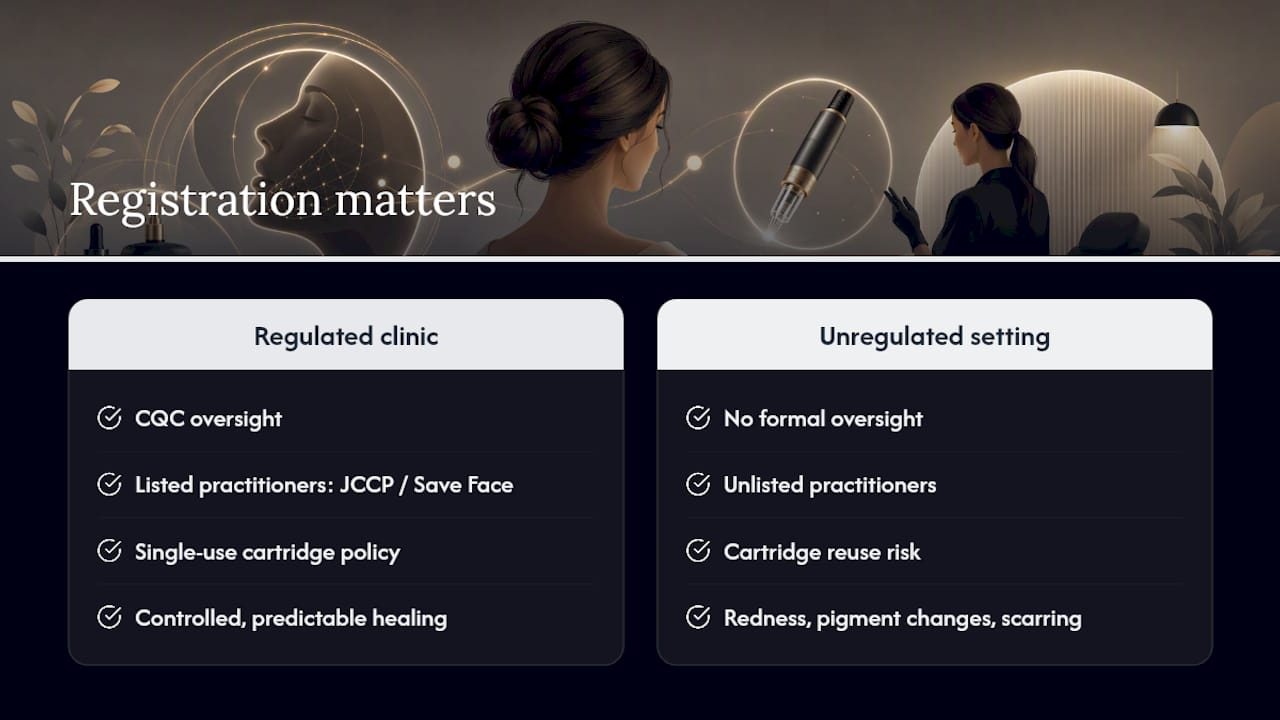
- Is the clinic CQC registered, and are practitioners listed with JCCP or Save Face?
- Are relevant medical staff registered with the GMC, GDC or NMC?
- Does the clinic use single-use sterile needle cartridges for every patient, with no reuse under any circumstances?
- What device do they use, and what training does the practitioner hold?
Walk away if a clinic hesitates to show registration, gives vague answers about training, or can’t confirm single-use cartridges. Reused needles and shallow answers about depth control are the clearest signs of a clinic cutting corners, and they raise real risk of infection and visible tram-line scarring. A CQC-registered clinic will have no trouble answering any of this on the spot.
Pro Tip: If you’re weighing up a professional appointment against a home device, remember the depth and sterility controls differ significantly. Home tools are designed for surface-level use only, while clinic-grade devices reach depths that require trained hands.
What to expect in the first 48 hours after treatment
Redness, tightness, warmth and occasional pinpoint bleeding are all part of the normal inflammatory response, not signs of a problem.
For the first 24–48 hours:
- Avoid direct sun exposure entirely.
- Skip makeup and harsh skincare products.
- Touch your skin as little as possible.
- Use only what your clinician recommends for cleansing and hydration.
Contact your clinic if you notice spreading redness, increasing pain, discharge or a fever. Genuine infection is uncommon when sterile technique and single-use cartridges are used correctly, but it’s worth acting quickly if anything feels off rather than waiting it out.
What a thorough consultation should cover
A consultation worth trusting will ask about your full medical history, isotretinoin use, pregnancy status and cold-sore history before anything is booked in. It should also review your current skincare and talk through realistic outcomes, not just the positives.
You should leave with:
- A written consent form.
- Clear pre- and post-treatment instructions.
- Confirmation of single-use device policy.
- A contact route if you have concerns afterwards.
Your seven-day and day-of checklist
Seven days out: no sun or fake tan, stop actives, hydrate well, cut alcohol and smoking.
Day of: clean face, comfortable button-down top, ID and medication list in hand.
Before you book: confirm the clinic’s registration and single-use cartridge policy directly. If you’d like a printable version, Theaestheticsroom’s pre-treatment checklist covers the same ground in a format you can keep on your phone.
Why regulated clinics and trained practitioners matter
The complications worth worrying about in microneedling almost always trace back to skipped preparation or an unregulated setting, not the treatment itself. Skin that’s still healing from a recent peel, or a patient who didn’t mention their isotretinoin history, tends to produce the same pattern: prolonged redness, patchy pigment, or scarring that a week’s proper preparation would have prevented.
That’s precisely why registration matters so much in this field. CQC oversight, practitioner listing with JCCP or Save Face, and a strict single-use cartridge policy aren’t paperwork exercises. They’re the practical difference between a controlled, predictable healing process and a genuinely avoidable complication. If you’re unsure whether your preparation is on track, a proper consultation with a registered clinic will tell you far more than another search result.
Book a consultation that starts with your skin, not a script
Theaestheticsroom is the alternative to booking blind: every consultation, virtual or in-person, begins with a proper review of your medical history, medications and skin condition before any treatment is scheduled, so you’re never guessing whether you’re ready. As a CQC-registered clinic and ACE Group member, the same safety checks covered in this guide, cold-sore history, isotretinoin timing, current medications, are built into every appointment from the outset.

If you’re weighing up microneedling alongside other options such as Botox or considering how it fits into a broader skin plan, a consultation is the simplest way to get a straight answer for your specific skin. Book a virtual or in-person consultation with Theaestheticsroom to get a personalised timeline before you commit to a date.
Sources
- Microneedling pre‑treatment information for patients — Chelsea and Westminster Hospital NHS Foundation Trust
- Microneedling: review article — PMC (peer‑reviewed)
- Hyaluronic acid — Cleveland Clinic
- Microneedling preparation: 5 must-dos before your microneedling treatment — Dr Pen UK
This article is general information, not a substitute for advice from a qualified doctor. Consult a qualified healthcare professional about your own circumstances before acting on anything here.