


TL;DR:
- Facial symmetry measures how closely the two sides of the face resemble each other, not perfect mirror images. Small asymmetries, especially fluctuating ones, influence attractiveness more than perfect bilateral balance, which is rare naturally. Professional assessment and targeted treatments can enhance perceived harmony without erasing individual facial character.
Most people assume that what is facial symmetry comes down to one thing: a perfectly mirrored face. That assumption is both understandable and wrong. True facial symmetry describes how closely your left and right sides resemble each other, not whether they match exactly. No face achieves perfect bilateral balance, and research consistently shows that flawless symmetry is neither the norm nor the ultimate measure of attractiveness. Understanding what symmetry actually means, how it is assessed clinically, and what you can realistically do to enhance it is far more useful than chasing an impossible ideal.
Table of Contents
- Understanding what facial symmetry really means
- How facial symmetry is measured and perceived
- The nuanced role of facial symmetry in attractiveness
- Practical approaches to enhancing facial symmetry
- Rethinking facial symmetry: embracing balanced uniqueness
- Explore expert facial symmetry treatments in London
- Frequently asked questions
Understanding what facial symmetry really means
Facial symmetry is defined as bilateral symmetry: how closely the left and right sides mirror around a facial midline, measured as relative similarity rather than exact perfection. This distinction matters enormously. When most people picture a “symmetrical face,” they imagine two halves that are virtually identical. In reality, what scientists measure is something far more nuanced.
There are two types of asymmetry worth knowing. Fluctuating asymmetry refers to small, random differences between the two sides of the face. These arise during development and are influenced by genetics, environment, and general health. Directional asymmetry refers to systematic, consistent differences, such as a jaw that reliably develops slightly larger on one side. It is fluctuating asymmetry that researchers link to perceived attractiveness, not directional differences.
Certain features are particularly sensitive to asymmetry perception. These include:
- The eyes: Even a millimetre of difference in lid height or position registers quickly.
- The nose: Subtle deviations in the nasal tip or bridge affect overall facial balance.
- The mouth: Asymmetric lip volume or commissure position draws attention almost immediately.
- The brows: Brow arch height and shape influence perceived expression and balance.
Symmetry is one contributor to perceived beauty, not the whole story. Factors such as skin quality, facial proportions, averageness (how closely a face resembles the population average), and femininity or masculinity of features each play their own distinct role. Our advanced facial analysis assesses 29 individual parameters precisely because no single metric, including symmetry, tells the full story.
How facial symmetry is measured and perceived
Understanding the facial symmetry definition is one thing. Knowing how clinicians and researchers actually quantify it is another. Modern measurement approaches use landmark-based analysis of 2D or 3D photographs, with automated software computing symmetry scores from 0 (highly asymmetrical) to 0.99 (near-perfect bilateral balance). This removes the subjectivity of the human eye from the equation.
Here is how a typical clinical symmetry assessment works:
- Standardised photography: The client is photographed in a neutral, forward-facing position under consistent lighting. Posture, camera distance, and head tilt all affect results, which is why controlled conditions are essential.
- Landmark mapping: Software identifies key anatomical points, such as the inner and outer corners of each eye, the nasal tip, and the corners of the mouth.
- Symmetry scoring: The software calculates the degree of deviation between mirrored landmarks, producing a numerical score.
- Heatmap visualisation: Advanced tools overlay colour-coded heatmaps onto the facial image, showing precisely where asymmetries are concentrated and how significant they are.
Pro Tip: Avoid self-assessing your symmetry in a standard mirror. Mirrors flip your image laterally, so what you see is actually your mirror image rather than how others perceive you. A smartphone camera in portrait mode gives a truer impression.
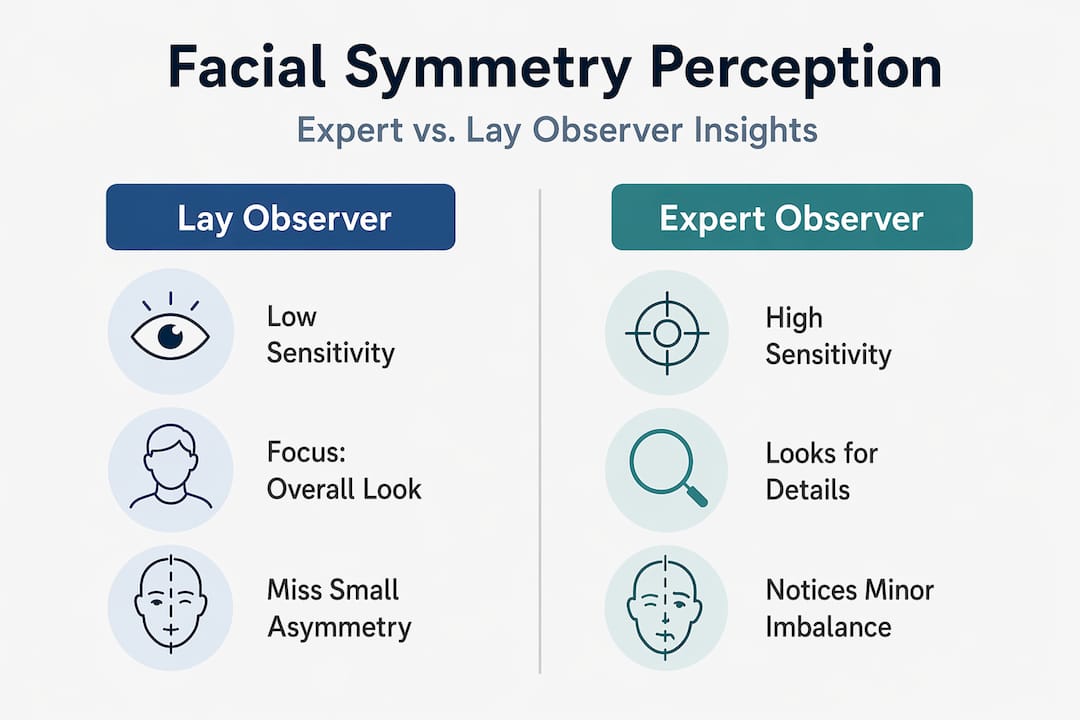
Perception does not respond linearly to asymmetry. Research shows that asymmetry below certain thresholds, specifically index values of 1.1 and 3.1, may not be reliably noticed by observers at all. In other words, small asymmetries that trouble you intensely may be entirely invisible to everyone else.
| Observer type | Sensitivity to asymmetry | Notes |
|---|---|---|
| Lay observers | Low to moderate | Tend to notice larger, obvious deviations |
| Trained aestheticians | High | Detect subtle landmark shifts |
| Automated software | Very high | Quantifies micro-deviations precisely |
| Clients (self-assessment) | Variable, often high | Frequently overestimate their own asymmetry |
Understanding facial anatomy in this context is critical. A holistic facial assessment that incorporates objective measurement tools gives practitioners a far more accurate baseline than a conversation about what the client thinks they see in the mirror.
The nuanced role of facial symmetry in attractiveness
Here is where popular culture and the science genuinely diverge. The idea that perfect facial symmetry equals maximum attractiveness is a compelling narrative, but the evidence is more complicated. Symmetry contributes positively to attractiveness ratings, but its impact is modest and frequently overstated. Other traits, including averageness and facial femininity, often prove stronger predictors of who is rated most attractive.
Consider these findings carefully:
- Perfectly symmetrical composites created by researchers are rated attractive, but not dramatically more so than naturally asymmetric faces.
- Mild asymmetries can read as character, individuality, and even uniqueness, all of which contribute positively to how others perceive a face.
- Context matters significantly: In photographs, symmetry ratings differ from live assessments. Lighting, expression, and angle all influence what observers notice.
- Self-perception bias: People rate their own asymmetries far more harshly than observers do, a gap that has real implications for cosmetic treatment planning.
“Some studies find that very low fluctuating asymmetry is not necessarily linked with maximum attractiveness, suggesting a preference for slight natural asymmetry.”
This is genuinely important for anyone considering cosmetic enhancement. The goal is not to engineer a face that scores highest on a symmetry index. The goal is to restore or improve balance, which is a perceptual quality that encompasses symmetry but extends well beyond it. Exploring your options through a dermal filler comparison is a useful starting point for understanding how volume and contouring can shift perceived balance without erasing what makes your face distinctively yours.
Practical approaches to enhancing facial symmetry
When the science is translated into clinical practice, enhancing facial symmetry becomes a precise, personalised process rather than a one-size approach. Symmetry scores inform treatment planning while acknowledging natural asymmetry and the variability that comes with different imaging conditions. Here is how that process typically unfolds:
- Baseline assessment: Standardised photography and landmark analysis establish your current symmetry profile across key facial zones.
- Identification of priority areas: Not all asymmetries need addressing. Practitioners identify which deviations are perceptually significant and which fall below the threshold of notice.
- Treatment selection: Specific interventions are matched to the asymmetry type. Muscle imbalances respond well to Botox treatments, which can rebalance overactive muscles on one side. Volume deficits or structural asymmetries are addressed with dermal fillers, which restore projection and contour where needed.
- Facial harmonisation: For clients with multiple contributing asymmetries, facial harmonisation solutions combine techniques across several facial zones for a cohesive result.
- Review and reassessment: Post-treatment photography using the same standardised setup allows objective comparison, removing guesswork from outcome evaluation.
Pro Tip: Ask your practitioner to show you your symmetry analysis both before and after treatment. Seeing the objective data builds realistic expectations and helps you understand exactly what has changed and why.
| Treatment | Best suited for | Typical symmetry benefit |
|---|---|---|
| Botox | Brow asymmetry, jaw imbalance, uneven smile | Muscle rebalancing, smoother contours |
| Dermal fillers | Lip volume, cheek projection, chin definition | Structural correction, improved proportions |
| Facial harmonisation | Multiple concurrent asymmetries | Cohesive balance across the whole face |

Realistic expectations are part of every well-planned treatment. Some degree of asymmetry will remain after any procedure, and that is entirely appropriate. The aim is meaningful improvement in perceived balance, not the elimination of individuality.
Rethinking facial symmetry: embracing balanced uniqueness
We see this pattern regularly at The Aesthetics Room: a client arrives with a carefully annotated photograph of their face, convinced that a specific asymmetry is their central aesthetic problem. After objective measurement, we often find the asymmetry they have fixated on falls well below the perceptual threshold. What is actually influencing their appearance is something else entirely, such as skin quality, brow position, or lip volume.
The obsession with perfect symmetry is, in part, a product of digital culture. Filters and editing tools can now produce a perfectly mirrored face in seconds, which creates a reference point that has never existed in nature. The result is a generation of clients comparing themselves to a standard that no one, including models and actors, actually meets unaltered.
Our perspective is straightforward. Fluctuating asymmetry matters for attractiveness, but many asymmetries are entirely natural and add genuine character. The most compelling aesthetic outcomes we achieve are not the ones that maximise a symmetry score. They are the ones that restore balance whilst keeping the face recognisably, distinctively that person’s own.
A holistic facial assessment is therefore not just a clinical tool. It is the foundation of honest, personalised treatment planning that serves your actual appearance rather than an abstract ideal. Self-measuring symmetry with a mirror or a symmetry app will nearly always mislead you. Professional assessment with calibrated tools and an experienced clinical eye gives you something far more valuable: an accurate picture of where you are starting from and a realistic vision of where treatment can take you.
Explore expert facial symmetry treatments in London
If this article has prompted you to think more carefully about your own facial balance, the logical next step is a professional assessment rather than further self-analysis. At The Aesthetics Room, our Knightsbridge clinic offers bespoke consultations that combine objective symmetry measurement with expert clinical judgement, giving you a genuinely informed foundation for any treatment decision.

Our Botox treatments can rebalance muscle activity across the brow, jaw, and midface for improved structural harmony. Our dermal fillers restore volume and refine contours where asymmetry is structural rather than muscular. For clients with multiple areas of concern, our facial harmonisation programme combines techniques across the whole face for cohesive, natural-looking results. Every treatment plan begins with advanced facial analysis, ensuring your care is tailored to your specific anatomy and goals. Book your consultation today and take the first step towards balanced, confident beauty.
Frequently asked questions
What exactly is facial symmetry?
Facial symmetry describes how similar the left and right sides of your face are when measured around a central midline, assessed as relative similarity rather than exact matching. No face achieves perfect bilateral balance, and this is entirely normal.
Is perfect facial symmetry necessary for beauty?
No. Perfect symmetry is rare and not required for attractiveness. Research suggests a preference for slight asymmetry in some contexts, meaning mild natural differences often enhance individuality rather than detract from it.
How do clinics measure facial symmetry?
Clinics use automated software to analyse standardised 2D or 3D photographs, mapping anatomical landmarks to calculate precise symmetry scores and identify which deviations are clinically significant.
Can cosmetic treatments improve facial symmetry?
Yes. Treatments such as Botox, dermal fillers, and facial harmonisation can meaningfully improve perceived balance by addressing muscle imbalances, volume deficits, and structural asymmetries across key facial zones.
Recommended
- Facial anatomy: the key to safer cosmetic results – The Aesthetics Room
- Step by step facial massage guide for radiant skin 2026 – The Aesthetics Room
- Advanced facial analysis: 29+ parameters for bespoke results – The Aesthetics Room
- Facial harmonization: personalised non-invasive solutions – The Aesthetics Room