

TL;DR:
- Facial anatomy involves multiple layers that influence aging and treatment outcomes.
- Understanding structural changes helps target treatments for natural, long-lasting results.
- Precise, anatomy-informed procedures reduce risks and improve facial harmony.
Most people assume cosmetic enhancements are about treating the surface. Smooth away a line here, add a little volume there. But the reality is far more layered, quite literally. The structures beneath your skin, including fat pads, ligaments, muscles, and bone, do more to shape how you look and how you age than the skin itself. For anyone in London considering Botox, dermal fillers, or facial contouring, understanding these deeper layers is not just interesting background knowledge. It is the difference between results that look natural and those that fall short.
Table of Contents
- Why facial anatomy matters for cosmetic enhancements
- The layered structure of your face: a closer look
- Understanding the science of facial ageing
- Precision, safety, and individual anatomy in London
- Why deeper anatomical knowledge is the edge in London aesthetics
- Enhance your look with expert-led, anatomy-based treatments
- Frequently asked questions
Key Takeaways
| Point | Details |
|---|---|
| Facial layers affect outcomes | Skin, fat, muscle, ligaments, and bone each play a crucial role in how aesthetic treatments work and age. |
| Ageing starts below the surface | Volume loss, bone changes, and ligament shifts drive visible ageing more than skin alone. |
| Anatomy-smart providers offer safer care | Practitioners with advanced anatomy training and dynamic assessment skills minimise risks and enhance results. |
| Early holistic treatments preserve youth | Addressing facial support in your 20s-30s maintains a natural, youthful look longer. |
Why facial anatomy matters for cosmetic enhancements
When we talk about facial anatomy in aesthetics, we are not simply discussing biology for its own sake. We are talking about safety, precision, and results that genuinely last. The face is not a flat canvas. It is a multi-layered structure where every intervention at one depth has consequences at another.
According to three-dimensional facial anatomy research, the face comprises distinct layers: the skin, subcutaneous fat (including the malar fat pad), the superficial musculoaponeurotic system (known as the SMAS), deep fascia protecting nerves and vessels, and retaining ligaments such as the orbitomalar ligament. Ageing causes fat atrophy, ligament weakening, and bone resorption, all of which lead to volume loss and structural descent. This is not a gradual surface fading. It is a structural shift happening at multiple depths simultaneously.
So why does this matter for someone booking a treatment in London? Because a practitioner who understands holistic facial assessment approaches each face as a three-dimensional structure rather than a collection of isolated concerns. They identify what is actually causing a sunken cheek or a deepening nasolabial fold, and they treat the root cause rather than masking the symptom.
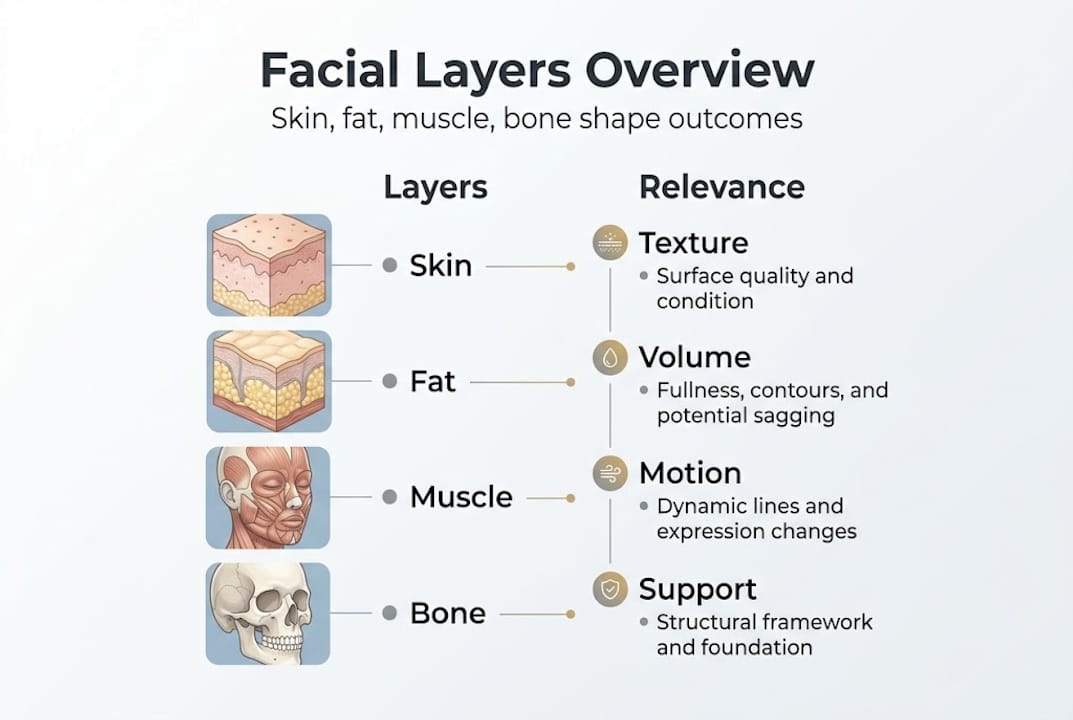
The key facial layers relevant to aesthetic treatment include:
- Skin: The outermost layer; reflects overall health, hydration, and sun damage
- Subcutaneous fat pads: Located directly beneath the skin; provide volume and define facial contours
- SMAS (superficial musculoaponeurotic system): A fibromuscular layer connecting facial muscles; a primary target in surgical facelifts
- Retaining ligaments: Anchor facial tissue to the underlying bone; their weakening causes sagging
- Periosteum and bone: The deepest structural foundation; bone resorption over time changes the entire facial framework
“Ageing is not a single-layer phenomenon. Volume loss, skeletal change, and ligament laxity all interact, and treating only the surface is like painting a wall without addressing the damp beneath it.”
Risks from improper treatments are real. Bruising, asymmetry, palpable lumps, and an unnatural appearance can all result from injecting at the wrong depth or missing an anatomical landmark. This is precisely why common facial procedures should always be performed by practitioners with a rigorous understanding of facial layers.
Pro Tip: Before booking any treatment, ask your practitioner how they assess facial anatomy and whether they perform dynamic assessments, observing your face both at rest and in movement, before recommending a plan.
After seeing how deep structure matters, let us examine these layers in detail.
The layered structure of your face: a closer look
Knowing layers is one thing. Understanding their individual and collective roles is another, and this knowledge directly shapes which treatments deliver the best outcome for your specific anatomy.
The muscles of facial expression are innervated by facial nerve VII, and they include the frontalis (responsible for brow elevation), the glabellar complex comprising the procerus and corrugator (which create frown lines), and the orbicularis oculi (which surrounds the eye). Repeated contractions across years cause what are known as rhytids, or dynamic wrinkle lines. Injectables like Botox must target specific depths to precisely balance elevator and depressor muscles, avoiding complications such as ptosis (drooping of the eyelid) or unintended brow descent.

Fat pads deserve particular attention. The midface contains both superficial and deep fat compartments, and they age at different rates. The deep medial cheek fat pad deflates earlier than superficial layers, which is why the midface often looks hollow before obvious skin sagging sets in. Facial contouring treatments that restore deep fat pad volume first create a far more natural result than those focused purely on surface skin tightening.
Here is a quick-reference table of the main facial layers and how they relate to aesthetic treatments:
| Layer | Role | Common treatment relevance |
|---|---|---|
| Skin | Barrier, texture, pigmentation | Skin boosters, laser, peels |
| Superficial fat pads | Surface volume, contour definition | Dermal fillers (superficial placement) |
| Deep fat pads | Structural volume, midface support | Dermal fillers (deep placement) |
| SMAS | Facial movement, muscular support | Surgical lifts, HIFU |
| Retaining ligaments | Anchors soft tissue to bone | Collagen stimulators, targeted fillers |
| Periosteum and bone | Foundational structure | Deep bolus fillers, bone-level support |
Why does this precision matter? Consider a treatment for nasolabial folds (the lines running from the nose to the corners of the mouth). A practitioner who treats only the fold itself may create a temporary smoothing effect. One who understands that those folds deepen primarily due to midface fat pad deflation will restore volume at a deeper level, achieving a result that looks natural and lasts longer.
Additional risks from anatomical misunderstanding include:
- Ptosis: Eyelid or brow drooping from Botox placed too close to the levator palpebrae muscle
- Tyndall effect: A bluish discolouration caused by filler placed too superficially under the eye
- Vascular occlusion: Filler inadvertently injected into a vessel, a rare but serious complication
- Uneven results: Asymmetry from not accounting for natural fat pad variations between sides
For patients seeking facial rejuvenation, this knowledge is not about creating anxiety. It is about helping you ask the right questions and choose a provider qualified to answer them confidently.
Understanding the science of facial ageing
With the layers in mind, let us see how they change over time and what this means for the timing of cosmetic treatment.
Facial ageing is a three-dimensional process, not a flat one. Research on unified facial contours confirms that the ideal youthful facial shape is an inverted triangle: full cheeks sitting high, narrowing to a refined chin. As we age, midface fat pads atrophy and descend, the maxilla (cheekbone area) undergoes recession, and jowls form along the jaw. The result is that the inverted triangle gradually becomes a rectangle or even an inverted pyramid, with widened lower facial heaviness replacing the lifted upper midface.
A 54-year longitudinal study on facial ageing involving population data of 594 subjects found that men and women age along remarkably similar structural trajectories, with key in and out changes occurring across all facial thirds rather than simple downward descent. The study also found that wrinkles and pigmentation together account for only about 24% of visible ageing variance, confirming that deeper structural changes carry far more visual weight than most people assume.
| Feature | Young face | Ageing face |
|---|---|---|
| Cheek volume | High and full | Deflated, descended |
| Jawline | Defined, narrow | Jowled, widened |
| Facial shape | Inverted triangle | Square or rectangular |
| Brow position | Elevated, arched | Lowered, flattened |
| Nasolabial fold | Minimal | Deepened from volume loss |
So when do these changes begin? Subtly, in the mid-20s. The deep fat pads begin to lose volume earlier than surface tissue, which is why some people in their late 20s notice a slight hollowing under the eyes or a less defined cheek projection even without obvious wrinkling. This is also why jawline changes are worth monitoring earlier than most expect.
Key anatomical ageing factors to be aware of include:
- Midface fat pad descent: The primary driver of nasolabial folds and tired appearance
- Bone resorption: The orbital rim widens, the pyriform aperture (nose base) expands, and the mandible loses height
- Ligament laxity: Retaining ligaments stretch, allowing tissues to descend
- Muscle imbalance: Depressor muscles grow relatively stronger as elevators weaken
Early, proactive treatment does not mean doing more. It means preserving what you have, maintaining the triangle of youth by subtly restoring volume at the right anatomical depth before major structural shifts occur. This philosophy aligns perfectly with what we at The Aesthetics Room advocate: bespoke, evidence-based plans that respect your anatomy rather than override it.
Precision, safety, and individual anatomy in London
As ageing and anatomy become clearer, the next step is ensuring safety and choosing the right provider. This is where anatomical nuance becomes critically important.
Not all faces follow the textbook. Research published in the Journal of Clinical Medicine on facial anatomy variants highlights that the zygomaticus major muscle (which controls your smile) has a bifid (split) variant in up to 35% of people. This variant alters smile dynamics and can increase the risk of asymmetry or an unnatural smile appearance following certain filler or lift procedures. The transverse facial artery, relevant for midface treatments, has a mean depth of 10.54mm and originates from the superficial temporal artery in 83 to 90% of individuals, but outliers exist. Facial vein variants can also increase the risk of vascular occlusion or, in the case of infection, facilitate its spread.
Here is a step-by-step overview of what a precision, anatomy-informed consultation should include:
- Dynamic assessment: Observing your face at rest, during expression, and with movement to understand muscle interactions
- Layer mapping: Identifying your specific fat pad distribution and any asymmetry
- Vascular and nerve awareness: Knowing the location of key vessels such as the infraorbital artery before injecting
- Variant consideration: Accounting for muscle or vessel variants that may affect your personal risk profile
- Panfacial planning: Designing a treatment plan that considers the whole face rather than isolated areas
Safe methodology for injectables involves layer-by-layer knowledge across skin, fat, muscle, and periosteum, with specific protocols for vascular and nerve avoidance. Ultrasound and MRI mapping are increasingly used by advanced practitioners to visualise anatomy in real time, reducing guesswork and improving accuracy for complex cases.
Pro Tip: Ask your practitioner whether they use dynamic assessment and whether they have completed advanced anatomy training specific to injectable procedures. A confident, detailed answer is a strong positive sign. A vague or dismissive response warrants further scrutiny.
When preparing for any injectable treatment, understanding safe filler preparation from a reputable clinic is an equally important step that supports both safety and optimal outcomes.
Why deeper anatomical knowledge is the edge in London aesthetics
Here is something the aesthetics industry does not always say clearly enough: the majority of visible dissatisfaction with cosmetic results comes not from the wrong product, but from the wrong understanding of where and why to place it. Surface-targeted interventions miss the primary drivers of ageing entirely.
We see this regularly. Patients arrive having had repeated treatments to smooth nasolabial folds directly, without ever addressing the midface volume loss driving them. The fold returns quickly, sometimes more pronounced, because the underlying structure has not been supported. Meanwhile, someone who understood the anatomical cause early sought midface restoration and now looks naturally refreshed without looking treated.
London’s leading aesthetic clinics are moving firmly toward 3D, holistic anatomy as the foundation of every treatment plan. This is not a trend. It is a recognition of the science. Practitioners who invest in advanced training, who ask about your smile dynamics, who assess your face in motion as well as stillness, are offering something categorically different from those who follow a standard injection template.
Consumers who understand the triangle of youth, the significance of the SMAS, and the role of fat pad compartments make better decisions. They choose providers who align with aesthetics for ageing skin at a sophisticated level, rather than simply seeking the lowest price or the most convenient appointment. Anatomy knowledge is your most powerful tool when navigating London’s aesthetics landscape.
Enhance your look with expert-led, anatomy-based treatments
Ready to translate this knowledge into real, lasting results? At The Aesthetics Room, our practitioners combine advanced anatomical expertise with a genuinely personalised approach to every treatment.

Whether you are considering dermal fillers to restore midface volume, or exploring Botox options to balance muscle dynamics, every plan we create is grounded in a thorough assessment of your unique facial anatomy. We do not follow templates. We follow your face. Book a virtual or in-person consultation at our Knightsbridge clinic today and experience the difference that anatomy-informed care delivers. Your results should look like you, only better.
Frequently asked questions
How does understanding facial anatomy reduce the risk of filler or Botox complications?
Layer-by-layer anatomical knowledge helps practitioners avoid key vessels and nerves, inject at the correct depth for the target tissue, and adapt safely to individual anatomical variants, all of which significantly reduce the risk of bruising, occlusion, and asymmetry.
What is the ‘triangle of youth’ in facial aesthetics?
It describes an inverted triangular facial shape characterised by full, elevated cheeks and a refined chin, which reverses with age as fat descends and the jaw widens, making midface and chin restoration central to a youthful result.
At what age do facial anatomical changes begin, and how can early action help?
Subtle anatomical ageing starts in the mid-20s with gradual volume shifts in deep fat compartments; early, targeted intervention can preserve the triangle of youth by supporting deeper structures before significant visible changes occur.
Why does holistic assessment matter more than treating isolated areas?
Panfacial treatment planning ensures that each area of the face remains in proportion and harmony, preventing the unnatural or overfilled appearance that often results from focusing on a single feature without considering its relationship to the whole face.
Recommended
- Advanced facial analysis: 29+ parameters for bespoke results – The Aesthetics Room
- Facial harmonization: personalised non-invasive solutions – The Aesthetics Room
- Clinical Facials: Enhancing Skin Safely in London – The Aesthetics Room
- 7 Essential Common Facial Procedures Explained Clearly – The Aesthetics Room