


An IV drip can help with the dehydration that often comes with a long flight. It cannot reset your body clock, and that clock is what causes jet lag. If you land in London tired, thirsty and foggy, a medically assessed infusion may ease some of the physical symptoms. Sleep timing, daylight and sensible fluids still do most of the work.
This guide explains what jet lag is, where IV hydration fits, what the evidence supports, and the safety checks to make before anyone puts a needle in your arm. We are a CQC-registered clinic, so we have a view on that last point.
TL;DR
- Jet lag is a body-clock problem. The NHS says it usually improves within a few days as you adjust to the new time zone.
- An IV drip can replace fluids and support hydration. Clinicians see it as temporary support, not a cure for circadian disruption.
- Any IV infusion carries clinical risks, including infection, nerve injury and allergic reaction. It should follow a face-to-face assessment with a qualified prescriber.
- Regulation is tightening in England. Choose a CQC-registered, medically led clinic, not a quick-fix drip bar.
- Light, sleep timing and drinking enough water remain your most effective tools.
Table of Contents
- What jet lag actually is
- Why flying leaves you dehydrated
- What an IV drip can realistically do
- The risks nobody puts on the menu
- The regulatory picture in England
- How to choose a safe provider
- What works for jet lag, in order of impact
- Our perspective at The Aesthetics Room
- Booking a consultation with us
- Planning around a trip: a worked example
- Frequently asked questions
- Sources
What jet lag actually is
Jet lag happens when your internal body clock no longer matches the local time after crossing several time zones. The NHS describes disturbed sleep, tiredness, trouble concentrating and sometimes nausea or indigestion. Symptoms usually ease within a few days, although tiredness and early waking can last five days or more.
Two things are going on at once, and it helps to separate them.
- Circadian disruption. Your brain expects night while the sun is up. Sleep, appetite, mood and alertness all run on the wrong schedule. This is the core of jet lag.
- Travel strain. Long hours seated, disturbed sleep, alcohol, caffeine and dry cabin air leave you tired and dehydrated. This is not jet lag itself, but it makes jet lag feel worse.
IV hydration can only speak to the second one.
Why flying leaves you dehydrated
NHS travel guidance on air travel notes that cabin air is very dry and can affect your skin, lips, nose and eyes. Add a glass of wine, a few coffees and a night of broken sleep, and you can arrive with a headache, heavy muscles and a dull, foggy head.
Not all of that is dehydration. Some is simply sleep debt. But fluid loss is the part you can address on the day you land, which is why IV hydration is marketed so heavily to travellers.
What an IV drip can realistically do
An infusion delivers fluid, and often electrolytes or vitamins, straight into a vein. NHS hospital guidance explains that intravenous fluids replace high fluid losses by giving water and electrolytes directly into the bloodstream, to stop you becoming dehydrated.
In a travel context, a well-run session may help with:
- A dry mouth, thirst and a headache linked to low fluid intake
- Muscle heaviness after a long day of travel
- The general washed-out feeling that follows a red-eye
It will not:
- Move your sleep window to local time
- Remove early waking or afternoon slumps overnight
- Replace the need for daylight and a consistent sleep schedule
NHS travel advice is clear that the most effective approach is behavioural: anchoring sleep to local time, limiting alcohol and caffeine, and getting natural light at your destination. We would say the same to any patient. A drip is a comfort measure on top of those habits.
Is a drip better than drinking water?
For most healthy travellers, no. If you can drink, drinking is the simplest and safest way to rehydrate. Oral fluids with some salt, such as an oral rehydration drink, work well and carry no needle risks.
An infusion is more appealing when you feel too unwell to drink, or when you want to feel better quickly before an important meeting. Even then, the decision should be medical, not a spur-of-the-moment impulse. The honest answer to “is it worth it?” is that it depends on how dehydrated you are, your health and your schedule.
The risks nobody puts on the menu
IV treatments are often presented as lifestyle products. They are still medical procedures.
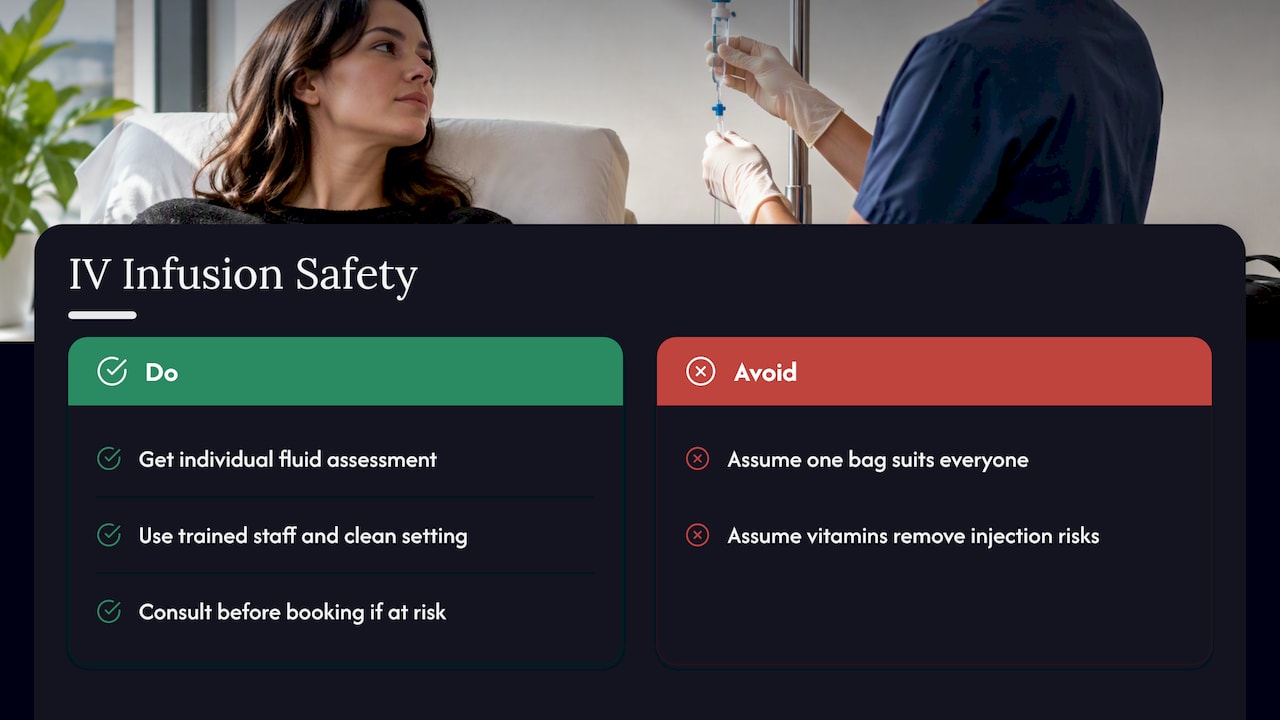
Fluid overload. Intravenous fluid is clinically indicated mainly for fluid deficit. NHS prescribing guidance warns that the wrong type or volume of fluid can do serious harm, and that fluid needs must be assessed and adjusted for the individual. A one-size-fits-all bag does not do that. People with heart or kidney conditions need particular care.
Infection, nerve injury and allergic reaction. Any injection or cannulation carries these risks, whether the bag contains vitamins or saline. A clean clinical setting, trained staff and a plan for emergencies matter.
Product quality. Local authority health officers in Wolverhampton have warned about illegal use of vitamin injections. They advise a face-to-face consultation with the prescriber of the product, who should go through your medical history and suitability.
If you are pregnant, have heart, kidney or liver disease, take regular medication or have allergies, speak to your GP or the prescriber before booking any infusion, and say so at the consultation.
The regulatory picture in England
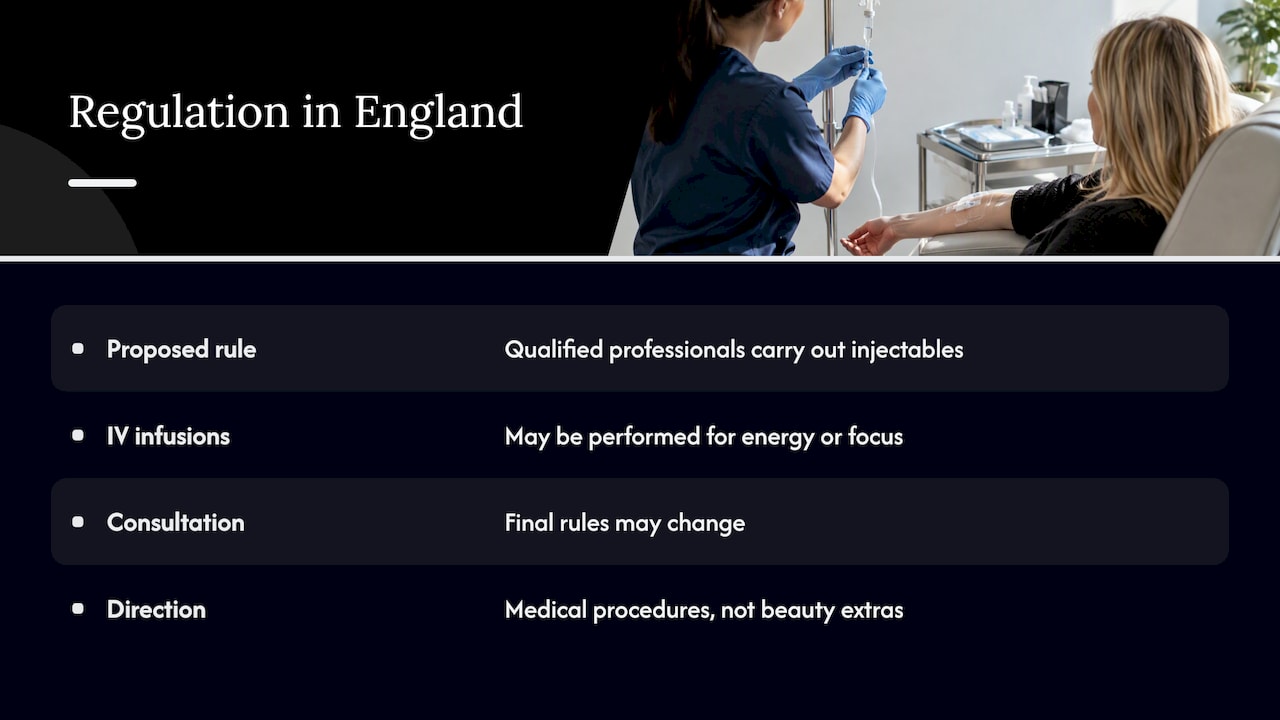
The government is moving towards tighter control of these services. A consultation on high-risk cosmetic and wellbeing procedures in England proposes that certain procedures, including injectable treatments, should only be carried out by specified, qualified healthcare professionals. The consultation document acknowledges that intravenous infusions of vitamins and minerals may be performed to improve energy or focus.
This is a consultation, so the final rules may change. What it tells you today is the direction of travel: IV infusions are being treated as medical procedures, not beauty extras. Choosing a provider that already works to a medical standard puts you ahead of any rule change.
How to choose a safe provider
Use this checklist before you book any IV hydration session in London or elsewhere.
- CQC registration. Check the clinic appears on the Care Quality Commission register for the service it offers.
- A real consultation. You should be asked about your medical history, medication, allergies and recent travel before anything is prepared. Be wary of anyone who offers a drip without questions.
- A qualified prescriber. Ask who prescribes your infusion and whether they assess you face to face. Prescribing for yourself and then treating clients is not an acceptable model.
- Clear product labelling. The bag and any additives should be labelled, dispensed properly and explained to you.
- Tailored volume. Fluid amount and rate should reflect your weight and health, not a standard menu.
- No cure claims. Walk away from anyone promising to “cure” jet lag or reset your body clock.
- A plan if something goes wrong. Ask what happens in the event of a reaction.
Our guide to London aesthetic consultations sets out what a proper consultation should cover, and the same questions apply to wellbeing treatments.
What works for jet lag, in order of impact
If you only have a few minutes to plan, spend them here.
Before you fly
- Shift your sleep by an hour or so a day towards destination time if your schedule allows.
- Drink steadily the day before, and go easy on alcohol.
On the plane
- Set your watch to destination time and try to sleep when it is night there.
- Drink water regularly and limit alcohol and caffeine, as NHS travel advice recommends.
- Use lip balm, moisturiser and glasses instead of contact lenses if cabin air dries your eyes, as suggested in the NHS air travel advice.
After landing
- Get outdoor daylight at local times. It is the strongest cue for resetting your body clock.
- Eat at local mealtimes, and avoid a long nap that pushes bedtime late.
- Keep caffeine for the morning.
What about melatonin?
The NHS says melatonin can be taken as a short-term treatment for jet lag in adults, and that there is some evidence it makes symptoms less severe. It is not available on a standard NHS prescription for this purpose, and it needs a prescription in the UK. NHS dosing guidance gives a standard 3mg dose at local bedtime for up to five nights, and says not to take it before 8pm or after 4am. Ask a pharmacist or GP whether it is suitable for you.
Our perspective at The Aesthetics Room
We are asked about wellbeing treatments alongside our aesthetic work, and our answer is consistent. Anything that goes into your body deserves the same rigour as anything we do to your face.
That is why we are CQC-registered and members of the ACE Group, which is dedicated to patient safety. It is also why our approach starts with a consultation, in person or virtual, before any treatment plan is agreed. Our protocols are medically led and look at what is happening inside as well as outside: your health, your habits and your goals.
On jet lag, we would not tell you a drip fixes it. We would tell you that hydration matters, that your body clock needs daylight and sleep, and that if an infusion is being considered, it should follow a proper assessment and be tailored to you. IV vitamin therapy is part of the range we provide, and whether it is appropriate for you is a decision we make with you in consultation, not on a menu.
If you are flying in for a short trip and want to look and feel your best, we usually suggest a different order of priorities: sleep, fluids and light first, then any treatment that suits your plans. Skin that feels tight and dull after a flight often responds better to simple moisturising and rest than to anything more invasive. Planning skin treatments around travel matters too. Our Botox maintenance schedule guide shows how to time top-ups so you are not rushing before a trip.
— Vishul
Booking a consultation with us
If you want advice on how to feel and look your best around travel, start with a conversation. We offer in-person and virtual consultations, and our clinicians will talk through your health history, your goals and what is, and is not, appropriate for you.
Our published treatments, from skin peels to Profhilo, are listed with prices on our price list. For example, a Mild Skin Peel is 120 GBP and Profhilo is 350 GBP, both as published on that page. For questions about IV vitamin therapy, get in touch through our site and we will explain what we can offer after a consultation.
Planning around a trip: a worked example
Say you fly overnight from New York to London on a Sunday and have meetings on Monday morning. Here is a sensible plan.
- On the plane: set your watch to London time. Drink water each hour you are awake. Skip the second glass of wine.
- On arrival, morning: walk outside for 20 to 30 minutes of daylight if you can. Eat breakfast. Have a coffee, but only in the morning.
- Midday: if you must nap, keep it short and early. Drink a rehydration solution if you feel flat.
- Evening: dim the lights, avoid screens and go to bed at a normal local time.
If you still feel unwell or cannot keep fluids down, that is a reason to speak to a doctor or a pharmacist, not to book a drip on impulse. For a healthy person, this plan costs nothing and carries no clinical risk. If you then want to explore an infusion for a future trip, discuss it at a consultation first.
Frequently asked questions
Can an IV drip cure jet lag?
No. Jet lag comes from a mismatch between your body clock and local time, and a drip does not change that. It may ease dehydration-related symptoms such as headache or heavy muscles, while light and sleep timing do the resetting.
Is Liquid IV good for jet lag?
Powdered oral rehydration drinks, which people often mean by this, can help you replace fluids and salts after a flight. They are a simple option without needles. They do not reset your body clock, so use them alongside sleep and daylight.
Can jet lag cause nausea?
Yes. The NHS lists nausea and indigestion among the possible physical symptoms of jet lag. Eating at local mealtimes, drinking water and avoiding heavy meals and alcohol can help. If nausea is severe or lasts, see your GP or pharmacist.
How much melatonin should I take for jet lag?
The NHS gives a standard dose of 3mg at local bedtime, for a maximum of five days, and not before 8pm or after 4am. In the UK it is a prescription medicine, so speak to a pharmacist or GP about whether it suits you and any medicines you take.
Is IV therapy safe for travellers?
It can be when it is delivered by a qualified prescriber in a CQC-registered setting after a face-to-face assessment. It is not risk-free, and it is not suitable for everyone. Always disclose your medical history and medication before treatment.
Sources
- Jet lag, NHS
- Air travel, Fit for Travel (NHS)
- Common questions about melatonin, NHS
- How and when to take melatonin, NHS
- Home intravenous fluids, Hull University Teaching Hospitals NHS Trust
- Guidance for intravenous fluid and electrolyte prescription in adults, Right Decisions
- Warning on illegal use of Vitamin B12 injections, City of Wolverhampton Council
- Restrictions on the performance of high-risk cosmetic and wellbeing procedures in England, GOV.UK
- Consultation document, GOV.UK