

TL;DR:
- A social media strategy helps clinics attract patients by using platforms like Instagram, TikTok, and Facebook while ensuring compliance with healthcare regulations. Clinics must address legal consent, professional conduct, and technical setup before posting, to reduce risks and build credibility. Effective content involves practitioner-led education and careful management of patient-related images, aligned with platform-specific rules.
A social media strategy for clinics is a structured plan for using platforms like Instagram, TikTok, and Facebook to attract patients, build trust, and meet healthcare regulations. Done well, it is one of the most powerful tools in digital marketing for clinics. Top-performing clinics report that 40–60% of new patient enquiries come directly from social platforms. That figure alone explains why a healthcare social media plan is no longer optional. The challenge is that clinics operate under strict rules from the GMC, ASA, and CAP, which means every post carries both an opportunity and a compliance obligation.
What are the foundational prerequisites for a clinic’s social media strategy?
Before publishing a single post, clinics must address three non-negotiable areas: legal consent, professional conduct, and technical infrastructure. Skipping any one of these creates serious risk.
Legal and ethical groundwork
UK clinics must obtain explicit, documented, and withdrawable patient consent before posting any patient-related content. This is a GDPR requirement, not a courtesy. A signed consent form that covers the specific platform, content type, and duration of use is the minimum standard. The GMC also mandates that doctors maintain the same professional standards online as they do in person. Breaches of confidentiality or trust on social media can trigger fitness-to-practise investigations.
Professional boundaries apply to every channel, including direct messages. Many practitioners assume private messages fall outside regulatory scrutiny. They do not. Contacting patients personally via social media is a recognised cause of GMC investigations. Establish a clear policy: all patient communication happens through official clinic channels only.
Tools and platforms to set up first
A well-prepared clinic needs three categories of tool before going live.
- Scheduling and publishing: Tools like Meta Business Suite, Later, or Hootsuite allow you to plan content in advance and maintain consistent posting frequency.
- Social listening: Google Alerts and platform-native analytics help you monitor mentions, comments, and sentiment around your clinic’s name.
- Compliance audit checklists: A written checklist reviewed against ASA CAP codes before every post goes live. This is the single most underused tool in clinic marketing.
The primary platforms for aesthetic and medical clinics are Instagram, TikTok, and Facebook. Instagram suits visual treatment content and practitioner authority. TikTok reaches a younger demographic with short educational videos. Facebook remains strong for local community engagement and paid advertising. Align your platform choices with your patient demographic, not with personal preference.
| Tool category | Example tools | Primary function |
|---|---|---|
| Scheduling | Meta Business Suite, Later | Plan and publish posts in advance |
| Analytics | Instagram Insights, TikTok Analytics | Track reach, engagement, and follower growth |
| Social listening | Google Alerts, Mention | Monitor brand mentions and patient sentiment |
| Compliance review | Internal CAP checklist | Verify every post meets ASA and GMC standards |

Pro Tip: Build your compliance checklist directly into your content calendar template. Every post should pass the checklist before it reaches the scheduling queue.
How to create engaging, compliant content for your clinic
Content is where most clinics either build real authority or create regulatory risk. The distinction between the two comes down to preparation and process.
Content types that work in healthcare
Practitioner-led educational reels and authentic transformation content consistently produce higher engagement and more patient enquiries than generic promotional posts. A consultant explaining how dermal fillers work, or a nurse practitioner walking through a skin assessment, builds credibility that a polished advertisement cannot replicate. Educational content also tends to attract patients who are genuinely ready to book, rather than casual browsers.
Patient stories and before-and-after images are powerful, but they carry strict rules. The ASA prohibits before-and-after imagery in paid advertising for cosmetic treatments. Organic posts are permitted, but only with explicit patient consent, clear disclaimers, and no suggestion of guaranteed results. A common and costly mistake is assuming that organic content operates in a different regulatory space to paid content. It does not.
Content do’s and don’ts
Do:
- Use practitioner-led video to explain treatments and set realistic expectations
- Include clear disclaimers on all before-and-after images
- Label paid partnerships with influencers transparently, as required by the ASA
- Repurpose long-form educational content into shorter platform-specific clips
- Align content themes with your clinic’s ethical standards
Don’t:
- Make absolute claims about results (“You will look ten years younger”)
- Use pressure tactics, countdown timers, or urgency language in paid ads
- Repost patient-generated content without explicit consent. Re-sharing patient content counts as promotional marketing under the CAP code, making the clinic responsible for compliance
- Use vague influencer disclosures. The ASA requires clear, transparent labelling of paid partnerships
- Post anything that could identify a patient without documented, specific consent
Pro Tip: When working with influencers, draft a written brief that includes required disclosures, prohibited claims, and a pre-publication approval step. This protects both the clinic and the influencer.
Which social media channels work best for clinics?
Platform choice is a strategic decision, not a default. Each channel has a distinct audience, content format, and compliance nuance that affects how you build your online presence for clinics.
Platform comparison for aesthetic and medical clinics
| Platform | Primary audience | Best content format | Key compliance note |
|---|---|---|---|
| 25–44 age group | Reels, Stories, carousels | Before-and-after allowed organically with consent | |
| TikTok | 18–34 age group | Short educational videos | Paid ads prohibit cosmetic before-and-after imagery |
| 35–55 age group | Posts, events, paid ads | Strong local targeting; strict ad policy on health claims |
Instagram remains the primary platform for aesthetic clinics because its visual format suits treatment photography and short practitioner videos. Stories and Reels allow clinics to share behind-the-scenes content, answer common patient questions, and demonstrate expertise in under 60 seconds. Hashtag strategy matters here: use a mix of broad terms like #aesthetics and specific local tags like #LondonClinic to reach both wide and geo-targeted audiences.
TikTok’s algorithm rewards consistency and educational value over follower count. A clinic with 500 followers can reach tens of thousands of viewers with a well-structured educational video. This makes it one of the most cost-effective channels for building an online presence for clinics, particularly when targeting younger patients considering their first aesthetic treatment.
Facebook’s local targeting tools give clinics the ability to reach patients within a specific postcode radius. This is particularly valuable for practices in competitive urban areas. Paid campaigns on Facebook require careful attention to health claim rules, and Meta’s paid advertising policies prohibit before-and-after images for cosmetic treatments in ads, even when organic posts are permitted.
- Post to Instagram 4–5 times per week, with at least two Reels
- Publish to TikTok 3–4 times per week for consistent algorithmic reach
- Use Facebook primarily for paid local campaigns and community engagement posts
- Review your clinic’s marketing workflow to align posting schedules with treatment capacity
How to measure and improve your clinic’s social media performance
Measurement turns social media activity into a repeatable growth system. Without it, you are producing content without knowing what works.
Key metrics for clinic social media
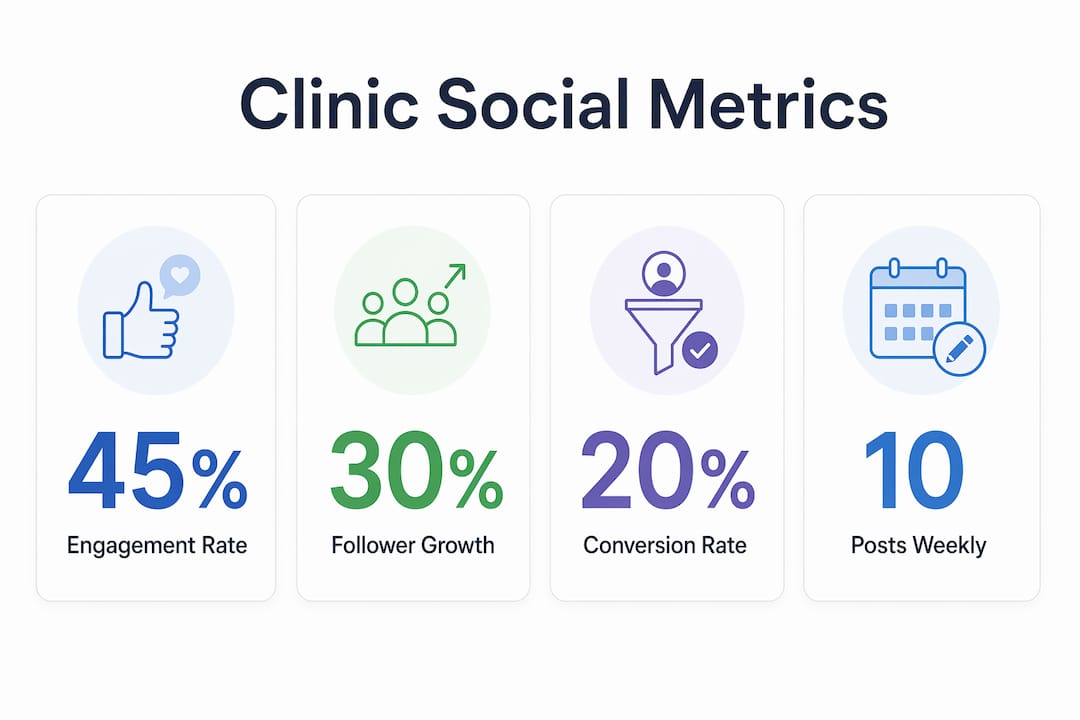
Focus on four metrics that directly connect to patient acquisition:
- Engagement rate: Likes, comments, shares, and saves divided by reach. A healthy engagement rate signals that content resonates with your audience.
- Reach and impressions: Reach tells you how many unique accounts saw your content. Impressions show total views, including repeat views from the same account.
- Follower growth rate: Steady growth indicates your content attracts new patients. Sudden spikes followed by drops often signal low-quality followers.
- Conversion to enquiry: Track how many profile visitors click through to your booking page or send a direct message. This is the metric that connects social media to revenue.
Set quarterly KPIs for each metric and review them against your business objectives. A clinic aiming to increase Botox bookings should track enquiry conversion from Instagram specifically, not just overall follower growth. The beauty business marketing checklist from Xolapp offers a practical framework for aligning social metrics with business goals, including GDPR-compliant data handling.
Annual compliance reviews are advised, particularly when introducing new treatments or campaigns. Build these reviews into your content calendar as fixed events, not reactive responses to regulatory changes.
Pro Tip: Schedule a quarterly content audit: review your top five and bottom five posts by engagement, identify the pattern, and adjust your content mix accordingly. Do the same for compliance, checking every live post against the current ASA CAP code.
Common compliance challenges in healthcare social media
Compliance is not a barrier to good social media marketing. It is the foundation that makes sustainable marketing possible.
Regulatory bodies and their rules
The GMC, ASA, CAP, and GDPR each govern different aspects of clinic social media. The GMC covers professional conduct and patient confidentiality. The ASA and CAP govern advertising standards, including what claims clinics can make and how they must label paid content. GDPR governs how patient data and images are collected, stored, and used. Advertising enforcement by the ASA and CAP is increasing, and clinics that fail to review marketing materials regularly face sanctions.
“Clinicians often mistakenly believe private social media messages are exempt from professional standards. The GMC treats all digital communication with patients as subject to the same conduct rules as in-person interactions. A boundary violation via direct message carries the same disciplinary weight as one that occurs in a clinic room.”
Compliance checklist for clinic social media
- Obtain written, specific, and withdrawable consent before posting any patient content
- Add disclaimers to all before-and-after images on organic posts
- Label all paid partnerships clearly and specifically, not just with “#ad” buried in a caption
- Never use before-and-after images in paid advertising on any platform
- Avoid absolute result claims, pressure language, or urgency tactics in any post
- Coordinate with a legal or compliance adviser before launching new campaigns
- Complete CPD in social media ethics and advertising standards at least once per year
Integrating compliance checks into routine content production, rather than treating them as one-off reviews, substantially reduces marketing risk. Make the checklist part of the production process, not an afterthought.
Key takeaways
A clinic’s social media strategy succeeds when compliance, content quality, and consistent measurement work together as a single system, not as separate tasks.
| Point | Details |
|---|---|
| Compliance is non-negotiable | GMC, ASA, CAP, and GDPR rules apply to every post, paid or organic. |
| Consent must be documented | Obtain explicit, withdrawable patient consent before posting any patient-related content. |
| Practitioner-led content converts | Educational videos from clinicians drive higher engagement and more patient enquiries. |
| Platform choice must match audience | Instagram suits visual content; TikTok reaches younger patients; Facebook supports local paid targeting. |
| Measure conversion, not just reach | Track enquiry conversion from social media to connect activity directly to bookings. |
Why compliance and creativity are not opposites
I have worked with enough clinic marketers to know that compliance anxiety is the single biggest reason clinics underinvest in social media. The fear of getting something wrong leads to either paralysis or bland, forgettable content that does nothing for patient acquisition. Both outcomes are avoidable.
The clinics that perform best on social media treat compliance as a creative constraint, not a ceiling. Knowing that you cannot make absolute result claims pushes you toward more honest, practitioner-led storytelling. Knowing that before-and-after imagery requires consent and disclaimers makes you more deliberate about the patient relationships you build. That deliberateness shows in the content, and patients notice it.
Theaestheticsroom approaches social media from exactly this position. The clinic’s CQC accreditation and ACE Group membership are not just credentials for the waiting room wall. They shape how every piece of content is produced and reviewed. The step-by-step marketing approach that underpins the clinic’s digital presence reflects the same standards that govern its clinical practice.
My practical advice: start with one platform, build a compliant content process, and measure conversion from day one. Do not wait until you have a large following to care about metrics. The clinics that grow fastest are the ones that learn fastest, and learning requires data from the very beginning.
— Vishul
Theaestheticsroom: where compliant social media meets real results
Theaestheticsroom is a CQC-accredited medical aesthetics clinic based in Knightsbridge, London, with locations on Harley Street and in Mayfair. The clinic’s approach to patient education and transparent communication makes it a natural reference point for any clinic marketer building a compliant social media presence.
The treatments at Theaestheticsroom, including Botox and dermal fillers, are the kind of high-quality, practitioner-led services that perform well on social media precisely because they are backed by clinical expertise and visible results. If you are looking to understand how a premium clinic translates treatment quality into patient-facing content, Theaestheticsroom’s booking portal and treatment pages offer a clear model. Book a consultation to see the standard in practice.
FAQ
What is a social media strategy for clinics?
A social media strategy for clinics is a structured plan covering content creation, platform selection, compliance checks, and performance measurement to attract patients and build trust online.
Do organic posts need to comply with ASA and CAP rules?
Yes. Both organic and paid posts must comply with ASA and CAP advertising standards. Most practitioners mistakenly believe organic content is exempt, but all clinic marketing content is subject to the same rules.
Can clinics use before-and-after images on social media?
Clinics can use before-and-after images in organic posts with explicit patient consent and clear disclaimers. Paid advertising on platforms including Meta prohibits before-and-after imagery for cosmetic treatments entirely.
How often should a clinic post on social media?
Instagram performs best with 4–5 posts per week including at least two Reels. TikTok benefits from 3–4 posts per week. Facebook is most effective when used for targeted paid campaigns alongside regular community posts.
What are the biggest compliance risks for clinics on social media?
The biggest risks are posting patient content without documented consent, making absolute result claims, using before-and-after images in paid ads, and failing to label influencer partnerships clearly. GMC investigations can also arise from contacting patients via personal social media messages.