


TL;DR:
- Injectable treatments such as Botox last typically three to six months, while hyaluronic acid fillers range from six to eighteen months in duration. The longevity depends on factors like treatment area, individual metabolism, product formulation, and technique; understanding these helps set realistic expectations. Maintaining results involves safe retreatment intervals, sun protection, avoiding smoking, proper hydration, and working with experienced practitioners to optimize longevity safely.
Understanding what is injectables longevity is one of the most searched yet most misunderstood topics in cosmetic aesthetics. Many people assume their Botox will last a year, or that a single filler treatment is a permanent fix. Neither is true. The reality is that injectable treatments lifespan varies significantly depending on the product used, where it is placed, and a host of individual factors. This guide cuts through the confusion and gives you clear, evidence-backed information so you can plan your treatments with realistic expectations.
Table of Contents
- Key takeaways
- Types of injectables: neurotoxins and dermal fillers
- How long do injectables last? Ranges and key factors
- Maintaining and extending your results safely
- Myths and misconceptions about injectable longevity
- My perspective on managing injectable expectations
- Restore and maintain your best results with Theaestheticsroom
- FAQ
Key takeaways
| Point | Details |
|---|---|
| Botox lasts 3 to 6 months | Effects begin within the first week and gradually wear off as muscle activity returns. |
| Filler duration varies by product | Hyaluronic acid fillers last 6 to 18 months; calcium hydroxylapatite and PLLA can last up to 2 years. |
| Treatment area affects longevity | High-mobility zones such as lips degrade filler faster than stable areas like cheeks. |
| Safe retreatment intervals matter | Botox should not be repeated more frequently than every 3 months for safety and effectiveness. |
| Lifestyle factors influence results | Sun exposure, smoking, and a fast metabolism all reduce how long injectables last. |
Types of injectables: neurotoxins and dermal fillers
Not all injectables work the same way, and understanding the difference is the first step to understanding their longevity. There are two main categories you need to know.
Neurotoxins (Botulinum toxin)
Products such as Botox and Dysport belong to this group. They work by temporarily blocking nerve signals to targeted facial muscles, which relaxes them and softens the appearance of dynamic wrinkles. Common treatment areas include the forehead, frown lines between the brows, and crow’s feet.
- How they work: Botulinum toxin interrupts the communication between nerve endings and muscle fibres
- Duration: Effects last approximately 3 to 6 months before muscle activity gradually resumes
- Onset: Visible changes typically begin within the first week after treatment
- Key characteristic: Results are entirely temporary by design
Dermal fillers
Fillers restore volume, smooth deep lines, and reshape facial contours. The most widely used are hyaluronic acid (HA) based products such as Juvéderm and Restylane. Other types include calcium hydroxylapatite (CaHA) and poly-L-lactic acid (PLLA), sometimes called biostimulatory fillers because they stimulate collagen production over time.
- Hyaluronic acid fillers: Temporary, dissolvable with hyaluronidase, and among the safest options available
- Calcium hydroxylapatite: Provides both immediate volume and longer-term collagen stimulation
- PLLA biostimulatory fillers: Effects build gradually and can last up to 2 years, making them a longer-term option
- Permanent fillers: Exist but carry significant safety risks and are rarely recommended by reputable practitioners
Understanding these distinctions makes it much easier to have a productive conversation with your injector about which product suits your goals and timeline.
How long do injectables last? Ranges and key factors
This is where most of the confusion sits. The longevity of injectables is not a single number; it is a range shaped by multiple variables. A useful way to think about it is to separate three distinct timelines: onset, peak effect, and wear-off.

For Botox, onset typically occurs within the first week. Peak effect is visible between two and four weeks post-treatment. Wear-off, which is when you would consider retreatment, generally falls at the 3 to 6 month mark.
For dermal fillers, the picture is more varied. The table below gives you a practical reference.
| Injectable type | Common areas | Average longevity |
|---|---|---|
| Botulinum toxin (Botox) | Forehead, frown lines, crow’s feet | 3 to 6 months |
| Hyaluronic acid fillers | Lips, nasolabial folds, cheeks | 6 to 18 months |
| Juvéderm Vollure XC | Nasolabial lines | Up to 18 months |
| Calcium hydroxylapatite | Cheeks, jawline | Up to 18 months |
| Poly-L-lactic acid (PLLA) | Temples, cheeks, jawline | Up to 2 years |
One important clinical insight: longevity is not just about whether the product is still physically present. Responder rates on clinical scales show a gradual decline over time. For example, hyaluronic acid filler efficacy in one prospective study sat at 99% at one month, 92% at six months, and 54% at twelve months. The product fades incrementally, not all at once.
Several factors shape where your results fall within these ranges.
Treatment area mechanics play a significant role. High-mobility areas such as the lips and around the mouth break down filler more quickly because the muscles there are in near-constant movement. Cheeks and temples, by contrast, are more stable and tend to hold volume longer.
Individual metabolism is another major variable. People with faster metabolic rates process hyaluronic acid and botulinum toxin more quickly. This is not something you can change, but it is something your injector can account for when planning your treatment.
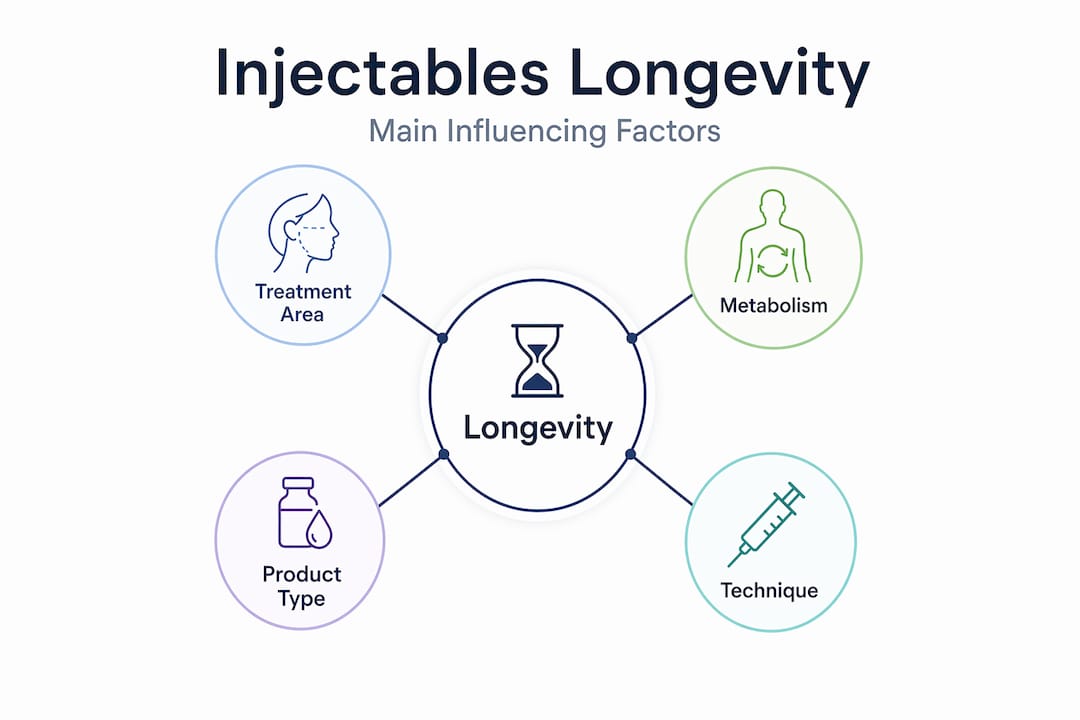
Product formulation and technique also matter enormously. Cross-linking density in hyaluronic acid gels affects how resistant the filler is to degradation. An experienced injector who places product at the correct depth and volume will achieve results that last closer to the upper end of the expected range.
Pro Tip: Ask your injector to explain which timeline phase you are in at each follow-up appointment. Knowing whether you are at peak effect or beginning the wear-off phase helps you schedule retreatments at the right time rather than waiting until results have fully gone.
Maintaining and extending your results safely
Protecting your investment in injectable treatments does not require dramatic lifestyle changes, but a few smart habits make a meaningful difference to injectable filler duration and overall results.
-
Respect safe retreatment intervals. For Botox, retreatment should not happen more frequently than once every 3 months. Going more often does not extend results; it raises safety risks and can lead to antibody development that reduces effectiveness over time.
-
Protect your skin from the sun. UV radiation accelerates the breakdown of hyaluronic acid in the skin and degrades collagen. Daily SPF use is one of the simplest and most effective ways to preserve filler results, particularly in the cheeks and under-eye areas.
-
Avoid smoking. Smoking restricts blood flow, impairs collagen synthesis, and significantly accelerates the visible breakdown of both fillers and skin quality in general. Clients who smoke consistently report shorter-lasting results.
-
Stay hydrated and maintain a stable weight. Hyaluronic acid is hydrophilic, meaning it binds water. Good hydration supports its performance. Significant weight fluctuations can also alter how fillers sit in the face.
-
Choose an experienced, medically trained injector. Technique and product selection are not interchangeable across practitioners. The depth of injection, the choice of product for the area, and the total volume placed all influence how long your results last. For guidance on safe injectable choices, working with a qualified medical professional is non-negotiable.
-
Plan a maintenance schedule rather than reacting. Waiting until results have completely faded means your skin has returned to its baseline. A staggered maintenance plan, particularly for fillers, allows for smaller top-up volumes that maintain results continuously and more cost-effectively.
Pro Tip: Many clients achieve the best long-term outcomes with a combination of neurotoxins and fillers on a maintenance plan. A practitioner who maps your treatment history can refine timing and volume with each appointment, progressively improving rather than simply maintaining.
Myths and misconceptions about injectable longevity
There is a lot of misinformation circulating about the effects of injectables over time. Knowing what is not true is just as useful as knowing what is.
-
“More injections mean longer-lasting results.” This is false. Adding excess product does not extend longevity; it increases the risk of complications such as migration, lumpiness, and vascular issues. Results are determined by product choice and individual biology, not volume alone.
-
“Injectables stop working after a while.” This rarely happens with Botox unless antibodies develop, which is uncommon at cosmetic doses. The perception that Botox “stops working” usually means the product has worn off and retreatment is needed.
-
“The product is still in my face, so it’s still working.” This is a crucial distinction. The physical presence of a filler and its visible clinical effect are not the same thing. Filler can still be present while its aesthetic contribution has faded significantly.
-
“Getting treatments more frequently will train my face to hold results longer.” For Botox, regular treatment over time can result in some reduction of muscle bulk, which may subtly extend results. However, this must happen within the safe 3-month minimum interval. There is no shortcut.
-
“Permanent fillers are a better investment.” Permanent products carry lifelong risks. If complications arise, they cannot be dissolved or corrected easily. For the overwhelming majority of clients, the safety profile of temporary products makes them the better long-term choice.
Understanding the benefits and safety of injectables helps you approach these treatments with clear expectations and reduces the risk of disappointment.
My perspective on managing injectable expectations
In my experience, the biggest source of dissatisfaction with injectable treatments is not the results themselves. It is the gap between what a client expected and what was realistically possible from the start.
I have seen clients genuinely frustrated that their lip filler lasted six months rather than twelve. When we looked at their lifestyle, it made complete sense: they were in a high-mobility area, they were regular smokers, and their skin hydration was poor. The product performed exactly as it should. The issue was the expectation.
What I find consistently is that clients who receive a full, honest consultation before their first treatment are the happiest at every stage. When you understand that a 3-month Botox cycle is not a failure of the product but its normal biology, you plan for it rather than resent it. When you know that filler longevity varies by area and individual metabolism, you stop comparing your results to a friend’s and start optimising for your own.
The most important shift I encourage is moving from “how long will this last?” to “how do I maintain the result I love?” That question leads to better treatment planning, more consistent outcomes, and a far more satisfying relationship with your aesthetic care.
— Vishul
Restore and maintain your best results with Theaestheticsroom
At Theaestheticsroom, we offer medically guided Botox treatments and a full range of dermal filler options at our Knightsbridge clinic, tailored to each client’s goals, anatomy, and lifestyle. Every treatment begins with a thorough consultation so you understand the realistic timeline, the product being used, and a clear maintenance plan designed for your needs.

Our practitioners are medically trained specialists who understand that longevity is not just about choosing the right product. It is about placing it with precision, timing retreatments correctly, and building a plan that works for your skin over months and years. Whether you are new to injectables or looking to refine an existing treatment programme, we are here to guide you with honesty and clinical expertise. Book your consultation today and discover what a personalised approach to injectable care can achieve for you.
FAQ
How long do injectables typically last?
Botox typically lasts 3 to 6 months, while hyaluronic acid fillers last between 6 and 18 months. Longer-lasting options such as PLLA biostimulatory fillers can maintain results for up to 2 years depending on the individual.
Why do injectables wear off?
Botulinum toxin wears off because the body gradually restores nerve signal transmission, allowing muscle activity to resume. Dermal fillers are broken down by natural enzymes and metabolic processes over time.
Can I make my injectables last longer?
Yes. Protecting skin from UV exposure, avoiding smoking, staying well hydrated, and following a professionally planned maintenance schedule all help maximise injectable filler duration. Working with an experienced injector also plays a significant role.
How often can I safely have Botox?
Botox should not be administered more frequently than once every 3 months. Shorter intervals do not improve results and may compromise safety and long-term effectiveness.
Does the treatment area affect how long fillers last?
Absolutely. High-mobility areas such as the lips break down filler more quickly than stable zones like the cheeks or temples. Your injector should factor this into product choice and the volume placed at each appointment.
Recommended
- Facial anatomy for injectables: safer treatment outcomes – The Aesthetics Room
- Why choose injectables? Benefits, safety and results – The Aesthetics Room
- Cosmetic injectables guide: Safe choices for London luxury – The Aesthetics Room
- Injectables in Aesthetics: Subtle Enhancement Explained – The Aesthetics Room