
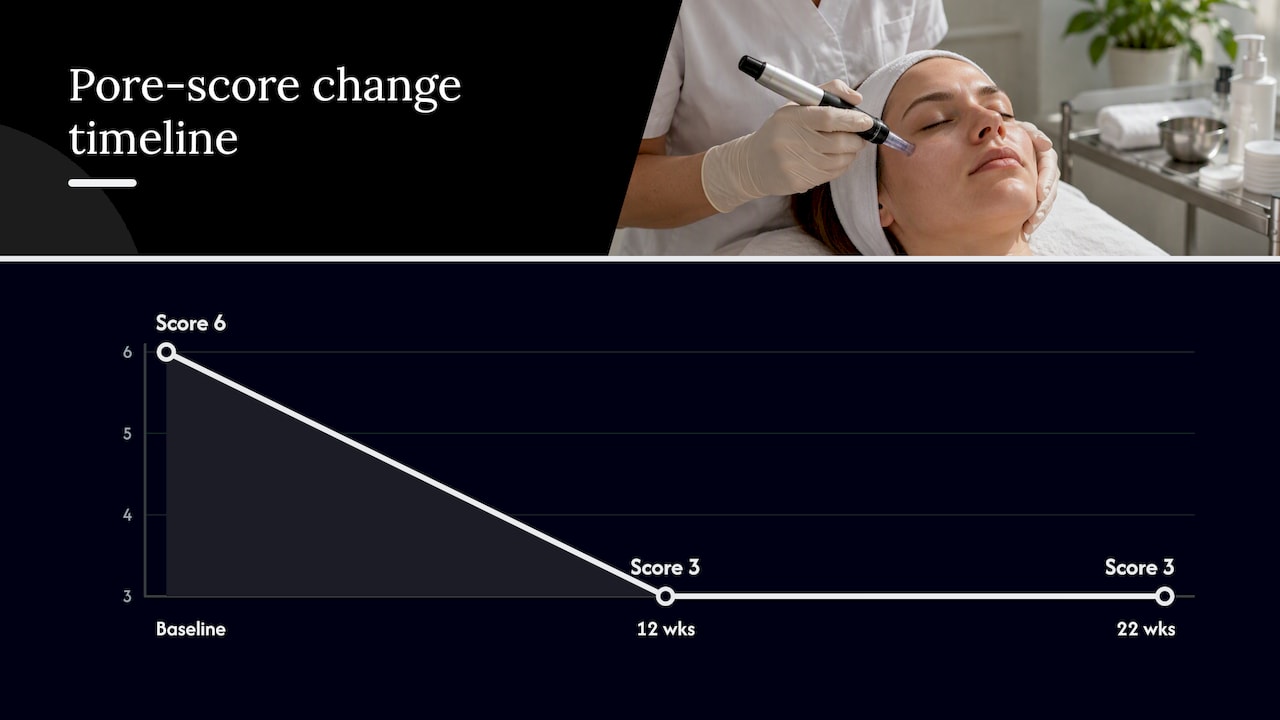
Microneedling can meaningfully reduce the visible size of enlarged pores for many patients, particularly when delivered as a course of treatments rather than a single session. It works by thickening and firming the skin around each pore rather than physically closing it, and a published case series found mean pore scores fell from 6 to 3 at 12 weeks and held at 22 weeks when combined with topical PDLLA. Results vary by skin type, technique and whether adjuncts are used, so a proper clinical screening before treatment matters as much as the device itself.
TL;DR:
- Microneedling combined with topical PDLLA has shown to halve pore size scores from 6 to 3 at 12 weeks and maintain improvements up to 22 weeks.
- Results depend heavily on needle depth, number of passes, device sterility, practitioner skill, and individual skin factors like oil production and sun damage.
- Proper candidate screening is essential, as conditions like active acne, recent isotretinoin use, or darker skin tones increase risks of complications or hyperpigmentation.
- A typical treatment course involves three sessions spaced three to four weeks apart, with immediate side effects like redness and swelling usually subsiding within a few days.
- Combining microneedling with adjuncts like PDLLA or exosomes may enhance results, but evidence remains early-stage and varies across patient skin types and conditions.
Table of Contents
- How microneedling works to improve pore appearance
- Research evidence: what studies and case series show about pore reduction
- Who is a suitable candidate and important contraindications
- Typical treatment course and what to expect during a session
- Adjuncts and combination approaches that boost pore reduction
- Risks, common side effects and aftercare to protect results
- Alternatives and complementary treatments for visible pores
- Clinical perspective: how The Aesthetics Room approaches microneedling for pore reduction
- Practitioner notes and real-world expectations
- Booking a consultation for microneedling at The Aesthetics Room
- Sources
- FAQ
How microneedling works to improve pore appearance
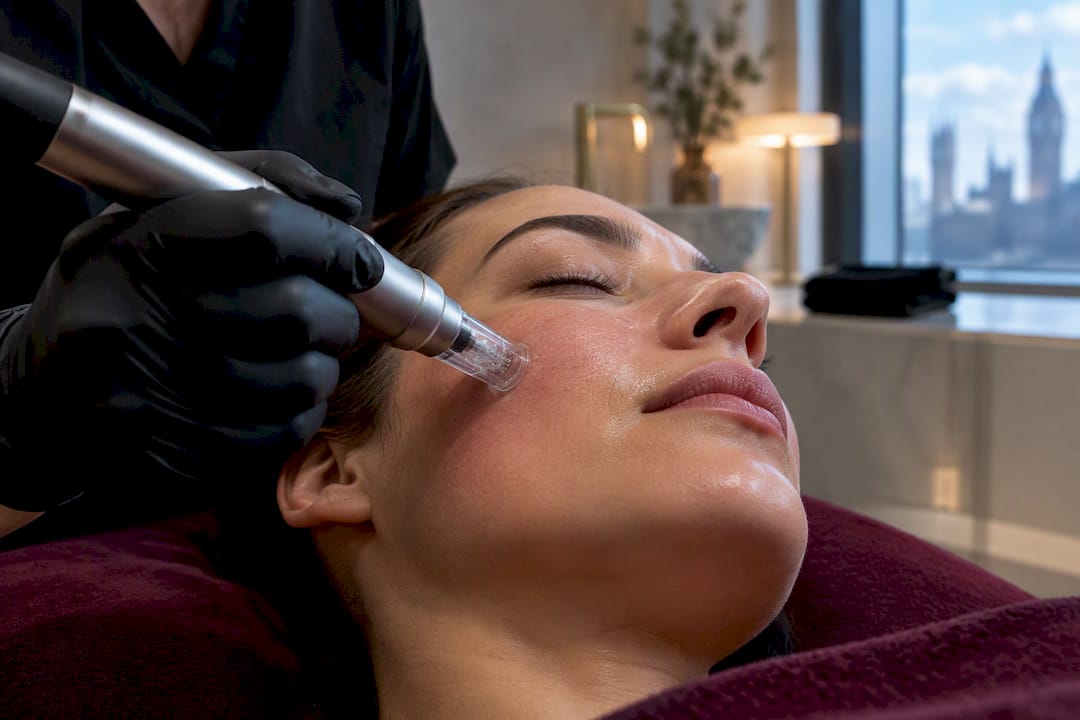
Microneedling uses a device with very fine needles to create controlled micro-injuries across the skin’s surface. The body responds to this trauma by triggering a wound-healing cascade: new collagen and elastin form in the dermis, blood flow increases, and epidermal turnover speeds up. Over several weeks, this process thickens and firms the skin, which is what actually changes how pores look.
It is worth being precise about the mechanism here. Microneedling does not shrink or seal a pore’s physical opening, which is fixed by the oil gland and follicle structure beneath it. What changes is the surrounding skin: as collagen builds and the dermis becomes denser, the skin around each pore tightens and the follicular opening appears smaller and shallower. Think of it as reducing the visual aperture of the pore rather than its true diameter, a distinction that matters when readers expect a permanent structural fix rather than a texture improvement.
Several technical variables influence how much benefit a patient sees:
- Needle depth: shallower passes (around 0.5 mm) target epidermal texture, while deeper passes (1.0 to 1.5 mm) reach the dermis and stimulate more collagen remodelling.
- Number of passes: more passes increase micro-injury and downtime, so practitioners balance intensity against tolerance and skin type.
- Device sterility: single-use, sterile needle cartridges and a properly maintained device reduce infection risk and support predictable healing.
- Practitioner technique: even pressure, consistent speed and correct angle across the treatment area affect how uniform the collagen response is.
Because pore appearance depends on skin thickness, oil production and sun damage as well as genetics, results differ from one patient to the next even when the device and protocol stay the same.
Research evidence: what studies and case series show about pore reduction
The clinical evidence for microneedling and enlarged pores is encouraging but still limited in scale. The most relevant data comes from a 15-patient case series combining three microneedling sessions with topical poly-d,l-lactic acid, known commercially as Juvelook.
A 15-patient case series found microneedling combined with topical PDLLA reduced mean pore size scores from 6 to 3 at 12 weeks, with improvements maintained through 22 weeks, according to research published in PMC. That represents a halving of the pore score on the scale used in the study, and the fact that it held steady ten weeks after the initial assessment suggests the benefit is not purely a short-lived swelling effect from the treatment itself.
A separate systematic review of microneedling combined with exosome therapy reported similar patterns: small studies and case series showed improvements in pore appearance and skin texture, but the authors were clear that sample sizes across the included studies were small and the evidence remains preliminary. A related three-patient case series using stem cell-derived exosomes reported sustained improvement at 12 and 22 weeks with no severe adverse events, though a cohort of three cannot establish how consistently that result would occur across a wider population.
Taken together, this evidence base is real but early-stage. It consists largely of case series rather than large randomised controlled trials, and the studies involved come from specific patient groups treated under specific protocols. That does not make the findings meaningless. It means the improvements reported (a pore score dropping by half, sustained response beyond three months, high patient satisfaction) are a reasonable basis for optimism rather than a guarantee. Larger controlled trials would help establish how reliably these results translate across skin types, ages and pore severities, and readers should treat individual outcomes as variable until that evidence exists.
Who is a suitable candidate and important contraindications
Not everyone is a good candidate for microneedling, and a proper clinical assessment before treatment is what separates a safe outcome from a risky one. Several conditions mean treatment should be delayed or avoided:
- Active inflammatory acne or skin infection, since needling can spread bacteria and worsen breakouts.
- Recent use of isotretinoin, which thins the skin and typically requires a waiting period before any needling treatment.
- Pregnancy, where most aesthetic clinics avoid microneedling as a precaution.
- A history of keloid or hypertrophic scarring, which raises the risk of an abnormal healing response.
- Uncontrolled skin conditions such as eczema or psoriasis in the treatment area.
Patients with darker skin tones need a more careful assessment, since skin that produces more melanin carries a higher risk of postinflammatory hyperpigmentation after any inflammatory skin procedure. This does not rule out treatment, but it does mean needle depth, pass count and aftercare need tailoring, and a rushed or poorly screened session raises the odds of a visible dark patch that can take months to fade.
This is why screening for contraindications before treatment is standard practice in clinical patient guidance, not an optional extra. A medically trained practitioner working from a clear protocol is far better placed to catch a contraindication, choose an appropriate depth and manage complications should they arise than a device used without that oversight.
Typical treatment course and what to expect during a session
Pore refinement with microneedling is a cumulative process, not a one-off fix. The protocol used in the PDLLA case series, and echoed across most clinics, involved three sessions spaced three to four weeks apart, giving the skin time to complete its collagen response between treatments before the next round of micro-injury.
Needle depth is chosen based on the goal and the patient’s skin. A superficial pass around 0.5 mm targets texture and fine pore refinement with minimal downtime, while deeper passes of 1.0 to 1.5 mm reach further into the dermis for more pronounced collagen stimulation, often used when acne scarring is also present. UK guidance on non-surgical procedures notes that depths under 1.5 mm sit within the non-surgical licensing framework, which is why depth selection is treated as a clinical decision rather than a cosmetic preference.
A typical session follows a consistent sequence:
- A consultation and skin assessment to confirm suitability and agree the treatment plan.
- Application of a topical anaesthetic to numb the area before needling begins.
- Multiple controlled passes of the microneedling device across the treatment zone.
- Application of a soothing or active topical agent immediately afterwards to support healing.
- Aftercare guidance covering sun protection and product use for the following days.
Immediately after treatment, the skin typically looks flushed and feels tight, similar to mild sunburn, and pinpoint bleeding can appear where the needles have penetrated. These effects are expected and usually settle within a day or two rather than signalling a problem.
Adjuncts and combination approaches that boost pore reduction
Microneedling alone produces a measurable improvement, but several clinics pair it with topical adjuncts to enhance and prolong the effect. The rationale is straightforward: the micro-channels created by needling allow topical agents to penetrate far deeper than they would on intact skin, so the two mechanisms complement rather than duplicate each other.
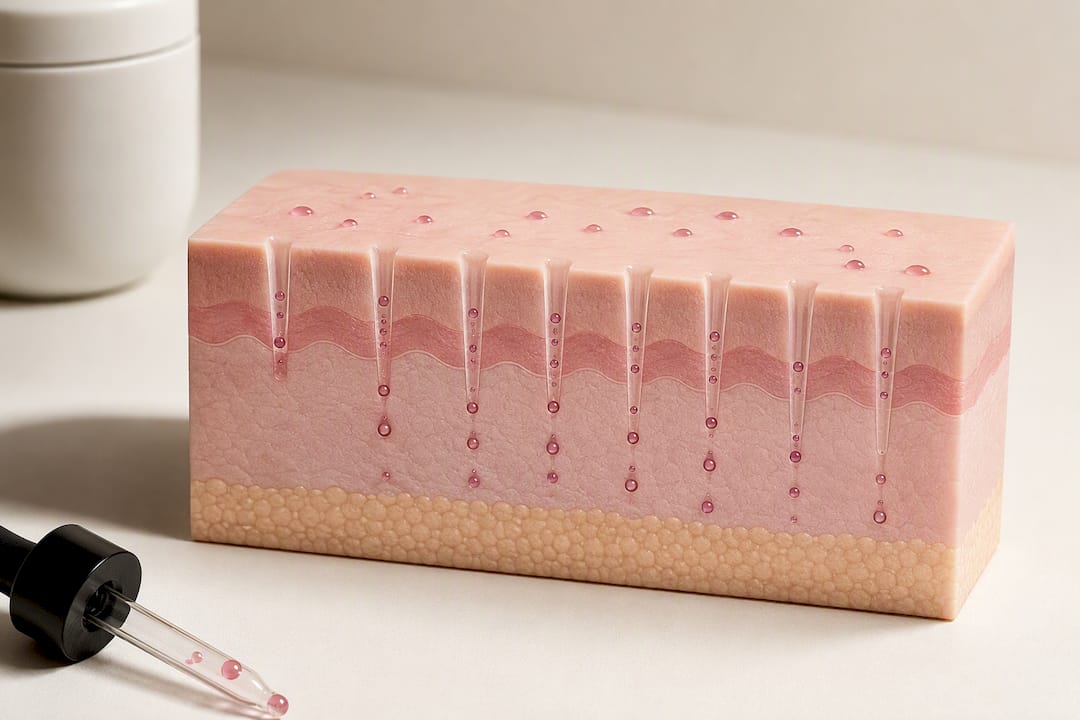
Topical PDLLA, applied immediately after needling in the Juvelook-style protocol, was the combination behind the 15-patient study showing pore scores fall from 6 to 3 by 12 weeks. PDLLA is thought to work alongside the skin’s own collagen response, which may explain why results in that series held through 22 weeks rather than fading quickly.
Exosome therapy is a newer addition to the combination toolkit. The systematic review of microneedling and exosomes found repeated signals of improved texture and pore appearance across the small studies reviewed, and a related case series reported sustained results at 22 weeks with no severe adverse events. Evidence here is still preliminary, so exosomes are best considered a promising adjunct rather than a proven upgrade.
Other clinics use skin boosters or polynucleotide treatments alongside microneedling for a similar penetration benefit; you can read more about how polynucleotides and skin boosters work together elsewhere on this site.
- PDLLA adds a collagen-stimulating topical layer applied directly after needling.
- Exosomes offer regenerative signalling molecules, with early but encouraging case-series data.
- Hyaluronic acid serums hydrate and plump the skin immediately post-treatment, supporting comfort during healing.
Combining treatments adds to the cost and time of a course, so it is worth discussing with a practitioner whether the extra investment suits your goals and budget.
Pro Tip: Ask your practitioner which adjunct, if any, suits your skin type before committing to a course, since not every combination is appropriate for every patient.
Risks, common side effects and aftercare to protect results
Microneedling is generally well tolerated, but short-term side effects are part of the normal healing process rather than a sign that something has gone wrong. Expect redness, tightness and mild swelling for 24 to 72 hours, along with transient pinpoint bleeding at the time of treatment, patterns confirmed in NHS patient guidance on microneedling.
Aftercare in the days following treatment has a direct bearing on how well results hold and how quickly the skin settles:
- Avoid direct sun exposure for at least a week and apply a high-factor sunscreen daily once the skin allows it.
- Use a gentle cleanser and simple moisturiser, avoiding anything that strips or irritates healing skin.
- Hold off on retinoids and strong acids such as glycolic or salicylic acid until the skin has fully recovered.
- Avoid make-up for the first 24 hours to reduce the chance of introducing bacteria into open micro-channels.
Complications are uncommon when treatment is performed in a sterile, medically supervised setting, but readers should know the warning signs. Persistent redness beyond a week, spreading warmth or pus-like discharge can indicate infection and warrant contacting the clinic promptly. Dark patches that appear or worsen in the weeks after treatment may signal postinflammatory hyperpigmentation, which is more common in deeper skin tones and typically needs specific management to fade. For a full recovery timeline, see our microneedling downtime plan.
Pro Tip: Keep your skin fragrance-free and makeup-free for the first day after treatment, since this single habit does more to reduce irritation than most aftercare products combined.
Alternatives and complementary treatments for visible pores
Microneedling is one of several routes to smaller-looking pores, and the right choice depends on your skin type, how much downtime you can tolerate and your budget.
- Fractional lasers (ablative or non-ablative) stimulate collagen through heat rather than mechanical injury, often with more visible short-term downtime and a higher price point, but can suit patients wanting a stronger single-session effect.
- Chemical peels exfoliate the surface layer to refine texture and reduce oiliness, working well for milder pore concerns with typically less downtime than deeper microneedling; see our comparison of microneedling versus chemical peels for a fuller breakdown.
- Skin boosters such as Profhilo hydrate and support skin quality from within, often used alongside microneedling rather than instead of it.
- Topical pore-minimising products can support results between clinical sessions, though their effects are generally more limited and short-lived than in-clinic treatments; background on topical pore-minimising ingredients gives a useful overview of what these products can and cannot do.
Some clinics combine radiofrequency with microneedling for patients wanting a stronger elasticity effect alongside pore refinement, since the added heat energy can enhance the collagen response beyond needling alone. Matching the method to your skin type and tolerance for downtime, rather than choosing on price alone, tends to produce the more satisfying outcome.
Clinical perspective: how The Aesthetics Room approaches microneedling for pore reduction
At The Aesthetics Room, microneedling for pore refinement begins with a full skin assessment to confirm suitability and rule out contraindications before any treatment is booked. The clinic is CQC registered and holds ACE Group membership, both markers of its commitment to patient safety and clinical standards in aesthetic practice.
Treatment plans are built around the individual: needle depth, pass count and any adjunct such as topical collagen stimulators are selected based on skin type, pore severity and the patient’s goals, rather than applied as a one-size protocol. Follow-up review after the course allows the practitioner to assess progress and adjust future sessions if needed. Patients preparing for treatment can review our pre-treatment checklist beforehand, and our downtime guide sets out what recovery looks like day by day.
Practitioner notes and real-world expectations
Patients asking about pores usually want a dramatic, permanent change, and the honest answer is that microneedling delivers a real but graded improvement built over a course of sessions. What varies most is not the treatment itself but the skin it is applied to: oiliness, sun damage and genetics all shape how visible the result will be. A personalised plan, built after a proper consultation, matters more than any single device setting.
— Vishul
Booking a consultation for microneedling at The Aesthetics Room
If enlarged pores are a persistent frustration, a consultation gives you a clear, medically grounded answer rather than another guess from a skincare aisle. Medically supervised microneedling can be offered with bespoke treatment plans, built around individual skin type, pore severity and adjunct options such as topical collagen stimulators.

A consultation includes a full skin assessment, a discussion of realistic outcomes based on your own skin, and a recommended course length and depth suited to your goals. Micro-needling is listed at £300 per session, and our practitioners will talk you through how many sessions your skin is likely to need before you commit. You can view the full price list for skin and aesthetic treatments or book a consultation directly to get a plan tailored to your pores rather than a generic protocol.
Sources
- The Efficacy of Combined Microneedling and Topical Poly-d,l-lactic Acid (Juvelook) Application for Facial Pore Reduction and Skin Texture Improvement – PMC
- Microneedling pre-treatment information for patients — Chelsea and Westminster Hospital NHS Foundation Trust
This article is general information, not a substitute for advice from a qualified doctor. Consult a qualified healthcare professional about your own circumstances before acting on anything here.
FAQ
Will microneedling help with big pores?
Yes, for many patients microneedling reduces the visible size of enlarged pores by thickening the surrounding skin rather than closing the pore itself. A 15-patient case series found pore scores dropped from 6 to 3 at 12 weeks when microneedling was combined with topical PDLLA, with results holding at 22 weeks.
What’s the best treatment for large pores?
There is no single best treatment, since fractional lasers, chemical peels, skin boosters and microneedling all work through different mechanisms and suit different skin types and downtime tolerances. Microneedling combined with a topical adjunct such as PDLLA has shown some of the more consistent results in small clinical studies, but a personalised assessment is the only reliable way to choose.
Does microneedling close your pores?
No, microneedling does not physically close a pore’s opening, which is determined by the follicle and oil gland structure beneath the skin. It works by thickening and firming the surrounding tissue through collagen stimulation, which makes the pore’s opening appear smaller rather than sealing it shut.
Why do my pores look so big after microneedling?
Pores often appear more noticeable in the first day or two after treatment because the skin is temporarily swollen and inflamed from the micro-injuries. This is a normal part of the healing response described in NHS aftercare guidance and typically settles within a few days as the redness and tightness fade, well before the longer-term collagen-driven improvement appears over the following weeks.