

TL;DR:
- Follow-up appointments after aesthetic treatments are mandatory clinical requirements that ensure safety and optimize results. They involve comprehensive assessments, documentation, and personalized care planned around each treatment’s biological timeline. Attending scheduled follow-ups significantly improves patient satisfaction, safety, and treatment outcomes.
Follow-up appointments are not optional extras after non-surgical aesthetic treatment. They are a clinical necessity that protects your safety, optimises your results, and ensures your care meets the standards set by the General Medical Council (GMC), the Royal College of Surgeons (RCS), and the Care Quality Commission (CQC). Research from PostCare indicates that 68% of first-time aesthetic clients who receive no post-treatment follow-up do not return to a clinic. Your immediate next step: confirm your follow-up is booked before you leave the clinic, and expect a structured assessment of your results, any concerns, and your personalised aftercare plan.
Table of Contents
- What actually happens at a follow-up appointment
- When should you expect your follow-up, and why does timing vary?
- What UK regulations require from your clinic
- How follow-ups reduce risk and improve your results
- Warning signs between appointments and what to do immediately
- Are follow-ups included, and how do virtual check-ins work?
- Questions to ask your clinic before you book
- Key takeaways
- Why Theaestheticsroom prioritises follow-up as part of every treatment
- Clinician-led follow-up at Theaestheticsroom, Knightsbridge
- Authoritative UK sources and further reading
What actually happens at a follow-up appointment
Most patients assume a follow-up is simply a quick glance and a reassuring nod. In practice, it is a structured clinical review covering several distinct elements.
A clinician will typically carry out:
- Visual assessment at rest and with movement (particularly relevant for Botox and anti-wrinkle injections)
- Comparative photography to document change against baseline images taken before treatment
- Symptom check covering swelling, bruising, asymmetry, tenderness, or unexpected reactions
- Palpation of treated areas where appropriate (common after dermal fillers and fat-dissolving injections)
- Aftercare review to confirm you have followed post-treatment instructions correctly
- Documentation update recording outcomes, any adjustments made, and the plan going forward
For Botox, the clinician assesses whether muscle relaxation is even and whether a top-up is warranted. For dermal fillers, they check integration, symmetry, and any nodule formation. After a chemical peel or laser treatment, the focus shifts to skin texture, pigmentation response, and barrier recovery. Fat-dissolving injections such as Aqualyx require assessment of localised swelling resolution and fat reduction progress.
Pro Tip: Bring a list of any symptoms you noticed in the days after treatment, however minor. Photographs taken at home under consistent lighting are also genuinely useful for your clinician to compare against clinic baseline images.

When should you expect your follow-up, and why does timing vary?
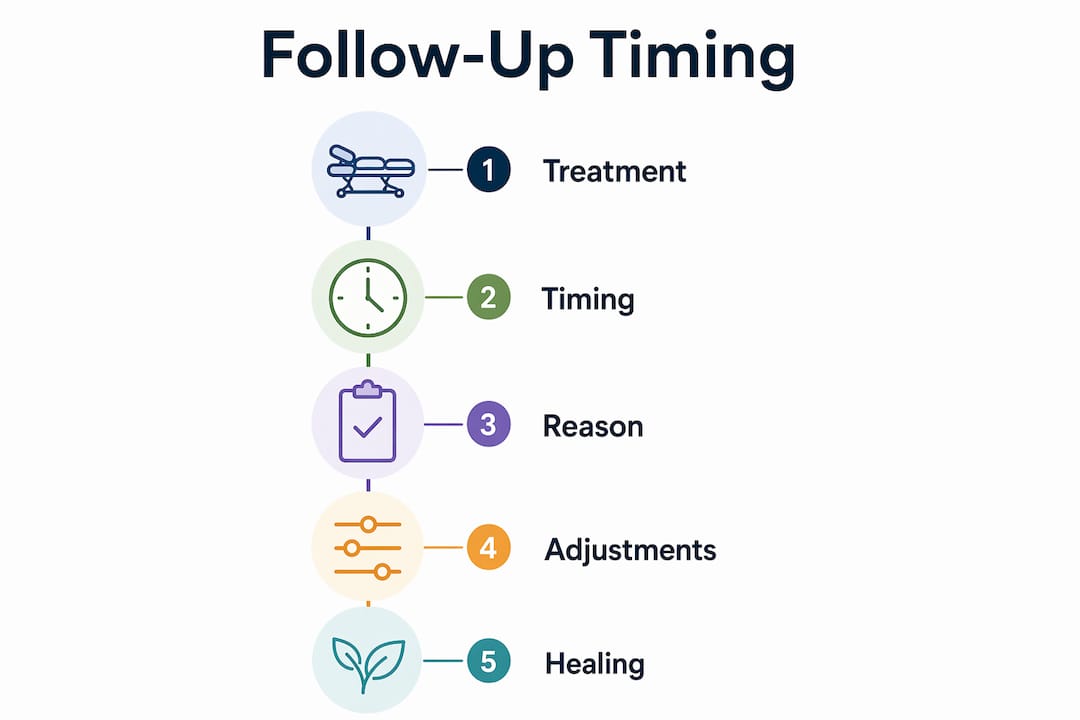
Timing is not arbitrary. It is calibrated to the biology of each treatment and to your individual healing response.
| Treatment | Typical first follow-up | Reason for timing |
|---|---|---|
| Botox / anti-wrinkle injections | 2 weeks post-treatment | Allows full neurotoxin effect to settle before assessing result |
| Dermal fillers (hyaluronic acid) | 2–4 weeks post-treatment | Swelling resolves; integration and symmetry can be accurately assessed |
| Chemical peels | 4–6 weeks post-treatment | Skin barrier recovery and pigmentation response need time to stabilise |
| Laser / energy-based treatments | 4–6 weeks post-treatment | Collagen remodelling is ongoing; premature assessment is unreliable |
| Fat-dissolving injections | 6 weeks post-treatment | Inflammatory response and fat cell breakdown require extended observation |
Several factors shift these windows. Product formulation matters: a longer-lasting hyaluronic acid filler with cross-linking may need a slightly later review than a softer, more superficial product. Injection depth, individual metabolism, immune response, and any medications that affect healing (anticoagulants, immunosuppressants) all change how quickly your body responds. Clinics that schedule the follow-up before you leave the treatment room report significantly higher attendance rates, which is why a well-run clinic will book yours on the day.
What UK regulations require from your clinic
Follow-up is not a courtesy. It is a professional obligation under UK guidance.
The RCS and GMC require clinicians to explain follow-up requirements at the outset of treatment, provide written discharge information, ensure continuity of care, and make arrangements for out-of-hours contact where complications may arise. Written aftercare information should be provided to you, and with your consent, relevant details may be shared with your GP.
The CQC’s inspection framework flags the absence of follow-up and outcome monitoring as a recurring marker of poor practice. A CQC-registered clinic is expected to have documented systems for monitoring patient outcomes and satisfaction.
Trust signals to look for before you book:
- CQC accreditation (verifiable on the CQC public register)
- Doctor-led or clinician-led treatments with named responsible practitioner
- Written aftercare policy provided at or before treatment
- Named contact for complications, including out-of-hours guidance
- Documented outcome monitoring and follow-up pathway
How follow-ups reduce risk and improve your results
The clinical case for follow-up goes well beyond reassurance. Individual responses to injectables vary considerably based on anatomy, muscle mass, metabolism, and prior treatment history. A clinician cannot predict at baseline exactly how your tissue will respond; the follow-up is where that evidence is gathered and used to refine your plan.
Structured aftercare is also strongly associated with retention. PostCare data shows clinics with structured aftercare retain 60–70% of first-time clients, compared with 30–35% for those without. That gap reflects not just commercial performance but patient experience: patients who feel monitored and supported report higher satisfaction and are more likely to leave positive reviews.
The follow-up is also where dose adjustments happen. Botox, for example, may need a small top-up in one area or a reduced dose next time based on how your muscles responded. Without that data point, every subsequent treatment starts from scratch rather than from an evidence base built around you.
Warning signs between appointments and what to do immediately
Most post-treatment experiences are straightforward. Some are not. Knowing which symptoms require urgent action could prevent a serious complication.
Seek immediate attention if you notice:
- Severe or worsening pain at the injection site, disproportionate to normal tenderness
- Spreading redness, warmth, or swelling that extends beyond the treated area
- Skin colour changes: white, blue, or mottled patches near an injection site (possible vascular occlusion)
- Visual disturbance, double vision, or sudden headache after facial injectables
- Signs of infection: pus, fever, or rapidly increasing swelling
- Difficulty swallowing or breathing after neck or jaw treatments
Vascular occlusion after dermal fillers is a time-critical emergency. Skin blanching or a dusky, mottled appearance near an injection site requires immediate contact with your clinic and, if unavailable, attendance at A&E. Minutes matter.
Your action sequence:
- Stop any active aftercare steps (massage, heat, pressure) immediately
- Photograph the area clearly in good lighting
- Contact your clinic directly using the emergency or out-of-hours number provided at treatment
- If you cannot reach the clinic and symptoms are severe, attend your nearest A&E or call 999
- Bring your treatment documentation, including the product name and batch number if available
For non-urgent concerns between appointments, your clinic’s treatment protocols should include a clear escalation pathway.
Are follow-ups included, and how do virtual check-ins work?
Charging models vary across clinics. The most common approaches are:
- Included within the treatment fee for a defined window (typically 2–6 weeks post-treatment)
- Complimentary for a first follow-up, with subsequent reviews charged if additional treatment is required
- Fee-for-service for any follow-up beyond the initial window, particularly where a top-up or new procedure is performed
Virtual follow-ups via video call or WhatsApp are increasingly used for routine check-ins. They work well for visual assessments where no palpation is needed, such as reviewing Botox symmetry or skin texture after a peel. They are not appropriate for red-flag symptoms, suspected infection, or any concern that requires physical examination. PostCare notes that WhatsApp messages achieve a higher open rate compared with email, making them an effective medium for timely check-ins.
Questions to ask your clinic about costs and logistics:
- Is the follow-up appointment included in my treatment fee?
- What is the cancellation or rescheduling policy if I cannot attend?
- Can I do a virtual follow-up, and what are the limits of that format?
- What happens if I need a top-up at my follow-up — is that charged separately?
Questions to ask your clinic before you book
Clarity at the consultation stage prevents confusion later. Before committing to treatment, ask:
- Who will conduct my follow-up appointment — the same clinician who treated me?
- When is the first follow-up scheduled, and is it included in the treatment cost?
- How do I contact the clinic outside of normal hours if I have a concern?
- Will photographs be taken and stored securely as part of my clinical record?
- What is your documented process if I experience a complication between appointments?
- Will I receive written aftercare instructions before I leave?
Record the answers in your phone notes or ask for them in writing as part of your consent documentation. If a clinic gives vague or dismissive answers to questions about out-of-hours contact or complication management, treat that as a significant warning sign. A well-run clinic welcomes these questions. For a broader overview of what to expect at each stage, the beauty enhancement guide from Onyx Wellness offers useful context on staged treatment planning.
Key takeaways
Follow-up appointments after non-surgical aesthetic treatment are a regulated clinical requirement under GMC and RCS guidance, not an optional add-on, and attending them directly improves your safety, results, and long-term care plan.
| Point | Details |
|---|---|
| Follow-up is a regulated duty | GMC and RCS require clinicians to explain, schedule, and document follow-up as part of safe care. |
| Timing is treatment-specific | Botox: 2 weeks; fillers: 2–4 weeks; peels and lasers: 4–6 weeks; fat-dissolving: 6 weeks. |
| Structured aftercare improves retention | Clinics with structured aftercare retain 60–70% of first-time clients versus 30–35% without follow-up. 68% of first-time clients who receive no follow-up never return to the clinic. |
| Know the urgent warning signs | Skin blanching, spreading redness, or visual disturbance after injectables requires immediate contact with your clinic or A&E. |
| Theaestheticsroom’s approach | CQC-accredited, doctor-led follow-up with documented aftercare and out-of-hours contact at its Knightsbridge clinic. |
Why Theaestheticsroom prioritises follow-up as part of every treatment
At Theaestheticsroom, follow-up is built into every treatment pathway, not offered as an afterthought. We are CQC-accredited and a member of the ACE Group, an organisation dedicated to patient safety in aesthetics. Every treatment is led by a qualified medical professional who takes clinical ownership of your outcome from consultation through to follow-up review.
Our documented aftercare policy means you leave every appointment knowing exactly who to contact, when your follow-up is scheduled, and what to do if a concern arises before then. We take comparative photographs as standard, record outcomes, and use that data to refine your personalised treatment plan over time. Patients frequently mention the quality of our post-treatment care in their reviews, and we consider that a direct reflection of the clinical standard we hold ourselves to. Ask us about our follow-up pathway at your consultation — we are confident in what we offer.
Clinician-led follow-up at Theaestheticsroom, Knightsbridge

Safe, lasting results from Botox or dermal fillers depend on what happens after the treatment as much as during it. At Theaestheticsroom’s Knightsbridge clinic, every patient receives a structured, clinician-led follow-up as part of their care pathway, backed by CQC accreditation and ACE Group membership. You will have a named clinician, written aftercare guidance, and a clear route to contact us between appointments. To book your treatment or confirm your follow-up, visit theaestheticsroom.co.uk or call the clinic directly to arrange an in-person or virtual consultation.
Authoritative UK sources and further reading
- RCS Professional Standards for Cosmetic Surgery — The primary document setting out clinician obligations for follow-up, discharge information, and continuity of care. Essential reading for understanding what your clinic is professionally required to provide.
- CQC Cosmetic Surgery Inspection Letter — Sets out the CQC’s expectations for outcome monitoring and follow-up; lack of follow-up is cited as a recurring inspection concern.
- CQC Surgical Procedures Guidance — Clarifies the regulatory scope of post-operative and follow-up care within CQC-registered providers.
- PostCare: What Is Aftercare? — Clinic-facing evidence on retention rates, virtual follow-up formats, and the operational case for structured aftercare.
- PostCare: Why Clinics Lose Clients by Ignoring Aftercare — Covers the 68% non-return statistic and the patient-experience rationale for proactive follow-up.
Prioritise clinics that are CQC-registered, doctor-led, and able to demonstrate a documented follow-up pathway. These sources give you the regulatory context to ask the right questions and make an informed choice.
This article provides general information about follow-up care after non-surgical aesthetic treatments. It is not a substitute for professional medical advice. Always confirm your specific aftercare and follow-up requirements with your treating clinician.