

Most dermal filler myths come from a handful of ideas: that fillers look fake, that they are permanent, that they hurt, and that they are only for older people. The facts are more reassuring, and more nuanced. Results can be subtle and proportionate, most hyaluronic acid fillers are temporary, discomfort is usually minor, and the biggest real risk is not the product but who injects it and where. Below we go through each myth, and give you the points that matter before you book.
Claims travel fast in aesthetics, and so does research on anti-ageing compounds, as Epitalon research updates show. Always check the date and the source behind what you read, including this article.
TL;DR
- Fillers do not have to look obvious: the JCCP says effects can be subtle or dramatic, but should always look natural and proportionate.
- Most fillers are temporary, typically 6 to 18 months, but some can linger longer than expected, so a slow, conservative approach makes sense.
- Discomfort is usually minor, and redness, swelling and bruising normally settle within days.
- Fillers are not only for older people, and they are not the same as Botox. They do different jobs.
- In the UK, anyone can legally inject some fillers, so check the practitioner’s training and the clinic’s registration before you book.
Table of Contents
- Myth 1: Fillers always look fake or overdone
- Myth 2: Fillers are permanent
- Myth 3: Fillers are very painful
- Myth 4: Fillers are only for older people
- Myth 5: Fillers and Botox are the same thing
- Myth 6: Fillers are “full of nasty chemicals”
- The myth that does the most harm: “it’s a simple, risk-free treatment”
- How to approach filler well
- Our perspective
- Book a consultation with us
- FAQ
- Sources
Myth 1: Fillers always look fake or overdone
The reality: a filler result reflects the plan, the product and the practitioner’s judgement, not the treatment itself.
The Joint Council for Cosmetic Practitioners (JCCP) states that filler effects can be subtle or dramatic, but should always look natural and proportionate. It also describes a range of techniques: superficial injections to soften fine lines, deeper placement to support folds, and larger volumes only where they are needed.
That range explains why some results look obvious. Too much product in one session, or a plan that treats one area without considering the rest of the face, can throw proportions off. Our approach is built around bespoke treatment plans, so we start with the face as a whole and with what you want to change, then build gradually.
If you want to see how a single area can look, our guide to cheek filler before and after results shows what subtle change looks like in practice.
Does filler make your smile look unnatural or restrict movement?
This is a common mix-up with Botox. Botox works by relaxing muscles. Fillers add volume beneath the skin. Women’s Health UK explains that fillers plump areas that have lost fullness, smooth deeper folds and improve facial contours. Well-placed filler should leave your expressions intact. If you are curious about the muscle-relaxing side, we cover it in our Botox myths guide.
Myth 2: Fillers are permanent
The reality: most fillers are designed to be temporary, but “temporary” is not a precise date.
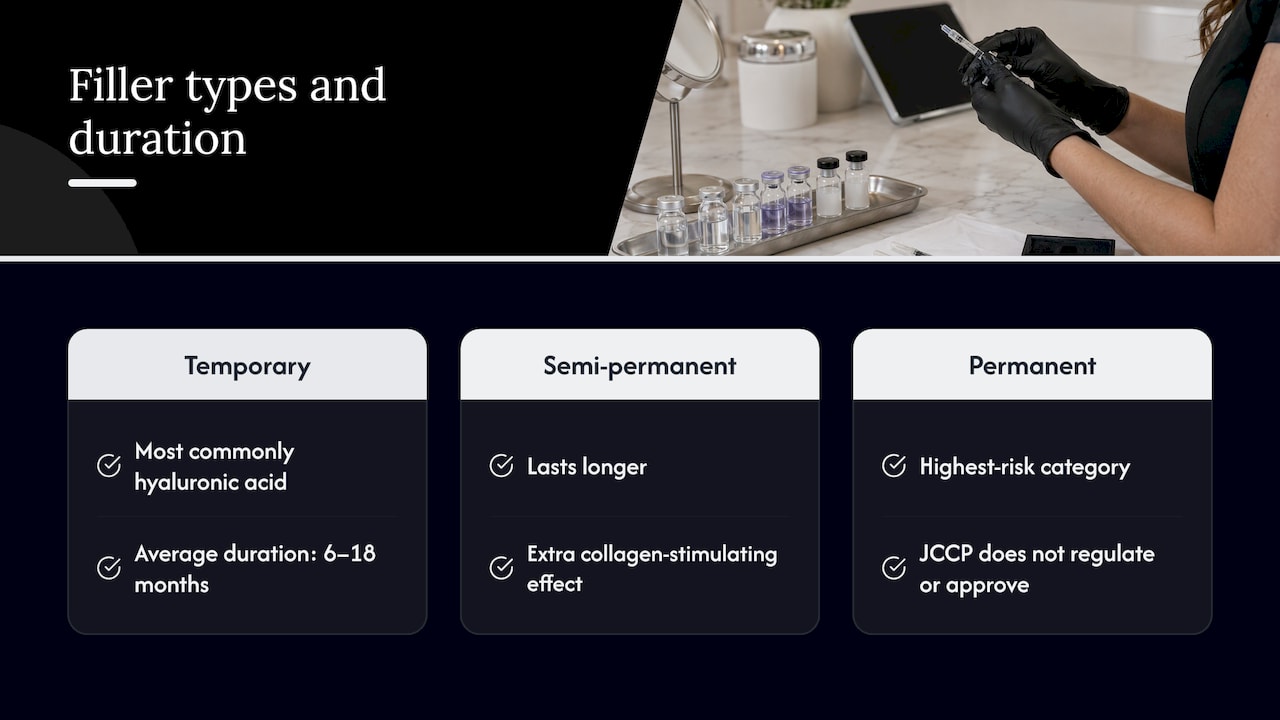
The JCCP says temporary fillers are most commonly made from hyaluronic acid, while semi-permanent varieties last longer because of an extra collagen-stimulating effect. The same sheet gives an average duration of 6 to 18 months, depending on the product and the area treated. It also notes that the JCCP does not regulate or approve the highest-risk category, permanent fillers. That is a reason to ask exactly what product is being used.
There is a more recent wrinkle. The Guardian reported that an Australian cosmetic doctor, Dr Gavin Chan, found through MRI scans that hyaluronic acid fillers can persist for many years rather than just 6 to 18 months. This is one clinician’s finding as reported in the press, not a settled rule. The practical lesson is simple: build results slowly, avoid topping up before you have judged the previous session, and keep a record of products and amounts.
We set out what the fade looks like in our filler breakdown timeline.
Do fillers stretch your skin or make it sag?
The sources we reviewed do not describe fillers stretching skin and causing sagging when they wear off. What they describe is the filler gradually being absorbed by the body. Facial ageing continues regardless, so the area simply returns to how it would have looked without treatment.
Do lips look smaller after filler dissolves?
Not smaller than your starting point from the filler itself. With natural wear-off, lips gradually return to their pre-filler appearance. The exception is deliberate dissolving with hyaluronidase. The Cleveland Clinic notes that this enzyme also breaks down the hyaluronic acid your lips naturally contain, so lips can look thinner for a time, and the body usually replaces what was lost. If you are unhappy with a result, speak to your practitioner about a measured plan rather than dissolving in a hurry.
Myth 3: Fillers are very painful
The reality: most people describe mild discomfort rather than pain.
DermNet states that hyaluronic acid filler treatment usually causes minor discomfort, minimised by local anaesthetic. Redness, bruising, swelling and tenderness may follow and usually improve within a few days. The British Cosmetic Dermatology Group adds itching, lumps or bumps at the injection site and asymmetry to the list of common temporary effects, most of which settle within days to weeks.
NHS patient information from Chelsea and Westminster Hospital for a filler used in a clinical service says that pain, bleeding, redness, swelling, itching and bruising are common and usually resolve within a few days to a week. So expect some visible effects, and plan around them.
Practical points for the first days:
- Avoid booking treatment right before a big event. The JCCP says the result is immediate, but several days may be needed for swelling and redness to settle.
- Read our advice on reducing post-treatment swelling safely.
- Check our guidance on alcohol after fillers and makeup after treatment.
- For delicate areas, see what to expect in our tear trough filler recovery guide.
Myth 4: Fillers are only for older people
The reality: people seek fillers at different ages and for different reasons, though the law sets a clear floor at 18 in England.
The British Association of Medical Aesthetic Nurses (BAMAN) says that aesthetic nursing is not solely for ageing patients: younger patients may want to enhance features or maintain healthy, youthful skin. The Guardian likewise reports that treatments were once a closely guarded secret of older women, and that younger women and men now use them to enhance their features.
But there is a legal limit. From 1 October 2021 it is a criminal offence in England to inject botulinum toxin or a filler for a cosmetic purpose into anyone under 18, even with a parent’s permission. It is also an offence to arrange or book such an appointment. GOV.UK guidance for businesses says they should ask for proof of age before booking and verify it again on the day.
Are fillers only for wrinkles?
No. Fillers are also used for facial contour, lips, under-eye hollows and jawline definition. In our clinic, for example, we offer lip filler, tear trough treatment and jaw definition and contouring. The Advertising Standards Authority adds a wording point: fillers can be described as temporarily reducing the appearance of fine lines and wrinkles, but not as curing skin or permanently eliminating lines. We keep to that standard.
Myth 5: Fillers and Botox are the same thing
The reality: they work differently and last differently.
According to Women’s Health UK, Botox temporarily relaxes the muscles responsible for expression lines and wears off in around three to four months. Fillers stay in the skin as a physical substance until the body absorbs them, so they take longer to fade. Many patients combine the two for balanced, natural-looking results.
| Anti-wrinkle injections (Botox) | Dermal fillers | |
|---|---|---|
| What they do | Relax muscles behind expression lines | Add volume, smooth folds, shape contours |
| Typical use | Forehead, frown and eye lines | Lips, cheeks, under-eyes, jawline |
| How long they last | Around 3 to 4 months | Typically 6 to 18 months, depending on product and area |
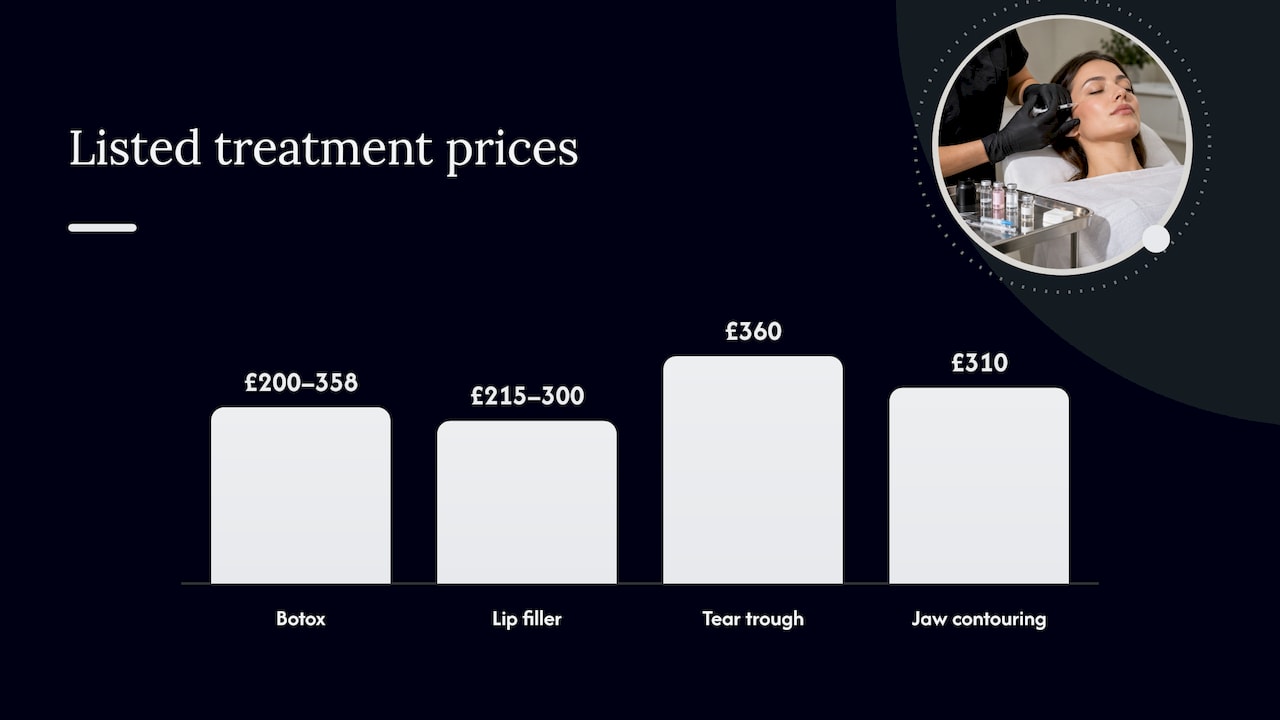
| Our listed price | £200 to £358 | Lip filler £215 to £300; tear trough £360; jaw definition and contouring £310 |
Prices are from our published price list. For maintenance timing on the muscle-relaxing side, see our Botox maintenance schedule.
Myth 6: Fillers are “full of nasty chemicals”
The reality: what matters is the product’s regulatory status, and in the UK that is not always straightforward.
The Medicines and Healthcare products Regulatory Agency (MHRA) states that dermal fillers making medical claims are regulated as medical devices and must be UKCA- or CE-marked. Aesthetic-only products are not medical devices, and products containing lidocaine are medicinal products under medicines regulation.
A UK Parliament research briefing goes further: fillers that do not make medical claims are not currently regulated as medical devices in England, can be supplied without a prescription, and there are no restrictions on who may administer them. So the useful question is not “is it chemical?” but “which product is this, is it CE or UKCA marked, and who is injecting it?”
The myth that does the most harm: “it’s a simple, risk-free treatment”
Hyaluronic acid fillers are widely used, and most effects are minor and short-lived. But a safe-use article has to be clear that serious complications exist, and that choosing the practitioner is the main safeguard.
The government’s Review of the Regulation of Cosmetic Interventions lists risks including infection, scarring, persistent inflammatory response, tissue loss, visual disturbance and blindness. The NHS leaflet places persistent swelling, infection or abscess, hardened skin, altered sensation and visual disturbance among rare early risks, fewer than 1 in 100 for the product it covers.
MHRA data for 2022 recorded 86 UK reports involving dermal fillers, including swelling and subcutaneous nodules, but the agency stresses that these voluntary reports cannot establish how common problems are.
What to do with this:
- Seek urgent medical help if after treatment you notice severe pain, skin that turns pale, dusky or mottled, or any change in vision. Contact your practitioner immediately and, if you cannot reach them, call 999 or go to A&E.
- Ask about training and registration. The Professional Standards Authority says that until stronger regulation arrives, practitioners without approved qualifications can legally perform procedures that put consumers at risk, including allergic reactions, severe infections and permanent scarring. It adds that the government has announced a licensing scheme for practitioners in England.
- Look at the setting. A registered clinic, a medical consultation first and clear aftercare are what you should expect.
How to approach filler well
- Start with a consultation, not a syringe. Talk through what bothers you, your medical history and what you do not want changed. Our guide to London aesthetic consultations explains what the appointment covers.
- Ask what product will be used and its brand, and where it is applied.
- Start modestly. A conservative first session lets you judge the result once swelling has settled.
- Plan the timing. Leave a buffer before events.
- Understand the cost properly. Our Harley Street dermal filler price guide breaks down what you pay for.
- Know your alternatives. If your concern is skin quality rather than volume, a skin booster may suit better; see polynucleotides versus skin boosters.
Our perspective
Most of the filler worries we hear in clinic are not really about the product. They are about the fear of losing control over how you look. That is a fair concern, and it is why we begin with a conversation.
We are CQC registered and members of the ACE Group, which is dedicated to patient safety. Every treatment is carried out by medically trained professionals, and we build a bespoke plan for each person, looking at the whole face rather than a single feature. Our aim is natural, personalised results that keep you looking like yourself.
Our advice is to treat the myths as questions. Ask who will treat you, what product they will use, what a sensible first step looks like and what the aftercare is. A good clinic welcomes those questions, and the answers set the foundation for a result you are happy with.
Vishul
Book a consultation with us
If you are considering filler, we offer in-person and virtual consultations from our London clinics in Knightsbridge, Harley Street and Mayfair. Our treatments include lip filler from £215 to £300, tear trough at £360, and jaw definition and contouring at £310. You can see everything on our full price list.

To talk through your goals with one of our practitioners, visit The Aesthetics Room and book your consultation.
FAQ
How long do dermal fillers last?
The JCCP gives an average of 6 to 18 months, depending on the product and the area treated. Some research and clinician reports suggest hyaluronic acid can persist longer in some people, so we recommend a gradual approach. See our filler breakdown timeline for more detail.
Is it legal for anyone to inject fillers in the UK?
In England, some fillers that do not make medical claims are not regulated as medical devices, and there is no restriction on who may administer them. That is why checking training, registration and the product used matters. The government has announced plans for a practitioner licensing scheme in England.
Do fillers hurt?
Most people report minor discomfort, which local anaesthetic helps to reduce. Redness, swelling, bruising and tenderness are common afterwards and usually settle within days.
Can I have fillers at 17?
No. In England it has been a criminal offence since 1 October 2021 to administer a cosmetic filler to anyone under 18, and also to book the appointment for them. Proof of age is required.
Sources
- JCCP Information Sheet 4: Dermal Fillers
- The Guardian: tweakments and long-term effects
- Women’s Health UK: Botox vs fillers
- Cleveland Clinic: Dissolving lip filler
- DermNet: Hyaluronic acid therapy, fillers
- British Cosmetic Dermatology Group: Dermal fillers
- Chelsea and Westminster Hospital: patient leaflet
- BAMAN: Public information
- GOV.UK: under 18s guidance for enforcement officers
- GOV.UK: under 18s guidance for businesses
- ASA: treatments using fillers
- MHRA FOI 22/901
- UK Parliament research briefing on non-surgical cosmetic procedures
- Review of the Regulation of Cosmetic Interventions
- MHRA 2022 adverse incident data
- Professional Standards Authority: non-surgical cosmetic procedures