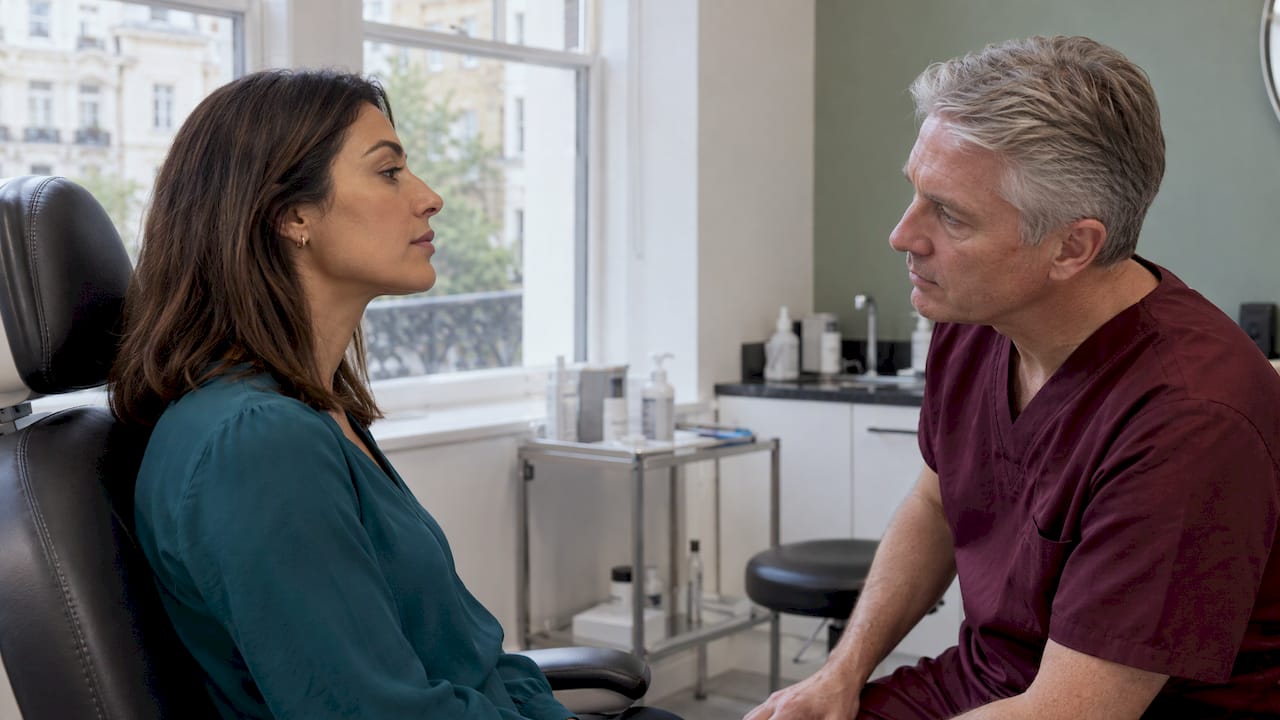


Tear trough filler can soften the hollow shadow under a man’s eyes, but only when the shadow comes from lost volume and the plan respects male facial structure. The aim is a rested face, never a changed one. At The Aesthetics Room, tear trough treatment is £360, and it is carried out by medically trained professionals at a CQC-registered clinic with locations in Knightsbridge, Harley Street and Mayfair.
TL;DR
- Under eye filler for men is a hyaluronic acid gel placed in the hollow between lower lid and cheek. It suits a true hollow, not pigment, crepey skin or puffy eye bags.
- Male cheeks are flatter and less prominent, so a good plan adds support without feminising the face.
- UK prices for a tear trough syringe run from about £350 to £850 or more. Ours is £360.
- Expect swelling for several days, bruising for one to two weeks and a settled result at two to four weeks. HA around the eyes tends to last over a year.
- The practitioner matters more here than almost anywhere else on the face. Check registration and ask for a consultation first.
Table of Contents
- What tear trough filler does for men
- Why male anatomy changes the plan
- Are you a good candidate?
- What happens during treatment
- Recovery: swelling, bruising and when it settles
- How long results last
- Risks and safe use
- What it costs in the UK
- Choosing a safe clinic
- Our perspective
- Book a consultation
- FAQ
- Sources
What tear trough filler does for men
The tear trough is the groove running from the inner corner of the eye diagonally down towards the cheek. With age, or in men who are naturally lean or have deep-set eyes, volume drops in this area and the groove casts a shadow. That shadow is what makes you look tired when you are not.
The treatment places hyaluronic acid (HA), a gel that occurs naturally in the skin and holds water, into the hollow. According to Dermatology UK’s 2026 guide, it works for a true hollow, meaning a shadow cast by a groove, where the lower-lid skin is in good condition and there are no significant eye bags. It does not lighten pigment, smooth crepey lines or fix puffiness caused by herniated fat.
That distinction decides whether you are a good candidate, so it is worth knowing which of these you have:
| What you see | What it usually is | Does filler help? |
|---|---|---|
| A groove with a shadow beneath it | Volume loss in the tear trough | Yes, this is what it is for |
| Brownish or bluish tint to the skin | Pigment or thin, translucent skin | Not on its own |
| Fine crinkles on thin skin | Skin texture change | No, other skin treatments suit this better |
| A bulge above the groove | Fat prolapse or fluid | Usually not, and it can look worse |
A short consultation sorts these out. Our under eye filler guide walks through the candidacy step in more detail.
Why male anatomy changes the plan
Most under eye filler content is written around women’s faces. Men need a different brief.
A 2022 study on midface treatment in men notes that the male cheek is less prominent, the width across the cheekbones is roughly equal to the width across the jaw, and the curve from lower lid to cheek is flatter. Its authors stress avoiding over-projection and excessive cheek height or fullness, which can feminise the face.
In practice this means:
- Support, not lift. The goal is to soften the transition from lid to cheek, not build a rounded cheek apex.
- Smaller amounts. Men often need less product, placed precisely.
- A conversation about your own proportions. The same study describes counselling on facial proportions as a way to set realistic expectations.
If you want the cheek area assessed too, see what cheek filler before and after results can look like. For men, subtle is the point.
Are you a good candidate?
Clinicians look at skin quality and the structure around the eye before they look at the hollow itself. A 2025 review in Aesthetic Surgery Journal Open Forum describes ideal candidates as having mild-to-moderate bags, thick, taut skin and minimal laxity. Pronounced bags, fat prolapse, thin skin or significant laxity count as relative contraindications, which means filler may be a poor fit.
A 2020 peer-reviewed protocol sets out how a careful assessment goes:
- You are examined semi-upright, not lying flat, so gravity shows the true shape.
- The clinician checks for fluid retention, because HA attracts water and can worsen already sluggish drainage.
- The depth of the hollow is marked while you look upwards.
- Lower-lid laxity is graded with a snap-back test, where the lid is gently pulled down and released.
If swelling from fluid is found, the plan changes: less product per session, more sessions, or no filler at all. A 2023 review adds that a prominent roll of muscle along the lower lid, very translucent skin or severe fat bulging make filler unlikely to succeed, and surgery may suit better. Hearing that honestly at a consultation is the right outcome, not a failure of the appointment.
If you are unsure which group you fall into, a consultation answers it. We offer virtual and in-person consultations, and our guide to London aesthetic consultations explains what to expect.
What happens during treatment
Treatment is short and done in clinic. The technique details below come from published clinical guidance and describe how the procedure is generally performed.
- Position. The 2023 review recommends sitting upright with your eyes open and fixed on a target, which stops the eye rolling upwards and distorting the area.
- Placement. Filler goes deep, close to the bone of the orbital rim. EyeWiki, from the American Academy of Ophthalmology, describes small retrograde amounts, avoiding the blood vessels at the inner corner and the thin lid itself.
- Product. Low-viscosity HA products are best around the eyes, according to the same source, and HA can be dissolved with the enzyme hyaluronidase if needed.
- Volume. The 2025 review recommends a maximum of 0.5 mL per eye, and a systematic review it cites found an average of 0.47 mL per side. For shallower hollows, a 2020 technique article says 0.2 to 0.3 mL per side can be enough.
- Approach. Under-correcting first is the consensus. The 2023 review puts it plainly: it is much better to undercorrect than overcorrect, with an optional top-up weeks later.
The 2025 review also advises treating the midface first where it is needed, then the hollow directly. That sequence is why a tear trough consultation sometimes ends with a plan for the cheek as well.
On comfort, you will feel pressure and some tenderness. Everyone’s tolerance differs, so raise it at the consultation and we will talk through what suits you.
Recovery: swelling, bruising and when it settles
The under-eye skin is thin and bruises easily. Save Face’s safety guide describes mild swelling for several days, bruising that can last one to two weeks, and a full settling in two to four weeks. It also advises avoiding strenuous exercise, alcohol, excessive heat and pressure on the area for 24 to 48 hours, and sleeping with your head raised.
A practical timeline:
| Period | What to expect |
|---|---|
| First 48 hours | Tenderness, some puffiness. Skip the gym, sauna and alcohol. |
| Days 3 to 7 | Swelling eases. Any bruise changes colour. |
| Weeks 1 to 2 | Bruising fades. Concealer is fine once the skin is intact and settled. |
| Weeks 2 to 4 | Filler settles. This is when the true result shows. |
The area can look worse before it looks better, so judge the result at the four-week mark, not on day two. For more detail, our pages on tear trough filler recovery, the filler bruising timeline and alcohol after fillers cover the days in order. If you have a work event or a photo shoot, book at least a month ahead.
How long results last
Eyewiki reports that HA filler around the eyes tends to last longer than one year on average, which is longer than in more mobile areas such as the lips. Individual results vary with metabolism, the product used and how much was placed. Our guides to the filler breakdown timeline and how to maintain filler results explain how it fades and what helps it last.
Realistic expectations matter here. You should expect a smoother lid-to-cheek transition and less shadow, not the removal of every sign of age. If you want a subtler, step-by-step approach, our natural looking filler tips show why gradual enhancement works well.
Risks and safe use
Tear trough filler is generally well tolerated in skilled hands, and it is worth knowing what to watch for so you can act early.
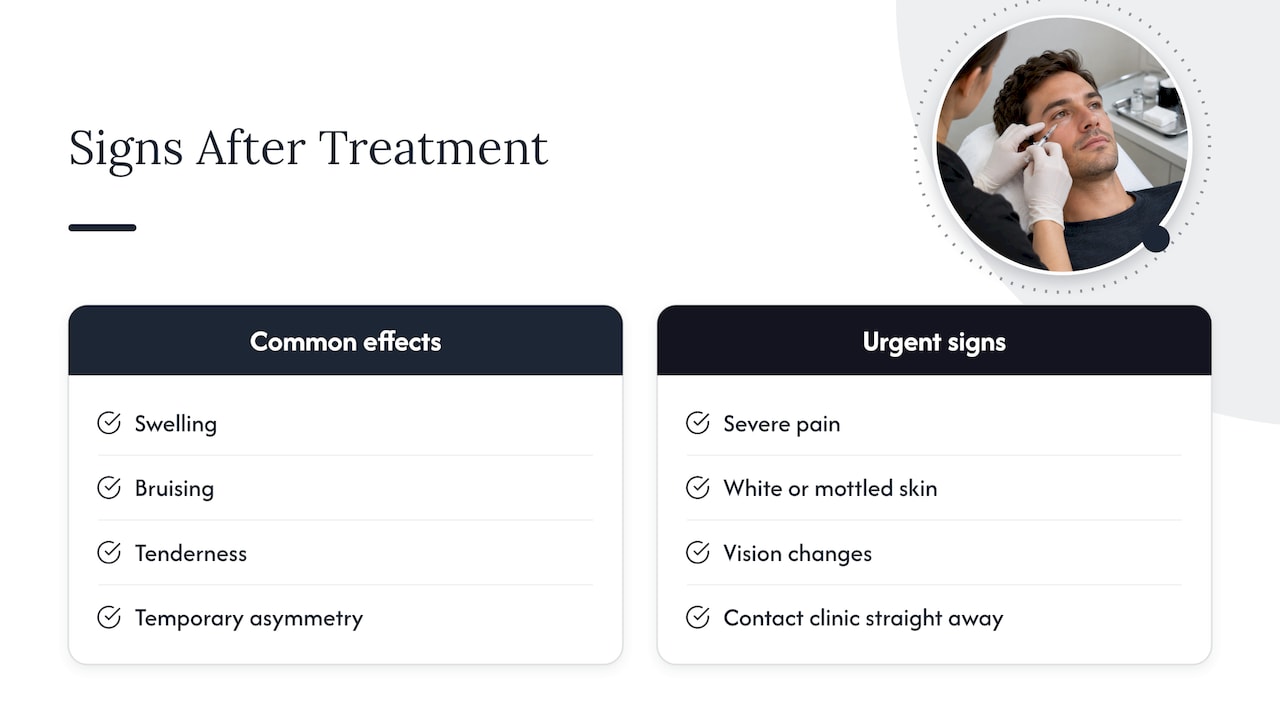
Common and short-lived: swelling, bruising, tenderness and temporary asymmetry. Dermatology UK lists these, along with puffiness that persists in the area, lumps and a bluish tint called the Tyndall effect.
The Tyndall effect. Professional British guidance on the Tyndall effect says it is more likely where skin is thin, as in the tear trough. Prevention rests on correct depth, at the bone or at least beneath the muscle, and very small amounts.
Rare but serious: vascular occlusion. This is when filler blocks or enters a blood vessel. Near the eye it can, in very rare cases, be linked to vision loss and is a medical emergency. The 2025 review stresses that knowing the course of the arteries around the eye is essential. Severe pain, a white or mottled patch of skin, or any change in vision after treatment means you contact your clinic straight away, and if you cannot reach them, go to A&E.
Who should hold off. Tell your practitioner about any eye condition, previous eye surgery, swelling or fluid retention in the face, bleeding disorders or blood thinners, and recent illness or infection. These change the plan or the timing.
If a result is not right, HA can be dissolved with hyaluronidase. That reversibility is one reason HA is the standard choice near the eyes, and why permanent fillers are not recommended in this area.
What it costs in the UK
Dermatology UK’s 2026 guide puts a tear trough syringe at roughly £350 to £850 or more in the UK. A true tear trough often needs one syringe for both eyes, and the treatment is not available on the NHS.
At The Aesthetics Room, tear trough treatment is £360 on our published price list. That sits at the lower end of the typical range for a Knightsbridge, Harley Street or Mayfair clinic with medical practitioners.
The same guide warns that unusually cheap deals and filler parties are not worth the saving, since a poor result near the eye can affect vision and correcting it often costs more than doing it properly once. Price should be the last thing you compare, after the practitioner’s training and the clinic’s registration.
Choosing a safe clinic
The UK does not tightly regulate who can inject dermal filler. The government’s consultation on licensing non-surgical cosmetic procedures explains that two voluntary registers, run by the Joint Council for Cosmetic Practitioners and Save Face, hold accreditation from the Professional Standards Authority. Medical injectors should also hold current GMC, GDC or NMC registration, and clinics in England carrying out certain procedures should be registered with the Care Quality Commission (CQC), the health regulator.
Before you book, check:
- The practitioner’s professional registration and training in tear trough work specifically.
- That the clinic is CQC-registered. The Aesthetics Room is, and is a member of the ACE Group, which is dedicated to patient safety.
- That you receive a proper consultation and assessment first, not a same-day upsell.
- That the plan allows for a top-up rather than overfilling in one go.
Our perspective
Men come to us saying the same thing: they look tired, and they are not. The right answer is rarely more product. It is a careful look at whether the shadow is a true hollow, and then a modest, precise treatment that leaves the face looking like his own.
We treat the face as a whole. For many men, a little support under the eye sits alongside a conversation about the cheek, the skin and general wellbeing, which is why our protocols are medically led and our treatment plans bespoke. Everything is performed by medically trained professionals, in a CQC-registered clinic, because the tear trough is not an area for shortcuts.
Subtle is the standard we hold. If you leave and a colleague says you look well rested, but cannot say why, the treatment has done its job.
Vishul
Book a consultation
If you are considering under eye filler, the first step is an assessment of whether your hollow suits treatment and how much, if any, is needed. We offer virtual and in-person consultations, and tear trough treatment is £360 at our Knightsbridge, Harley Street and Mayfair locations. See the full price list or book through theaestheticsroom.co.uk.

Before your appointment, our preparation steps for under eye filler cover what to avoid in the days beforehand.
FAQ
Is under eye filler for men different from the treatment for women?
The product and the area are the same, but the plan differs. Male cheeks are flatter and less prominent, so the aim is to soften the hollow without adding cheek projection that feminises the face. Smaller amounts, placed with restraint, are the usual approach.
Does tear trough filler hurt?
Most people describe pressure and tenderness rather than sharp pain, and the area can feel sore afterwards. Tolerance varies, so discuss comfort at your consultation. Bruising and mild swelling are common in the following days.
How long does it take to settle?
Swelling usually eases within several days and bruising can last one to two weeks. Save Face says the final result shows at two to four weeks, so judge it then.
Can it be reversed?
Yes. HA filler can be dissolved with hyaluronidase, according to EyeWiki. That is one reason HA is used near the eyes, and why it is chosen over permanent products.
How much does it cost in London?
UK prices run from about £350 to £850 or more per syringe. Tear trough treatment at The Aesthetics Room is £360, as listed on our price list.
Sources
- Tear Trough Fillers UK (2026): Cost, Risks & Who They Suit
- Midface Rejuvenation Using Juvederm Fillers in Male Patients
- Optimizing Infraorbital Hollows Treatment With Hyaluronic Acid
- Recommendations for the treatment of tear trough deformity
- Infraorbital Hollow Rejuvenation: Considerations
- Periocular rejuvenation using hyaluronic acid fillers
- Eyelid Filler Injection – EyeWiki
- Management of Tyndall Effect
- Tear Trough Fillers: Risks, Suitability & What to Ask
- The licensing of non-surgical cosmetic procedures in England: consultation document