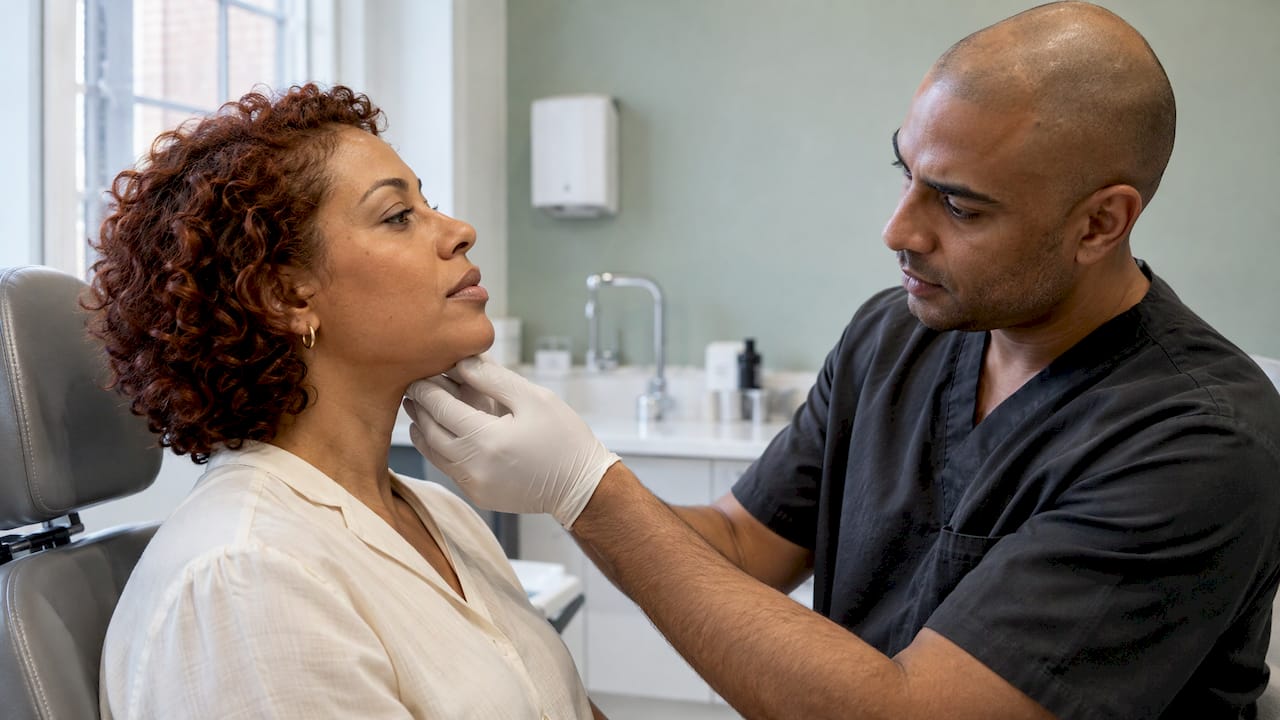
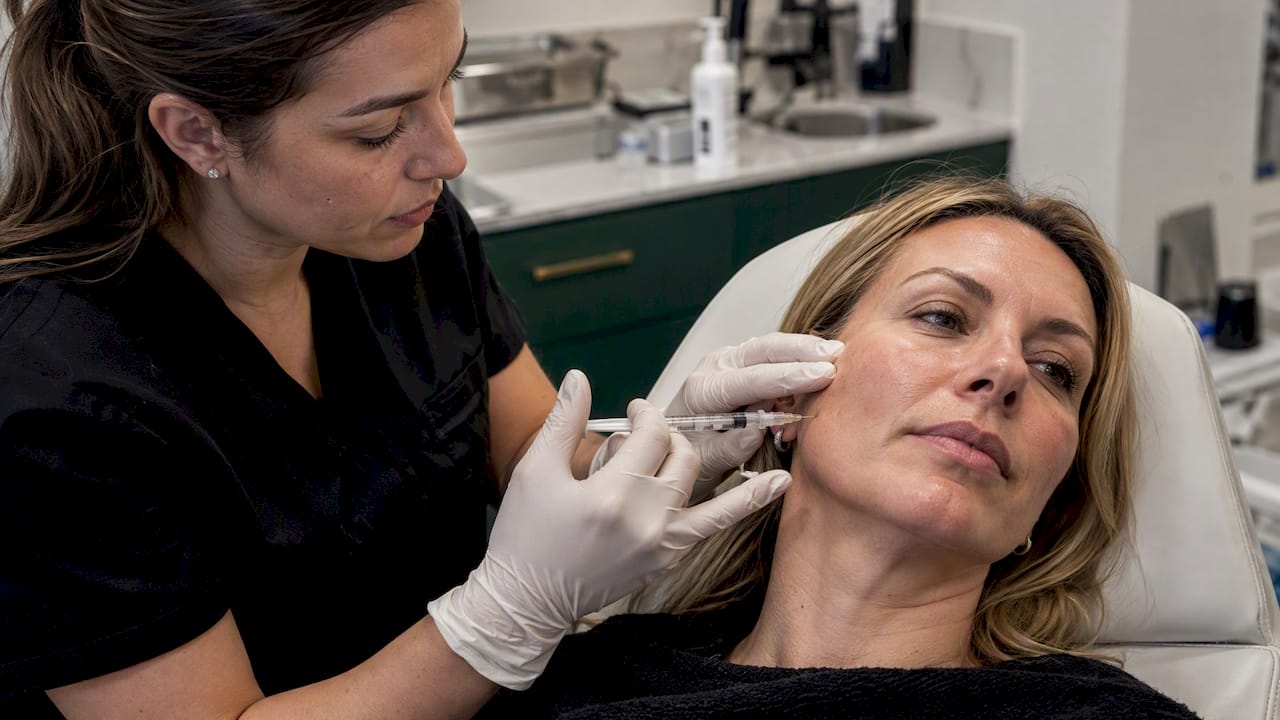

The standard Profhilo course is two sessions about 30 days apart. After that, most people return for a single maintenance session roughly every four to six months, though some need a third session in the first course and some stretch the gap further. The right rhythm for you depends on your skin, your age and the result you want, and a practitioner should set it after assessing your face.
Below we explain the initial course, how maintenance works, what shifts the timing, and what to ask at your consultation. At The Aesthetics Room, Profhilo is priced at £350 per session, as published on our price list.
TL;DR
- The usual starting protocol is two Profhilo sessions, around four weeks (30 days) apart.
- Mature or sun-damaged skin may benefit from a third session a month after the second.
- Results typically last up to six months, so maintenance is usually one top-up every four to six months.
- Booking sooner than four weeks between the first two sessions, or topping up too often, does not give better results and is not advised.
- Your practitioner should personalise the schedule after a face-to-face or virtual consultation.
Table of Contents
- The initial Profhilo course: two sessions
- How long results last and what that means for timing
- Profhilo maintenance: how often to top up
- What changes how often you need Profhilo
- Profhilo alongside other treatments
- Signs it is time to book a top-up
- Who should not have Profhilo, or should wait
- Our perspective on Profhilo scheduling
- Book your Profhilo plan
- Questions to ask at your consultation
- FAQ
- Sources
The initial Profhilo course: two sessions
Profhilo is an injectable made of hyaluronic acid. It is not a filler in the traditional sense: it is spread through the tissue to hydrate the skin and stimulate collagen and elastin, rather than to add volume. Because the effect builds up, the first treatment is a course rather than a single appointment.
The recommended starting protocol is two sessions at 30-day intervals, according to a safety assessment published in the academic literature. In clinics across the UK this is usually described as two sessions four weeks apart, and the sector’s own guidance matches it: one UK supplier’s blog says that two sessions spaced four weeks apart are recommended on average.
Why two and not one? The first session starts the hydration and the skin’s response. The second, a month later, builds on it while the first dose is still working. Think of it as laying a foundation, then completing it, rather than repeating the same treatment.
Why the four-week gap matters
The gap is not arbitrary. Spacing the sessions properly allows the hyaluronic acid to hydrate the tissue and lets collagen and elastin production get underway before the next dose. Putting sessions closer than recommended risks overloading skin that is still responding. Leaving much longer than six weeks between the first two can mean the first session has faded before the second arrives, which defeats the point of a course.
If an event, holiday or illness forces a small delay, a few days either way is rarely a problem. If you have missed the window by months, speak to your practitioner. They may suggest simply continuing, or treating it as a fresh start.
When a third session is considered
Not everyone stops at two. A 2023 paper on bio-remodelling of the face and neck in a UK aesthetics journal notes that for more mature tissue or sun-damaged skin, a third treatment a month after the second may be required.
This is a judgement call made at your review, not a default upsell. Signs a practitioner may consider:
- Marked crepiness or laxity that has only partly improved after two sessions.
- Visible sun damage or thinner skin on the neck, décolletage or hands.
- A clear improvement that has not yet reached the level you discussed at consultation.
If your skin is younger and already well hydrated, two sessions are normally enough, and a third adds cost without much benefit.
How long results last and what that means for timing
Profhilo results do not switch on and off. Skin quality tends to keep improving for several weeks after the second session, then gradually tapers. The same Fox Pharma guidance says that effects generally last up to six months, varying with age, skin condition and metabolism, and that results taper off gradually rather than ending abruptly.
The bio-remodelling paper above describes the biostimulation effects as continuing over a period of months, with further treatment needed four to six months after the second injection. That is why you should judge your result at about four to eight weeks after the second session, not the next day. Early on, you may only notice that your skin feels more hydrated and plump; the finer changes in texture and firmness arrive later.
Profhilo maintenance: how often to top up
After the initial course, the question becomes how long to wait before returning. The honest answer is a range, not a single number.
| Stage | Typical timing | What it involves |
|---|---|---|
| Session 1 | Day 0 | Starts hydration and skin response |
| Session 2 | About 4 weeks (30 days) later | Completes the initial course |
| Optional session 3 | About 4 weeks after session 2 | For mature or sun-damaged skin, at practitioner’s discretion |
| Maintenance | Every 4 to 6 months | Usually a single top-up session |
Published UK guidance gives a three to six month interval for top-ups, with some people preferring every three months and others waiting a full six. The academic and professional sources above point to four to six months after the second injection for the first return. In practice, a single session around the five to six month mark suits many people, because it restores the result before it has fully tapered.
Two points are worth keeping in mind:
- A maintenance visit is usually one session, not two. You are topping up an existing effect, not rebuilding from scratch.
- More frequent is not better. Topping up every few weeks does not speed anything up. The gap exists to let your skin respond.
A worked example
Suppose you start in January. Your sessions fall in January and February. You assess your skin in April, when the full effect has settled. If your skin still feels firm and hydrated, you wait. Around July, when you notice the glow beginning to fade, you book a single top-up. From then on, you repeat that rhythm. At £350 a session at our clinic, the first year would be three sessions (two for the course, one maintenance), plus any second maintenance visit you choose. That gives a realistic idea of the annual commitment before you start.

What changes how often you need Profhilo
Two people can follow the same protocol and need different timing. These are the factors a practitioner weighs:
- Age and skin condition. Thinner, more lax or sun-damaged skin often needs a third session and may respond for a shorter period.
- Your goals. If you want a subtle glow, a longer gap may be fine. If you want visible firmness on the lower face or neck, you may prefer tighter maintenance.
- Metabolism and lifestyle. Sun exposure, smoking and poor sleep all affect how quickly skin quality declines. Fox Pharma notes that age, skin condition and metabolism influence how long effects last.
- Which area is treated. Face, neck, décolletage and hands age differently, so the plan can differ by area.
- Other treatments. Peels, micro-needling, polynucleotides or energy treatments can change what the skin needs and when.
At-home care counts as well. Daily SPF is the most important habit, and a gentle hyaluronic acid serum can support surface hydration between appointments. Neither replaces a clinic top-up, but they help your results look their best for longer.
Profhilo alongside other treatments
Profhilo works well as one part of a wider plan. Because it targets skin quality rather than structure, it sits comfortably next to treatments that do something different:
- Anti-wrinkle injections soften movement lines, while Profhilo improves the skin’s texture. If you are already on a three to four month Botox rhythm, our Botox maintenance schedule explains how often to top up, and the two can often be aligned so you attend fewer appointments.
- Dermal fillers restore or add volume. Profhilo does not replace them.
- Skin boosters and polynucleotides overlap with Profhilo in purpose. Our guide to polynucleotides versus skin boosters helps you compare them.
- Peels and micro-needling resurface the skin. Your practitioner will usually space these from your injection sessions rather than stack them on the same day.
The point of a combined plan is that each treatment runs on its own clock. A good clinic maps those clocks onto a calendar so you are not rebooking every month.
Signs it is time to book a top-up
You do not have to wait for a fixed date. Common signs that your Profhilo is wearing off:
- Skin feels drier or less bouncy than it did a few months ago.
- Fine lines around the cheeks, neck or under the eyes look more visible again.
- Makeup sits less smoothly.
- Firmness along the jawline or neck seems to have eased.
If you notice two or more of these, and you are in the four to six month window, it is a sensible moment to arrange a review. Noticing them in month two, by contrast, usually means the course has not yet reached its peak, so wait.
Who should not have Profhilo, or should wait
Safety comes before schedule. You should tell your practitioner about anything that could affect treatment, and they will advise you personally. Situations that call for a conversation first include:
- Pregnancy or breastfeeding.
- An active skin infection, cold sore or inflammatory skin condition in the area.
- A history of allergies to hyaluronic acid products, or bleeding disorders and blood-thinning medication.
- Autoimmune conditions.
The academic safety assessment cited earlier is a good starting point for the evidence base, but it does not replace an individual medical history. Please give your GP or the treating clinician the full picture before booking.
For the days after treatment, expect small bumps at the injection points, which usually settle within a short time, and possible mild bruising. Our guides on reducing swelling safely after treatment, when makeup is safe and alcohol after injectable treatments cover the practical points.
Our perspective on Profhilo scheduling
We see the same pattern again and again: people either under-treat, doing one session and expecting a course-level result, or over-treat, rebooking too soon because they want faster change. Both come from treating Profhilo like a quick fix. It is a skin-quality treatment, and skin takes time to respond.
Our approach is medically led and personal. Every treatment is delivered by medically trained professionals at a CQC-registered clinic, and we build the plan around you rather than a calendar template. In practice that means:
- We start with a consultation, in person or virtual, to look at your skin, your history and your goals.
- We recommend the standard two-session course and only add a third when your skin shows it needs one.
- We set your maintenance window at review, usually in the four to six month range, and adjust it as your skin responds.
- We tell you when you do not need a session yet.
The best schedule is the one that keeps your skin looking good with the fewest appointments.
— Vishul
Book your Profhilo plan
If you would like a schedule built around your skin, we offer consultations at our Knightsbridge, Harley Street and Mayfair locations, and virtually if that suits you better. Profhilo is £350 per session, and you can see every treatment and price on our full price list. If you are unsure what to expect, our guide to London aesthetic consultations walks through the first appointment.

To begin, visit The Aesthetics Room and book your consultation.
Questions to ask at your consultation
Go in prepared. These questions help you get a plan rather than a sales pitch:
- How many sessions do you recommend for my skin, and why?
- When should I expect to see the full result?
- What maintenance gap do you expect for me, and how will we decide when to book?
- Which areas do you suggest treating, and in what order?
- How does Profhilo fit with other treatments I have or want?
- What is the total cost across the first year?
- Who will perform the treatment, and what are their qualifications?
A clear, unhurried answer to each is a good sign of a careful practitioner.
FAQ
How often should you have Profhilo?
The usual start is two sessions about four weeks apart. After that, most people have one top-up every four to six months. Your practitioner may adjust this for your skin and goals.
Can you have Profhilo two weeks apart?
It is not the recommended approach. The standard protocol uses 30-day intervals, which gives the first dose time to work before the next. Booking closer together does not speed up results and may overload the skin, so follow the interval your practitioner sets.
Do you always need a third Profhilo session?
No. A third session about a month after the second may be needed for more mature or sun-damaged skin, according to UK professional literature. For many people, two sessions are enough.
How long does Profhilo last before maintenance?
Results typically last up to six months and taper gradually. Top-ups are generally planned between three and six months, depending on your skin and goals. You can often tell it is time when skin feels drier and less firm.
What happens if you stop having Profhilo?
Your skin does not suddenly worsen. The effects gradually fade over the months as the treatment is absorbed, and your skin returns towards where it would have been. You can restart at any time, though a long gap may mean your practitioner suggests a fresh course.
Sources
- Safety Assessment of High- and Low-Molecular-Weight Hyaluronic Acid (PubMed Central)
- Bio-remodelling of the face and neck (PMFA Journal, 2023)
- How Often Should You Have Profhilo? (Fox Pharma)