

TL;DR:
- A thread lift is a minimally invasive cosmetic procedure that uses absorbable PDO sutures to lift sagging facial tissue and stimulate collagen. It offers subtle, temporary improvements suitable for mild to moderate laxity, with results lasting 12 to 18 months, depending on the mechanism. Proper patient selection, skilled technique, and realistic expectations are essential to minimize risks and achieve satisfying outcomes.
A thread lift is a minimally invasive cosmetic procedure that uses temporary sutures to mechanically reposition sagging facial tissue and stimulate collagen production. Clinically known as a percutaneous suture suspension, the treatment targets the face, neck, and jawline to restore a subtler, more youthful contour without general anaesthesia or surgical incisions. Unlike a surgical facelift, which removes excess skin, a thread lift works by anchoring tissue and triggering a biological repair response. The results are visible but modest, and lift longevity typically spans 3 to 9 months with collagen benefits extending further. For adults weighing non-surgical options, understanding thread lifts clearly is the foundation for making a confident, informed choice.
What does understanding thread lifts actually mean for candidacy?
Not every patient with visible facial ageing is a suitable candidate, and age alone is not the deciding factor. The American Society of Plastic Surgeons notes that physiologic health, including cardiac, lung, and nutritional status, matters more than chronological age when assessing suitability. A 45-year-old with poor healing capacity may be a worse candidate than a healthy 58-year-old with mild jowling. This distinction matters because thread lifts place physical stress on tissue, and the body’s repair response is central to the collagen benefit.
The ideal candidate presents with mild to moderate skin laxity, good tissue volume, and realistic expectations about the degree of improvement. Patients with early jowling, a softening jawline, or slight brow descent tend to respond well. Those with severe sagging, very thin skin, or significant volume loss are unlikely to achieve satisfying results. Thin skin in particular increases the risk of visible or palpable threads post-procedure, which is one of the more frustrating late complications.
Factors that support good candidacy:
- Mild to moderate facial sagging, particularly along the jawline or mid-face
- Adequate skin thickness and tissue volume to anchor threads securely
- Good general health with no active skin infections or autoimmune conditions
- Realistic expectations: a subtle refresh, not a dramatic transformation
- Willingness to commit to follow-up appointments and post-procedure care
Factors that reduce suitability:
- Severe skin laxity that requires tissue excision to correct
- Very thin or fragile skin prone to thread visibility
- Active acne, rosacea flares, or skin infections in the treatment area
- Unrealistic expectations about matching surgical facelift outcomes
Pro Tip: Ask your practitioner to assess your skin thickness and tissue quality specifically, not just your age or degree of sagging. These two factors predict outcome and complication risk more accurately than any other variable.
How does the thread lift procedure work?
The thread lift procedure takes place in an outpatient setting under local anaesthesia and typically lasts between 30 and 60 minutes. A fine cannula or needle is used to insert threads beneath the skin at precise depths, after which the threads are anchored and the tissue is repositioned upward. The sensation during treatment is generally described as mild pressure and occasional tugging rather than sharp pain. Most patients return to light activity within a few days.
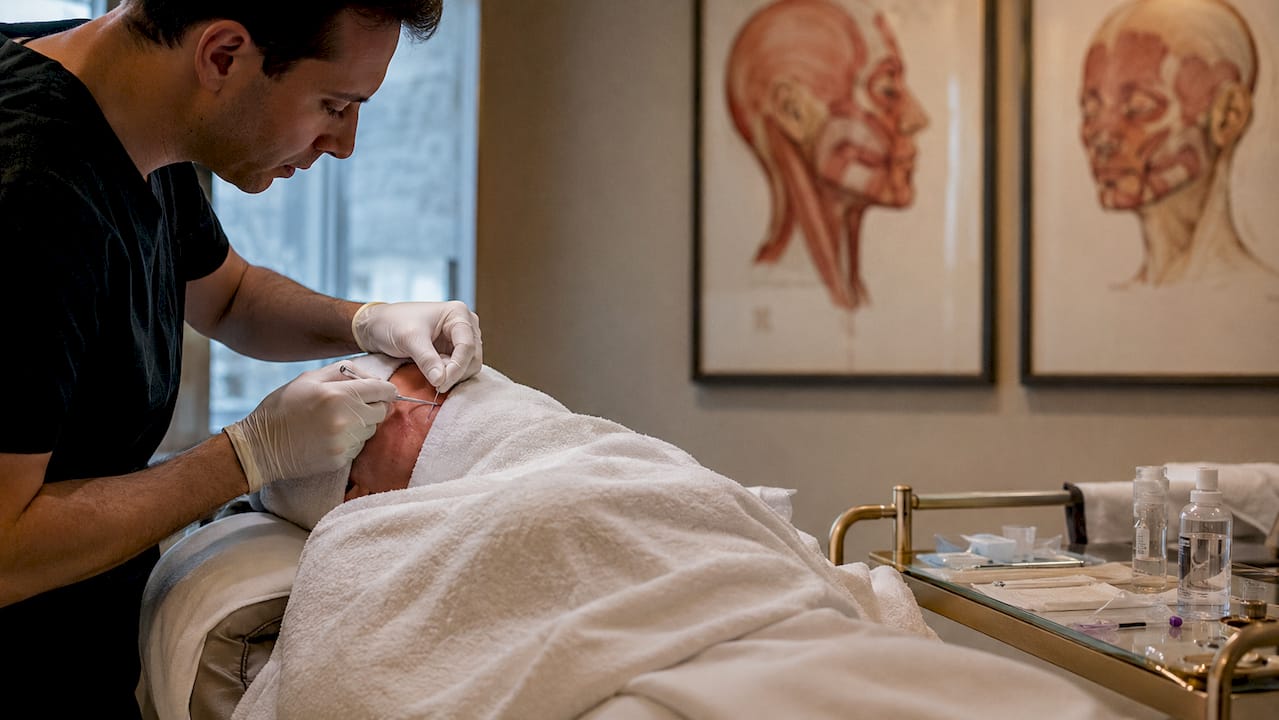
The threads used in the vast majority of cosmetic thread lifts are made from polydioxanone, commonly abbreviated as PDO. PDO sutures are FDA-cleared for wound closure but their cosmetic lifting application is technically off-label. They hydrolyse and absorb over approximately 6 to 8 months, leaving behind a collagen scaffold that continues to support the skin. This two-phase mechanism is what makes thread lifts more than a simple mechanical repositioning.
Thread designs vary significantly, and each serves a different purpose:
- Mono threads (smooth): Inserted in a mesh pattern to stimulate collagen without mechanical lift. Best suited for skin quality improvement rather than repositioning.
- Cog threads (barbed): Feature small barbs that grip tissue and physically reposition it upward. These produce the most visible immediate lift.
- Screw or tornado threads: Twisted around a needle to increase volume and stimulate collagen in hollow areas. Often used alongside cog threads for a combined effect.
The depth of insertion is critical. Superficial placement risks dimpling and bulging, while excessively deep placement risks damage to nerves and major vessels. The supra-SMAS layer or deep subcutaneous layer close to the SMAS is generally recommended, though no single universally agreed plane exists. Clinicians tailor depth to each patient’s fat distribution and skin thickness.
Pro Tip: Before booking, ask your practitioner which thread type they plan to use and why. A practitioner who can explain the rationale for cog versus mono threads in your specific case demonstrates the anatomical knowledge that separates safe, skilled treatment from a generic approach.
What are the benefits and expected outcomes?
The two core mechanisms of PDO threads are immediate mechanical lift from barbed threads and progressive collagen stimulation from the foreign-body response. The mechanical lift is visible from the day of treatment. The collagen benefit matures over 2 to 3 months and can sustain skin quality improvements for up to 18 months after the threads have fully absorbed.
In a retrospective analysis using Silhouette threads, 82% of patients showed AI-detected facial rejuvenation with a mean perceived age reduction of approximately 2.5 years at six months. Sixty per cent rated their outcomes as excellent. These figures are encouraging, though they reflect a specific thread brand and patient cohort. Results across different thread types and patient profiles will vary.
“Thread lifts are best understood as a niche procedure for mild laxity. They offer a genuine but modest improvement, and patients who approach them with that framing tend to be the most satisfied.” — ASPS surgeon Dr. Nazarian, as cited by the American Society of Plastic Surgeons.
Key benefits of thread lifts include:
- Minimal downtime compared with surgical alternatives, with most patients resuming normal activity within days
- No general anaesthesia, reducing systemic risk for patients who are not surgical candidates
- Subtle, natural-looking enhancement that avoids the over-corrected appearance sometimes associated with surgery
- Collagen stimulation that continues to improve skin texture and firmness after the threads absorb
- Complementary use alongside dermal fillers or Botox for a more complete facial rejuvenation result
- Reversibility: unlike surgery, thread lifts do not permanently alter facial anatomy
The most commonly treated areas are the mid-face, jowls, jawline, brow, and neck. Patients typically notice the most visible improvement along the jawline and lower face, where gravitational descent is most pronounced.
What are the risks and complications of thread lifts?
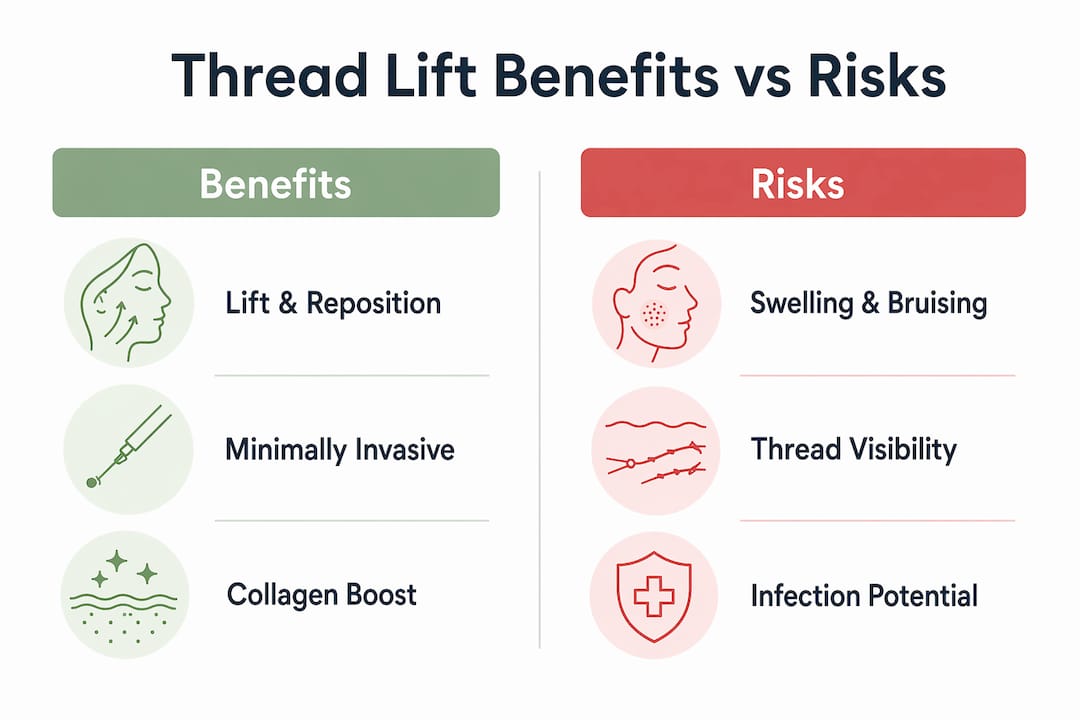
Thread lifts carry a well-documented complication profile, and understanding it is non-negotiable before proceeding. A meta-analysis of 2,827 patients across 26 studies found swelling in 34% of cases and ecchymoses (bruising) in 26%, with most early complications resolving within four weeks. These figures confirm that short-term side effects are common but generally self-limiting.
| Complication | Approximate frequency | Onset |
|---|---|---|
| Swelling | 34% | Early (within 4 weeks) |
| Bruising (ecchymoses) | 26% | Early (within 4 weeks) |
| Pain or discomfort | 11% | Early |
| Visible or palpable threads | 10% | Late |
| Skin dimpling | 7% | Late |
Late-onset complications such as thread visibility, dimpling, and infection tend to have a greater impact on patient satisfaction than early side effects, precisely because they are harder to resolve. Thread migration, persistent paraesthesia, and in rare cases parotid duct damage or nerve injury represent the more serious end of the risk spectrum. These serious complications are uncommon but not negligible.
Complication rates vary widely depending on operator skill, thread type, patient anatomy, and study follow-up methods. The high heterogeneity in published data (I² values of 76% to 92% for key complications) means that population-level statistics are a starting point, not a guarantee. You should ask your specific clinic for their own complication and retreatment rates.
Pro Tip: Request a follow-up appointment at four to six weeks post-procedure as standard. Early identification of thread visibility or dimpling allows for prompt correction before the issue becomes established.
Thread lift vs facelift: which option suits you?
A thread lift and a surgical facelift address the same problem through fundamentally different means. Thread lifts are best suited to younger patients with mild sagging seeking subtle improvement, while a surgical facelift is the appropriate choice for moderate to severe laxity where tissue excision is necessary for meaningful correction.
| Factor | Thread lift | Surgical facelift |
|---|---|---|
| Degree of correction | Subtle, mild laxity | Significant, moderate to severe laxity |
| Downtime | Days to one week | Two to four weeks |
| Anaesthesia | Local | General or sedation |
| Duration of results | 12 to 18 months | Five to ten years |
| Risk profile | Lower, mostly self-limiting | Higher, includes surgical risks |
| Cost | Lower | Significantly higher |
Among non-surgical facial rejuvenation options, thread lifts occupy a specific niche. Botox addresses dynamic wrinkles and brow position. Dermal fillers restore volume and smooth static lines. A liquid facelift combines fillers and Botox for a multi-dimensional result. Thread lifts add a mechanical repositioning element that fillers and Botox cannot replicate. For many patients, the most effective approach combines thread lifting with one or more of these complementary treatments rather than treating them as competing options.
Thread lifts are also increasingly relevant for men seeking discreet facial rejuvenation, where the preference for subtle results and minimal social downtime aligns well with what the procedure delivers. Cosmetic treatments for men have grown considerably, and thread lifts fit naturally within that trend.
Key takeaways
Thread lifts deliver a genuine but modest lift through two mechanisms: immediate mechanical repositioning and progressive collagen stimulation lasting up to 18 months.
| Point | Details |
|---|---|
| Candidacy depends on tissue quality | Mild laxity, good skin thickness, and strong general health predict the best outcomes. |
| PDO threads work in two phases | Mechanical lift is immediate; collagen scaffold matures over 2 to 3 months and persists beyond thread absorption. |
| Early complications are common but temporary | Swelling affects 34% and bruising 26% of patients, typically resolving within four weeks. |
| Late complications carry more risk | Thread visibility and dimpling affect up to 10% and 7% of patients respectively and require prompt follow-up. |
| Thread lifts complement, not replace, surgery | For moderate to severe laxity, a surgical facelift remains the more effective and longer-lasting solution. |
What I have learned from watching thread lifts evolve
The single biggest mistake I see prospective patients make is conflating the marketing language around thread lifts with clinical reality. Clinics sometimes advertise results lasting “up to 18 months,” which is technically accurate for the collagen benefit but misleading if a patient expects to see a visible lift for that entire period. The mechanical lift fades as threads absorb, typically within 6 to 9 months. The collagen improvement is real, but it is subtle and not the same as a sustained repositioning effect.
What I find genuinely impressive about the procedure is the two-phase mechanism. The collagen scaffold that PDO threads leave behind is not a marketing claim. It is a measurable biological response, and for patients with early laxity and good skin quality, it can meaningfully slow the visible progression of ageing. The problem is that this benefit is often oversold to patients who needed a surgical facelift from the outset.
Skilled technique and precise anatomical knowledge are not optional extras in thread lifting. They are the difference between a clean result and a visible thread or a dimple that requires correction. I would always recommend choosing a practitioner who can explain their insertion plane rationale, not just their before-and-after portfolio. The portfolio shows you their best cases. The anatomical explanation tells you whether they understand why those results happened.
— Vishul
Explore thread lifts and facial rejuvenation at Theaestheticsroom
Theaestheticsroom is a CQC-accredited medical aesthetics clinic based in Knightsbridge, London, with additional locations on Harley Street and in Mayfair. The clinic specialises in non-surgical facial rejuvenation, offering thread lifts alongside Botox treatments and dermal filler procedures tailored to your specific anatomy and aesthetic goals.

Every treatment at Theaestheticsroom begins with a personalised consultation to assess your skin quality, tissue laxity, and overall health before recommending a treatment plan. Whether you are considering a thread lift as a standalone procedure or as part of a broader facial rejuvenation programme, the team will give you an honest assessment of what results are realistic for you. Book a virtual or in-person consultation today to take the first step towards a refreshed, natural-looking result delivered safely by trained specialists.
FAQ
What is a thread lift and how does it work?
A thread lift is a minimally invasive procedure that uses temporary PDO sutures to mechanically reposition sagging facial tissue and stimulate collagen production. The threads absorb over 6 to 8 months, leaving a collagen scaffold that continues to support the skin for up to 18 months.
How long do thread lift results last?
The immediate mechanical lift typically lasts 3 to 9 months, while the collagen stimulation effect can extend results to 12 to 18 months. Patients should clarify with their practitioner whether the quoted longevity refers to the lift or the collagen benefit, as the two are distinct.
What are the most common thread lift side effects?
Swelling occurs in approximately 34% of cases and bruising in 26%, with both typically resolving within four weeks. Late complications such as visible threads and skin dimpling affect a smaller proportion of patients but require prompt clinical review.
Is a thread lift better than a facelift?
A thread lift is not a replacement for a surgical facelift. It is best suited to patients with mild laxity seeking subtle improvement with minimal downtime, while a surgical facelift remains the more effective option for moderate to severe sagging with longer-lasting results.
Can thread lifts be combined with other treatments?
Thread lifts combine well with Botox, dermal fillers, and PRP treatments to address volume loss, dynamic wrinkles, and skin quality alongside the mechanical lift. Many practitioners recommend a combined approach for patients seeking a more complete facial rejuvenation outcome.