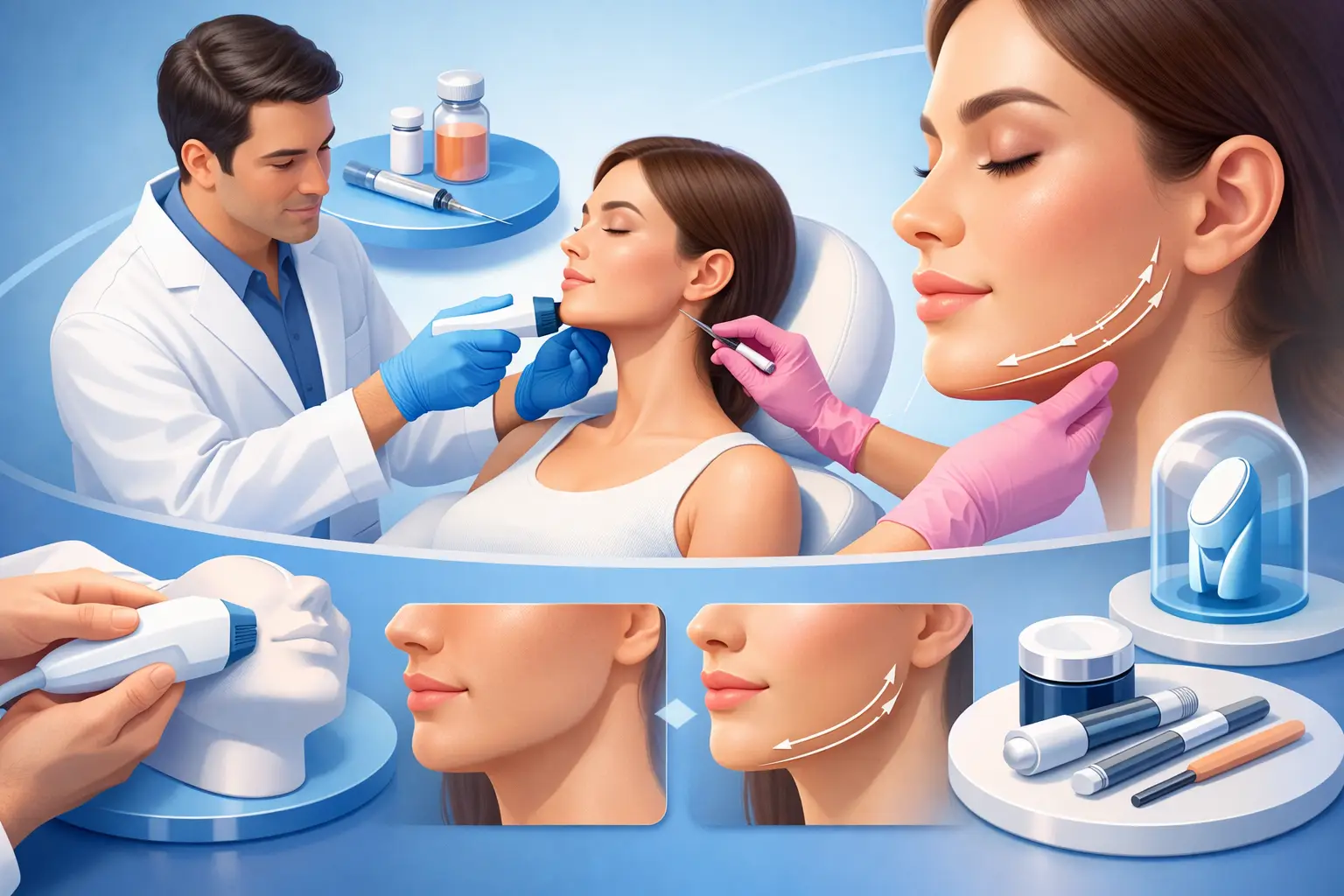

A well-defined jawline can make the whole face look more balanced, rested and refined. That is why so many patients now ask about the best non surgical jawline treatments – not because they want to look dramatically different, but because they want subtle structure, better definition and results that still feel like them.
The right treatment depends on what is actually softening the jawline. For some, it is genetics and naturally less projection through the chin or jaw. For others, it is skin laxity, excess fullness under the chin, teeth grinding that widens the lower face, or age-related volume changes that blur facial contours. This is where a proper medical consultation matters. A stronger jawline is rarely created by one product alone. It is usually the result of treating the face as a whole.
What makes a jawline look less defined?
Patients often describe a “weak jawline” as one concern, but in clinic it can mean several different things. The chin may sit too far back, making the jaw appear shorter or less structured from the side. The jowl area may start to descend, softening the line from ear to chin. There may be fullness beneath the chin, even in patients who are otherwise slim. Skin quality also plays a part. When the skin loses firmness, the outline of the lower face becomes less crisp.
This is why the best non surgical jawline treatments are not chosen by trend. They are chosen by anatomy, skin quality, muscle activity and the type of result you want. A treatment that works beautifully for one patient can look underwhelming – or simply be the wrong option – for another.
Best non surgical jawline treatments by concern
Dermal filler for structure and definition
Jawline filler remains one of the most effective options for patients who need more projection, sharper contour or improved balance between the chin and lower face. Placed carefully along the jaw angle, prejowl area or chin, dermal filler can create cleaner lines and a more sculpted profile.
The nuance is in the assessment. A patient asking for jawline filler may actually need chin support first, because without enough projection at the front of the lower face, the jawline can still look incomplete. Equally, overfilling a naturally soft or heavy lower face can make the area look broader rather than more elegant. In experienced medical hands, filler should enhance structure, not add unnecessary bulk.
Results are immediate, although there can be some swelling at first. Longevity varies by product and metabolism, but many patients enjoy results for many months. This option suits those who want visible definition without surgery, provided they are happy with an injectable treatment and understand that maintenance is usually needed.
Chin filler for overall facial balance
Not every jawline concern starts at the jaw. A recessed or under-projected chin can make the entire lower face appear weaker. In these cases, chin filler is often one of the most impactful treatments, even if the patient initially thought they only needed the sides of the jaw addressed.
Improving chin projection can sharpen the profile, support the area beside the chin where shadowing often develops, and create a cleaner transition from chin to neck. It can also help the nose, lips and lower face look more harmonious overall. For many patients, this is the difference between looking subtly refined and looking obviously treated.
Anti-wrinkle injections for a slimmer lower face
If the jaw looks overly square because of enlarged masseter muscles, anti-wrinkle injections may be a better option than filler. This treatment relaxes the masseter over time, which can soften width at the back of the jaw and create a slimmer facial shape.
It is particularly useful for patients who clench or grind their teeth, as the aesthetic improvement can come with functional relief too. The trade-off is that this is not a treatment for everyone. If your concern is laxity or lack of bone structure, relaxing the masseter will not create the support that filler can provide. It can also take several weeks to see the full contouring effect, so it is less immediate than dermal filler.
Fat dissolving injections for fullness under the chin
A defined jawline is often lost because of submental fullness rather than lack of projection. In simpler terms, the issue is under the chin rather than in the jaw itself. Fat dissolving injections can help reduce small, localised pockets of fat in this area, improving the angle between the chin and neck.
This treatment can work very well for the right patient, but expectations need to be sensible. It is not a replacement for weight loss, and it does not tighten significantly loose skin. Most patients need a course of treatments, and the area can be swollen afterwards, so timing matters if you have social or work commitments. When chosen well, however, it can make the jawline look cleaner and more refined without adding volume.
Skin tightening for a firmer outline
If the main problem is skin laxity, structural filler alone may not be enough. Energy-based skin tightening treatments can support collagen production and improve firmness around the lower face and jaw. These are often best for patients who want gradual improvement, especially in the early stages of looseness.
The benefit here is subtlety. You are not adding volume or changing facial shape dramatically. You are improving the quality of the tissue that frames the jawline. The limitation is that non-surgical skin tightening has boundaries. If there is significant sagging or heavier jowling, results may be modest compared with surgery. That does not make it the wrong choice – it simply means the plan should be honest.
Combination treatment often gives the best result
The most successful jawline work is rarely about chasing a single treatment. A patient may need a small amount of chin filler for projection, conservative jawline filler for continuity and a course of skin tightening to improve tissue support. Another may benefit more from fat dissolving under the chin than from adding any filler at all.
This is where bespoke planning matters. At a premium medical aesthetics clinic, the goal should not be to sell the most treatment. It should be to identify what is causing the concern and choose the least invasive route that gives a balanced, natural-looking result. For the right patient, combination treatment produces a result that looks polished rather than obvious.
What to look for when choosing a clinic
Jawline enhancement is technically demanding because small changes can alter the whole face. The lower face also contains important blood vessels and anatomical structures, which makes injector expertise and safety standards critical.
Look for a clinic that offers consultation-led care, clear discussion around suitability, and a willingness to say when a treatment is not the right fit. Before-and-after images should show tasteful, believable results rather than exaggerated angles. Medical oversight matters too, especially when you are treating an area that needs both aesthetic judgement and anatomical precision.
For patients in Central London, this standard of care is particularly important because there is no shortage of choice – but there is a real difference between a luxury medical clinic and a high-volume treatment provider. The experience should feel tailored, not transactional.
Are non-surgical jawline treatments worth it?
For the right candidate, yes. Non-surgical treatment can improve profile balance, restore definition and boost confidence with far less downtime than surgery. It can also be adjusted over time, which appeals to patients who want refinement without committing to a permanent surgical change.
That said, worth is always tied to suitability. If someone has significant skin laxity, heavy jowls or expectations that only surgery can meet, non-surgical treatment may offer improvement but not transformation. The best practitioners will explain that clearly. Good aesthetic medicine is not about promising everything. It is about delivering the right level of change safely and elegantly.
At The Aesthetics Room, jawline treatment is approached in exactly this way – through detailed assessment, bespoke planning and results that prioritise balance over excess. That tends to be what sophisticated patients value most: not a trend-led face, but a more confident version of their own.
If you are considering jawline enhancement, the most useful starting point is not deciding which injectable you want. It is understanding why your jawline has changed, or why it has never looked as defined as you would like. Once that is clear, the right treatment plan tends to become much simpler.