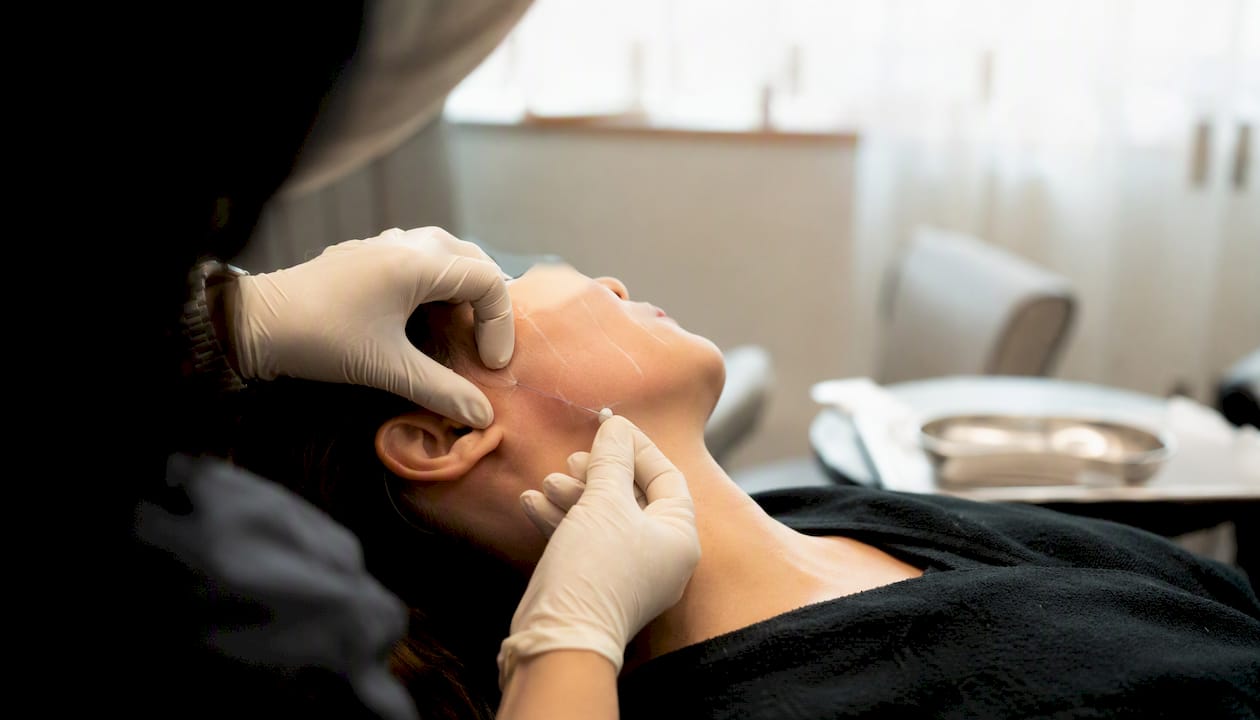

PDO threads are biodegradable polydioxanone sutures inserted beneath the skin during a minimally invasive cosmetic procedure to lift, tighten, and rejuvenate facial tissue. Barbed threads create an immediate mechanical lift by anchoring and repositioning soft tissue; all thread types trigger a biostimulatory response that drives new collagen production over the following weeks. Results typically last around 6–12 months, though outcomes depend heavily on practitioner skill, patient selection, and whether threads are combined with complementary treatments. PDO threads are not a surgical facelift alternative, and the phrase “lunchtime facelift” can set unrealistic expectations. Safety and satisfaction are closely tied to the experience and anatomical knowledge of the person performing the procedure.
Key takeaways
PDO threads are biodegradable polydioxanone sutures that produce an immediate mechanical lift (barbed designs) and a collagen-stimulating biostimulatory response, with results typically lasting 6–12 months and safety outcomes closely tied to practitioner skill and anatomy knowledge.
| Point | Details |
|---|---|
| What PDO threads do | Barbed threads lift tissue mechanically; all types stimulate new collagen production over 6–12 weeks. |
| How long results last | Clinical lifting effects typically last 6–12 months; combination therapy with fillers or neurotoxins extends longevity. |
| Common early side effects | Pooled data show swelling in roughly 34% of patients and bruising in roughly 26%; both are usually self-limiting. |
| Choosing a safe clinic | Seek CQC-registered clinics with documented thread-lifting training and a full written consent process. |
| Theaestheticsroom | Offers PDO thread treatments at Harley Street and Mayfair, combining threads with fillers and neurotoxins within a CQC-registered clinical framework. |
Table of Contents
- What are PDO threads and how do they work?
- The three main thread designs and what each one does
- Which areas can be treated and who is a suitable candidate?
- What happens during a PDO thread procedure?
- Recovery, results, and aftercare
- What are the risks and complications of PDO threads?
- How do you choose a safe clinic and practitioner?
- How much does a PDO thread lift cost?
- PDO threads versus surgical facelifts and dermal fillers
- Who should consider PDO threads?
- A practitioner’s perspective on PDO threads
- Sources
What are PDO threads and how do they work?
Polydioxanone (PDO) is a synthetic, biodegradable polymer with a long history as an absorbable surgical suture, used since the 1980s in cardiovascular and paediatric surgery. Its tissue-compatibility profile is well understood, which is one reason it became the material of choice for aesthetic thread lifting. When inserted into the subcutaneous layer of the face or body, PDO threads work through two distinct mechanisms.
Mechanism one: immediate mechanical lift. Barbed or cog threads grip the surrounding tissue and physically reposition it upward or inward, producing a visible lift the moment the procedure is complete.
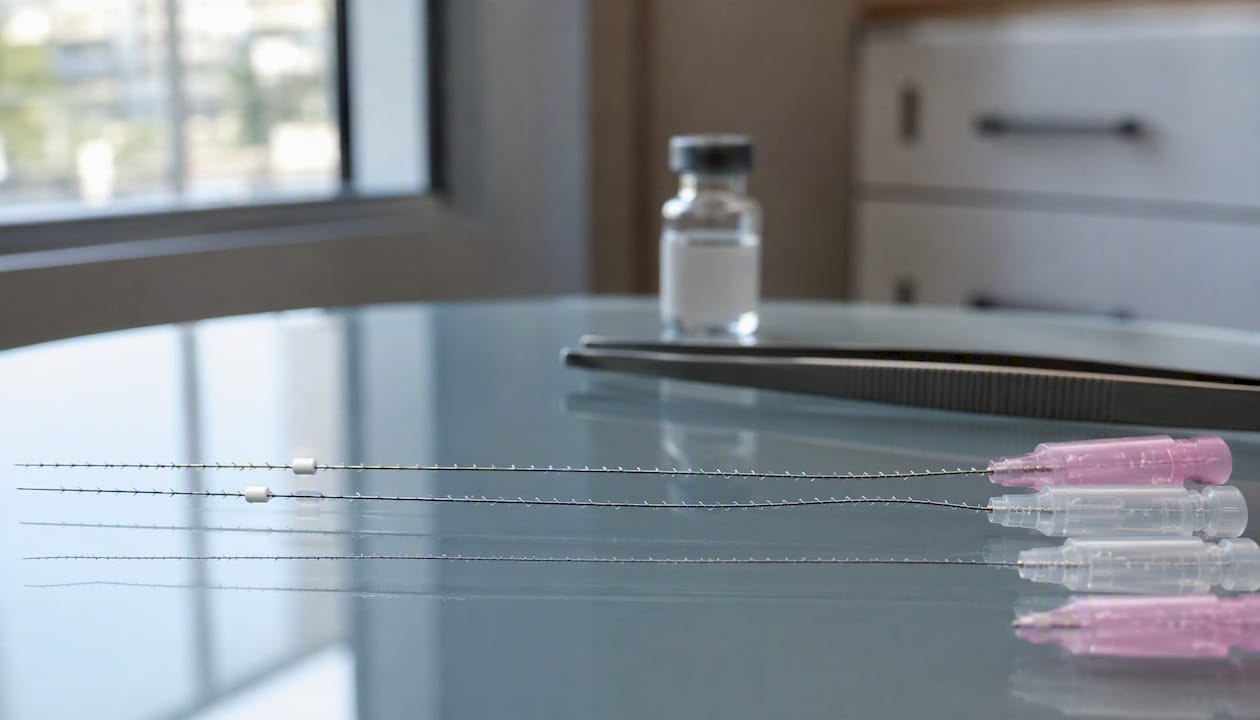
Mechanism two: biostimulation and neocollagenesis. All thread types provoke a controlled foreign-body response. The body recognises the suture material and responds by producing new collagen around it, gradually improving skin texture, firmness, and elasticity. This collagen remodelling continues and peaks at roughly 12 weeks after insertion.
The threads themselves hydrolyse through a process of hydrolysis over approximately 6–8 months. Crucially, the collagen laid down during that period persists beyond thread absorption, which means skin quality improvements can outlast the physical presence of the suture. The timeline looks like this:
- Week 0: Threads inserted; barbed threads produce immediate visible lift.
- Weeks 2–4: Minor swelling resolves; early collagen deposition begins.
- Week 12 (approx.): Collagen remodelling peaks; skin texture improvements most pronounced.
- Months 6–8: Threads fully hydrolysed and absorbed.
- Months 6–12+: Lifting and skin quality benefits persist, supported by the collagen matrix formed during absorption.
PDO’s predictable absorption timeline and favourable tissue response make it a reliable choice compared with newer polymers such as polylactic acid (PLA) or polycaprolactone (PCL), which absorb more slowly and carry different biostimulatory profiles.
The three main thread designs and what each one does
Not all PDO threads are the same. The design of the thread determines whether it primarily stimulates collagen, restores volume, or physically repositions tissue. Understanding the difference helps you have a more informed conversation at consultation.
-
Smooth (mono) threads are plain, barb-free sutures placed in a mesh or grid pattern beneath the skin. They produce no mechanical lift. Their value lies entirely in the biostimulatory response they trigger: multiple smooth threads placed across an area generate a diffuse collagen-stimulating effect that gradually improves skin quality, fine lines, and overall texture. They work well for early skin laxity and as a preparatory or maintenance treatment.
-
Screw (tornado) threads feature one or two strands wound helically around the needle. This spiral structure increases the surface area in contact with tissue, producing a more localised volume-restoring effect. They are commonly used in areas where mild volume loss accompanies laxity, such as the cheeks or temples.
-
Barbed (cog) threads carry small, directional barbs along their length that grip the deep dermis or subcutaneous fat and anchor into the tissue above. When the thread is tensioned, it physically repositions the tissue, producing the strongest and most immediate visible lift. Cog threads are the primary tool for jawline definition, jowl lifting, and brow elevation.
Beyond PDO, practitioners may use PLA or PCL threads. PLA threads absorb over roughly 12–18 months and are considered more strongly biostimulatory; PCL threads absorb even more slowly, over 18–24 months, and are often chosen when a longer-lasting scaffold is the priority. The right material depends on your anatomy, goals, and the practitioner’s clinical judgement.
Pro Tip: Ask your practitioner specifically which thread design and material they plan to use and why. A practitioner who can explain the rationale for smooth versus barbed threads in your particular case is demonstrating the anatomical understanding that separates safe, effective treatment from a generic approach.
Which areas can be treated and who is a suitable candidate?
PDO thread lifting is most effective for patients with mild to moderate skin laxity who want a visible improvement without committing to surgery. The procedure is not appropriate for everyone, and honest candidate assessment is one of the most important things a skilled practitioner does.
Treatable areas
The face and neck are the most common treatment zones:
- Jawline and jowls (definition and lift)
- Mid-face and cheeks (volume support and repositioning)
- Brow and lateral forehead (brow elevation)
- Neck and décolletage (skin tightening and texture)
- Nasolabial folds and marionette lines (softening through tissue repositioning)
- Under-eye area (smooth threads for skin quality, with caution)
Selected body areas can also be treated, including the abdomen, inner thighs, upper arms, and knees, though facial applications remain the most studied and widely performed.
The ideal candidate
- Adults with mild to moderate skin laxity who retain reasonable skin elasticity.
- Patients with realistic expectations: threads improve and lift, but they do not replicate a surgical result.
- Medically fit individuals with no active skin infection in the treatment area.
- Those willing to follow aftercare instructions and attend follow-up appointments.
Contraindications to discuss with your practitioner
- Active infection, acne, or open wounds in the treatment area
- Bleeding disorders or current anticoagulant therapy
- Autoimmune conditions affecting connective tissue
- Pregnancy or breastfeeding
- History of keloid scarring
- Unrealistic expectations about the degree of lift achievable
- Very thin skin or significant skin excess (where surgery is the more appropriate option)
Age and skin type matter too. Patients in their 30s and 40s with early laxity tend to see the most satisfying results. For patients over 50 with more pronounced laxity, combination therapy with dermal fillers or neurotoxins is commonly recommended to achieve a more complete and durable outcome.
What happens during a PDO thread procedure?
A well-conducted PDO thread treatment follows a clear sequence. Knowing what to expect removes anxiety and helps you assess whether a clinic is following best practice.
-
Consultation and assessment. Your practitioner reviews your medical history, photographs your face from multiple angles, and maps the vectors (directions of lift) that will achieve your goals. This is also when thread type, number, and placement are decided. Consent is taken and the off-label nature of cosmetic thread use is explained.
-
Marking and preparation. Entry points and thread vectors are marked on the skin with a surgical pen. The face is cleansed and prepared.
-
Anaesthesia. Topical anaesthetic cream is applied for 20–30 minutes before the procedure. Local anaesthetic is then injected at entry points to numb the area. Most patients describe the sensation during insertion as pressure rather than pain once anaesthesia is effective.
-
Thread insertion. Threads are loaded onto a fine needle or cannula. A cannula is blunter and generally causes less bruising; a needle is sharper and may be preferred for precision in certain zones. The thread is guided through the subcutaneous tissue along the planned vector. For barbed threads, the practitioner tensions the thread to anchor the barbs and achieve the lift; excess thread is trimmed flush with the skin. Smooth threads are placed in a grid or fan pattern without tensioning.
-
Immediate result and minor side effects. Barbed thread patients see a visible lift immediately. The face may appear slightly swollen or puffy, and small entry-point marks are visible. Mild bruising, tenderness, and a sensation of tightness are normal in the first 24–48 hours.
A full treatment session typically takes 30–60 minutes depending on the number of threads and areas treated. Most patients return to light daily activity the same day, though social downtime of a few days is realistic for barbed thread treatments.
Recovery, results, and aftercare
The post-procedure course is predictable for most patients, and understanding it helps you judge whether your recovery is on track.
Recovery milestones
- First 48–72 hours: Swelling, mild bruising, and tenderness are expected. The face may feel tight or slightly asymmetrical as swelling is uneven. Sleep on your back with your head slightly elevated to reduce swelling.
- Days 3–7: Bruising fades; swelling reduces. Entry-point marks become less visible. Tightness and occasional mild discomfort when opening the mouth wide are normal with barbed threads.
- Weeks 2–4: The mechanical lift settles into its final position. Collagen deposition begins in earnest.
- Weeks 6–12: Neocollagenesis peaks. Skin texture, firmness, and the quality of the lift all improve during this window.
Aftercare guidance
- Avoid vigorous massage or facial manipulation in treated areas for at least two weeks.
- Sleep on your back for the first week where possible.
- Avoid high-impact exercise, saunas, and steam rooms for 7–10 days.
- Do not undergo dental procedures requiring wide mouth opening for 3–4 weeks.
- Use gentle skincare; avoid active exfoliants (retinoids, AHAs) on treated areas for one week.
- Attend your follow-up appointment, typically at 4–6 weeks, so your practitioner can assess the result and identify any early complications.
How long do results last?
PDO thread lifting effects typically last around 6–12 months. Claims of 18 months or more for PDO threads alone are not well supported by clinical evidence. Longevity is influenced by skin quality, age, lifestyle factors (sun exposure, smoking), and whether combination treatments are used. Combining threads with dermal fillers or neurotoxins typically extends and enhances the result, particularly for patients over 50.
What are the risks and complications of PDO threads?
PDO thread lifting has a generally favourable safety profile when performed by a trained, experienced practitioner, but complications do occur and patients should understand both the common minor events and the rarer, more serious ones.
Early complications (usually self-limiting)
These typically resolve within days to a few weeks:
- Swelling and oedema
- Ecchymosis (bruising)
- Mild pain or tenderness at entry points
- Temporary asymmetry
- Palpable threads under the skin
Late complications (less common but clinically important)
- Visible or extruded threads
- Dimpling or puckering of the skin
- Infection (rare but requires prompt treatment)
- Paresthesia (altered sensation, usually temporary)
- Thread migration
- Granuloma formation
What the data shows
A meta-analysis published in Frontiers in Surgery found pooled swelling incidence of approximately 34% and ecchymoses of approximately 26% across included studies, with high heterogeneity between them. Late complications such as dimpling and visible threads were less frequent but clinically meaningful. The heterogeneity across studies reflects real differences in technique, thread type, and operator experience, which means published rates are a guide rather than a precise prediction for any individual patient.
Statistic to know: Pooled data indicate swelling occurs in a substantial proportion of patients and bruising in a significant minority, but these figures vary substantially depending on the practitioner’s technique and the thread design used.
Red flags requiring urgent attention
Seek immediate medical advice if you experience any of the following after a PDO thread procedure:
- Increasing pain rather than improving pain after the first 48 hours
- Spreading redness, warmth, or swelling suggesting infection
- Fever
- Visible thread extrusion through the skin
- Sudden or progressive sensory loss or numbness
- Severe asymmetry developing after initial swelling has resolved
Published clinical guidance underlines that serious complications such as vascular injury are rare but possible, and are most effectively prevented by practitioners with detailed facial anatomy knowledge who understand how to avoid structures such as the superficial temporal artery.
How do you choose a safe clinic and practitioner?
The single most important variable in PDO thread safety and outcome is the person performing the procedure. Thread lifting requires a thorough understanding of facial anatomy, not just familiarity with the insertion technique. Practitioner skill and anatomy knowledge materially affect both safety and results, and choosing a clinic on price alone is a genuine risk.
Questions to ask at consultation
- What is your medical qualification and specific training in thread lifting?
- How many thread lift procedures have you performed?
- Can you show me before-and-after photographs of your own patients?
- How do you manage complications if they arise?
- What is your follow-up policy?
- Will I receive a full written consent form that explains the risks, including the off-label status of the procedure?
- Will photographs be taken before and after for my clinical record?
Trust signals and credentials to look for
- CQC registration: In England, aesthetic clinics offering procedures that break the skin must be registered with the Care Quality Commission (CQC). CQC registration means the clinic is subject to inspection and must meet defined standards of safety and governance.
- ACE Group membership or equivalent: Membership of recognised professional bodies dedicated to patient safety signals a commitment beyond the minimum regulatory requirement.
- Documented training: Your practitioner should be able to name the training programme they completed and the awarding body.
- Photographic documentation: A clinic that photographs patients before and after every treatment is practising good clinical governance, not just good marketing.
A robust consent process is not a formality. It should include a clear explanation of realistic outcomes, the temporary nature of results, the off-label status of cosmetic thread use, and a specific discussion of the complications relevant to your planned treatment. If a clinic rushes consent or discourages questions, that is a reason to look elsewhere.
Pro Tip: Check the CQC register directly at cqc.org.uk before booking any procedure that breaks the skin. A clinic that cannot be found on the register is not operating within the required regulatory framework for England.
Understanding why registered practitioners matter is the foundation of safe treatment decisions in medical aesthetics.
How much does a PDO thread lift cost?
PDO thread lift pricing varies considerably depending on several factors, and price alone should never be the deciding criterion.
Typical range: PDO thread treatments in the UK generally range from around £500 for a limited smooth-thread session to £2,500 or more for a full-face barbed thread lift with multiple cog threads. Prices at specialist medical aesthetics clinics in London tend to sit at the higher end of this range, reflecting practitioner experience, clinic standards, and the number of threads used.
Factors that influence cost include:
- Number of threads: More threads mean more material cost and more procedure time.
- Thread type: Barbed cog threads are more expensive than smooth mono threads.
- Treatment area: A full-face lift costs more than a targeted jawline or brow treatment.
- Practitioner experience and qualifications: A medically qualified practitioner with specialist training commands a higher fee, and rightly so.
- Clinic location: Central London clinics, particularly those on Harley Street or in Mayfair, reflect higher overheads in their pricing.
- Combination treatments: Adding dermal fillers or Botox to a thread session increases the total cost but typically improves and extends the result.
Very low prices for thread lifts are a safety concern. Threads are a technically demanding procedure; a practitioner charging significantly below the typical market rate may be cutting corners on training, thread quality, or aftercare provision. For a transparent view of clinic pricing, Theaestheticsroom’s price list provides a useful reference point.
PDO threads versus surgical facelifts and dermal fillers
Understanding where PDO thread lifting sits relative to other options helps you decide which approach fits your goals.
| Feature | PDO thread lift | Surgical facelift | Dermal fillers |
|---|---|---|---|
| Invasiveness | Minimally invasive | Major surgery under general anaesthesia | Non-surgical injection |
| Downtime | A few days to one week | 2–4 weeks | Minimal (hours to 1–2 days) |
| Anaesthesia | Local | General | Topical/local |
| Primary effect | Mechanical lift + collagen stimulation | Structural repositioning of deep tissue | Volume restoration |
| Longevity | 6–12 months | 5–10 years | 6–18 months (product-dependent) |
| Best for | Mild to moderate laxity, contouring | Significant laxity, deep structural change | Volume loss, line filling |
| Combination use | Often combined with fillers/neurotoxins | May be combined with skin treatments | Often combined with threads |
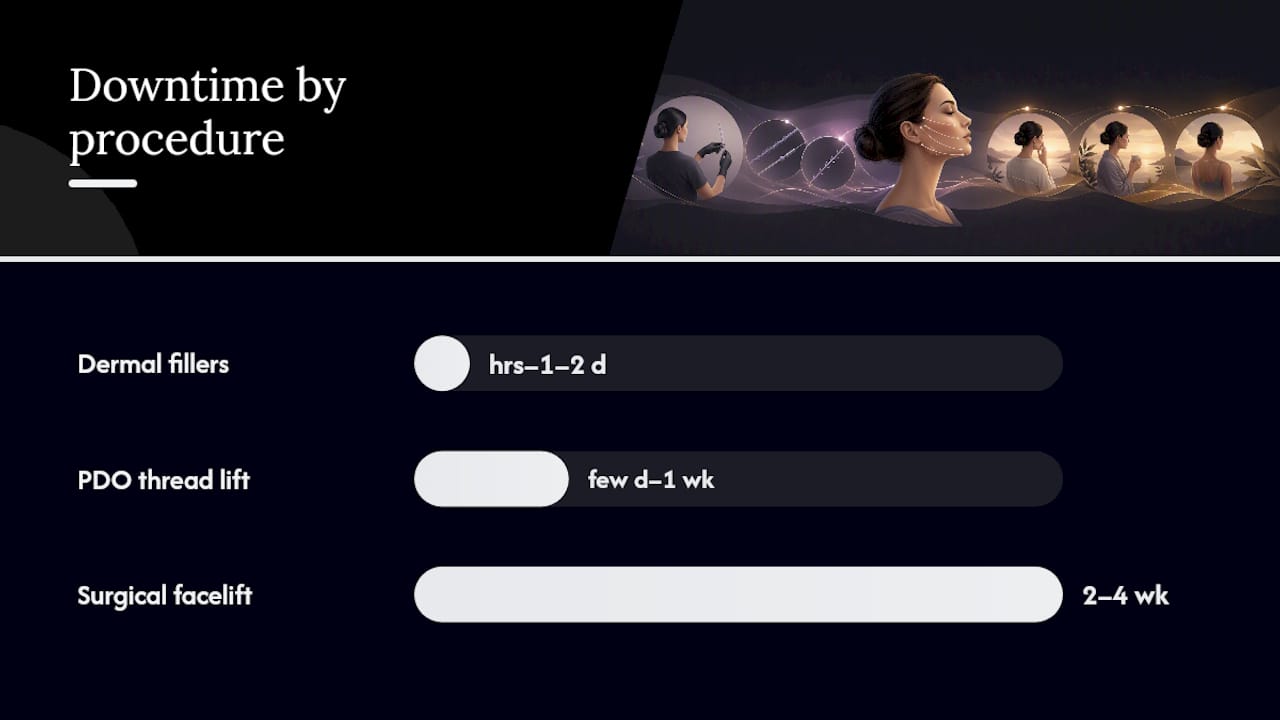
Thread lifts are minimally invasive with short recovery times, but the “lunchtime facelift” label can mislead. A surgical facelift repositions the deep structural layers of the face and produces results that last years; PDO threads work at a shallower level and produce a subtler, temporary improvement. They are not competing treatments so much as tools for different stages of ageing and different patient goals.
Dermal fillers address volume loss rather than laxity. A patient with hollowed cheeks and mild sagging often benefits most from a combination of threads (for lift) and fillers (for volume), rather than either alone. For patients considering non-device alternatives, anti-ageing skin devices offer another non-invasive option worth understanding before committing to any procedure.
When combination therapy is the right choice:
- Patients over 50 with both laxity and volume loss
- Those seeking a more complete facial rejuvenation without surgery
- Patients who have had threads previously and want to maintain and build on the result
Who should consider PDO threads?
PDO threads are a well-suited option for adults with mild to moderate facial laxity who want a visible but natural-looking improvement without surgery or extended downtime. They work best when expectations are realistic and the procedure is performed by a medically qualified practitioner with specific thread-lifting experience.
- PDO threads suit adults with early to moderate skin laxity who are not ready for, or do not want, surgery.
- The most satisfying results come from combining threads with complementary treatments such as fillers or neurotoxins, particularly for patients over 50.
- Outcomes vary; a thorough consultation with a qualified practitioner is the only reliable way to assess whether threads are right for your anatomy and goals.
- Choose a CQC-registered clinic with documented training and a transparent consent process.
If you recognise yourself in that profile, the recommended next step is a consultation with a qualified medical aesthetics practitioner who can assess your facial anatomy, discuss realistic outcomes, and design a treatment plan specific to you.
A practitioner’s perspective on PDO threads
PDO threads occupy a genuinely useful space in non-surgical aesthetics, but they are also one of the procedures most vulnerable to overpromising. The “lunchtime facelift” framing has done real damage to patient expectations: people arrive hoping for a surgical result and leave disappointed by a subtle one, even when the outcome is clinically excellent for what threads can achieve.
What the evidence actually supports is this: threads are a reliable tool for mild to moderate laxity, they produce a real but modest mechanical lift with barbed designs, and they deliver meaningful skin quality improvements through collagen stimulation. The collagen effect is often undervalued by patients who focus on the lift. For someone in their late 30s or 40s with early jowling and skin that has lost its spring, a well-placed thread treatment combined with a neurotoxin and a collagen-stimulating skin programme can produce results that look genuinely refreshed rather than treated.
The complication data from meta-analyses is worth reading carefully. Swelling and bruising are common and expected. Late complications such as visible threads or dimpling are less frequent but not rare, and they are almost always technique-dependent. The practitioner who understands facial anatomy at a vascular level, who knows which layer to place the thread in at the temple versus the lower face, and who can manage an extrusion or infection if it occurs is not interchangeable with someone who has attended a one-day course. That distinction is the most important thing this article can communicate.
PDO threads at Theaestheticsroom: CQC-registered care in London
Theaestheticsroom offers PDO thread treatments from its clinics on Harley Street and in Mayfair, delivered by medically qualified practitioners with documented training in thread lifting and facial anatomy. CQC registration and ACE Group membership mean every treatment is conducted within a governed clinical framework, with full photographic documentation and a transparent consent process.

Thread treatments at Theaestheticsroom are frequently combined with dermal fillers and neurotoxins for patients seeking a more complete rejuvenation outcome, and the clinic’s hybrid treatment approach is designed for exactly this kind of multi-modality planning. Whether you are exploring threads for the first time or looking to build on a previous treatment, the starting point is a consultation where your anatomy and goals are assessed properly. Book your consultation at Theaestheticsroom today and find out whether PDO threads are the right fit for you.
Sources
The following sources provide high-quality clinical information on PDO threads, thread lift safety, and related procedures. Each is selected for its evidence quality or regulatory authority.
- Thread lift: what to expect, benefits & complications
- A meta-analysis and review of thread lift complications (Frontiers in Surgery)
- Review on thread lifting safety and anatomy considerations (PMC article)
This article is general information, not a substitute for advice from a qualified doctor. Consult a qualified healthcare professional about your own circumstances before acting on anything here.