
Skin boosters typically last around six to nine months, and Profhilo, the best-known booster, is described by ACE Group’s patient leaflet as lasting about six months. The exact figure depends on the product, your age, your lifestyle and how precisely it is placed. The practical answer is a plan, not a single number: an initial course, then maintenance timed to when your skin starts to feel less hydrated. At The Aesthetics Room, a CQC-registered clinic and member of the ACE Group, we build that plan around you in a consultation, in person in London or online.
TL;DR
- Most skin boosters last roughly six to nine months. Profhilo is described by ACE UK as lasting about six months.
- Longevity varies with the product, the degree of correction needed, your age, your lifestyle and the accuracy of placement.
- Expect an initial course of sessions about four weeks apart, then top-ups. Maintenance intervals range from three to twelve months depending on the product and your skin.
- Sun protection and a good skincare routine between sessions help you get the most from each treatment.
- At The Aesthetics Room, Profhilo is £350 per session and Sunekos is £450 per session.
Table of Contents
- What a skin booster actually does
- How long do skin boosters last?
- What affects how long results last
- How often should you have skin boosters?
- Timeline: when you will see results
- How to make results last longer
- What a skin booster costs to keep up
- Safety: what to know before you book
- Our perspective
- Plan your skin booster course with us
- FAQ
- Sources
What a skin booster actually does
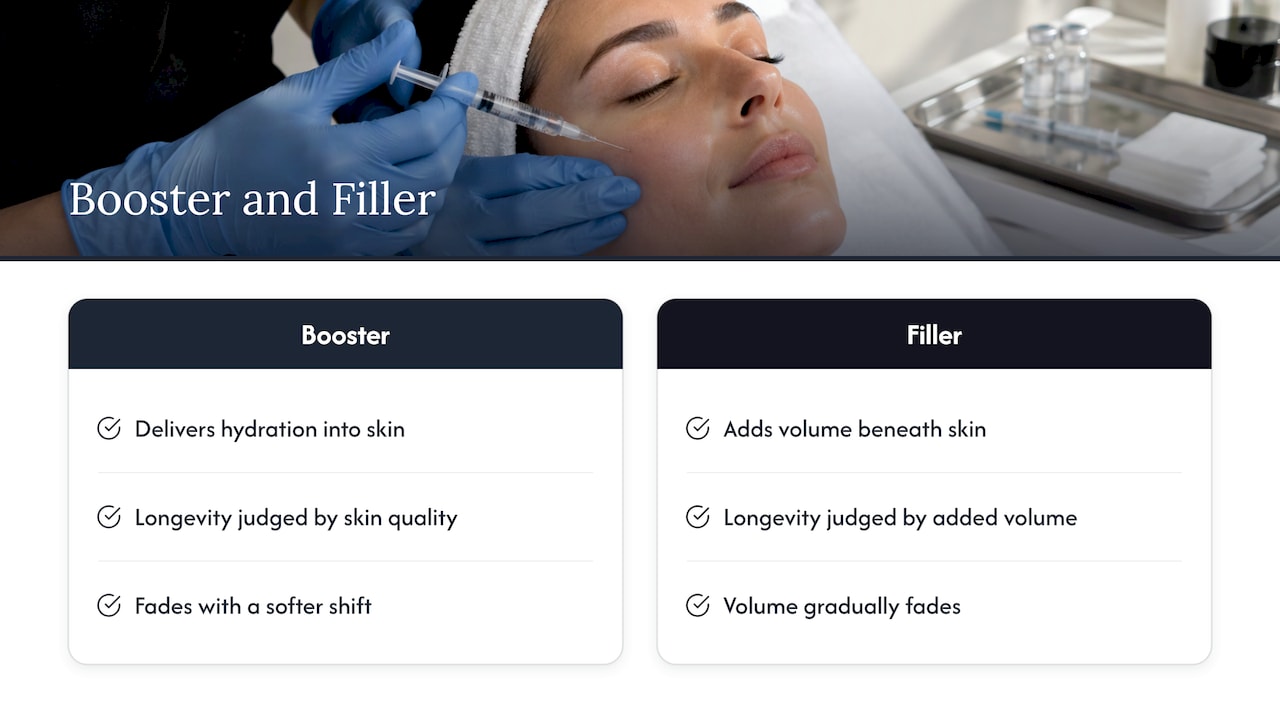
A skin booster is an injectable treatment that delivers hydrating or skin-conditioning ingredients into the skin itself, rather than adding volume beneath it as a traditional filler does. The best-known examples use hyaluronic acid, a molecule your skin already makes that holds water. The aim is smoother, more hydrated, firmer-looking skin, not a change in the shape of your face.
That difference explains why booster longevity is quoted differently from filler longevity. A filler is judged by how long the volume it adds holds. A booster is judged by how long skin quality stays improved: hydration, bounce and the fine texture of the surface. Both gradually fade as your body absorbs the product, but boosters tend to show a softer, more gradual shift in both directions.
If you are weighing boosters against newer polynucleotide treatments, our guide to polynucleotides vs skin boosters sets out how they differ.
How long do skin boosters last?
The commonly quoted range is six to nine months. Here is how that looks in practice.
| Stage | What to expect |
|---|---|
| Initial course | Usually two or more sessions, spaced weeks apart |
| Peak result | Builds over the weeks following the course |
| Typical duration | About six months for Profhilo, up to nine for some protocols |
| Maintenance | Top-up when hydration and texture begin to slip |
For Profhilo specifically, the ACE UK leaflet says effects last about six months, depending on the degree of correction required, your age, your lifestyle and correct product placement. It adds that further maintenance treatments can be considered after six to twelve months. That range matters: some people choose a top-up at the point they notice a change, others book on a fixed schedule.
Treat any figure as a typical range, not a guarantee. Skin is individual, and two people having the same product on the same day can see different timelines.
What affects how long results last
Four factors do most of the work.
The product you choose
Hyaluronic acid boosters, polynucleotide treatments and collagen-stimulating products are all absorbed or remodelled at different rates. The more a product relies on a one-off hydration effect, the sooner you may want a top-up. The more it prompts your skin to produce its own collagen, the more gradual both the build-up and the fade-out tend to be.
The degree of correction
The ACE leaflet specifically names the degree of correction required as a factor. Someone treating mild dryness and early fine lines is in a different position from someone treating pronounced crepey texture on the neck. Greater concerns often need a fuller course and closer follow-up.
Your age and lifestyle
Skin that is already producing less collagen, or that is exposed to sun, smoking or poor sleep, tends to need more frequent support. Daily sunscreen is the simplest thing you can do between sessions. Our team will talk through your routine and what is realistic for you during your consultation.
Placement and technique
Boosters work where they are placed. Even, accurate placement by a medically trained practitioner affects how consistent the result looks and how well it lasts. At The Aesthetics Room, all treatments are performed by medically trained professionals, and our approach is built on personalised plans rather than a one-size protocol.
How often should you have skin boosters?
There are two phases: the initial course and maintenance.
The initial course
For Profhilo, UK supplier guidance from Fox Pharma describes an initial regimen of two sessions spaced four weeks apart. Other booster products use different protocols, with some courses involving three sessions. The point of the course is to build the effect up gradually, so that the first session is not expected to do all the work.
Details of our own Profhilo approach are in our guide to Profhilo session frequency.
Maintenance
Once the course is done, maintenance depends on how your skin behaves. Supplier guidance for Profhilo points to top-ups at intervals of three to six months depending on skin condition and goals. The ACE leaflet allows for maintenance after six to twelve months. The two are compatible: there is a window, and your skin and goals decide where in it you land.
A sensible way to decide is to watch for the signs that your hydration is fading:
- Skin looks duller or feels tighter by the afternoon
- Fine lines around the cheeks, neck or under the eyes reappear
- Make-up sits less smoothly
- The softness you noticed after your course has faded
Those signs, rather than a calendar date, are the cue to book a review.
Timeline: when you will see results
Skin boosters do not change your face overnight. Many people notice a first improvement in skin feel within the first couple of weeks, and the benefit tends to keep building after the course is complete. Temporary marks from the injection points settle quickly for most people, and our guidance on reducing post-treatment swelling covers what helps in the first days.
The length of a booster result is also easier to judge if you photograph your skin in the same light before treatment, at the end of your course and every couple of months after. That gives you your own timeline rather than a general one.
How to make results last longer
Nothing replaces the treatment itself, but several habits support it.
- Wear sunscreen every day. UV exposure breaks down collagen and undoes what your treatment has built.
- Keep a consistent skincare routine. A prescribed medical-grade routine supports your skin between sessions. Our Medical Skincare Prescription is £50.
- Stay hydrated and sleep well. Neither is dramatic, but both show in skin quality.
- Avoid smoking. It is one of the clearest drivers of premature skin ageing.
- Keep your follow-ups. A short review lets your practitioner time the top-up so the result never lapses fully.
The same logic applies to injectables more broadly, and our article on how to maintain filler results sets out habits that carry over.
What a skin booster costs to keep up
Longevity has a price side. Our published prices, as listed on our price list, are:
| Treatment | Price per session |
|---|---|
| Profhilo | £350 |
| Sunekos | £450 |
| Micro-needling | £300 |
| Vampire Peel (PRP) | £450 |
| Mild Skin Peel | £120 |
An initial Profhilo course of two sessions at £350 each is £700. If you then top up once or twice a year, you can see what a year of maintenance involves before you start. A consultation is the place to work out which product and schedule suit your skin and budget.
Safety: what to know before you book
Boosters are injectables, so the practitioner matters as much as the product. In the UK, polynucleotide injectables are among the products moving into tighter regulation: Harper’s Bazaar UK reported in June 2025 that they had been reclassified in Europe as Class III medical devices and that the MHRA was drafting rules to treat them like dermal fillers, with stricter safety studies and record-keeping. The same article notes that polynucleotides cannot be dissolved the way hyaluronic acid filler can, which is a reason to choose your practitioner carefully.
When you book any injectable treatment:
- Choose a provider regulated by the Care Quality Commission (CQC). The Aesthetics Room is CQC-registered.
- Ask who will perform your treatment and what their medical training is. Doctors can be checked on the GMC Register.
- Confirm the product, its batch number and expiry date are recorded for you.
- Tell your practitioner about pregnancy, breastfeeding, allergies, autoimmune conditions, a history of cold sores or any current skin infection. Your practitioner will advise whether treatment is suitable.
Suspected side effects can be reported through the MHRA Yellow Card Scheme. If you have severe pain, spreading redness, swelling that worsens or any change in vision after an injectable, seek urgent medical help.
Our guide to London aesthetic consultations explains what a good consultation should cover.
Our perspective
We think of skin booster longevity as something we plan with you, not a number we promise. A six-month figure is a useful average, but your age, your skin, your lifestyle and your goals decide where you sit.
That is why we start with a consultation and a bespoke plan. Our approach is medically led and holistic: we look at what is happening in the skin and at the daily habits that influence it, then recommend a course and a maintenance rhythm that fit you.
We would rather see you for a short review when your skin starts to flatten than on a rigid schedule that does not suit you. Natural, well-judged results come from steady, personalised care, delivered by medically trained professionals in a CQC-registered clinic.
Vishul
Plan your skin booster course with us
If you are in London and want a clear schedule for your skin, The Aesthetics Room offers in-person and virtual consultations, with clinics in Knightsbridge, Harley Street and Mayfair. Our practitioners will recommend a booster, set out your initial course and agree when to review. Profhilo is £350 and Sunekos £450 per session; see the full price list or book a consultation.

FAQ
How long do skin boosters last?
Most last around six to nine months. For Profhilo, ACE UK says effects last about six months, depending on the correction needed, your age, your lifestyle and placement. Your practitioner can tell you what to expect for your skin.
How often should I have skin boosters?
After an initial course, usually two or more sessions a few weeks apart, many people top up every six to twelve months, and some every three to six. The right interval depends on the product and how your skin responds, so it is best agreed at consultation.
How long until skin boosters work?
Skin feel often begins to improve within the first couple of weeks, and the benefit builds across the course and in the weeks after. Because results develop gradually, your practitioner will usually review you after the course rather than judging after one session.
Is a skin booster the same as Botox?
No. Anti-wrinkle injections relax specific muscles to soften expression lines, while a skin booster improves hydration and skin quality across the treated area. They work differently and are often planned together. See our Botox maintenance schedule for how often anti-wrinkle top-ups are typically needed.
Sources
- Profhilo – ACE UK patient leaflet
- How Often Should You Have Profhilo? – Fox Pharma
- #SkinSchool: Polynucleotides injectable treatments explained – Harper’s Bazaar UK