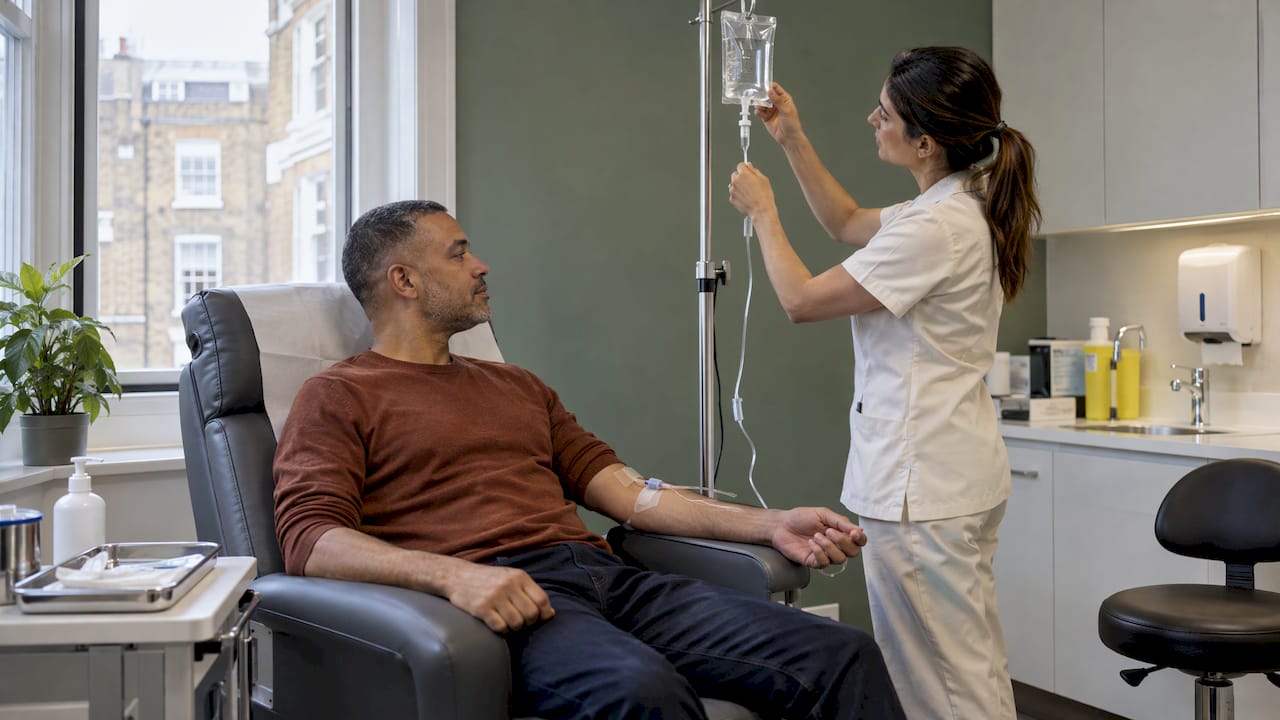
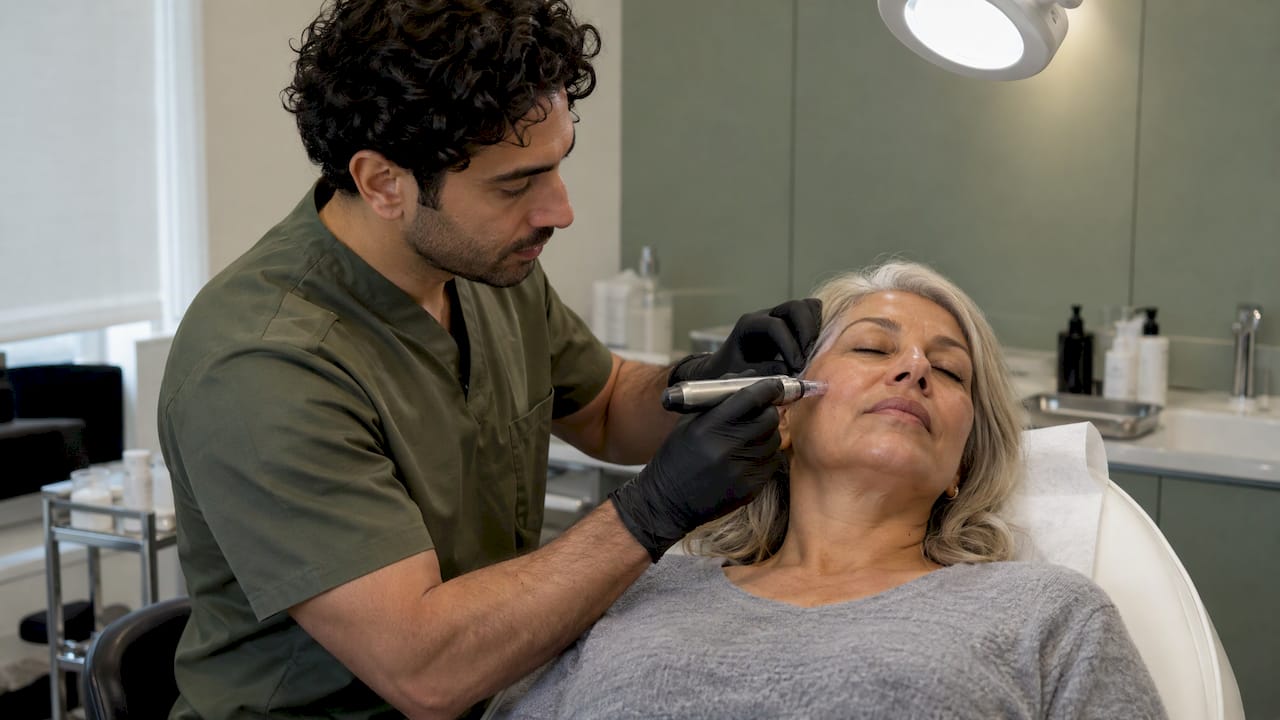

Collagen stimulation treatments work by prompting your skin to build its own collagen, the protein that gives skin its firmness and spring. The main routes are controlled micro-injury (micro-needling, peels, lasers), injectable skin treatments, PRP and prescription-strength skincare. The right choice depends on your skin and how much change you want, and the result depends heavily on who assesses and treats you. At The Aesthetics Room, a CQC-registered clinic with locations in Knightsbridge, Harley Street and Mayfair, we build a bespoke plan around your skin rather than selling a single procedure.
TL;DR
- Collagen stimulation encourages your skin to rebuild its own support structure. It is gradual: expect weeks to months, not days, and usually a course of sessions.
- Micro-needling, peels, PRP and prescription retinoids all act on the skin’s fibroblasts, the cells that make collagen. They suit different concerns and different levels of downtime.
- Our published prices range from £50 for a Medical Skincare Prescription to £450 for Vampire Peel (PRP) and Sunekos.
- In England, training for non-surgical practitioners is not yet set by law, so check for CQC registration and an in-person assessment before you book.
Table of Contents
- What collagen is and why it matters
- The main ways to stimulate collagen
- Which treatment suits which concern
- What results and timelines to expect
- Side effects and safe use
- Choosing a practitioner in the UK
- What this costs in London
- Our approach to collagen stimulation
- Book a consultation
- FAQ
- Sources
What collagen is and why it matters
Collagen is the main structural protein in your skin. Type I collagen, the most abundant kind, keeps skin firm and smooth. Fibroblasts, the cells in the deeper layer of skin (the dermis), produce it. With age and sun exposure, fibroblasts slow down and existing collagen breaks down faster than it is replaced. The visible result is fine lines, thinner skin and a loss of bounce.
A collagen stimulation treatment does not add collagen from outside. It gives fibroblasts a reason to work harder. That is why results build gradually, and why one session rarely tells the whole story.
The main ways to stimulate collagen
Most treatments fall into four groups. Each works through a different trigger.
Controlled micro-injury: micro-needling, peels and lasers
A peer-reviewed 2016 review of non-invasive facial rejuvenation describes micro-needling as a controlled injury that stimulates fibroblasts and new collagen. The same review notes temporary pain, redness and swelling, and that several sessions are often needed.
The review also explains how lasers differ. Ablative lasers remove layers of skin to trigger wound healing and collagen remodelling. Non-ablative lasers remodel dermal collagen without disrupting the surface. Chemical peels follow the same principle: a measured, controlled injury to the skin that the body repairs by producing fresh tissue.
On our price list, this group includes:
- Micro-needling: £300
- Mild Skin Peel: £120
- Medium / Deep Peel: £350
A mild peel suits a first step with little downtime. Deeper peels and micro-needling go further into the skin and ask for more recovery time, so we discuss your diary before choosing.
Injectable skin treatments
Some injectables are designed to improve skin quality and stimulate the skin’s own repair. Research on hyaluronic acid, the same hydrating molecule found naturally in skin, is a good example. A small study of 11 volunteers found cross-linked hyaluronic acid injections increased collagen deposition and type I procollagen markers in photodamaged forearm skin at 4 and 13 weeks. The authors proposed that the filler may do this indirectly, by mechanically stretching fibroblasts.
Our menu includes two skin-quality injectables:
- Profhilo: £350
- Sunekos: £450
If you are weighing skin boosters against newer options such as polynucleotides, our guide to polynucleotides versus skin boosters sets out the differences. For how long results last and when a top-up makes sense, see our piece on skin booster longevity.
PRP: using your own platelets
Platelet-rich plasma (PRP) is made from a small sample of your own blood, spun to concentrate the platelets, which carry growth factors involved in tissue repair. In the face it is often combined with micro-needling so the plasma reaches the skin through the tiny channels. We offer this as the Vampire Peel (PRP) at £450.
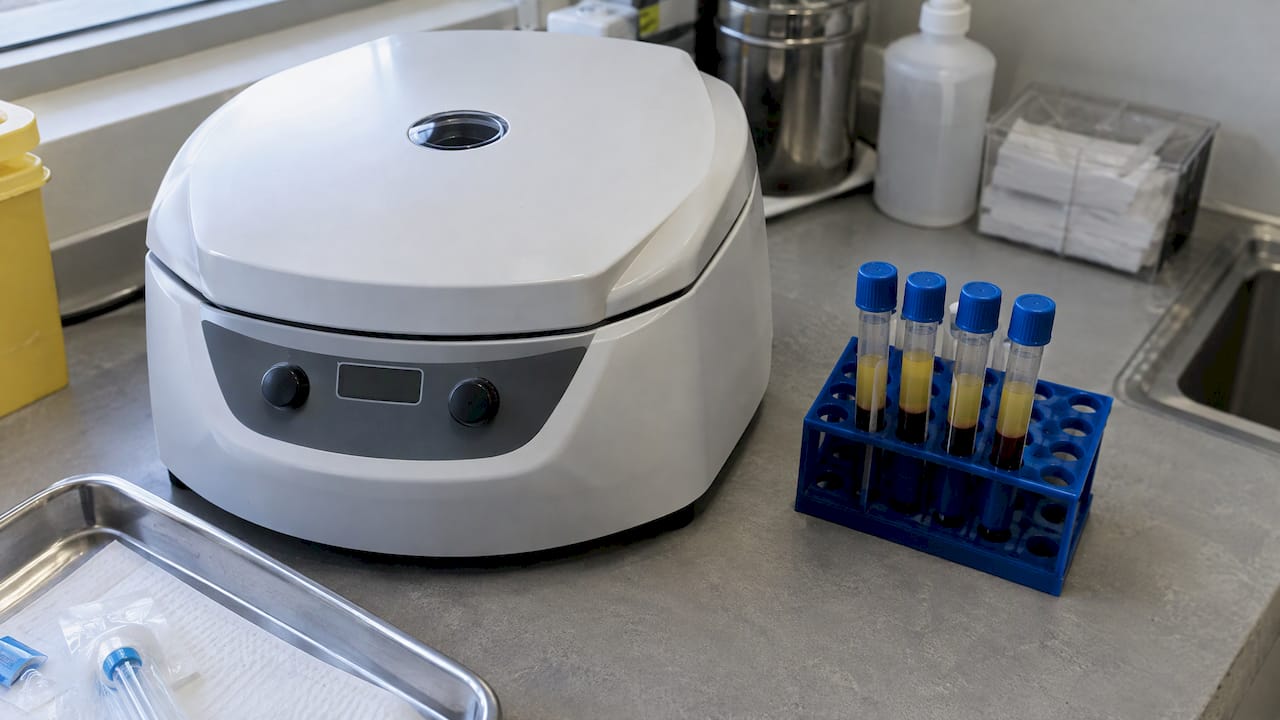
PRP is also used for hair, and we offer PRP for hair at £450 and PRP for facial hair at £258. If hair is your concern, our guides to PRP hair treatment cost in the UK and PRP hair for women cover it in detail.
Prescription skincare
Topical retinol is the best-known collagen-supporting ingredient. A 2023 review of human skin ageing reports that topical retinol can increase type I collagen expression in aged human skin by activating dermal fibroblasts. It works slowly and steadily, which is why it pairs well with in-clinic treatments: the clinic procedure triggers repair, the home routine keeps the signal going.
Our Medical Skincare Prescription is £50. It is the simplest starting point if you want a plan built around your skin before committing to a procedure.
Which treatment suits which concern
There is no single best collagen stimulator. The better question is what you want to change.
| Your concern | Treatments to discuss | Typical effort |
|---|---|---|
| Dull, uneven or slightly rough skin | Mild Skin Peel (£120), prescription skincare (£50) | Low downtime, regular sessions |
| Fine lines, texture, early laxity | Micro-needling (£300), Profhilo (£350) | A course, with mild redness afterwards |
| Crepey, tired-looking skin | Sunekos (£450), Vampire Peel (PRP) (£450) | A course, with swelling or marks for a short time |
| Deeper texture or pigmentation | Medium / Deep Peel (£350) | More downtime, careful aftercare |
| Moving lines on the forehead and around the eyes | Anti Wrinkle (£200 to £358) | Relaxes muscle, a different mechanism |
That last row matters. Anti-wrinkle injections do not stimulate collagen. They soften the muscle movement that creases skin, and many clients combine them with a collagen-stimulating treatment so lines are both relaxed and rebuilt. Our guide to where anti-wrinkle injections work on the face explains the areas.
What results and timelines to expect
Collagen takes time to form. Expect to see changes build over several weeks after a session, and most plans involve more than one visit. The micro-needling review above notes that multiple sessions are often needed, and that the ideal course has not been fixed across studies, which is why we set the spacing and number of sessions after assessing your skin.
Broader evidence on injectable biostimulants is encouraging on satisfaction. A 2025 systematic review and meta-analysis of 25 observational studies of calcium hydroxyapatite, poly-L-lactic acid and polycaprolactone found pooled patient satisfaction of 91%, though results varied between studies. Those figures concern those specific products, not every collagen-stimulating treatment.
A sensible approach is to build gradually. Starting subtly and topping up lets you see how your skin responds. Our tips on opting for gradual enhancements apply to skin treatments as much as to fillers.
Side effects and safe use
Every treatment that triggers repair involves a short period of visible reaction. The same meta-analysis estimated bruising at 27%, redness at 16%, and swelling and small nodules at 5% each for injectable biostimulants, with wide variation between studies. Micro-needling commonly brings redness and swelling that settle over a short time.
Plan around this:
- Avoid booking a procedure just before an event. Leave time for redness and swelling to settle.
- Tell your practitioner about your full medical history, medicines and skin conditions. Active infection, pregnancy and breastfeeding are common reasons to postpone treatment, and certain conditions, such as uncontrolled diabetes, also need to be discussed first.
- Treatments of this kind are for adults only.
- Follow aftercare carefully, especially sun protection, as treated skin is more sensitive.
Your assessment is where these points are covered. We take your history, discuss your expectations and agree consent before any treatment goes ahead.
Choosing a practitioner in the UK
This is the part most guides skip, and it matters most. A UK Parliament briefing from September 2025 says England had no specific education or training requirement for practitioners delivering non-surgical cosmetic procedures, with voluntary registers setting standards only for their own members. The government is moving towards risk-tiered licensing.
A GOV.UK consultation, updated in November 2026, proposes restricting certain higher-risk treatments to regulated healthcare professionals and CQC-registered providers. Examples it lists include deep chemical peels and cosmetic PRP, both relevant to collagen stimulation. It is a proposal, so check the GOV.UK page for the current position.
Until rules settle, use these checks:
- CQC registration. Ask whether the clinic is registered with the Care Quality Commission, the independent regulator of health and social care in England. We are CQC-registered and a member of the ACE Group, which is dedicated to patient safety.
- Medically trained practitioners. All our treatments are performed by medically trained professionals.
- An in-person assessment. The JCCP and CPSA code of practice, a professional best-practice guide rather than law, says prescribers should take a full history and carry out an in-person physical and emotional-wellbeing examination before prescribing injectable cosmetic medicines or other invasive procedures. It also asks for valid consent, a discussion of risks and time to decide.
- Willingness to say no. The same code says treatment should be refused where it is not in your best interests. A good clinic will tell you when waiting or a simpler option is better.
A virtual consultation is a convenient way to talk through your goals before you come in. Where a treatment involves prescribing or injecting, the examination happens in person.
What this costs in London
Prices below come from our price list, published on our website. Treatments are priced per session.
| Treatment | Price |
|---|---|
| Medical Skincare Prescription | £50 |
| Mild Skin Peel | £120 |
| Micro-needling | £300 |
| Medium / Deep Peel | £350 |
| Profhilo | £350 |
| Sunekos | £450 |
| Vampire Peel (PRP) | £450 |
Because most collagen plans use a course, your total depends on how many sessions your skin needs. We set that out at consultation so you know the plan before you start. If you want to understand the clinic experience first, our guide to choosing a skin clinic in Knightsbridge explains what to look for.
Our approach to collagen stimulation
Collagen is not one product. It is a result, and skin gets there by different routes depending on its age, its history and how much time you can give it.
At The Aesthetics Room, we start with the whole picture: your skin, your health history and the internal factors that affect how skin repairs itself. That is why our protocols are medically led and holistic, and why every plan is bespoke. Two people with the same fine lines can need quite different treatments.
We favour natural results. That usually means building gradually, combining a treatment that triggers repair with skincare that supports it, and reviewing progress together. Our practitioners are medically trained, and we are CQC-registered because you should not have to wonder who is treating you.
If you are unsure where to begin, begin with a conversation. We will tell you what we would do for our own skin and why.
Vishul
Book a consultation
If you would like a plan for your skin, we offer virtual and in-person consultations. Our full list of collagen-supporting treatments, from the Mild Skin Peel to Micro-needling, Profhilo, Sunekos and Vampire Peel (PRP), is on our price list. You can book through The Aesthetics Room.

FAQ
What stimulates new collagen production?
Anything that signals your skin’s fibroblasts to repair or renew. Controlled micro-injury from micro-needling or peels does this, as do PRP and topical retinol, which research links to higher type I collagen expression. A consultation will match the trigger to your skin.
How long do collagen stimulation results take to show?
Collagen forms gradually, so improvements build over weeks after treatment, and most plans involve a course of sessions rather than one visit. The number of sessions depends on your skin and the treatment. We agree this with you at your consultation.
Is micro-needling a collagen treatment?
Yes. A peer-reviewed review describes micro-needling as a controlled injury that stimulates fibroblasts and new collagen. We offer it at £300 per session, and it can be combined with PRP in our Vampire Peel.
Do anti-wrinkle injections boost collagen?
No, they relax the muscles that crease the skin, so they work differently. Many people combine them with a collagen-stimulating treatment. Our guide to anti-wrinkle injection safety covers what to know before treatment.
Who should check with their practitioner before treatment?
Anyone who is pregnant or breastfeeding, has an active infection, has diabetes that is not well controlled, or has a skin condition in the treatment area should raise it at the assessment. Treatments are for adults only. Your practitioner will take your full history before going ahead.
Sources
- Noninvasive Facial Rejuvenation. Part 3 (2016 review)
- In Vivo Stimulation of De Novo Collagen Production Caused by Cross-linked Hyaluronic Acid (JAMA Dermatology, 2007)
- Human Skin Aging and the Anti-Aging Properties of Retinol (2023)
- Biostimulants in Aesthetic Medicine: A Systematic Review and Meta-Analysis (Aesthetic Surgery Journal, 2025)
- The regulation of non-surgical cosmetic procedures in England (UK Parliament briefing, September 2025)
- Restrictions on the performance of high-risk cosmetic and wellbeing procedures in England (GOV.UK consultation)
- JCCP and CPSA Code of Practice and Guidance (March 2023)