
IV therapy comes in a handful of main types: hydration drips, vitamin C, B-vitamin and B12 formulations, Myers’-style blends, glutathione, NAD+, magnesium, and combinations built around your own goals. The type matters less than who prescribes it and where it is given. In the UK, an IV drip is a clinical procedure, so the safest choice is a CQC-registered clinic that takes a medical history first. At The Aesthetics Room, our IV vitamin therapy sits alongside our skin and wellbeing treatments in Knightsbridge, and each plan starts with a consultation.
TL;DR
- Most UK wellness drips are a saline base with vitamins, minerals or antioxidants added. The main types are hydration, vitamin C, B complex and B12, Myers’-style blends, glutathione, NAD+ and magnesium.
- Which drip is right depends on your goal, your medical history and your medication, not on a menu name.
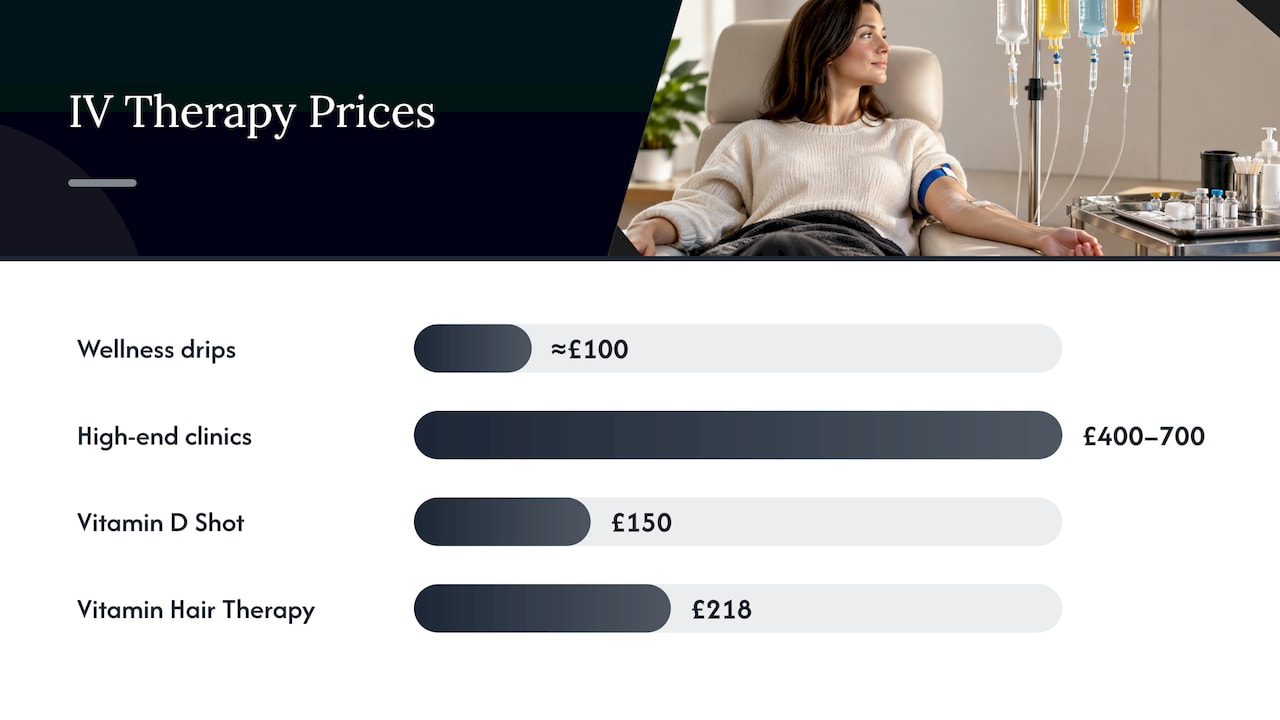
- Prices for UK wellness drips typically run from around £100 to £400-£700 at high-end clinics, according to Which?.
- For skin, an IV drip is one option. Treatments such as Profhilo, peels and micro-needling can work on the skin directly, and we can combine them in one plan.
- Choose a clinic registered with the Care Quality Commission (CQC), where a clinician checks your history before anything goes into a vein.
Table of Contents
- What an IV drip actually is
- The main IV therapy types
- Which IV drip is best for skin?
- What you can expect to pay
- How to choose a safe clinic
- Safe use: who should take extra care
- Matching the type to your goal
- Book a consultation at The Aesthetics Room
- FAQ
- Sources
What an IV drip actually is
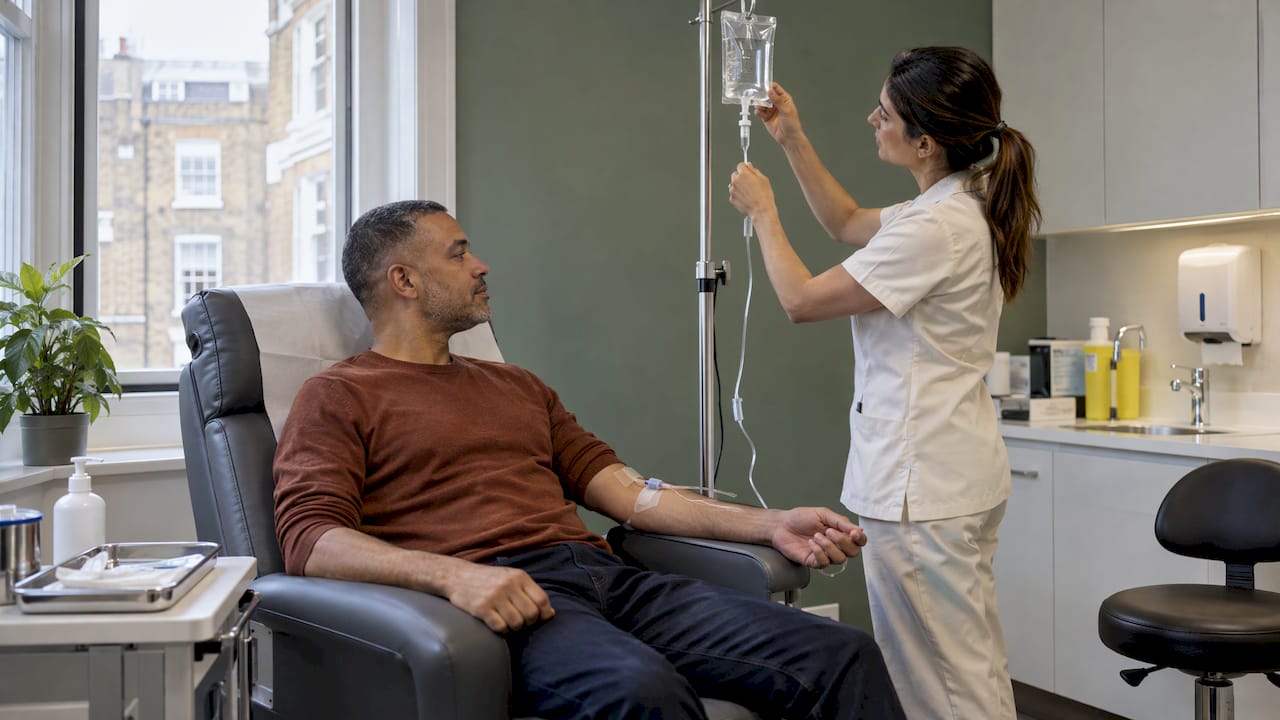
A wellness drip is typically a saline fluid bag containing vitamins, minerals and other substances. It is given directly into the bloodstream through a vein, according to CAP and ASA guidance. Which? describes the usual delivery as a cannula (a thin tube placed in a vein) over 30 to 60 minutes.
This is different from the IV fluids used in hospitals, such as normal saline or Ringer’s solution, which are prescribed to replace fluid and electrolytes in unwell patients. The wellness types below use a similar fluid as a carrier for added nutrients. If you want the basics first, our guide to how a vitamin infusion works covers them.
The main IV therapy types
The names vary between clinics, but the ingredients fall into a few families. Which? lists them as vitamins (often high-dose vitamin C and B vitamins such as B12), minerals and electrolytes (magnesium, calcium, zinc), and antioxidants, most commonly glutathione, alpha-lipoic acid and NAD+.
| Type | Typical contents | What people usually request it for |
|---|---|---|
| Hydration drip | Saline, sometimes with electrolytes | Rehydration after travel, illness or heavy training |
| Vitamin C drip | High-dose vitamin C in saline | Radiance and immune support |
| B complex / B12 drip | B vitamins, including B12 | Tiredness and energy |
| Myers’-style blend | Magnesium, calcium, B vitamins and vitamin C | A general multi-nutrient option |
| Glutathione drip | Glutathione, often with vitamin C | Antioxidant support and skin goals |
| NAD+ drip | NAD+ | Longevity and cognitive interest |
| Magnesium drip | Magnesium | Stress, sleep and muscle relaxation |
The request pattern in the last column comes from Aesthetic Medicine Magazine’s January 2026 report on the ingredients UK patients ask for most: vitamin C for radiance and immunity, glutathione, B complex and B12 for fatigue, magnesium for stress, sleep and muscle relaxation, and NAD+ for longevity and cognitive optimisation.
Hydration drips
The simplest type. A saline base, sometimes with electrolytes, it suits people who feel depleted after a long-haul flight, a bout of illness or a hard training block. It is also the foundation of most other drips, so a clinic that builds the base carefully is a good sign.
Vitamin C drips
Vitamin C is among the most requested ingredients. Strengths vary widely: a 2026 review in Acta Dermatovenerologica APA reports UK IV vitamin C typically at 5 to 25 g per infusion. Because the range is so broad, dose is something your clinician should set for you after reviewing your history, rather than a figure to pick from a menu.
B complex and B12
B vitamins take part in the reactions that turn food into energy, which is why these drips are associated with tiredness. B12 is also available as a quick injection rather than a drip. Your clinician can tell you which format fits, and whether a blood test is worth doing first.
Myers’-style blends
The Myers’ cocktail is one of the most common IV vitamin infusions. It usually contains magnesium, calcium, B vitamins and vitamin C, though ingredients vary between providers. Always ask for the full ingredient list and doses of any blend before you agree to it.
Glutathione and NAD+
These are the antioxidant and longevity-led options. The same Acta review reports UK glutathione doses typically at 600 to 1,200 mg per infusion and NAD+ infusions at 250 to 750 mg. They are the types where product quality and clinical oversight matter most, because these are prescription-level preparations handled in a clinical setting.
Magnesium
Magnesium is requested for stress, sleep and muscle relaxation. It is often included in a blend, but can also be given on its own where a clinician considers it suitable.
Which IV drip is best for skin?
Skin is one of the most common reasons people look at drips, and the usual candidates are vitamin C and glutathione, often combined. The honest answer is that the best choice is the one matched to your skin goal and checked against your health history by a clinician.
It also helps to know the rules. UK advertising regulators require marketers to hold robust documentary evidence for any benefit claim made for an IV drip, including claims about skin appearance, as set out in the CAP and ASA guidance on intravenous nutritional therapy. A clinic that speaks carefully about what a drip can and cannot promise is following the standard you want.
For visible skin goals, we often build a plan around treatments that act on the skin directly, and a drip can sit alongside them as part of a wider wellbeing approach. Our published prices are:
- Mild Skin Peel: £120
- Micro-needling: £300
- Profhilo: £350
- Sunekos: £450
- Vampire Peel (PRP): £450
- Medical Skincare Prescription: £50
The same combined approach appears in UK clinic menus. Aesthetic Medicine Magazine notes that IV plans are personalised after a medical consultation and are sometimes paired with aesthetic treatments such as polynucleotides, Profhilo or B12 injections.
What you can expect to pay
Which?, in a December 2025 article, put UK wellness drip prices from around £100 up to £400-£700 in high-end wellness clinics. Price usually reflects the ingredients, the dose, the practitioner and the setting.
If you want a lower-commitment option, we offer a Vitamin D Shot at £150 and Vitamin Hair Therapy at £218. Both are listed on our price list. For a breakdown of what drips cost and why, see our UK vitamin infusion cost section.
How to choose a safe clinic
This is the part that matters most. Type of drip is a preference. Safety is a requirement.
Check the registration
The CQC states that IV vitamins and prescription-only products, including 0.9% saline, used to enhance wellbeing, count as treatment of disease, disorder or injury. Registration applies where a service is delivered by or under a listed healthcare professional and uses products that are prescription-only for IV use. We are a CQC-registered clinic and a member of the ACE Group, which is dedicated to patient safety.
Which? reports that standards of cleanliness, infection control, staff qualifications and clinical oversight vary widely across the wellness drip market. Registration is the simplest way to know what standard you are getting.
Expect a proper consultation
As described by Aesthetic Medicine Magazine, a well-run UK IV service involves:
- A full consultation with medical history and risk review.
- Medication checks.
- A vein-suitability assessment and baseline vitals.
- Infusion in a clinical treatment room with monitoring.
- Registered practitioners with accredited cannulation training.
- Sterile single-use equipment, aseptic technique, emergency drugs and resuscitation equipment.
JCCP nurse Andrew Rankin, quoted in the same article, says the inherent risk of IV administration is enough to restrict it to appropriate healthcare professionals in CQC-registered facilities.
Know the rules that are changing
The government has published a consultation on high-risk cosmetic and wellbeing procedures in England. It proposes that intravenous procedures be performed only by specified regulated healthcare professionals at CQC-registered providers, for people aged 18 and over. These are proposals, so check the GOV.UK page for the current position.
Safe use: who should take extra care
Tell your clinician about everything you take and every condition you have before any drip. Which? lists the recognised risks of IV vitamin drips as infection, tissue damage, nutrient imbalances and interactions with medicines, with allergic reactions and anaphylaxis rarer. It also notes that:
- Too much B6 can cause nerve damage.
- Repeated IV iron has been linked to liver problems.
- High-dose vitamin C has been associated with kidney injury, especially in people with kidney or heart problems.
If you have kidney or heart disease, take regular medication, have known allergies or are unsure about your health, speak to your GP before booking, and tell the clinician at your consultation. Our guide to who should avoid IV vitamin infusions goes through each group.
If you suspect a deficiency, such as low B12, say so at the start. Dr Nasir, quoted in Aesthetic Medicine Magazine, explains that used properly, IV therapy can correct low-level nutrient deficiencies and support recovery after illness, travel or intense training. He adds that it works best as an add-on for people with solid foundational habits such as sleep, nutrition and stress management.
Matching the type to your goal
- Tired after travel or training: a hydration drip or a B-vitamin formulation, depending on your history. Our article on whether IV therapy can improve energy levels safely explains the reasoning.
- General wellbeing and recovery: a Myers’-style blend or a magnesium-led drip.
- Skin and radiance: a vitamin C or glutathione drip, ideally planned together with skin treatments such as Profhilo, a peel or micro-needling.
- Hair: Vitamin Hair Therapy or PRP, which we offer at £218 and £450 respectively.
- Longevity interest: an NAD+ discussion in consultation, where the dose and format are set by a clinician.
Whatever the goal, the consultation decides the plan. A good clinician will talk you out of a drip that does not fit you as readily as into one that does.
Our view: the plan matters more than the drip
When someone asks us about IV therapy types, we steer the conversation away from the menu and toward the person. Two people can ask for the same vitamin C drip and need very different things: one is run down after a work trip, the other wants brighter skin before an event.
Our approach is medically led and bespoke. Every treatment is performed by medically trained professionals, and our protocols look at internal factors such as nutrition and recovery alongside external ones such as skin and facial balance. That is why our IV vitamin therapy sits in the same clinic as our skin treatments, so one plan can cover both.
Safety comes first. We are CQC-registered and members of the ACE Group, which is dedicated to patient safety, and we would always rather spend ten extra minutes on your history than skip a step.
Vishul
Book a consultation at The Aesthetics Room
We offer IV vitamin therapy as part of a bespoke plan, alongside skin rejuvenation, hair restoration and wellbeing treatments. You can choose a virtual or in-person consultation, and our clinicians will talk through your goals, your history and which type of drip, shot or skin treatment suits you.

See our full treatment price list, read what to expect from a London aesthetic consultation, or start at theaestheticsroom.co.uk to book.
FAQ
What are the most common types of IV therapy?
The most common are hydration drips, vitamin C, B complex and B12, Myers’-style blends, glutathione, NAD+ and magnesium. Most use a saline base with the nutrients added. Your clinician chooses the doses after reviewing your history.
Which IV drip is best for skin?
Vitamin C and glutathione are the ingredients most often requested for skin, but the right choice depends on your goal and health history. We often plan these alongside treatments that work on the skin directly, such as Profhilo, peels and micro-needling. A consultation is the best way to decide the combination.
How long does an IV drip take?
A typical UK wellness drip is delivered through a cannula over 30 to 60 minutes, according to Which?. Allow extra time for your consultation and for the checks beforehand.
Is IV therapy regulated in the UK?
It can be. The CQC requires registration where IV vitamins and prescription-only products are given by or under a listed healthcare professional to alter a physiological state in response to a defined concern. The government has also consulted on restricting IV procedures to regulated professionals at CQC-registered providers, so check GOV.UK for the current position.
Who should avoid IV vitamin drips?
People with kidney or heart problems need particular care with high-dose vitamin C, and anyone with allergies or regular medication should discuss it with their GP and clinician first. Tell the clinician everything you take before any infusion.
Sources
- Why IV vitamin drips are a waste of money, Which?
- THE IV ECONOMY, Aesthetic Medicine Magazine, January 2026
- Healthcare: Intravenous Nutritional Therapy, CAP and ASA
- Treatment of disease, disorder or injury, Care Quality Commission
- Restrictions on the performance of high-risk cosmetic and wellbeing procedures in England, GOV.UK
- Intravenous longevity therapy: a critical review, Acta Dermatovenerologica APA, 2026
- Intravenous (IV) Vitamin Infusions: Benefits and Risks, ConsumerLab